Heat planning data space: the new digital infrastructure of the WPG amendment
On 27 May 2026 the German federal cabinet adopted the amendment to the Heat Planning Act. Its core for digitalisation is the heat planning data space, an IT infrastructure usable across the federal, state and municipal levels. This article explains what the data space does, how the new small heat planning eases the burden on small municipalities and what you as a municipality or utility should prepare now.
The heat planning data space is a nationwide IT infrastructure, usable across the federal, state and municipal levels, that the WPG amendment of 27 May 2026 creates. It bundles the provision of input data such as building, grid and consumption data and the use of result data such as the area classification, mainly for updating the heat plans. The amendment also makes the rules on data collection and processing more practical and clears up legal uncertainties. Beyond the data space it brings two more changes: the optional small heat planning for municipalities with up to 15,000 residents, where inventory and potential analyses as well as target scenarios are largely dropped, and a duty to plan cold supply for areas over 45,000 residents during updates. The amendment is expected to enter into force towards the end of 2026, while the planning deadlines stay unchanged. The benefit stands or falls with data quality: a data space only helps if municipalities feed in current, uniformly structured data. For municipalities and utilities that means putting your own data in order now rather than waiting for the law to take effect.
The 2026 WPG amendment at a glance
The amendment pursues two goals: relieve small municipalities and digitalise heat planning. The federal cabinet adopted it on 27 May 2026, led by the Federal Ministry for Economic Affairs and Energy and the Federal Ministry for Housing, Urban Development and Building. It is meant to enter into force towards the end of 2026. The original Heat Planning Act has applied since 1 January 2024.
The mandatory dates do not change. Cities over 100,000 residents must submit their heat plan by 30 June 2026, smaller municipalities by 30 June 2028. What changes is the how: simpler for the small ones, more digital for everyone.
Economy Minister Katherina Reiche calls it a streamlined, practice-oriented procedure. Building Minister Verena Hubertz stresses that heat and cold must be planned together with urban change. Sounds like administrative routine. The real lever, though, sits in the fine print, in the infrastructure for the data.
What is the heat planning data space?
The heat planning data space is a new IT infrastructure that bundles input and result data of heat planning in one place and makes it usable across the federal, state and municipal levels. It is meant to ease the updating of heat plans above all. That is the real progress of the amendment, not the simplified procedure, but the shared data basis.
What is inside? On the input side, the data a municipality needs for planning, such as building, grid and consumption data. On the result side, the classification of the area into likely district heating zones, examination zones and zones for decentralised supply. So far both sat scattered across separate systems, often in inconsistent formats. The local basis comes from the digital heat cadastre, which brings a municipality's building and geodata together.
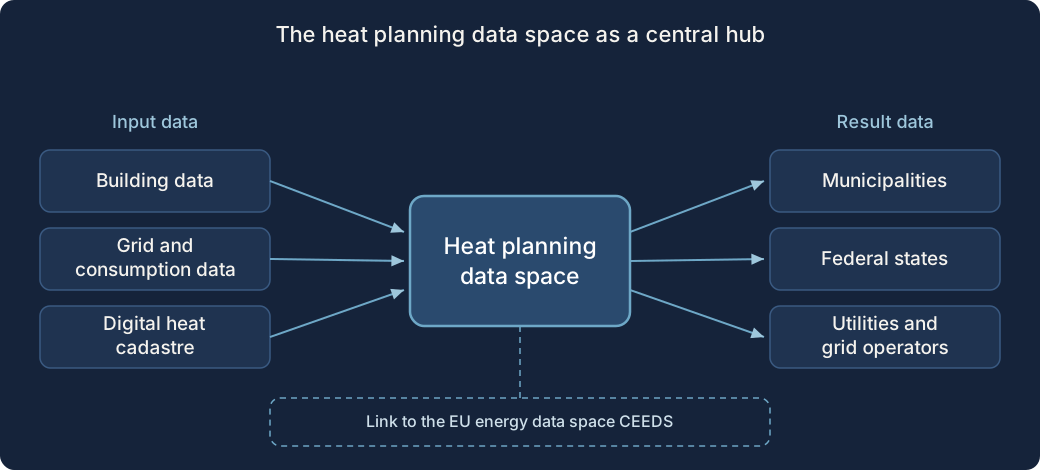
A second point is easy to miss. The amendment makes the rules on data collection and processing more practical and clears up existing legal uncertainties. Anyone who hesitated because the legal basis for accessing consumption data looked shaky gets firmer ground. The data space fits into a chain: locally the heat cadastre, nationally this data space, at EU level the European energy data space CEEDS.

Small heat planning for small municipalities
For municipalities with up to 15,000 residents the amendment introduces a strongly simplified, optional procedure. The goal: a heat plan within a few months rather than years. The municipality decides for itself whether to take this route. Around 9,200 municipalities in Germany have fewer than 10,000 residents, so for them this is a real relief.
What falls away? Inventory and potential analyses, the development of target scenarios and comprehensive documentation are largely dropped. Digital energy maps are the basis instead of costly individual surveys. The procedure assumes that most areas are supplied decentrally and only checks, in a targeted way, where a heat network might pay off.

| Feature | Regular heat planning | Small heat planning |
|---|---|---|
| Inventory and potential analysis | mandatory | largely dropped |
| Target scenario | mandatory | dropped |
| Basis | individual surveys | digital energy maps |
| Time horizon | several years | a few months |
| Applies to | all obligated municipalities | up to 15,000 residents, optional |
This simplification comes at a price. Whoever only goes into detail where a network looks plausible at first glance easily overlooks the second row. More on that shortly.
Cold planning and further changes
Besides heat, cold moves into view for the first time. Municipal areas with more than 45,000 residents must also plan cold supply when they update their heat plans. This implements requirements of the EU Energy Efficiency Directive. Hot summers make the question concrete, not theoretical.
- Cold planning becomes part of the regular update, not a separate process with its own deadline.
- For operators of industrial heat networks, the deadline for the decarbonisation and expansion roadmap moves from the end of 2026 to the end of 2030. How such a roadmap is built is shown in the article on the decarbonisation roadmap under Section 32 WPG.
- The amendment bundles additional reporting duties. Bavaria's economy ministry welcomes the simplifications but criticises bureaucracy that goes beyond the EU requirements.
Data governance: the German and European view
Whether the data space holds up is decided by data governance, not by the number of servers. A national data space must not become an island. It has to fit the EU data strategy and the emerging energy data space, otherwise the data cannot be used across borders later.
Three questions decide its practical value. Which interfaces and standards does the data space require so municipalities, states and utilities can actually reuse the data? On what legal basis are building and consumption data processed without breaching data protection? And who operates the infrastructure in the long run, who funds the operation? On the last question the amendment does not yet give a detailed answer.
A data space is not an end in itself. Its value only emerges when open standards make the data connectable, for the next update, for the neighbouring country, for the EU level. Otherwise it turns into an expensive archive.
Challenges and risks
The simplification has a downside. Associations warn that small heat planning overlooks real chances for heat networks in rural areas. And a data space stands or falls with the data quality that municipalities provide.
The German Renewable Energy Federation puts it plainly: if an area is classified as decentralised too quickly, a possible heat network stays unexamined for good. Village centres, apartment blocks and public buildings often have enough density for a small network. The WWF warns in the same direction: speed must not come before quality. Neither voice opposes the amendment, they flag the gap in the simplified procedure.
What municipalities should do now
Do not wait for the law to take effect. The data space rewards municipalities that keep their data clean and machine-readable. Four steps help, whether you choose the regular or the small heat planning.
-
Review your data holdings
Check building, grid and consumption data for currency and format. What is available in a structured form, what only on paper or in isolated tools? This inventory decides later how easily the connection to the data space works.
-
Assess network potential honestly
Even with small heat planning, look at individual districts to see whether they can carry a heat network before classifying them as decentralised. Town centres and dense settlements first. That avoids the gap the BEE warns about.
-
Clarify interfaces early
As soon as the standards and formats the data space requires are known, align your own IT and service providers with them. Whoever plans for this early spares the rebuild later.
-
Factor in cold planning
Areas over 45,000 residents plan cold supply at the next update straight away. Running heat and cold in one model saves double work.
Further reading
Frequently asked questions
The heat planning data space is an IT infrastructure, usable across the federal, state and municipal levels, that the 2026 WPG amendment creates. It bundles the provision of input data such as building, grid and consumption data and the use of result data such as the area classification. This mainly eases the updating of heat plans and makes the rules on data processing more legally secure.
The federal cabinet adopted the amendment on 27 May 2026. It is expected to enter into force towards the end of 2026. The Bundestag debated the draft in a first reading in June 2026 and referred it to committee. The deadlines for the heat plans themselves stay unchanged: municipalities over 100,000 residents by 30 June 2026, smaller ones by 30 June 2028.
Small heat planning is an optional, strongly simplified procedure for municipalities with up to 15,000 residents. Inventory and potential analyses, target scenarios and comprehensive documentation are largely dropped. Digital energy maps are the basis. This allows a heat plan within a few months rather than years. Around 9,200 municipalities in Germany have fewer than 10,000 residents.
Municipal areas with more than 45,000 residents must also plan cold supply when they update their heat plans. This implements requirements of the EU Energy Efficiency Directive. Cold planning becomes part of the regular update, not a separate process.
The German Renewable Energy Federation warns that small heat planning could systematically underestimate district heating potential in rural areas if areas are classified as decentralised too quickly. A practical problem is the time-limited funding: it often ends with the plan's adoption, so small municipalities in particular lack the means for a deeper assessment.