
Settlement of energy exchange between transmission system operators: 15 minutes is to become binding
Ruling Chamber 6 of the Federal Network Agency (BNetzA) opened two procedures on 9 November 2026: BK6-26-401 and BK6-26-402. All asynchronously connected transmission system operators want to change their common settlement rules in two places, and the two German operators concerned filed the proposal on behalf of the group. In Germany this reaches 50Hertz and TenneT, the two houses with an HVDC link to Denmark and to Norway.
The TSO-TSO settlement period is the time unit in which two transmission system operators settle the energy they exchange across an HVDC link between two synchronous areas; it is to become a fixed 15 minutes, and the Federal Network Agency (BNetzA) accepts comments until 23 November 2026. The change is to touch the two methodologies under Article 50(4) and Article 51(2) of Regulation (EU) 2017/2195, in force since May 2020: Article 4(1) loses the clause that lets the relevant operators jointly decide otherwise, and Annex 7 with the link between PSE and Litgrid is deleted, because the Baltic grids have run synchronously with Continental Europe since 9 February 2025. The reason given for the fixed period is the rest of the market, which already works in quarter hours, from the imbalance settlement period to day-ahead market coupling since 30 September 2025. Commenting is voluntary; what becomes binding is the version all relevant regulatory authorities approve, to be implemented within twelve months. For suppliers, metering operators and balance responsible parties nothing changes directly.
What Ruling Chamber 6 is consulting on until 23 November
The Federal Network Agency (BNetzA) published two consultations on 9 November 2026 on amendment proposals by all asynchronously connected transmission system operators, and asks for comments by Monday, 23 November 2026. BK6-26-401 covers intended energy exchange resulting from the frequency containment process and from ramping restrictions, on the legal basis of Article 6(3) in conjunction with Article 50(4) of Regulation (EU) 2017/2195, the Electricity Balancing Regulation; intended means the grid operation triggers it on purpose. BK6-26-402 covers unintended energy exchange, the volume that arises without intent, under Article 51(2). The methodology on intended exchange is approved under Article 5(3)(k), the one on unintended exchange under (m), in both cases which means jointly by all relevant regulatory authorities rather than by the German regulator alone.
Dated 18 June 2026, the proposal text arrived complete at the regulator on 30 October 2026. The two German operators concerned filed it on behalf of the whole group. The German date of receipt does not start a deadline on its own: the six months to a decision only run from receipt by the last competent authority. Comments go to the registry of Ruling Chamber 6 by email, with attachments as a Word file or as a PDF with printable and copyable text; the agency may publish them, so business secrets belong out of the document or redacted before it is sent.
Settlement between two grid operators, not on the market
Intended and unintended energy exchange are not trades, they are consequences of grid operation. When more or less energy flows across an HVDC link than planned, because frequency containment kicks in or a ramping restriction changes the schedule, a volume appears that no balancing group ordered. The two methodologies say in which time raster those volumes are determined and at what price the two operators settle them.
Article 44 of the Electricity Balancing Regulation sets the frame: settlement procedures should give operators the right incentives to meet their obligations from grid operation, avoid distorted incentives for balance responsible parties, balancing service providers and grid operators, and keep operators financially neutral. Prices still sit in separate annexes per link: mostly the average of two day-ahead prices, two balancing capacity prices in the dominant direction or two imbalance prices, while for frequency containment reserve exchanged between Elering and Fingrid it is the cost of balancing energy or of the reserve provider. Which rule applies is what the two houses agreed per link. Links for which a balance responsible party acts as the settlement entity stay outside under Article 44(4), which is why the documents distinguish between all asynchronously connected operators and the relevant ones.
What changes in the text
The proposal touches two places, identically in both methodologies. Article 4(1) will read only: the TSO-TSO settlement period is set at 15 minutes. What goes is the addition that lets the relevant operators jointly decide otherwise, together with the instruction to harmonise the period during the review. A default with a back door becomes a rule.
| Place | So far | In future |
|---|---|---|
| Article 4(1) | 15 minutes unless the relevant asynchronously connected operators jointly decide otherwise; harmonisation during the review | 15 minutes, with no option to deviate |
| Annex 7 | PSE/Litgrid, settled at the average of the Polish and Lithuanian imbalance prices | deleted, because the link no longer connects two synchronous areas |
| Annexes 8 to 10 | Litgrid/Svenska kraftnät, Elering/Fingrid, TenneT DE/Statnett | move up to Annexes 7, 8 and 9, unchanged in substance |
Deleting it goes back to 9 February 2025. On that day Elering, AST and Litgrid synchronised their grids with the Continental European system. The link between Poland and Lithuania now connects two points inside the same synchronous area, and a methodology for exchange between synchronous areas no longer has a case for it. Everything else stays, including how volumes are determined: for intended exchange from ramping restrictions the time integral of the schedule difference with and without the restriction, for unintended exchange the difference between measured energy and intended exchange, from then on per quarter hour. Sign convention, prices in euros per megawatt hour and English as the reference language are unchanged too.
Which German transmission system operators are affected
Two of the four German transmission system operators appear in the annexes. 50Hertz settles with Energinet under Annex 5 for the Kontek link between Denmark and Germany, settled at the average of two day-ahead prices (DK2 and Germany for intended exchange, DK1 and Germany for unintended exchange). TenneT settles with Statnett under Annex 10, soon Annex 9, for NordLink between Germany and the Norwegian bidding zone NO2: 1400 megawatts, settled at the average of the German and the Norwegian imbalance price. Amprion and TransnetBW run no link into another synchronous area and appear in neither methodology.

Eleven operators took part in the review: Elering, Fingrid, TenneT NL, Statnett, Svenska kraftnät, 50Hertz, PSE, Litgrid, Energinet, Baltic Cable and TenneT DE. The report lists ten of them as relevant, because they settle under one of the annexes; Baltic Cable belongs to the group but appears in no annex, so it does not settle under these methodologies.
Why 15 minutes, and why only now
In the review report the reasoning is plain: the rest of the market has long been working in quarter hours, so settlement between operators should follow. Article 53(1) of the Electricity Balancing Regulation obliges every transmission system operator to settle imbalances for periods of 15 minutes and to align market time unit boundaries with settlement period boundaries; the operators of a synchronous area may apply for an exemption under Article 53(2). In Single Day-Ahead Coupling the quarter hour as a market time unit went live on 30 September 2025, for delivery day 1 October 2025, after a postponement from the original date of 11 June 2025. What that meant for procurement is in the article on 15-minute day-ahead trading.
The quarter hour was already the default in 2020, but with the option for the operators involved to jointly decide otherwise, and settlement at each link follows its own agreement between the two houses. The 2022/2023 review added NordLink as a further annex and adjusted several prices after the Nordic operators moved to a single balancing position; the operators considered further harmonisation premature at the time. In this round the time raster is to follow. Which links actually settle in another raster today, the review report does not say.
What stays open: one price for everyone
A harmonised price calculation for all asynchronously connected operators, the second task of the review mechanism, is postponed again. The operators consider the step premature as long as not all relevant houses use the European balancing platforms: an operator still running a local market for secondary or tertiary reserve produces prices that may say little to the other side. How the MARI and PICASSO platforms grow together therefore decides the timing.
Statnett said on 2 September 2026 that the Nordic operators expect to connect to MARI only after the summer of 2027, probably in September or October. The Nordic operators are waiting for a platform change meant to prevent unwanted price effects and wrong prices in the Nordic market; until then the Nordic mFRR market stays in service. The PICASSO connection follows after that. If the MARI connection happens in 2027, the next review loses its main argument against a common price, at least for tertiary reserve; if it slips again, the next round starts from the same position.
What a harmonised price would look like is open too. For unintended exchange within a synchronous area, Article 51(1) of the Electricity Balancing Regulation requires the price to reflect balancing energy prices; for exchange between synchronous areas it sets no such rule, and the report leaves open whether balancing energy or imbalance prices should become the yardstick. Imbalance prices mirror each national balancing philosophy, so a range of products and calculation methods would first have to be brought onto one basis. The operators deliberately did not produce a quantitative assessment of settlement so far: every link follows its own bilateral agreement, so a comparison would be laborious and say little. Anyone who sees it differently can say so by 23 November.
From proposal to implementation: the timeline
After the consultation the German regulator does not decide alone. Competent are all regulatory authorities whose operators run at least one HVDC link between two synchronous areas. Under Article 5(6) of the Electricity Balancing Regulation they decide within six months of receipt by the last of them, and they have to coordinate with each other to get there.
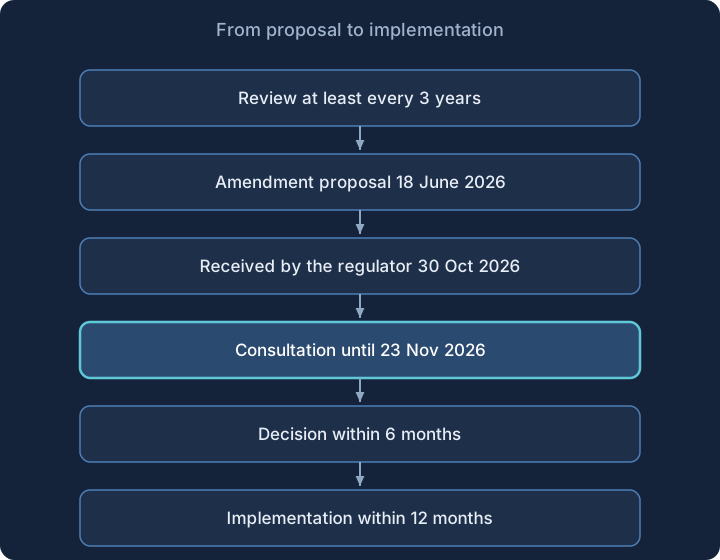
If they reach no agreement, or jointly ask for it, ACER decides within six months. After approval all asynchronously connected operators publish the version without delay; the operators that settle under one of the annexes implement it within twelve months, unless all relevant authorities agree to an extension. For the operators involved, that is the date by which systems and contracts have to be ready.
What happens if the deadline passes
Commenting is voluntary, and the law attaches no consequence to missing it. Anyone who files nothing by 23 November 2026 does not bring their objections into these two procedures; what becomes binding is the version the regulatory authorities approve. The obligation only starts with approval, namely implementation within twelve months under Article 5(5) of the Electricity Balancing Regulation. Article 10(1) of the same regulation separately requires the responsible operators to consult for at least one month on draft methodologies and their amendments; whether that consultation by the operators has already taken place is not stated in the opening of the procedure. The national deadline of Ruling Chamber 6 runs alongside it and, at two weeks, is shorter. Whether a particular agreement or settlement run meets the amended rules is not something this overview assesses.
Where the change gets difficult in practice
- The period sits in the methodology, settlement itself in the bilateral agreement for each link. An operator working in another raster today has to touch the contract, the data exchange and the settlement run, not just a table.
- Anyone settling in hours today will have four times as many settlement rows. Article 4(2) leaves the time zone in which the settlement day begins to the agreement of the two houses, so it belongs explicitly in the bilateral agreement.
- Without harmonised pricing, settlement still differs per link. An operator with several links keeps running several pricing logics in parallel, now in the same time raster.
- The numbering shifts. Anyone referring to Annex 10 in procedures, test cases or interfaces should check those references before implementation rather than after.
- These procedures run without an audience. Beyond the operators involved and their regulators almost nobody is watching, and two weeks of consultation on a methodology that has stood unchanged since the 2022/2023 review leave little room for a coordinated position.
What utilities should do now
The circle of those directly affected is small, the rest read along. For some this is a comment to be written in the next few days, for others the question of where in the house someone still calculates in hours.

Three steps by role
Transmission operators with an HVDC link: hold your annex against the contract
Put the proposal, the review report and your own link's annex next to the bilateral agreement and work out what a fixed 15-minute raster changes in accounting, data exchange and the invoicing run. Whatever gets in the way belongs in a comment to Ruling Chamber 6 by 23 November 2026.
Regulatory management: diarise the approval
The approval decision by all relevant authorities and the twelve-month implementation deadline attached to it are the dates that count after the consultation. When they fall depends on receipt by the last authority, not on the German procedure; the approval becomes visible when the operators publish the approved version without delay under Article 7 of the methodologies.
Balancing and settlement teams: look for hourly assumptions
Check whether your own processes at interconnectors still work with hourly values, in forecasting, schedule reconciliation or reporting. The change itself only concerns the transmission operators; the check pays off where your processes take data from interconnectors.
Day-ahead market, quarter-hour balancing and now settlement between grid operators thus follow the same raster. We track the date of this consultation and the roles concerned in the deadline calendar.
Deadline, market roles, systems
23 November 2026Settlement of energy exchange between TSOs: consultation closes (BK6-26-401, BK6-26-402)Consultation · open
If the deadline is missed: No direct legal consequence Commenting is voluntary. Parties that do not comment by 23 November 2026 do not bring their objections into this procedure; only the settlement rules approved by the Federal Network Agency become binding. Legal basis ↗
- Transmission system operatoraffectedSubmitted the amendments together with the other asynchronously connected TSOs and settles energy exchange under the approved rules.Typically affected: Trading and procurement system (ETRM), Regulatory management, controlling
A classification for typical market roles, not a review of your individual case and not legal advice. Whether an obligation applies to your company (thresholds, exemptions) is for your legal department or counsel to confirm. The calendar doesn't replace your own deadline review. Information as of: 11 November 2026.
Further Reading
Frequently Asked Questions
It is the settlement of energy that two transmission system operators exchange at the ends of an HVDC link without planning it or for technical reasons, for example through the frequency containment process or through ramping restrictions. The rules sit in two common methodologies under Article 50(4) and Article 51(2) of Regulation (EU) 2017/2195, approved in May 2020.
The proposal changes two things. Article 4(1) of both methodologies is to set the TSO-TSO settlement period at a fixed 15 minutes and drop the option for the operators to jointly decide otherwise. Annex 7, the link between PSE and Litgrid, is to be deleted because it no longer connects two synchronous areas since the Baltic grids synchronised on 9 February 2025.
Until Monday, 23 November 2026, by email to the registry of Ruling Chamber 6. Attachments are accepted as a Word file or as a PDF with copyable text. Commenting is voluntary, and the Federal Network Agency (BNetzA) may publish the comments it receives.
50Hertz and TenneT. 50Hertz settles with Energinet under Annex 5 for the Kontek link between Denmark and Germany, TenneT with Statnett under Annex 10, soon Annex 9, for NordLink between Germany and the Norwegian bidding zone NO2. Amprion and TransnetBW operate no link into another synchronous area.
No. The two methodologies govern settlement between two transmission system operators. Imbalance settlement with balance responsible parties sits in Articles 52 to 55 of the same regulation and is untouched; Article 53(1) already requires 15 minutes there, subject to exemptions per synchronous area.
Once all relevant regulatory authorities approve it. Under Article 5(6) of Regulation (EU) 2017/2195 they decide within six months of receipt by the last of them; without agreement, ACER decides. The approved version has to be implemented within twelve months under Article 5(5).
Let's collaborate
One contact, a team behind it
Thirty minutes on what you're working on, whether grid, metering, market processes, IT architecture or AI. Afterwards you'll know how we'd approach it and who would sit at the table.
Energy and measurement technology since 2010 · innobu GmbH since 2014 · Based in Schleswig-Holstein, Germany
Whoever pitches also delivers: whoever leads the first call stays your contact right through to the steering committee, with established partners in the project. Direct: info@innobu.com