
15-Minute Day-Ahead Trading: What Utilities Must Change Now
Since the first delivery day on 1 October 2025, the day-ahead market trades quarter-hour products instead of hourly blocks. Twenty-four products a day become 96, and the market time unit drops from 60 to 15 minutes. It was rolled out Europe-wide in the Single Day-Ahead Coupling, so the daily auction at 12:00 CET clears every bidding zone at once in the new resolution. Why now? Settlement. The EU settles imbalance energy per quarter-hour, and trading cannot be coarser than that. An earlier go-live set for 11 June 2025 broke on test instability and slipped to October. For utilities the reach goes well past the exchange. Forecasts run four times an hour, trading and risk compute per quarter-hour, and settlement systems reconcile 15-minute slices. For the direct marketing of renewables it is mostly an opportunity, because the PV bell can be marketed already at the day-ahead stage. Put the whole chain cleanly on 15 minutes and you lower imbalance costs and build the data base for more granular procurement.
The day-ahead market now runs on quarter-hours
One price per hour is gone. Since 1 October 2025 the day-ahead price forms in 15-minute slices, so it is set four times an hour now. That sounds small. It is not. For a utility this is a new cadence, and it runs straight through procurement, forecasting and settlement.
One thing matters for context. This was no national move. The switch ran Europe-wide in the Single Day-Ahead Coupling, the coupled day-ahead trading of Europe's power exchanges. The price per quarter-hour maps generation and load profiles far more precisely than the old hourly average, and that is both the benefit and the burden.
What changed on 1 October 2025
The auction keeps its place, but its result is finer. Instead of 24 hourly prices, 96 quarter-hour prices form each day. The European coupling algorithm EUPHEMIA clears all bidding zones and borders at once in the 15-minute grid, and the German layout of those zones is the subject of the German bidding zone split.
- Products per day rise from 24 to 96 time slices, a fourfold increase.
- The market time unit changes from 60 to 15 minutes. Bids remain possible in 15-, 30- and 60-minute blocks and combine through cross-product matching.
- Eleven countries in the EPEX SPOT area are affected, excluding Great Britain and Switzerland.
The date slipped, though. First it was 11 June 2025. Then the coupled auction failed to run cleanly in roughly one test in five, and the plan moved. No single house was to blame. It was the stability of the whole Europe-wide coupling that wobbled under the finer grid. So the real start became 30 September 2025, delivery on 1 October. A useful reminder of how touchy market coupling gets once you cut the interval.
Why the switch came: 15-minute settlement
Follow the rule upstream and the switch stops looking like an exchange decision. The EU already settles imbalance energy in a 15-minute Imbalance Settlement Period. Settle someone per quarter-hour and you have to let them trade per quarter-hour too. Anything coarser leaves an artificial gap between the trade and the bill, and that gap is paid as imbalance energy. How those costs can be steered is covered in the piece on AI in balancing group management.
- The legal basis is Regulation (EU) 2017/2195 (Electricity Balancing Guideline) and Regulation (EU) 2019/943.
- The settlement period for imbalance energy is 15 minutes EU-wide, and the trading interval must not be coarser. How the metering side tracks this is covered in the piece on quarter-hour balancing.
- The coupling itself follows the CACM regulation and the Clean Energy Package. Every market operator in the SDAC had to introduce quarter-hour products; that was an obligation, not an option.
So trading and settlement interlock. On the settlement side the central balancing group settlement is changing in parallel, and both moves point at the same 15-minute logic. Switch only the exchange and treat settlement separately, and you build in a break.
From 24 to 96, what it means operationally
Four times the products is not just a trading-desk number. It lands in several departments at once. More prices, more data points, more bids, more positions, more lines to settle. Reporting grows too, as REMIT II shortens the deadlines for reporting wholesale energy contracts. Every process that was built on hourly logic now has to carry the finer resolution the whole way, forecasting through settlement.
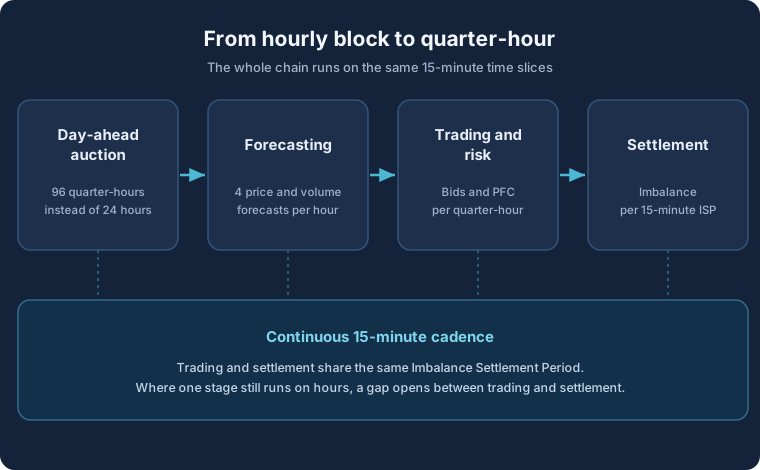
- Trading and optimization: bidding strategies and portfolio optimization compute on a quarter-hour basis rather than hours.
- Risk management: position exposure is valued per quarter-hour, and the price forward curve needs finer granularity.
- Settlement: systems must reconcile 15-minute units cleanly, and valuation effects per delivery day grow.
- Data volume: time series, forecasts and schedules grow fourfold. This is the point where manual processes tip over.
Effects on forecasting and portfolio management
Forecasting takes the biggest hit. One price and volume forecast per hour becomes four. Yes, that is more work. It also sharpens the picture, because a load peak or a generation ramp no longer disappears inside an hourly average.

- One forecast per hour becomes four. Generation and load profiles map more precisely, especially the steep morning and evening ramps.
- Data-driven forecasting models gain value, because the error cost per quarter-hour becomes more visible. How AI-based load and generation forecasts come in here is a field of its own.
- The finer resolution gives a better basis for active procurement and long-term planning.
Rebuilding trading, risk and procurement
Trading and risk carry the commercial weight here. More products, more complexity, and liquidity and volatility both move at once. Expect sharper short-term swings. The typical PV bell now shows up at the day-ahead stage, not just intraday, so the price already reflects it.
Without an API link to the exchange, manual effort rises disproportionately. At 96 products a day, bidding by hand is no longer an option. Skip the automation and you lose time exactly where prices swing hardest.
- The finer price structure can raise price volatility in the short term.
- Liquidity in the intraday auctions can decline, because part of the fine-tuning moves into the day-ahead.
- Existing procurement and marketing strategies belong on the test bench. Old assumptions about price formation no longer hold, much as with the new controllable tariff models for 2026.
Opportunities for renewables and direct marketing
For renewables the switch is mostly good news. Solar can be marketed closer to what it actually generates, and the market value now follows the 15-minute structure. Fewer costly intraday corrections follow from that.
- The PV bell can be marketed directly at the day-ahead stage. Marketing and delivery line up better.
- The market value of renewable assets tracks the quarter-hour structure. Fewer after-the-fact direct marketing corrections intraday tend to mean lower imbalance costs.
One honest caveat. The switch on its own creates no flexibility. That still takes flexible generation and controllable loads that actually react to the finer price signals. The 15-minute cadence only makes those signals visible. Nothing more.
What utilities must change now
Start with an honest inventory of your own systems along the chain. Where does hourly logic still run? Where is the quarter-hour resolution missing? And where does a break open between trading and settlement? Answer those, and the fixes to systems, interfaces and forecasting models fall out on their own.

Five priority steps
-
Review the system chain
Check forecasting, trading system, portfolio management, energy data management and settlement for 15-minute capability. Any stage still computing in hours is a candidate for a break.
-
Extend forecasting
Move models and data pipelines to quarter-hour price and volume forecasts. Four forecasts an hour need more data and compute, but they cut the error cost where it is largest.
-
Strengthen market access
Set up API-based bidding to keep the fourfold product count manageable. Manual bids no longer scale at 96 products.
-
Compute risk granularly
Move the price forward curve and position valuation to quarter-hours and plan for the higher valuation effects per delivery day.
-
Couple trading and settlement
Make sure 15-minute trading and 15-minute settlement sit on the same time slices. This seam is where costly imbalance charges otherwise arise.
Further reading
Frequently Asked Questions
The day-ahead market trades electricity for the next day in a daily auction at 12:00 CET. Since the first delivery day on 1 October 2025 the price no longer forms per hour but per quarter-hour. Twenty-four hourly products become 96 quarter-hour products per day, and the market time unit changes from 60 to 15 minutes. The switch was coordinated Europe-wide in the Single Day-Ahead Coupling.
The driver is imbalance settlement. The EU set the Imbalance Settlement Period at 15 minutes, and the trading interval must not be coarser than the settlement period. Anyone settled per quarter-hour must be able to trade per quarter-hour. The legal basis is Regulations (EU) 2017/2195 and (EU) 2019/943 together with CACM and the Clean Energy Package.
The first delivery day was 1 October 2025, with the auction result on 30 September 2025. An earlier go-live was planned for 11 June 2025 but was postponed because the coupled auction failed to run stably in about 20 percent of test cases. The cause was not a single market participant but the stability of the Europe-wide coupled system.
The whole process chain from forecasting to settlement must run at quarter-hour resolution. Forecasting models deliver four price and volume forecasts per hour instead of one. Market access should be API-based to handle 96 products a day. Risk metrics such as the price forward curve compute per quarter-hour. And trading and settlement must sit on the same 15-minute time slices.
For direct marketing the change is mostly good. Solar power can be marketed closer to its actual generation profile, the typical PV bell becomes visible already at the day-ahead stage, and the market value reflects the quarter-hour structure. That reduces the need for costly intraday corrections and tends to lower imbalance costs. System flexibility does not follow automatically, though; that still needs flexible generation and controllable loads.
Let's collaborate
One contact, a team behind it
Thirty minutes on what you're working on, whether grid, metering, market processes, IT architecture or AI. Afterwards you'll know how we'd approach it and who would sit at the table.
Energy and measurement technology since 2010 · innobu GmbH since 2014 · Based in Schleswig-Holstein, Germany
Whoever pitches also delivers: whoever leads the first call stays your contact right through to the steering committee, with established partners in the project. Direct: info@innobu.com