
ZSG Quarter-Hour Balancing: From the Standard Load Profile to Measured Data
These are the same slices in which the day-ahead market has traded since October 2025. The metered load curve (Zaehlerstandsgang) delivers the data stream, governed by the BNetzA ruling BK6-24-174.
ZSG quarter-hour balancing shifts electricity balancing from a statistical profile to measured data. A metered load curve is, under section 2 StromNZV, a series of meter readings recorded every quarter hour, from which the real quarter-hour consumption is formed and balanced. This is governed by the BNetzA ruling BK6-24-174 of 24 October 2024, which adapts GPKE, WiM and MaBiS so that the data stream works at mass-business scale via MSCONS.
ZSG quarter-hour balancing is the data stream that shifts German electricity balancing from the statistical standard load profile to measured quarter-hour values. A metered load curve (Zaehlerstandsgang) is, under section 2 StromNZV, a series of meter readings recorded every quarter hour, from which the real quarter-hour consumption is formed instead of assuming a typified profile. This is governed by the BNetzA ruling BK6-24-174 of 24 October 2024, which adapts GPKE, WiM and MaBiS so that ZSG data can be transmitted at mass-business scale and balanced down to the quarter hour. The legal basis is the metering point operation act (MsbG), and data protection is preserved through pseudonymisation under section 52 MsbG. The key dates are the preparation duty for grid operators and metering point operators from 1 December 2024 and the actual start on 6 June 2025, postponed from the original 4 April 2025. The data stream runs via MSCONS in the electricity market communication, and per meter this produces 96 quarter-hour values per day and around 35,040 per year, compared with a single annual SLP value. Market locations with a fully smart metering system have since been balanced no longer on the standard load profile, which closes the gap between the low-cost SLP mass business and the expensive registering power metering and makes dynamic tariffs in the household segment representable. Critical are the multiplied data volume, the IT load, data quality and substitute-value handling, and the full load on small metering point operators and municipal utilities. ZSG is the precursor to the MaBiS-Hub under BK6-24-210, which will aggregate the quarter-hour values centrally; its start date is still open. Whoever implements the MSCONS formats, consolidates the master data, scales the capacity and plans the connection to the MaBiS-Hub keeps the transition manageable.
What ZSG balancing means
ZSG balancing shifts electricity balancing from a statistical profile to measured data. A metered load curve is a series of meter readings recorded every quarter hour. Instead of assuming a standard load profile, the real quarter-hour consumption is balanced. This is governed by the BNetzA ruling BK6-24-174, and the precondition is a smart metering system with a smart meter gateway.
Behind ZSG balancing stands a clear legal basis. The legal definition of the metered load curve is provided by the StromNZV, the implementation in the market communication is governed by the ruling BK6-24-174 of Ruling Chamber 6, and the legal basis is the metering point operation act (MsbG). Affected are grid operators, metering point operators, balancing group managers and suppliers. The precondition is a communicating smart metering system (iMSys) with a smart meter gateway (SMGW), because only there do the quarter-hour meter readings exist at all. With this, ZSG balancing is the precursor to the future MaBiS-Hub, which aggregates the measured values centrally later on. How many metering locations have a smart metering system is reported by the BNetzA: on 30 June 2026 it was 3,172,579 of 54,135,202, or 5.9 percent. On 21 September 2026 the agency corrected its earlier figure for 31 December 2025 to 2,406,454, or 4.4 percent, because the old total contained double counts.
From the standard load profile to measured data
The core is the change of the data basis. The standard load profile assumes a typified consumption, the metered load curve measures it in real terms in the 15-minute grid. This closes the gap between the low-cost SLP mass business and the expensive registering power metering.
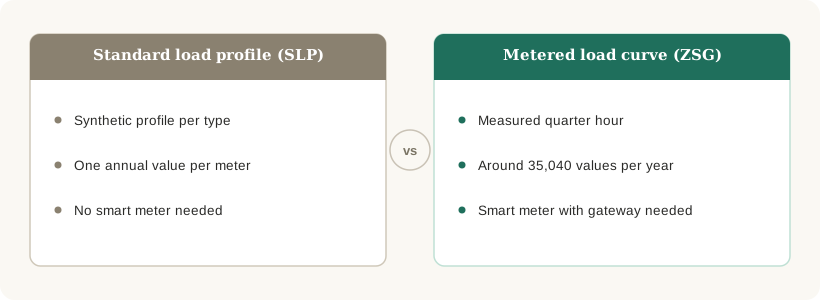
In detail the two methods differ fundamentally. The standard load profile is a synthetic profile per load profile type and works at its core with a single annual value per meter, which is distributed across the quarter hours via a typified pattern. The metered load curve, by contrast, delivers real measured quarter-hour values, around 35,040 per meter and year, and requires a fully smart metering system for this. The benefit lies in accuracy: only on the basis of measured quarter hours can dynamic and time-variable tariffs in the household segment be represented cleanly, because the actual consumption per time window is known and not assumed via a statistical average. In this way ZSG balancing closes the gap between the low-cost SLP mass business and the expensive registering power metering, which has so far been reserved for larger consumers. That same measured quarter hour is the precondition for energy sharing across the grid boundary, which may span two grid areas from June 2028.
What BK6-24-174 changes
The ruling adapts the market communication so that the ZSG data stream works in the mass business. Affected are GPKE, WiM and MaBiS, and the transport runs via MSCONS. Whoever knows the affected processes can plan the migration in a targeted way.

In concrete terms, the ruling BK6-24-174 adapts the central processes of the market communication to the ZSG transfer. Affected are the business processes for customer supply with electricity, the switch processes in metering and the market rules for balancing group settlement, that is GPKE, WiM and MaBiS. The transport of the quarter-hour values runs via the MSCONS data format in the electricity market communication, which is upgraded for the mass volume. On the deadlines, the preparation duty for grid operators and metering point operators has applied since 1 December 2024, the actual start took place on 6 June 2025, postponed from the originally planned 4 April 2025. On data protection, pseudonymisation under section 52 of the metering point operation act (MsbG) applies, so that the fine-grained consumption data does not run unprotected through the market communication. For practice this means every affected process must be checked against the new ruling and followed through in the IT system.
Data volume and challenges
The migration multiplies the data volume and loads the IT. From one SLP annual value, around 35,040 quarter-hour values per meter arise. An honest view has to name the load and the risks, rather than painting the migration only as an orderly modernisation.

In detail the pressure arises at several points. From a single SLP annual value, around 35,040 quarter-hour values per meter arise, which loads processing, storage and aggregation considerably. On top of this comes data quality: in the case of communication outages or missing values, a clean substitute-value handling has to take effect, otherwise balancing errors arise that must be corrected at great expense later on. Small metering point operators and municipal utilities in particular often lag behind in the implementation, because they have to handle the same range of functions as large market participants but have less staff and scale. Whoever underestimates the load risks bottlenecks in processing and gaps in the balancing.
Watch data volume and data quality: The jump from one annual value to around 35,040 values per meter hits the IT load in processing, storage and aggregation. If a robust substitute-value and plausibility logic is missing, communication outages hit the balancing directly. Small metering point operators and municipal utilities in particular come under pressure if they do not build capacity and data quality in good time.
ZSG and the MaBiS-Hub: the distinction
ZSG and the MaBiS-Hub belong together but are two layers. ZSG is the data stream, the hub is the future central platform. Whoever separates the two plans the projects correctly.
For planning this means: ZSG under BK6-24-174 is the quarter-hour data stream that provides the measured values per meter from 2025, while the MaBiS-Hub under BK6-24-210 is the central aggregation that will bundle these values; the Bundesnetzagentur has not yet set a start date. The smart meter rollout delivers the devices that make ZSG possible in the first place, because without a smart metering system there are no quarter-hour meter readings. Whoever separates the three layers avoids duplicate assumptions and plans coordinated projects. The details of the central platform are in the innobu article on the MaBiS-Hub, and the basics of the device rollout are covered in the innobu article on the smart meter rollout.
What companies should do now
The ZSG migration is a data and IT topic with a hard deadline. Whoever updates the formats, consolidates the master data quality and scales the capacity avoids balancing errors. A regulatory obligation then becomes an orderly step.
-
Implement the MSCONS formats and the market processes
Implement and test the MSCONS formats as well as the adaptations to GPKE, WiM and MaBiS through which the ZSG data stream runs. Only with tested formats and processes do the quarter-hour values arrive reliably in the balancing, without clarification cases tying up day-to-day operations.
-
Consolidate the metering-location master data
Keep the assignment of metering location to market location clean and consolidate the master data. Faulty assignments are a main source of errors and generate clarification cases that have to be resolved manually at the deadline and burden the back-office teams.
-
Scale storage and processing capacity
Plan the storage and processing capacity for the data growth from one annual value to around 35,040 values per meter. Only with sufficient scaling do processing and aggregation withstand the multiplied volume without deadlines slipping.
-
Build substitute-value logic and prepare for the MaBiS-Hub
Build a robust substitute-value and plausibility logic for communication outages and consider the connection to the MaBiS-Hub from the start. This way the values remain balanceable even with gaps and the later central aggregation can be connected without a break.
At heart ZSG quarter-hour balancing is a data and IT project with a hard rhythm, not a mere format update. Whoever implements the MSCONS formats, consolidates the metering-location master data, scales the capacity for around 35,040 values per meter and builds the substitute-value logic avoids balancing errors. Whoever wants to go deeper into the central aggregation sets ZSG alongside the MaBiS-Hub and recognises how the two layers work together.
Further reading
Frequently asked questions
A metered load curve (Zaehlerstandsgang) is, under section 2 StromNZV, a series of meter readings recorded every quarter hour. From them the real quarter-hour consumption is formed and balanced, rather than assuming a statistical standard load profile. Per meter this produces 96 quarter-hour values per day and around 35,040 per year, compared with a single annual SLP value. The precondition is a fully smart metering system (iMSys) with a smart meter gateway.
The BNetzA ruling BK6-24-174 of 24 October 2024 adapts GPKE, WiM and MaBiS so that ZSG data can be transmitted at mass-business scale and balanced down to the quarter hour. The data stream runs via MSCONS in the electricity market communication. The legal basis is the metering point operation act (MsbG), and data protection is preserved through pseudonymisation under section 52 MsbG. The preparation duty for grid operators and metering point operators applied from 1 December 2024.
The standard load profile (SLP) assumes a typified, synthetic consumption per load profile type and works at its core with one annual value per meter. The metered load curve (ZSG) measures consumption in real terms in the 15-minute grid and delivers around 35,040 values per meter and year. ZSG requires a fully smart metering system, SLP does not. ZSG balancing closes the gap between the low-cost SLP mass business and the expensive registering power metering and makes dynamic and time-variable tariffs in the household segment representable.
The preparation duty for grid operators and metering point operators applied from 1 December 2024. The original start of application was 4 April 2025, and the actual start shifted to 6 June 2025 following BNetzA notice no. 4 of 6 December 2024. Market locations with a fully smart metering system have since been balanced no longer on the standard load profile but on the basis of measured quarter-hour values.
The ZSG migration is a data and IT topic with a hard deadline. Grid operators and metering point operators should implement and test the MSCONS formats and the GPKE, WiM and MaBiS adaptations, keep the assignment of metering location to market location clean, scale storage and processing capacity for the data growth from one annual value to around 35,040 values per meter, and build substitute-value and plausibility logic while planning the connection to the MaBiS-Hub.
Let's collaborate
One contact, a team behind it
Thirty minutes on what you're working on, whether grid, metering, market processes, IT architecture or AI. Afterwards you'll know how we'd approach it and who would sit at the table.
Energy and measurement technology since 2010 · innobu GmbH since 2014 · Based in Schleswig-Holstein, Germany
Whoever pitches also delivers: whoever leads the first call stays your contact right through to the steering committee, with established partners in the project. Direct: info@innobu.com