Energy Sharing under Section 42c EnWG: Sharing Allowed, Practice Stalled
Energy sharing under Section 42c EnWG turns into a legal right on 1 June 2026: distribution grid operators must then provide 15-minute metering values, allocate volumes and settle with all participants. But the technical and digital base is missing across much of Germany. Smart meter coverage stood at 5.9 percent in mid-2026, shared electricity carries full grid fees, and a real financial incentive is absent.
Energy sharing under Section 42c EnWG lets several people share electricity from a shared renewable installation through the public grid without losing their end-customer status. The provision took effect on 22 December 2025, and from 1 June 2026 distribution grid operators must enable it technically: 15-minute metering values, volume allocation and settlement with every participant. The legal right is here, but the practice lags. By mid-2026 smart meter coverage in Germany was 5.9 percent, against about 95 percent in Austria at the end of 2025, and without an intelligent metering system there is no legally sound settlement. On top of that Section 42c carries no financial incentive: shared electricity bears full grid fees, levies and taxes, while Austria and Italy reduce the grid fees for shared power. The real gap is not the legal text but the data and process chain behind it. Experts expect broad everyday use only from around 2027 to 2029, with 2026 as the year of pilot projects.
What changes on 1 June 2026
From 1 June 2026 distribution grid operators must enable energy sharing technically. From that date several people can share the electricity from a shared renewable installation through the public power grid without losing their status as end customers. The legal framework is in place, but the practice lags behind it.
The duty is concrete. Grid operators must provide 15-minute metering values, allocate the shared volumes and settle with all participants. Some operators have already announced that they can only deliver the technical implementation later than the deadline. The link to metering is tight, which innobu set out in its article on the stalled smart meter rollout.
What energy sharing actually means
Energy sharing lets locally generated solar or wind power be passed to neighbours, tenants or members of a community. Unlike a tenant electricity model with a virtual sum meter, the power runs through the public grid rather than only through a building's internal wiring. Every feed-in and consumption point needs metering in 15-minute intervals, and the shared volumes are then allocated and credited to the participants.
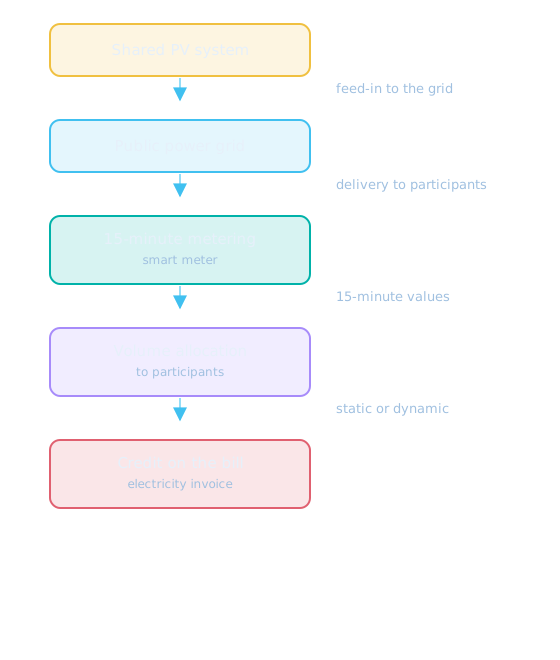
The allocation of the volumes can be static, with fixed quotas, or dynamic, varying over time with the generation profile. From 2028 energy sharing is also meant to become possible between neighbouring grid areas, which widens its reach beyond a single building or street. What that second stage across the grid boundary actually demands has been settled since the Bundesnetzagentur published Mitteilung Nr. 73.
The real bottleneck: smart meters
Energy sharing stands or falls with the smart meter rollout, and the rollout is stalling. Without an intelligent metering system with a gateway there is no legally sound settlement. The 15-minute values are the input that every allocation depends on, so the metering gap is the gap that matters.

Since 25 February 2025 new photovoltaic systems from 2 kilowatts must have an intelligent metering system and a control box. The Bundesnetzagentur opened supervisory proceedings in 2026 against metering operators that delay the rollout. For the end of 2025 the Bundesnetzagentur first reported 5.5 percent of metering points with a smart metering system and corrected this to 4.4 percent in September 2026 because the totals contained double counts; by mid-2026 the share was 5.9 percent. Still, the share of households with a smart meter remains small, and energy sharing reaches only as far as the metering does.
The German and EU perspective
Energy sharing puts EU rules into national law, yet Germany uses the room for manoeuvre more cautiously than its neighbours. The deadline from the EMD III electricity market directive runs until 17 July 2026. The decisive difference lies in the grid fees: Germany keeps them in full on shared power, while Austria and Italy reduce them.

Section 42c contains no financial incentive: shared electricity carries full grid fees, levies and taxes. Austria and Italy reduce the grid fees for shared power and so create a real price advantage. Without that incentive, the German right grants permission to share but little reason to do so beyond the wish for local supply.
The community base differs accordingly. Germany has around 870 citizen energy communities with over 180,000 members, while Austria already counts around 3,700 energy communities on a smaller population. The legal framework alone does not create the dynamic. Higher smart meter coverage and a real price advantage do.
Challenges and risks
The central contradiction is a legal right without the infrastructure to honour it. That carries disappointment potential for consumers and effort for grid operators. If participants expect savings and instead see full grid fees, the gap between promise and practice becomes visible quickly.
Beware the right that stays on paper: A legal claim without a metering base, without reduced grid fees and with uneven processes between grid operators risks becoming a formal entitlement that few can actually use. Realistically, energy sharing becomes fit for everyday use only from around 2027 to 2029, with 2026 as the year of pilot projects.
What companies should do now
Utilities, municipal utilities and grid operators should treat energy sharing as a data and process topic, not a marketing topic. Whoever builds the metering and settlement chain now is ready to deliver in 2027, when broader demand arrives and the smart meter base has grown.
-
Prioritise metering data and 15-minute flows
Build the processing of 15-minute metering values in parallel with the smart meter rollout, so that the input for any allocation is available where a smart meter exists.
-
Define settlement and onboarding processes
Set clear settlement and onboarding processes for energy sharing communities, including static and dynamic allocation, so that new communities can be connected without manual workarounds.
-
Run pilots with the housing sector
Use pilot projects with the housing sector and cooperatives to test the processes before mass operation, where apartment blocks already combine a shared roof and many metering points.
-
Plan for cross-area sharing from 2028
Design the data architecture so that sharing between neighbouring grid areas, planned from 2028, does not require a second rebuild of the settlement chain later.
The right to share electricity exists in 2026, the means to settle it largely do not. Whoever builds the metering and settlement chain now turns the legal duty into a usable service. How new tariff models make the electricity market steerable shows how energy sharing fits into a wider shift toward time-variable pricing and grid fees under GDPR -compliant data handling.
Deadline, market roles, systems
1 June 2026Energy sharing under § 42c EnWGLaw · in force
If the deadline is missed: Regulator can enforce There is no specific fine. If a distribution system operator does not enable shared use under Section 42c(4) EnWG, the regulator can order remedies under Section 65 EnWG; breaching the enforceable order is an administrative offence under Section 95(1) no. 3(a) EnWG (up to EUR 100,000). According to the Federal Network Agency's Notice No. 73, the supplier-based service model already meets the duty. Legal basis ↗
- Electricity grid operatorrole obligationEnsures under Section 42c(4) no. 1 EnWG that energy sharing is possible within its balancing area; under Notice No. 73 the service model suffices.Typically affected: Market communication gateway (EDIFACT, AS4, API)
- Suppliercheck applicabilityDecides whether to offer energy sharing as a service and, if so, settles allocation, balancing and residual supply by contract.Typically affected: Grid usage and customer billing, EDM / MDM
date openEnergy sharing: network operators' joint web platform (Section 20b EnWG)Law · adopted, date open
If the deadline is missed: Regulator can enforce There is no specific fine. The regulator can enforce the duty under Section 20b(1) EnWG to build the platform jointly through Section 65 EnWG; a binding date only exists once the Federal Network Agency sets one under Section 20b(3) EnWG. Legal basis ↗
- Electricity grid operatorrole obligationTakes part in building and running the joint platform under Section 20b EnWG; the Federal Network Agency sets the date.Typically affected: Customer and grid connection portal, Market communication gateway (EDIFACT, AS4, API)
- Suppliercheck applicabilityChecks whether energy sharing offers have to be registered on the platform once it is live.Typically affected: Customer and grid connection portal
A classification for typical market roles, not a review of your individual case and not legal advice. Whether an obligation applies to your company (thresholds, exemptions) is for your legal department or counsel to confirm. The calendar doesn't replace your own deadline review. Information as of: 23 October 2026.
Further reading
Frequently asked questions
Energy sharing lets several people share electricity from a shared renewable installation, such as a solar or wind system, through the public power grid without losing their status as end customers. Section 42c EnWG took effect on 22 December 2025, and from 1 June 2026 distribution grid operators must enable it technically. Unlike a tenant electricity model, the power runs through the public grid rather than only through a building's internal wiring.
Section 42c EnWG has been in force since 22 December 2025, and the duty of distribution grid operators to enable energy sharing technically applies from 1 June 2026. From that date operators must provide 15-minute metering values, allocate volumes and settle with all participants. Some grid operators have already announced that the technical implementation will only follow later.
Energy sharing needs an intelligent metering system with a gateway that records every feed-in and consumption point in 15-minute intervals, otherwise the shared volumes cannot be settled in a legally sound way. By mid-2026 the smart meter coverage in Germany was 5.9 percent, compared with about 95 percent in Austria at the end of 2025. Without that data base the legal right stays on paper.
Not directly under the current rules. Section 42c contains no financial incentive: shared electricity carries full grid fees, levies and taxes. Austria and Italy reduce the grid fees for shared power and so create a real price advantage. In Germany the economic benefit for participants therefore stays small for now, which limits the appeal of energy sharing in 2026.
Experts consider broad everyday use realistic only from around 2027 to 2029. In 2026 pilot projects dominate, because the smart meter rollout, the metering processes and the settlement platforms are not yet ready across the board. From 2028 energy sharing is also meant to become possible between neighbouring grid areas, which widens the reach further.
Let's collaborate
One contact, a team behind it
Thirty minutes on what you're working on, whether grid, metering, market processes, IT architecture or AI. Afterwards you'll know how we'd approach it and who would sit at the table.
Energy and measurement technology since 2010 · innobu GmbH since 2014 · Based in Schleswig-Holstein, Germany
Whoever pitches also delivers: whoever leads the first call stays your contact right through to the steering committee, with established partners in the project. Direct: info@innobu.com