Energy sharing across the grid boundary: what stage two demands in 2028
This article sets out what section 42c(4) no. 2 EnWG actually demands by 1 June 2028, what Mitteilung No. 73 changes about it, which allocation question remains open, and what a utility should be discussing with its neighbouring grid operators now.
Stage two of energy sharing opens the grid boundary: under section 42c(4) no. 2 of the German Energy Industry Act, shared use of electricity must from 1 June 2028 also be possible in the balancing area of a directly adjacent electricity distribution grid operator, provided both sit in the same control zone, and the adjacent operator must cooperate to the extent required. Stage one has applied since 1 June 2026 and stops at the edge of one balancing area. With Mitteilung No. 73 of 7 July 2026, Chamber 6 of the Bundesnetzagentur held that energy sharing can be settled inside the existing supplier and balancing group system and that no further implementation duties arise for grid operators; the Buendnis Buergerenergie accuses the regulator of thereby stalling a statutory entitlement in practice. What stays unresolved is which actor merges generation and consumption time series and who may access which data. Both stages presuppose 15-minute metering at every generation and consumption point, and intelligent metering systems covered just 5.5 percent of all metering points at the end of 2025.
What arrives on 1 June 2028
Stage two moves a boundary that has been very convenient so far: the balancing area. From 1 June 2028 an energy sharing community may reach beyond it.
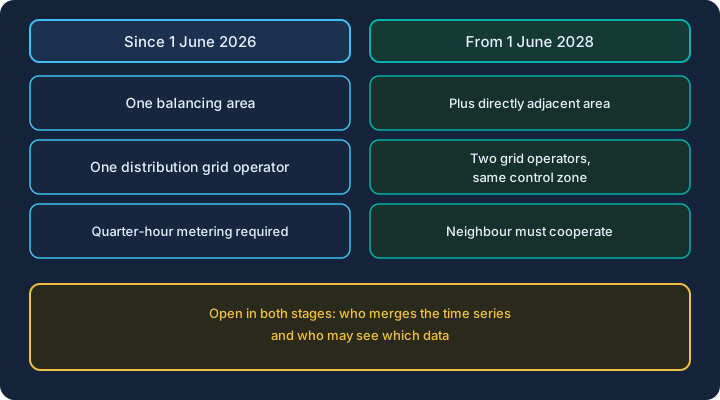
Legal text is terse here. Section 42c(4) no. 2 EnWG requires the grid operator to ensure that shared use is also possible in the balancing area of a directly adjacent electricity distribution grid operator. Two conditions hang off that: both areas must sit in the same control zone, and the adjacent operator must cooperate to the extent required.
Anyone who followed the start of stage one knows the mechanics. What is new is simply that from 2028 a second company sits at the table.
The notice that moved everything
On 7 July 2026 Chamber 6 set out the implementation path in Mitteilung No. 73, and it went differently from what many parties expected.
Its core finding: energy sharing can be settled inside the existing supplier and balancing group system, so no further implementation duties arise for grid operators. As reasoning the regulator argues that a model coordinated through grid operators would create considerable additional complexity and require extensive IT changes. On top of that, not all volumes would then be represented completely and unambiguously in the balancing group system.
In practice it runs through a service model: a supplier or service provider takes in the electricity from the generation installations and passes it on to the final customers, frequently acting as the residual supplier at the same time.
So the enabling duty under section 42c(4) still binds the distribution grid operator, while a settlement process of its own does not. Convenient, and unsatisfying at the same time, because the duty stays in the statute.
Two positions, one entitlement
That decision split the industry. Both sides argue from the same legal position.
None of this is resolved, and it will not resolve itself by 2028 either. How much work stage two creates in grid operations hangs on exactly this.
What stays open across two grid areas
The real knot sits in the allocation rather than in the statute. And across the grid boundary it pulls twice as tight.
The Forschungsstelle fuer Energiewirtschaft names the gap precisely: it is not defined which actor merges the generation and consumption time series and allocates the energy volumes, nor which actor may access which data.
Inside a single grid area that is already awkward. For a community spanning the boundary, two grid operators, possibly two metering point operators and two separate data estates come together. The neighbour's duty to cooperate is in the statute. Its extent is not.
The law says the neighbour has to cooperate. It does not say on what. Two companies settling that only in 2028 will settle it under time pressure.
The FfE sums the position up soberly: legally possible, but technically, organisationally and economically only partly feasible.
Metering remains the bottleneck
Without quarter-hour values everywhere there is no allocation. Without an intelligent metering system there are no quarter-hour values.

Metering has to run in 15-minute intervals, and it has to run twice over: on the electricity generated or stored at the installation, and on what is drawn at every supplied consumption point. That is not a comfort feature but the basis of every settlement.
Deployment lags behind. At the end of 2025 intelligent metering systems sat at 5.5 percent of all metering points. Among the mandatory installation cases the figure was 23.3 percent, and among small metering point operators with fewer than 30,000 points only 14.6 percent. How slowly this moves into the field shows in the control box rollout at scale .
For stage two that carries a wrinkle which is easy to miss: a community spanning the boundary needs the equipment on both sides of it. Your own average will not help if the neighbour is not there yet.
Why the benefit does not appear by itself
Germany permits the sharing but lowers no charges. A deliberate choice, and it shapes every business case.
Shared electricity still bears full network charges, levies and taxes. Austria, Italy and Spain reduce network charges for shared electricity instead. So the advantage here has to come out of procurement and scale.
Liliane Ableitner puts the yardstick for that as follows: the two hundredth community has to be operable just as economically as the first. That is the real measure. A pilot with plenty of manual work proves nothing about whether a product carries.
What utilities should do now
June 2028 is a good twenty months away. Sounds like plenty, and is not, once two companies have to agree.

Five steps before 2028
-
Settle your own role
Are you stepping up as a supplier in the service model, or only as a grid operator with an enabling duty? That single answer determines everything else, from IT through to sales.
-
Talk to the neighbours
Who is directly adjacent, and which of them sits in the same control zone? That list is short and takes an hour. The conversation afterwards takes longer, which is why it should not start in 2028.
-
Put the allocation in writing
Who merges the time series, who allocates the volumes, who sees which data? The statute does not answer this, so the parties have to.
-
Check iMSys coverage along the boundary
Not as an average across the whole grid area, but specifically where a cross-boundary community could plausibly form.
-
Cost out one community, then two hundred
Work out the effort for the first and for the two hundredth. The difference is your automation requirement, and it is a hard number rather than an opinion.
Further reading
Frequently asked questions
The geographic boundary moves out by one step. Under section 42c(4) no. 2 EnWG, shared use must from 1 June 2028 be possible not only within a single balancing area but also in the balancing area of a directly adjacent electricity distribution grid operator. Both grid areas have to sit in the same control zone, and the adjacent operator must cooperate to the extent required.
On 7 July 2026 Chamber 6 of the Bundesnetzagentur held that energy sharing can be settled inside the existing supplier and balancing group system, and that no further implementation duties arise for grid operators. Its reasoning: a model coordinated through grid operators would create considerable additional complexity and require extensive IT changes.
Both the electricity generated or stored at the installation and the electricity drawn at every supplied consumption point must be metered in 15-minute intervals. That presupposes intelligent metering systems. At the end of 2025 those sat at 5.5 percent of all metering points in Germany, and at 23.3 percent of the mandatory installation cases.
German law does not say. According to the analysis by the Forschungsstelle fuer Energiewirtschaft, it is defined neither which actor merges the time series and allocates the energy volumes, nor which actor may access which data. Across two grid areas that gap involves two grid operators and two separate data estates.
No. Section 42c EnWG carries no financial incentives; shared electricity still bears full network charges, levies and taxes. Austria, Italy and Spain by contrast reduce network charges for shared electricity. In Germany the economic benefit therefore has to come from procurement and scale effects rather than from regulation.