EU Methane Regulation 2027 to 2030: six deadlines for gas network operators, storage operators and gas importers
Regulation (EU) 2024/1787 has applied directly since 4 August 2024, including to the gas distribution networks of German municipal utilities. On 14 October 2026 the Commission proposed pushing importer duties back by one year; Parliament wants to move dates as far as 2031 and to postpone the network operators' report as well. None of it has been adopted, so on 27 October 2026 all six deadlines stand as published in the Official Journal in 2024.
The EU Methane Regulation (Regulation (EU) 2024/1787) obliges operators of gas transmission and distribution networks, underground storage and LNG facilities, as well as importers of natural gas, crude oil and coal, to measure, report and evidence methane emissions; six of its deadlines fall between 1 January 2027 and 5 August 2030. Network operators submit by 5 February 2027 the source-level report for non-operated assets and the verifier-assessed report with site-level measurements, the latter then every year by 31 May. From 1 January 2027 importers must show that supply contracts concluded or renewed since 4 August 2024 cover only production under equivalent monitoring, they report the Annex IX information by 31 May each year, the methane intensity by 5 August 2028 and every year after, and compliance with maximum values, still to be set by the Commission, by 5 August 2030 and every year after. A Commission proposal of 14 October 2026 would delay the importer duties in Articles 28 and 29 by one year but has not been adopted. Member states penalise breaches under Article 33; fines on companies may reach 20 percent of the previous year's turnover.
Six deadlines from 2027 to 2030
Both network operation deadlines fall on the same day: on Friday, 5 February 2027, the source-level report for non-operated assets and the first verified report with site-level measurements are due. Anyone importing gas from third countries has four dates, and three of them recur every year. Two reports are already behind network operators, the report based on generic emission factors due on 5 August 2025 and the source-level report for operated assets due on 5 February 2026 (Article 12(1) and (2)(a)).
| Date | Duty | Who | Source | Legal consequence |
|---|---|---|---|---|
| from Fri, 1 Jan 2027 | Show that supply contracts since 4 Aug 2024 cover only volumes with equivalent monitoring, reporting and verification at producer level; reported with the annual report | Importers of natural gas, crude oil and coal from third countries | Article 28(1) Regulation (EU) 2024/1787 | Penalties under Article 33 (para. 5(n)); Commission recommends a grace period for 2027 to 2029 |
| Fri, 5 Feb 2027 | Report quantifying source-level methane emissions for non-operated assets not already reported for 2026 | Operators and undertakings in gas transmission, distribution, underground storage and LNG | Article 12(2)(b) | Penalties under Article 33 (para. 5(c)) |
| Fri, 5 Feb 2027, then every 31 May | Source-level report complemented by site-level measurements, assessed by a verifier with a verification statement, for operated assets | Operators and undertakings in gas transmission, distribution, underground storage and LNG | Article 12(3)(a) | Penalties under Article 33 (para. 5(c), naming the verification statement) |
| Mon, 31 May 2027, then every year | Annex IX information on exporter, producer, origin, measurement and verification to the authority of the member state of establishment, BAFA in Germany | Importers | Article 27(1) | Penalties under Article 33 (para. 5(m)); grace period recommended |
| Sat, 5 Aug 2028, then every year | Report the methane intensity of production for supply contracts since 4 Aug 2024, using a method the Commission sets by 5 Aug 2027 | Importers and Union producers | Article 29(1) | Penalties under Article 33 (para. 5(o)); grace period recommended |
| Mon, 5 Aug 2030, then every year | Show that methane intensity is below maximum values for contracts concluded or renewed after 5 Aug 2030; the values are not yet set | Importers and Union producers | Article 29(2) | Penalties under Article 33 (para. 5(o) and (p)) |
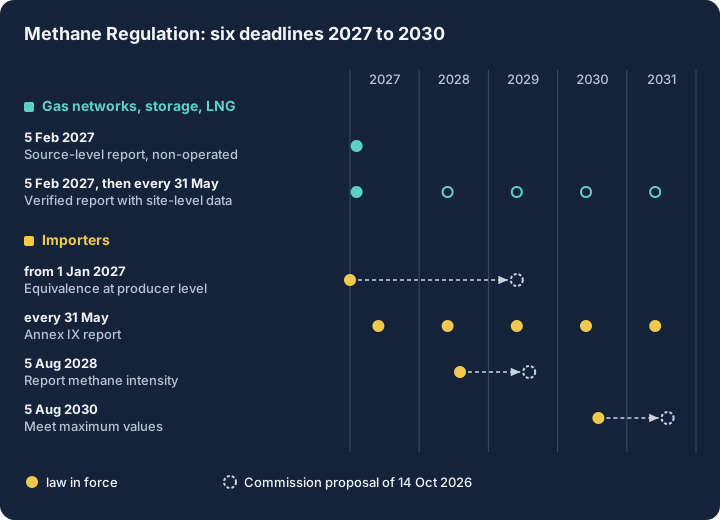
All six deadlines are in the regulation as it stands. Two building blocks are still missing, though: the Commission has to set the method for methane intensity by delegated act by 5 August 2027 (Article 29(4)), and the maximum values only follow after a report it must deliver by 5 August 2029 (Article 29(5) and (6)). So the 2028 and 2030 dates depend on acts that do not exist yet. Other dates in this field, the hydrogen network deadlines among them, are in the deadline calendar for the energy transition.
Who the regulation covers
Chapter 3's reporting duties apply to operators and undertakings established in the Union that transmit or distribute natural gas, store gas underground or run LNG facilities (Article 1(2)(c), Article 11). That includes the gas distribution networks of German municipal utilities. Only metering systems at final consumption points and the parts of service lines on the final customer's property between the distribution network and the meter are excluded. Nobody has to put the gas meter in the basement or the private section of the service line into the methane balance; the operator's pressure regulating and metering station, by contrast, belongs in it.
Chapter 5 covers a different group. An importer is anyone who, in the course of a commercial activity, places crude oil, natural gas or coal from a third country on the Union market (Article 2(59)). A municipal utility buying its gas at the German trading hub or from an upstream supplier inside the Union is not an importer under that definition. A trading company that takes over Norwegian pipeline gas or an LNG cargo at the Union border itself is a different case; all four importer deadlines apply to it.
Source-level report for non-operated assets by 5 February 2027
For every asset they do not operate themselves, operators and undertakings report source-level methane emissions by Friday, 5 February 2027, unless they already covered it in the February 2026 report (Article 12(2)(b)). "Source level" means per component that can release methane, such as a valve, a flange or a compressor (Article 2(2) and (15)). The report goes to the competent authority of the member state where the asset is located, not to the one where the company has its seat. Where direct measurement is not possible, the regulation requires specific emission factors based on source-level quantification or sampling; generic factors from databases were only enough for the first report due on 5 August 2025.
Article 12(4) sets the content: type and location of sources, data per source type in tonnes of methane and tonnes of CO2 equivalent under the IPCC's Sixth Assessment Report, the quantification methods, the ownership share in the non-operated asset with the corresponding emissions, and a list of the undertakings that hold operational control. There is no EU reporting template yet. Until the Commission adopts one by implementing act, the technical guidance and templates of the Oil and Gas Methane Partnership 2.0 (OGMP 2.0) apply. In its proposal of 14 October 2026 the Commission says it will adopt "some of the necessary templates" shortly.
Most of the effort goes into getting the data rather than calculating it. The figures for a non-operated asset sit with whoever operates it, and the shareholder's report depends on that operator delivering on time. Without numbers by early December, there is little time left to align the report internally before February.
Verified report with site-level measurements by 5 February 2027
The second report due on 5 February 2027 is the harder one. It adds site-level measurements to the source-level quantification so that the authority can compare the source values aggregated by site with measured ones, and it needs a verification statement from a verifier before submission (Article 12(3)). After that it is due every year by 31 May, first on 31 May 2028. For non-operated assets the German text says 5 February 2028; the English, French, Italian, Dutch and Spanish texts say 5 August 2028. Planning for February meets either reading.

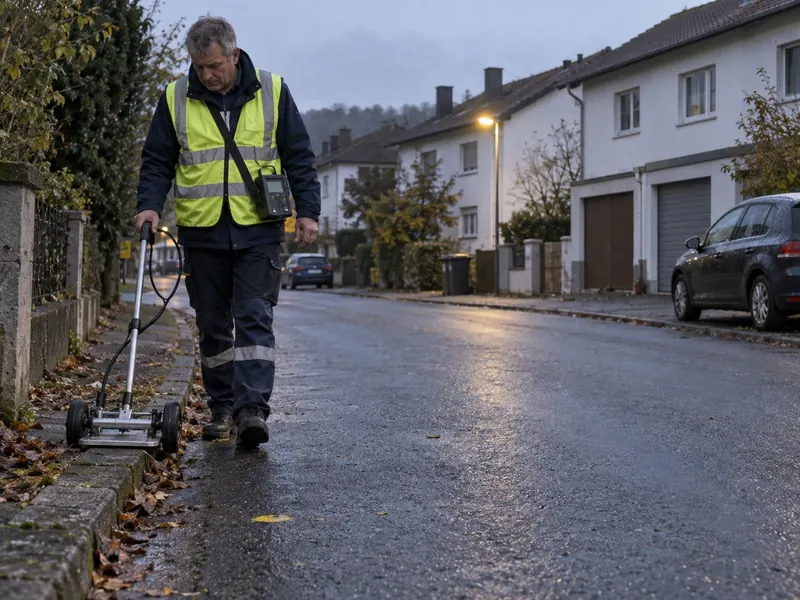
For a gas distribution system operator this means a measurement campaign that covers network segments in full, for instance with survey vehicles driving the streets above the mains, on top of the leak statistics from routine network surveys. If source-level and site-level values differ in a statistically significant way, the operator informs the authority without delay and before the end of the reporting period, reconciles the figures as soon as possible and reports the result in the next reporting period at the latest (Article 12(6)). The reconciliation has to address at least the accuracy and suitability of the technology and methods used and any data uncertainty.
We see the verifier as the bottleneck. A verifier is a legal person accredited by a national accreditation body under Regulation (EC) No 765/2008, or a natural person where a member state allows it; either way it may neither be owned by nor own the operator (Article 2(14), Article 9). The Commission itself cites the time accreditation bodies need to accredit verifiers as one reason for its postponement proposal, yet that proposal only moves importer duties, not the network operators' report. If the verifier finds the report non-compliant, the operator submits a revised version within the deadline the verifier sets (Article 8(4)), and there has to be room for that in January 2027 too. The authority publishes the reports within three months of submission (Article 12(8)); an operator withholding confidential business information states in the report which type of information that is and why (Article 12(7)).
Leak detection and repair since 2025
The reports do not stand alone. Since 5 May 2025 a leak detection and repair (LDAR) programme for existing sites has to be with the authority, the first type 2 LDAR survey was due by 5 August 2025, and each year a report on the previous year's surveys goes to the authority (Article 14(1), (2) and (14)). For distribution and transmission networks, Annex I Part 1 point 2 sets the intervals; at a design pressure up to 16 bar it only requires type 2 surveys. The type sets the threshold above which a component must be repaired: 7,000 parts per million of methane or 17 grams per hour for type 1, but for type 2 already 500 ppm or 1 gram per hour on above-ground components and 1,000 ppm or 5 grams per hour in the second step on underground ones (Article 14(8)).
| Component or material | Interval |
|---|---|
| Pressure regulating and metering station | 9 months |
| Valve station | 21 months |
| Grey cast iron, with or without bitumen coating | 6 months |
| Asbestos, ductile cast iron | 12 months |
| Unprotected steel, copper | 24 months |
| Polyethylene, PVC, protected steel | 36 months |
If a pipe's material cannot be determined, the shortest interval applies. A network with patchy material records is surveyed every six months until the data is cleaned up. A leak above the thresholds in Article 14(8) is repaired immediately; where that is not possible, the first attempt must follow within five days and the repair must be completed within 30 days (Article 14(9)). Operators keep records of every leak for at least ten years (Article 14(13)). For operators that plan to decommission parts of their network or convert them to hydrogen under the gas grid transformation plan, every pipe stays on the LDAR schedule until then.
Importers: equivalence evidence from 1 January 2027
From 1 January 2027 importers must show the authority of their member state of establishment that supply contracts concluded or renewed on or after 4 August 2024 cover only crude oil, natural gas or coal whose production is subject to equivalent monitoring, reporting and verification (Article 28(1)). This is reported with the annual Article 27 report, so in practice first by 31 May 2027. For older contracts the regulation asks for all reasonable efforts, up to amending the contract, and from 2027 an annual report on the outcome; where the efforts fail, a sound justification is required (Article 28(2)).

Article 28(5) allows two routes to equivalence. Either production is verified by an independent third party in a way equivalent to Articles 8 and 9, and the producer monitors crude oil and gas as Article 12 requires or reports under OGMP 2.0 Level 5, the highest reporting level of that standard. Or the Commission finds by implementing act that the third country's regulatory framework is at least equivalent; the Article 28 reporting duties then fall away for volumes from that country (Article 28(6) and (7)). For gas traded several times or blended before import, the importer often does not know the producer. For that case, Recommendation (EU) 2026/1834 of 20 July 2026 describes two kinds of compliance solution that authorities should recognise: "trace and claim", which follows the transactions back to the producer, and certification of the producer by an independent provider. It also offers optional model clauses for supply contracts.
Annual importer report by 31 May
By 31 May each year importers send the Annex IX information to the authority of their member state of establishment; the first report was due on 5 May 2025 (Article 27(1)). In Germany the Federal Office for Economic Affairs and Export Control (BAFA) collects the reports; the 2026 round ran through the ELAN-K2 portal with a closing date of 31 May 2026. Monday, 31 May 2027, is the first date on which the Article 28 equivalence evidence is part of it.
Annex IX asks among other things for the name and address of the exporter and, if different, the producer; the production and transit regions at NUTS 1 level; whether the producer measures at source and site level, whether an independent third party verifies and which standard the reporting follows, with a copy of the latest methane report; measures against leaks, venting and flaring; the equivalence evidence; whether the model clauses are used; and from 2028 the methane intensity. If information is missing, the importer gives a sound justification and lists the steps taken to obtain it. Without the supplier's cooperation that list cannot be filled, which is why it belongs in contract negotiations rather than in May.
Methane intensity: reporting 2028, maximum values 2030
By Saturday, 5 August 2028, and every year after, Union producers and importers report the methane intensity of the production they place on the Union market for supply contracts since 4 August 2024 (Article 29(1)). Older contracts again require reasonable efforts, with an annual report from 5 August 2028. How intensity is calculated is for the Commission to set by delegated act by 5 August 2027 (Article 29(4)); until then all a buyer can prepare is which data each contract will need.
The first duty that goes beyond reporting follows in 2030. By Monday, 5 August 2030, and every year after, producers and importers show that methane intensity is below maximum values, for contracts concluded or renewed after 5 August 2030 (Article 29(2)). The Commission sets the maximum values and intensity classes by delegated act after reporting, by 5 August 2029, on their effects on security of supply and competitiveness (Article 29(5) and (6)). For gas procurement that means long-term contracts negotiated now and extended after 2030 should already carry methane intensity data.
The postponement in the legislative procedure
On 27 October 2026 the law in force is the 2024 text. On 14 October 2026 the Commission proposed an amending regulation (COM(2026) 569) that only touches Articles 28 and 29: equivalence evidence and the report on efforts for older contracts would be due "by 31 May 2029 and every year thereafter", each for the previous calendar year; methane intensity by 5 August 2029 and then every 31 May; evidence on maximum values by 5 August 2031. Articles 12 and 27 are left untouched. The Commission cites the supply situation after the supply shock in the Middle East, missing national penalty rules and the pending accreditation of verifiers.
The European Parliament adopted amendments on 22 October 2026 (P10_TA(2026)0360) and referred the file back to committee for negotiations with the Council. It wants equivalence evidence moved to 31 May 2031 and methane intensity reporting to 5 August 2031, but 31 May 2028, 5 August 2028 and 5 August 2030 for volumes from third countries whose imports the EU restricts under sanctions. It also adds something the Commission did not propose: the verified report with site-level measurements under Article 12(3) would be due on 5 February 2030 for operated assets and on 5 August 2031 for non-operated ones. We found no Council position as of 27 October.
For gas network operators, 5 February 2027 applies until an amendment appears in the Official Journal, and whether a deal between Parliament and Council will cover Article 12 at all is open. An operator who waits for Parliament and Council and starts measuring in January 2027 is late if the deadline holds.
Implementation in Germany is open too. According to a federal government reply to a parliamentary question (Bundestag printed paper 21/8334, hib of 12 October 2026), a draft implementing act is being coordinated within the government; it is meant to reflect changes at EU level, and the stated aim is to postpone the introduction of the reporting duties.
What applies if a deadline is missed
The regulation leaves penalties to member states but sets the frame. Article 33 requires effective, proportionate and dissuasive penalties, at least fines that remove the economic benefit of the breach and periodic penalty payments. Authorities must have the power to order an end to a breach, confiscate profits, issue public warnings and impose periodic penalty payments and fines, as long as this does not endanger security of supply; fines on legal persons may not exceed 20 percent of the previous financial year's annual turnover (Article 33(2)). A missing Article 12 report with its verification statement is named explicitly among the infringements (Article 33(5)(c)), the importer duties in points (m) to (p). Authorities can also order corrective measures with deadlines after inspections (Article 6).
For importers, the Commission recommended on 20 July 2026 that member states not apply the penalties under Article 33(5)(m), (n) and (o) to breaches of the duties for 2027, 2028 and 2029, except in cases of fraud (Recommendation (EU) 2026/1835). The recommendation is not binding, and the duties themselves still apply. There is no such recommendation for network operators. Germany has no penalty rules at all yet, because the implementing act has not been adopted. This is a general assessment for roles, not a review of your individual case.
Industry against detailed rules, NGOs against delay
The German gas industry finds the technical requirements excessive; environmental groups find implementation too slow. In May 2025 BDEW, DVGW, FNB Gas and figawa rejected the Commission's draft for the minimum detection limits and thresholds of leak detection that Article 14(7) provides for as an implementing act:
"The minimum detection values and the thresholds are generally set too low." (translated from German)
The associations also want the extra costs recognised in network charges under Article 3. The regulation provides for that as far as costs match those of an efficient undertaking; how the new regulatory framework for gas networks from 2028 treats costs is covered in our piece on RAMEN Gas and GasNEF. Two months later Deutsche Umwelthilfe (DUH), an environmental NGO, saw the opposite of overly strict enforcement: one year after entry into force, eleven of 16 federal states had not designated a supervisory authority and a federal act on breaches was missing. Constantin Zerger, head of energy and climate protection at DUH, said on 29 July 2025: "Authorities must proactively identify and punish violations." (translated from German)
For a network operator both critiques lead to the same place: it reports under a text whose templates and detection limits are still missing and whose national authorities are not designated everywhere. In its proposal the Commission itself points out that implementing acts and standards are still outstanding and that it has issued a standardisation request. Its proposal still leaves the network operators' deadline unchanged.
What to do before February 2027
Gas network and storage operators have just over three months until 5 February 2027, and the bottleneck is the verifier, not the calculation. Importers have more time with 31 May 2027, but their data comes from suppliers they first have to bring on board by contract.
Next steps by role
-
Engage a verifier
Network, storage and LNG operators: sign up an accredited verifier now and agree which site-level measurements it will accept before the campaign starts.
-
Finish the measurement campaign
Measure network segments and sites so that the values are available in December 2026. Plan the reconciliation with the source-level quantification, because a significant gap has to be reported before the reporting period ends.
-
Sort out stakes
List every non-operated asset with ownership share and operator, and request the data for the 5 February 2027 report in writing.
-
Reset the reporting calendar
From 2028, 31 May is the annual date; put the LDAR annual report, repair schedules and methane report into one process with named owners.
-
Inventory supply contracts
Importers: list every contract concluded or renewed since 4 August 2024, request Article 28(5) evidence from the supplier, check the model clauses of Recommendation (EU) 2026/1834 for new contracts and, for traded volumes, choose a compliance solution BAFA can recognise.
Deadline, market roles, systems
1 January 2027Methane Regulation: importers prove equivalent monitoring at producer levelLaw · adopted
Applicability: Only undertakings that import natural gas, crude oil or coal from third countries into the Union (importers under Regulation (EU) 2024/1787). Suppliers buying on the wholesale market inside the Union are not importers.
If the deadline is missed: Regulator can enforce Article 33 of the Methane Regulation (EU) 2024/1787 requires member states to lay down effective penalties, at least fines and periodic penalty payments. Legal basis ↗
- Supplierrole obligationChecks import contracts since 4 August 2024 for equivalent MRV evidence from producers and reports it from 2027.Typically affected: Trading and procurement system (ETRM)
- Company-wide, several rolesrole obligationAs an importer, proves equivalent monitoring from 2027.Typically affected: Trading and procurement system (ETRM)
5 February 2027Methane Regulation: emissions report for non-operated assetsLaw · adopted
Applicability: Operators and undertakings in gas transmission, gas distribution, underground storage and LNG within the scope of Article 1 of Regulation (EU) 2024/1787.
If the deadline is missed: Regulator can enforce Article 33 of the Methane Regulation (EU) 2024/1787 requires member states to lay down effective penalties, at least fines and periodic penalty payments. Legal basis ↗
- Gas grid operatorrole obligationAs a gas distribution or transmission operator, reports source-level methane emissions of non-operated assets by 5 February 2027.Typically affected: Grid planning, GIS, load flow, Regulatory management, controlling
- Storage operatorrole obligationAs an underground storage operator, reports for non-operated assets by 5 February 2027.Typically affected: Plant master data and MaStR
5 February 2027Methane Regulation: verified report with site-level measurementsLaw · adopted
Applicability: Operators and undertakings in gas transmission, gas distribution, underground storage and LNG within the scope of Article 1 of Regulation (EU) 2024/1787.
If the deadline is missed: Regulator can enforce Article 33 of the Methane Regulation (EU) 2024/1787 requires member states to lay down effective penalties, at least fines and periodic penalty payments. Legal basis ↗
- Gas grid operatorrole obligationCarries out site-level measurements, has the report verified and submits it by 5 February 2027, then each year by 31 May.Typically affected: Grid planning, GIS, load flow, Field service and work orders
- Storage operatorrole obligationSubmits the verified report for underground storage by 5 February 2027, then each year by 31 May.Typically affected: Plant master data and MaStR
31 May 2027Methane Regulation: annual importer report under Annex IXLaw · adopted
Applicability: Only undertakings that import natural gas, crude oil or coal from third countries into the Union (importers under Regulation (EU) 2024/1787). Suppliers buying on the wholesale market inside the Union are not importers.
If the deadline is missed: Regulator can enforce Article 33 of the Methane Regulation (EU) 2024/1787 requires member states to lay down effective penalties, at least fines and periodic penalty payments. Legal basis ↗
- Supplierrole obligationCompiles and reports the Annex IX information on origin and producers by 31 May.Typically affected: Trading and procurement system (ETRM)
- Company-wide, several rolesrole obligationAs an importer, reports the Annex IX information by 31 May.Typically affected: Trading and procurement system (ETRM)
5 August 2028Methane Regulation: report the methane intensity of productionLaw · adopted
Applicability: Only undertakings that import natural gas, crude oil or coal from third countries into the Union (importers under Regulation (EU) 2024/1787). Suppliers buying on the wholesale market inside the Union are not importers.
If the deadline is missed: Regulator can enforce Article 33 of the Methane Regulation (EU) 2024/1787 requires member states to lay down effective penalties, at least fines and periodic penalty payments. Legal basis ↗
- Supplierrole obligationObtains the methane intensity per supply contract from producers and reports it by 5 August.Typically affected: Trading and procurement system (ETRM)
- Company-wide, several rolesrole obligationAs an importer, reports the methane intensity by 5 August.Typically affected: Trading and procurement system (ETRM)
5 August 2030Methane Regulation: meet maximum methane intensity valuesLaw · adopted
Applicability: Only undertakings that import natural gas, crude oil or coal from third countries into the Union (importers under Regulation (EU) 2024/1787). Suppliers buying on the wholesale market inside the Union are not importers.
If the deadline is missed: Regulator can enforce Article 33 of the Methane Regulation (EU) 2024/1787 requires member states to lay down effective penalties, at least fines and periodic penalty payments. Legal basis ↗
- Supplierrole obligationFrom August 2030 only concludes supply contracts with volumes below the maximum values and proves this each year.Typically affected: Trading and procurement system (ETRM)
- Company-wide, several rolesrole obligationAs an importer, proves compliance with the maximum values from 2030.Typically affected: Trading and procurement system (ETRM)
A classification for typical market roles, not a review of your individual case and not legal advice. Whether an obligation applies to your company (thresholds, exemptions) is for your legal department or counsel to confirm. The calendar doesn't replace your own deadline review. Information as of: 27 October 2026.
Further Reading
Frequently Asked Questions
Regulation (EU) 2024/1787 sets out how methane emissions in the energy sector are measured, reported, verified and reduced. It has applied directly in every member state since 4 August 2024, among others to gas transmission and distribution, underground storage and LNG facilities, and through Chapter 5 to importers of natural gas, crude oil and coal from third countries.
Yes. Article 1(2)(c) names the distribution of natural gas explicitly. Only metering systems at final consumption points and the parts of service lines on the final customer's private property between the distribution network and the meter are excluded. Network operators therefore submit LDAR programmes, source-level reports and, by 5 February 2027, the verified report with site-level measurements.
A measurement that captures all methane emissions of a site, and for a pipeline network the emissions of its segments (Article 2(22)). Typical tools are sensors on vehicles, drones, aircraft, boats or satellites, fixed sensors or continuous point sensor networks. The site-level values are compared with the source-level quantification; a statistically significant gap requires a reconciliation (Article 12(6)).
Anyone who, in the course of a commercial activity, places crude oil, natural gas or coal from a third country on the Union market (Article 2(59)). A municipal utility that buys gas at the German trading hub or from an upstream supplier inside the Union does not fall under this definition. In Germany the Federal Office for Economic Affairs and Export Control (BAFA) receives the importer reports.
Proposed, not adopted. On 14 October 2026 the Commission proposed postponing the duties in Articles 28 and 29 by one year (COM(2026) 569): equivalence evidence to 31 May 2029, methane intensity to 5 August 2029, maximum values to 5 August 2031. Parliament adopted amendments on 22 October 2026 that push dates to 2031 and sent the file into negotiations with the Council. Until an amending act is published in the Official Journal, the 2024 text applies.
Article 33 requires member states to lay down effective penalties, at least fines and periodic penalty payments; fines on legal persons may reach 20 percent of the previous year's turnover. Failing to submit an Article 12 report with its verification statement is listed explicitly as an infringement. For importers, the Commission recommends not penalising breaches of the duties for 2027 to 2029 except in cases of fraud (Recommendation (EU) 2026/1835). Germany has not yet adopted its implementing act.
Let's collaborate
One contact, a team behind it
Thirty minutes on what you're working on, whether grid, metering, market processes, IT architecture or AI. Afterwards you'll know how we'd approach it and who would sit at the table.
Energy and measurement technology since 2010 · innobu GmbH since 2014 · Based in Schleswig-Holstein, Germany
Whoever pitches also delivers: whoever leads the first call stays your contact right through to the steering committee, with established partners in the project. Direct: info@innobu.com