
Hydrogen networks 2026 to 2033: eight deadlines from WANDA, KOSMO, WasABi, the MsbG and the EU Gas Regulation
The dates come from four rulings of the Federal Network Agency (BNetzA), from Section 20 of the Metering Point Operation Act (MsbG) and from Regulation (EU) 2024/1789. Three recur every year. Two fall on 1 January 2028, the day capacity booking under WaKandA moves to the joint platform; by then network operators, balancing responsible parties and suppliers need to have registered on the new data hub and tested their interfaces.
The hydrogen network deadlines are eight dates between 1 November 2026 and 1 January 2033 that apply to operators of the German hydrogen core network, hydrogen and gas transmission operators, balancing responsible parties, suppliers and metering point operators. Recurring every year are the publication of the core network charge by 1 November (WANDA), the submission of planned costs by 31 May and actual costs by 30 June (KOSMO), and the revenue information of gas transmission operators before 1 January (BK9-25/617). One-off dates are the WasABi data platform by 1 July 2027, balancing under WasABi and the duty to install gateway-ready hydrogen meters from 1 January 2028, and the EU dates in 2031 (transparency on tariff setting) and 2033 (entry-exit system, tariffs on the ENNOH platform). None of the deadlines carries its own fine; the Federal Network Agency can order compliance and enforce it with coercive fines.
Eight deadlines from 2026 to 2033
If you operate a section of the hydrogen core network, you have four dates until mid-2027: the charge by 1 November, as a gas transmission operator the revenue information at year end, planned costs by 31 May and actual costs by 30 June. For balancing responsible parties, suppliers and metering point operators the work starts with the data platform in July 2027 and the balancing start on 1 January 2028. The EU dates in 2031 and 2033 set the frame that today's German rulings are already working towards.
| Date | Duty | Who | Source | Consequence |
|---|---|---|---|---|
| Sun, 1 Nov 2026, then every year | Publish the network charge, during ramp-up the ramp-up charge, for the following year; correct later changes without delay | Hydrogen core network operators | WANDA (GBK-24-01-2#1), operative paragraph 2 sentences 3 and 4, paragraph 3 | Order under Section 65 EnWG, coercive fine under Section 94 EnWG; no change once the year has begun |
| Thu, 31 Dec 2026, every year before 1 Jan | Publish the information under Annex I point 1 of the EU Gas Regulation on regulated revenues, accessible, in German and English | Gas transmission system operators (natural gas) | BK9-25/617 of 9 Dec 2025, operative paragraphs 1 to 4 | Order under Section 65 EnWG, coercive fine under Section 94 EnWG |
| Mon, 31 May 2027 and Wed, 30 Jun 2027, every year | Planned costs for the following year and actual costs for the previous year, with calculation basis, to the Federal Network Agency | Hydrogen core network operators | Section 14(2) and (3) WasserstoffNEV as amended by KOSMO (GBK-24-01-2#2), operative paragraph 5 | Order under Section 65 EnWG; review period starts only with complete documents |
| Thu, 1 Jul 2027 | Data exchange platform set up, tested with market participants until 1 Jan 2028 | Hydrogen market area manager; network operators supply data, balancing responsible parties and suppliers test | WasABi (BK7-24-01-014), operative paragraph 7(d) | Order under Section 65 EnWG, coercive fine under Section 94 EnWG |
| Sat, 1 Jan 2028 | Apply the hydrogen balancing rules | Market area manager and all hydrogen network operators; balancing responsible parties and suppliers affected | WasABi, operative paragraph 10 | Order under Section 65 EnWG, coercive fine under Section 94 EnWG |
| Sat, 1 Jan 2028 | New hydrogen meters only if they can be connected securely to a smart meter gateway | Default and competitive metering point operators | Section 20(3) with (1) MsbG | Measures under Section 76 MsbG, coercive fine under Section 94 EnWG |
| Wed, 1 Jan 2031 | Publish complete information on tariff derivation, methodology and structure | Hydrogen network operators or the regulator | Art. 66(2) Regulation (EU) 2024/1789 | Order under Section 65 EnWG (Section 56(1) sentence 1 no. 2 EnWG) |
| Sat, 1 Jan 2033 | Entry-exit system; meet the requirements of Articles 5, 10 and 13, tariffs per network point on the ENNOH platform | Hydrogen transmission network operators | Art. 7(6) and (9) Regulation (EU) 2024/1789 | Order under Section 65 EnWG (Section 56(1) sentence 1 no. 2 EnWG) |
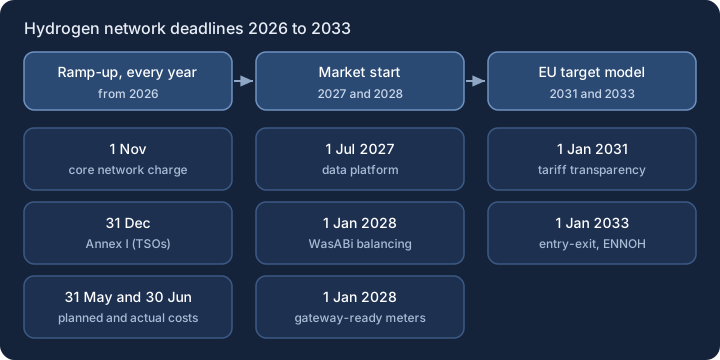
All eight deadlines are adopted or written into law; none comes from a draft. Two values that those affected need are still missing: we have not found a published ramp-up charge for 2027 as of 27 October 2026, and the market area manager's page does not yet give interface specifications for the data hub.
Publish the 2027 core network charge by 1 November
Hydrogen core network operators publish the charge for 2027 by 1 November 2026 at the latest. That is operative paragraph 2 sentence 3 of the WANDA ruling of 6 June 2024, and paragraph 3 applies the rule expressly to the ramp-up charge, which replaces a cost-based charge while the amortisation phase runs. If the charge changes after 1 November, the publication has to be corrected without delay; once the calendar year it applies to has begun, any change is ruled out (paragraph 2 sentence 5). 1 November 2026 is a Sunday, and the ruling does not move the date to the next working day.
Since 14 July 2025 the level has been fixed: EUR 25.00 per kWh/h per year for a firm annual capacity product (GBK-24-02-2#4). Every year the operators adjust it for inflation. Since KOSMO of 12 December 2025, they multiply the current charge by the consumer price index of the previous year relative to that of the year before (KOSMO, paragraph 3); for 2027 that means the 2025 and 2024 indices. For 2026, Open Grid Europe published EUR 25.55 and gave 2.2 percent inflation for 2024.
Since KOSMO, the surcharges and discounts belong in the same publication (paragraph 2(e)): monthly products cost one twelfth of the annual charge times 1.33, daily products one 365th (366th in a leap year) times 3.38, interruptible capacity gets a 10 percent discount, and at exit points to storage a discount cancels the monthly and daily surcharges. WaKandA introduced these products for network access from 2028; where a core network operator offers them earlier, the KOSMO prices already apply (KOSMO, paragraph 8).
For suppliers, 1 November is the day from which they can price hydrogen offers for the next year with fixed transport costs. That is why we see the correction clause as the sensitive part: until 31 December the charge may still change, and every correction hits network customers who have already priced with the 1 November figure. A core network operator should settle before publishing who approves a correction and how network customers are told about it. The Federal Network Agency's first scheduled review of the ramp-up charge is due on 1 January 2028, then every three years (WANDA, paragraph 3).
Planned costs by 31 May, actual costs by 30 June
Core network operators send the Federal Network Agency their planned costs for the following year with the calculation basis by 31 May each year, and the costs actually incurred in the previous year by 30 June. For both, the WasserstoffNEV sets 30 September; KOSMO replaces these dates for the core network (paragraph 5) and extends the agency's decision period on planned costs from three to four months. If the documents are complete, the decision on planned costs is therefore due by the end of September at the latest, a good month before the charge is published on 1 November.
The calculation basis has to let an expert third party follow the costs without further information (Section 14(2) sentence 2 WasserstoffNEV). If it is incomplete, the review period only starts once everything has arrived (sentence 4). If the period ends without a decision, the costs as submitted count as approved (sentence 5). For actual costs the agency has 15 months (subsection 3 sentence 3); the difference between revenues and approved costs flows into a later calculation period as a surcharge or deduction (WANDA, paragraph 7(g)).
Only the core network gets the early dates. A municipal utility building a regulated hydrogen distribution network outside the core network keeps 30 September for both submissions, so an operator with both kinds of network runs two calendars. In its 2024 version, WANDA had set 30 June for both core network submissions. KOSMO applies with effect from 1 November 2025, and internal schedules still built on the old date have been out of date since.
WasABi: data platform in 2027, balancing from 2028
By 1 July 2027 the data exchange platform for hydrogen, also called the data hub in the ruling, has to be in place; it is tested with market participants until 1 January 2028, and from then on balancing follows WasABi. Ruling Chamber 7's decision of 27 October 2025 (BK7-24-01-014) puts the platform in the hands of the hydrogen market area manager. On 8 December 2025 the hydrogen transport network operators named Trading Hub Europe, and THE accepted on 12 December. THE launched the tender for the data hub on 15 April 2026; its own page now reports the procurement as completed.

All data exchange for hydrogen balancing runs through the platform. It brings together registration for network access contracts under WaKandA, the balancing group contract and access to the virtual trading point in one place (paragraph 7(a)), takes nominations and publishes the overall network balancing status. Connection is through a standardised application programming interface whose standard the market area manager sets; existing API standards of German market communication have to be taken into account (7(c)(ii)). The specifications have to reach market participants "at a reasonable time" before 1 July 2027 (7(d), our translation). No date for that is given.
For hydrogen network operators, the main change is the metering data chain. At final customers' exit points and at entry points from domestic production plants, measured values count; they have to be recorded every quarter hour and sent to the market area manager without delay (paragraph 2(b)(bb)). Obviously faulty values have to be detected automatically by the network operator, who supplies substitute values (2(e)) and delivers the final, calorific-value-corrected volumes at the latest after ten working days of the following month (2(g)). There are no tolerances, and balancing is continuous.
Balancing responsible parties receive their balance without delay, at least every 15 minutes. The market area manager continuously classifies them as helpers when their balance runs against the overall network status, or as causers when it points the same way; in hours in which the overall status crosses the edge of the green zone, helpers receive a bonus and causers pay a penalty (paragraph 5). Where no balancing energy is used, the penalty is based on the EEX HYDRIX index. We see balancing as the larger of the two WasABi deadlines: THE builds the platform, but every network operator has to deliver the quarter-hour values from its own network. The market area manager submits its first report on the balancing system by 1 April 2029 (paragraph 9). How WasABi works together with capacity booking is covered in our article on WaKandA and the booking platform.
Hydrogen meters only with a gateway connection
From 1 January 2028, new hydrogen meters may only be installed if they can be connected securely to a smart meter gateway. Section 20(3) MsbG extends to hydrogen what subsection 1 already requires for gas meters; the connection has to meet the state of the art set in the protection profiles and technical guidelines. It applies at installation. It does not cover meters already in place, and it does not require every hydrogen meter to be connected to a gateway straight away.

The rule applies to default and competitive metering point operators that run or want to take on hydrogen metering points. For them the deadline is a procurement question: framework contracts, stock and type approvals still running in early 2028 have to cover gateway-capable devices. Metering operators know reading via the gateway from multi-utility metering through the smart meter gateway. WasABi fits in: from the same day, balancing requires measured quarter-hour values at final customers' exit points.
Gas TSOs: revenue information before 1 January
Gas transmission system operators publish by 31 December 2026, and then every year before 1 January, the information under Annex I point 1 of the Gas Regulation on the methods, parameters and values used to set their regulated revenues. Ruling Chamber 9 decided this on 9 December 2025; the ruling bears the reference BK9-25/617. The duty concerns the natural gas network, not the hydrogen network: Article 7(8) of Regulation (EU) 2024/1789 expressly excludes Article 19 for hydrogen networks. It appears in this article because the core network goes back to a proposal by the gas transmission operators, and many of them keep both dates in the same annual plan.
Six data points from Annex I stay out because the ruling chamber classes them as commercially sensitive (paragraph 2): details of depreciation and data from which the regulated asset base could be derived. Everything else goes on the operators' websites in a freely accessible, downloadable, read-only and barrier-free document in German and English (paragraph 3). Gas distribution system operators are not covered; the ruling is addressed only to transmission system operators within the meaning of Section 3 no. 5 EnWG.
EU Gas and Hydrogen Regulation: 2031 and 2033
The two EU dates are a little over four and six years away, yet they already shape where the German rules are heading. From 1 January 2031, hydrogen network operators or the competent regulators publish complete information on tariff derivation, methodology and tariff structure (Article 66(2) Regulation (EU) 2024/1789). The regulation leaves open which of the two; Germany has not yet settled it.
From 1 January 2033, hydrogen networks are organised as entry-exit systems (Article 7(6)). Isolated networks covered by a derogation under Article 52 of Directive (EU) 2024/1788 can be exempted (Article 7(7)). From the same day, hydrogen transmission network operators meet the requirements that Articles 5 (separate regulated asset base), 10 (capacity allocation and congestion management) and 13 (balancing rules) set for transmission system operators, and publish tariffs for every network point on a platform run by the European Network of Network Operators for Hydrogen, ENNOH (Article 7(9)). Until a network code on capacity allocation applies, links to the tariffs on the operator's own website are enough.
Germany is ahead with WaKandA and WasABi: capacity booking through a joint platform, balancing groups and a market area manager arrive in 2028. Whether the German rules need another adjustment by 2033 depends on the EU network codes for hydrogen, none of which is in force yet. How the EnWG implements the package is set out in our article on the EnWG amendment for the gas and hydrogen package.
What applies if a deadline is missed
None of the eight deadlines carries its own fine. The WANDA, KOSMO, WasABi and BK9-25/617 rulings set no specific consequence; the regulator can order compliance under Section 65 EnWG and enforce it with coercive fines under Section 94 EnWG. For duties under Regulation (EU) 2024/1789, the Federal Network Agency performs the regulator's tasks and applies the procedural rules of the EnWG (Section 56(1) sentence 1 no. 2 EnWG). For hydrogen meters, the MsbG sets no administrative offence; the agency can order measures under Section 76 MsbG and enforce them with coercive fines (Section 76(4) MsbG).
More tangible are the effects built into the rules themselves. An incomplete calculation basis delays the start of the review period for planned costs, and without approved costs the basis for the charge on 1 November is weak. A core network charge cannot be changed after 1 January. This is a general classification by role, not an assessment of your individual case.
Criticism of the ramp-up charge and of balancing
The ramp-up charge has been disputed since it was set, because it has to recover costs until 2055 without putting off the first customers. On the day of the decision, the German Hydrogen Association (DWV) saw a "potentially deterrent effect" (ZfK, 14 July 2025, our translation). In the consultation, the German Steel Federation (Wirtschaftsvereinigung Stahl) had worked out that the charge is due at both entry and exit points:
"This means not just a double burden; with injection into and withdrawal from storage, an average of four times the ramp-up charge per kilowatt hour used has to be expected."
The Federal Network Agency kept EUR 25. In December 2025 KOSMO added a storage discount that cancels the monthly and daily surcharges at exit points to storage; charging at both entry and exit points remains. On balancing, the criticism came from traders. EFET Deutschland wrote in the first WasABi consultation on 30 August 2024: "We are, however, concerned that cluster formation, indirectly through capacity restrictions, will lead to several market areas each with its own VHP" (our translation). VHP is the virtual trading point at which hydrogen is transferred between balancing groups. The ruling expressly allows clusters at the start of the ramp-up (paragraph 1). Whether that ends in one market area with one trading point or several depends on how the network is built out, not on the balancing rule.
What to do by mid-2027
Core network operators have two fixed dates in the next eight months, 1 November and 31 May. Balancing responsible parties and suppliers are preparing for an interface whose specifications are still pending, and metering point operators for a procurement rule from 2028. All deadlines with roles and systems are also in the energy transition deadline calendar.
Next steps by role
-
Publish the 2027 charge
Core network operators: by Sunday, 1 November 2026, put the ramp-up charge, multipliers and discounts online and decide who approves a correction until 31 December.
-
Finish the Annex I document
Gas TSOs: publish the document on regulated revenues, without the six excluded data points, by 31 December in German and English, accessible and read-only.
-
Move the calculation basis to May
Core network operators: schedule annual planning, investment planning and cost forecasts so that the 2028 planned costs are complete and traceable for third parties on 31 May 2027, and the 2026 actual costs on 30 June. If you also run a distribution network outside the core network, keep 30 September for that one.
-
Prepare for the data hub
Hydrogen network operators, balancing responsible parties and suppliers: clean up master data for entry and exit points, settle quarter-hour metering and automated plausibility checks at exit points, book test capacity for the second half of 2027, and wait for THE's API specifications before fixing your own formats.
-
Change procurement
Metering point operators: require a secure gateway connection under Section 20 MsbG in tenders for hydrogen meters delivered from 2028.
Deadline, market roles, systems
1 November 2026Hydrogen core network: publish the network charge for the following yearRegulatory ruling · adopted
Applicability: Only operators of the hydrogen core network.
If the deadline is missed: Regulator can enforce The ruling sets no specific consequence. The regulator can order compliance under Section 65 EnWG and enforce it with coercive fines under Section 94 EnWG. Legal basis ↗
- Gas grid operatorrole obligationAs a core network operator, publishes the charge for 2027 by 1 November 2026, then yearly.Typically affected: Regulatory management, controlling, Customer and grid connection portal
- SupplieraffectedPrices hydrogen supply with the published core network charge.Typically affected: Trading and procurement system (ETRM)
31 December 2026Gas TSOs: publish revenue information under Annex I of the Gas RegulationRegulatory ruling · adopted
Applicability: Only gas transmission system operators, not gas distribution system operators.
If the deadline is missed: Regulator can enforce The ruling sets no specific consequence. The regulator can order compliance under Section 65 EnWG and enforce it with coercive fines under Section 94 EnWG. Legal basis ↗
- Gas grid operatorrole obligationAs a gas TSO, publishes the Annex I revenue information by 31 December for the following year, in German and English.Typically affected: Regulatory management, controlling, Customer and grid connection portal
31 May 2027Hydrogen core network: submit planned costs by 31 May, actual costs by 30 JuneRegulatory ruling · adopted
Applicability: Operators of the hydrogen core network. For other regulated hydrogen networks, Section 14(2) and (3) WasserstoffNEV sets 30 September for both submissions.
If the deadline is missed: Regulator can enforce The ruling sets no specific consequence. The regulator can order compliance under Section 65 EnWG and enforce it with coercive fines under Section 94 EnWG. Legal basis ↗
- Gas grid operatorrole obligationAs a core network operator, submits planned costs by 31 May and actual costs by 30 June.Typically affected: Regulatory management, controlling
1 July 2027WasABi: set up the hydrogen data exchange platformRegulatory ruling · adopted
If the deadline is missed: Regulator can enforce The ruling sets no specific consequence. The regulator can order compliance under Section 65 EnWG and enforce it with coercive fines under Section 94 EnWG. Legal basis ↗
- Gas grid operatorrole obligationAs a hydrogen transport network operator, equips the market area manager for the platform and connects its own data by 1 July 2027.Typically affected: EDM / MDM, Market communication gateway (EDIFACT, AS4, API)
- SupplieraffectedConnects hydrogen supply to the platform and takes part in testing.Typically affected: Trading and procurement system (ETRM)
- Balance responsible partyaffectedRegisters on the platform and tests the interfaces until 1 January 2028.Typically affected: Trading and procurement system (ETRM)
1 January 2028Hydrogen meters: only devices that connect to the smart meter gatewayLaw · adopted
If the deadline is missed: Regulator can enforce The MsbG sets no administrative offence. The Federal Network Agency can order measures under Section 76 MsbG and enforce them with coercive fines under Section 94 EnWG (Section 76(4) MsbG). Legal basis ↗
- Default metering point operatorrole obligationProcures only gateway-capable meters for hydrogen metering points from 2028.Typically affected: Gateway administration and CLS management, Field service and work orders
- Competitive metering point operatorrole obligationProcures only gateway-capable meters for hydrogen metering points from 2028.Typically affected: Gateway administration and CLS management, Field service and work orders
1 January 2028WasABi: balancing rules for hydrogen apply, data platform from July 2027Regulatory ruling · adopted
If the deadline is missed: Regulator can enforce The ruling sets no specific consequence. The regulator can order compliance under Section 65 EnWG and enforce it with coercive fines under Section 94 EnWG. Legal basis ↗
- Gas grid operatorrole obligationAs a hydrogen network operator, sets up data delivery and interfaces to the data exchange platform by 1 July 2027 and balances under WasABi from 1 January 2028.Typically affected: EDM / MDM, Market communication gateway (EDIFACT, AS4, API)
- SupplieraffectedAligns hydrogen supply with the balancing rules from 2028.Typically affected: Trading and procurement system (ETRM)
- Balance responsible partyaffectedRuns hydrogen balancing groups under the WasABi rules from 1 January 2028 and joins platform testing beforehand.Typically affected: Trading and procurement system (ETRM)
1 January 2031Hydrogen networks: publish network charge setting and methodsLaw · adopted
Applicability: Operators of hydrogen networks; in Germany mainly the operators of the hydrogen core network.
If the deadline is missed: Regulator can enforce The Federal Network Agency performs the regulator's tasks under Regulation (EU) 2024/1789 and applies the procedural rules of the EnWG (Section 56(1) sentence 1 no. 2 EnWG); it can order compliance under Section 65 EnWG. Legal basis ↗
- Gas grid operatoraffectedAs a hydrogen network operator, prepares publication of charge setting from 2031.Typically affected: Regulatory management, controlling, Customer and grid connection portal
1 January 2033Hydrogen transmission: entry-exit rules and charges on the ENNOH platformLaw · adopted
If the deadline is missed: Regulator can enforce The Federal Network Agency performs the regulator's tasks under Regulation (EU) 2024/1789 and applies the procedural rules of the EnWG (Section 56(1) sentence 1 no. 2 EnWG); it can order compliance under Section 65 EnWG. Legal basis ↗
- Gas grid operatorrole obligationAs a hydrogen transmission operator, moves capacity services and charge publication to the EU rules by 2033.Typically affected: Regulatory management, controlling, Customer and grid connection portal
A classification for typical market roles, not a review of your individual case and not legal advice. Whether an obligation applies to your company (thresholds, exemptions) is for your legal department or counsel to confirm. The calendar doesn't replace your own deadline review. Information as of: 27 October 2026.
Further reading
Frequently asked questions
The ramp-up charge is the uniform charge that hydrogen core network operators levy at all entry and exit points during the amortisation phase. The Federal Network Agency set it on 14 July 2025 at EUR 25.00 per kWh/h per year for firm annual capacity (GBK-24-02-2#4); the operators index it to consumer prices every year. For 2026, OGE published EUR 25.55.
By 1 November 2026 at the latest, which is a Sunday (WANDA, operative paragraph 2 sentence 3 and paragraph 3). If the charge changes after that, the publication has to be corrected without delay; once calendar year 2027 has begun, no change is allowed. Since KOSMO, operators also publish the multipliers and discounts together with the charge.
Planned costs for the following year, with the calculation basis, by 31 May each year, and actual costs for the previous year by 30 June (Section 14(2) and (3) WasserstoffNEV as amended by KOSMO, operative paragraph 5). Hydrogen networks outside the core network keep 30 September. If the calculation basis is missing or incomplete, the Federal Network Agency's review period only starts once the complete documents arrive.
The data exchange platform is the central data hub of the hydrogen market area manager under the WasABi ruling (BK7-24-01-014). Registration, balancing group, volume and network information and nominations run through it. It has to be set up by 1 July 2027 and is tested with market participants until 1 January 2028. Trading Hub Europe has been the market area manager since December 2025.
From 1 January 2028, only new hydrogen meters that can be connected securely to a smart meter gateway (Section 20(3) with (1) MsbG). The connection has to meet the state of the art set out in the protection profiles and technical guidelines. The rule covers new installations, not meters already in place.
None of the eight deadlines carries its own fine. The Federal Network Agency can order compliance under Section 65 EnWG and enforce it with coercive fines under Section 94 EnWG, for the MsbG via Section 76 MsbG. The rules also have built-in effects: an incomplete calculation basis delays the start of the review period, and a core network charge cannot be changed once the year has begun.
Let's collaborate
One contact, a team behind it
Thirty minutes on what you're working on, whether grid, metering, market processes, IT architecture or AI. Afterwards you'll know how we'd approach it and who would sit at the table.
Energy and measurement technology since 2010 · innobu GmbH since 2014 · Based in Schleswig-Holstein, Germany
Whoever pitches also delivers: whoever leads the first call stays your contact right through to the steering committee, with established partners in the project. Direct: info@innobu.com