Meter-to-cash at German utilities: what quarter-hour data, the rollout quota and the 2027 MaKo release change in billing
Meter-to-cash is the chain from the meter to money in the bank. Three dates are pulling at it right now: the rollout quota at year end, the market communication release on 1 April 2027, and the dynamic tariff duty every German electricity supplier has carried since 2025. We show where the chain breaks and which figures management needs to see it.
Meter-to-cash is a utility's process chain from meter installation through readings, validation and billing to payment; it involves metering operators and suppliers, and the first period quota of Germany's smart meter rollout ends on 31 December 2026. By 30 June 2026, 3.17 million of 54.1 million metering points had a smart metering system, 5.9 percent; among mandatory installations the rate was 26.1 percent. Each of these devices delivers 35,040 quarter-hour values a year, customers with remote reading are entitled to monthly billing information, and since 2025 every electricity supplier has had to offer a dynamic tariff. The next market communication format release follows on 1 April 2027.
What meter-to-cash is and why the chain is tipping now
Meter-to-cash, M2C for short, is everything between the meter in the basement and the money in the account: installation, reading, validation, billing, invoice, payment, dunning. Three roles share it in Germany. The metering operator supplies the value, the grid operator bills grid use, and the supplier writes the bill and collects.
The chain was built for the old electromechanical meter. One reading a year, an estimate, one bill, eleven instalments. That worked for thirty years.
A smart metering system brings a different scale: 96 values a day, 35,040 a year, per metering point. Each of them travels as a market communication message from the metering operator to the supplier, who has to validate it, substitute it if necessary, and bill it.
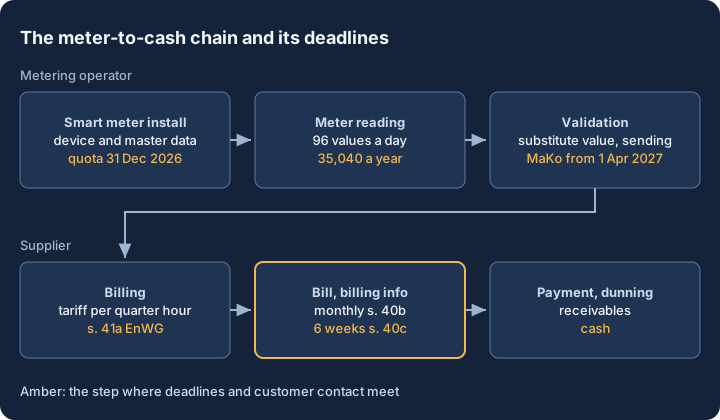
On its own that's a volume problem. It turns critical because the tariff now hangs on the quarter hour. Billing a dynamic tariff needs every value with its own quarter-hour price. An estimate won't do.
Where the numbers stand in 2026
By 30 June 2026, 3,172,579 metering points had a smart metering system, 5.9 percent of 54,135,202. Sounds small, and for the total it is.
5.9%
of metering points had a smart meter in mid-2026
26.1%
of mandatory installations were done by the same date
434
supervisory proceedings opened by the regulator since March 2026
Mandatory installations look different. These are customers using 6,000 to 100,000 kWh a year and controllable devices under Section 14a EnWG, which is exactly where dynamic tariffs make economic sense. There, coverage stood at 26.1 percent, 1,259,270 of 4,831,178. Around 765,000 devices were added in the first half of the year.
Since March 2026 the Bundesnetzagentur has opened proceedings against 434 companies, 77 of them at zero percent. From the end of 2026 the period quotas of Section 45 of the Metering Point Operation Act apply, as our piece on the 2026 rollout quota explains. For suppliers, that means the number of customers billed on quarter-hour data grows by hundreds of thousands every six months, ready or not.
The deadlines along the chain
Every step has its own deadline, and most of them sit with the supplier. Org charts tend to miss that.
| Step | Duty | Basis |
|---|---|---|
| Installation | period quota by 31 Dec 2026, 90 percent of mandatory cases by 2032 | Section 45 MsbG |
| Data exchange | new format versions and transmission rules from 1 April 2027 | Communication No. 58 |
| Tariff | dynamic tariff for smart meter customers, all suppliers since 1 Jan 2025 | Section 41a(2) EnWG |
| Information | free monthly billing information with remote reading | Section 40b(3) EnWG |
| Bill | periodic and final bills no later than six weeks after the period ends | Section 40c(2) EnWG |
Monthly billing information is easy to underestimate. It isn't a bill, but it has to be based on measured consumption, and it's free. Send it twelve times a year plus one bill, and you have twelve chances to show the customer a number that won't match the bill later.
On 1 April 2027, Communication No. 58 makes the next market communication release binding, with new rules for certificates and transmission paths. A release is no event for billing. A release after which no readings arrive for three days is.
Where the chain breaks
Rarely at the meter. Mostly in between, at the handovers between two roles or two systems.
The most common break is the missing value. If no true reading arrives in time, German law requires the metering operator to form a substitute value. For a fixed-price customer that's annoying. For a dynamic tariff customer it's a problem, because a substitute value in an expensive evening quarter hour costs something different from the same value at midday with negative prices.

Master data is the second break. A device is installed, but the supplier's record for the metering point still shows the old meter type, so its system expects an annual reading and discards the quarter hours. Such cases end up in clearing, and at many utilities clearing is still manual work.
The third is the deadline itself. Six weeks for a periodic bill is tight when the last weeks of the period only arrive after substitution and correction. Every bill sent late is a potential complaint. Every bill redone on corrected values costs twice.
The chain breaks at the handovers, not in the systems. Modernise the billing software without measuring the handover from the metering operator, and you just move the problem into clearing.
Who is liable for a wrong value?
Regulator and industry part ways on this question, and for the chain it decides a lot.
Klaus Müller, President of the Bundesnetzagentur, said when presenting the rollout figures on 21 September 2026: "Entscheidend ist, dass die intelligenten Messsysteme ihre Funktion erfüllen." What matters is that smart metering systems do their job. Installation alone isn't enough, he added; the devices have to record and transmit quarter-hour values reliably. That points at the metering operator.
The municipal utilities association VKU saw it differently during the legislative process. When the 2025 ministry draft provided for sanctions on faulty readings, the association warned, according to ZfK on 21 July 2025, of a "one-sided liability risk without corresponding means of control" (our translation). Many errors, it argued, arise in end devices or data communication, outside the metering operator's reach.
BDEW demanded in the same proceedings that liability should apply only where the metering operator clearly caused the error.
For the supplier this isn't academic. It faces the customer with the bill, whoever lost the value.
What happens if the rollout quota is missed
If a default metering operator misses the quota, the Bundesnetzagentur can order measures under Section 45(2) and Section 76 of the Metering Point Operation Act and enforce them with penalty payments of €1,000 to €10 million (Section 76(4) MsbG, Section 94 EnWG). If the rollout of control devices lags by at least 25 percent and this contributes significantly to a possible threat to system security, it can withdraw the default responsibility under Section 12(2g) EnWG. That describes what the law provides, not what any individual company faces. Our piece on smart meter rollout sanctions has more.
What utilities should do now
Measure first, rebuild second. Most meter-to-cash programmes don't fail on technology. They fail because nobody knows at which step the chain breaks today.
Four steps before April 2027
-
Introduce four metrics
Share of bills sent without manual correction. Share of substitute values among billed quarter hours. Number and age of open clearing cases. Share of periodic and final bills sent after the six weeks. Monthly, per role, for management.
-
Measure the metering handover
How many values arrive on time, how many as substitutes, how many not at all? That holds even when metering operator and supplier belong to the same group.
-
Put the release date in the plan
1 April 2027 belongs in billing planning, not just in IT.
-
Use dynamic tariffs as the test case
Even with few dynamic tariff customers today, they're the most sensitive part of the chain, because every missing value there costs money. Bill them cleanly and you have the chain under control for everyone else.
Anyone planning a system migration should measure the chain first. Our piece on SAP S/4HANA Utilities shows why: a migration carries over the handovers as they are. And the next change is already scheduled, when the MaBiS hub centralises balancing settlement from 2028.
Further Reading
Frequently Asked Questions
Meter-to-cash, also M2C or meter2cash, is a utility's process chain from installing the meter through readings, validation, billing and invoicing to payment and receivables management. In Germany it involves the metering operator, the grid operator and the supplier, who exchange data through standardised market communication.
Instead of one reading a year, a smart metering system delivers 96 quarter-hour values a day, 35,040 a year. Under Section 40b(3) of the German Energy Industry Act, customers with remote reading are entitled to free monthly billing information, and dynamic tariffs have to price every quarter hour separately.
Under Section 40c(2) EnWG, periodic and final bills are due no later than six weeks after the end of the billing period or the supply relationship. For agreed monthly billing, the Bundesnetzagentur names three weeks.
Yes. Since 1 January 2025, Section 41a(2) EnWG requires every electricity supplier to offer customers with a smart metering system a contract with a dynamic tariff. Before that, the duty applied only to suppliers with more than 100,000 final customers.
The Bundesnetzagentur can order measures under Section 45(2) and Section 76 of the Metering Point Operation Act and enforce them with penalty payments of €1,000 to €10 million. It says it has opened 434 supervisory proceedings since March 2026.
Let's collaborate
One contact, a team behind it
Thirty minutes on what you're working on, whether grid, metering, market processes, IT architecture or AI. Afterwards you'll know how we'd approach it and who would sit at the table.
Energy and measurement technology since 2010 · innobu GmbH since 2014 · Based in Schleswig-Holstein, Germany
Whoever pitches also delivers: whoever leads the first call stays your contact right through to the steering committee, with established partners in the project. Direct: info@innobu.com