SAP S/4HANA Utilities: How the ECC End Sets the IS-U Clock
That platform is reaching the end of its life, and the move to SAP S/4HANA Utilities is now a fixed deadline rather than an option.
SAP S/4HANA Utilities is the industry solution with which SAP succeeds the older Industry Solution Utilities (IS-U). The reason for the urgency is a maintenance date. Mainstream maintenance for SAP Business Suite 7, and with it ECC, ends on 31 December 2027, while optional extended maintenance runs to the end of 2030. Any utility running IS-U on ECC therefore has a fixed outer deadline for a programme that usually takes several years.
The end of SAP ECC maintenance puts a fixed clock on every utility that runs SAP IS-U. Mainstream maintenance for SAP Business Suite 7, and with it ECC, ends on 31 December 2027, optional extended maintenance runs from 2028 to the end of 2030 at a surcharge of two percentage points, and for S/4HANA SAP has stated an innovation commitment until 2040. IS-U, the utility industry solution, falls under the same dates, so the late 2030 mark is the hard deadline by which the grown billing and device management estate must move to SAP S/4HANA Utilities or an alternative. S/4HANA Utilities is the established meter-to-cash solution and the direct IS-U successor, keeping device management, metering, billing and contract accounts receivable and payable, now on the HANA database and a model that separates a lean digital core from cloud services over the SAP Business Technology Platform (BTP). The hard part is not the technology but the legacy: IS-U systems carry decades of ABAP custom code, and clean core requires that this logic be lifted out of the standard core and run as encapsulated extensions. The choice of migration path, greenfield, brownfield or selective data transition, depends on the depth of customisation and the master data quality. The pressure is real, with around half of German municipal utilities yet to start their SAP transformation in mid 2024 while consultant capacity tightens, so the sensible answer is an early migration programme with clear enterprise architecture control rather than a last-minute big bang.
What S/4HANA Utilities is and why the clock is ticking now
SAP S/4HANA Utilities is the industry solution with which SAP succeeds the older Industry Solution Utilities (IS-U), and the reason for the urgency is a maintenance date. Mainstream maintenance for SAP Business Suite 7, and with it ECC, ends on 31 December 2027, while optional extended maintenance runs to the end of 2030. Any utility running IS-U on ECC has a fixed outer deadline for a programme that usually takes several years.
A short clarification matters here. S/4HANA Utilities is the established meter-to-cash solution for regulated and deregulated utility markets and the direct IS-U successor, not a simple version bump. For IS-U customers the end of 2030 is the hard deadline, the point after which neither security updates nor interface adjustments are guaranteed, while for S/4HANA itself SAP has stated an innovation commitment until 2040. This is the same architectural rotation that innobu set out for the SAP estate as a whole in its guide to RISE, BTP and clean core.
IS-U versus S/4HANA Utilities: what really changes
S/4HANA Utilities keeps the familiar utility functions of IS-U, such as device management, billing and contract accounts receivable and payable, but sets them on the HANA database and a new architecture model. A monolithic core becomes a lean digital core that connects over the SAP Business Technology Platform (BTP) to cloud services such as SAP Cloud for Energy and the SAP Market Communication Cloud. Functionally much is preserved, while architecturally the rule changes.

The familiar building blocks stay in place. Device management, meter data, billing and contract accounts receivable and payable remain the functional core, and the meter-to-cash or bill-to-cash process, from meter read through validation to the invoice, is mapped end to end in S/4HANA Utilities. What changes is the surrounding architecture: customer service and interaction move to Customer Management, formerly S4CM, or to SAP C4U, while the cloud services dock onto the digital core rather than being baked into it.
Clean core with decades-old IS-U logic
The hardest part of the migration is not the technology but the legacy. IS-U systems are known for being heavily customised, with ABAP custom code for tariffs, renewable energy settlement and special processes that has grown over years. Clean core requires that exactly this logic be lifted out of the standard core and run cleanly encapsulated as an extension on BTP. Only a clean core makes later updates and AI-supported processes maintainable at all.
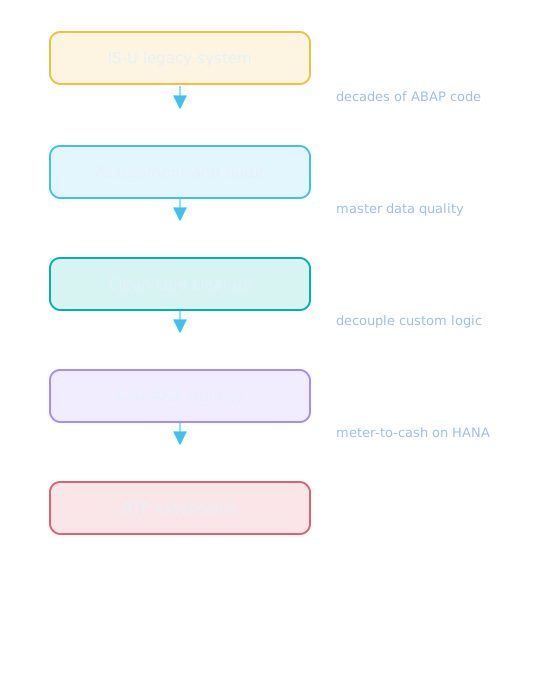
Clean core means leaving the standard core unchanged and building extensions as decoupled add-ons on BTP rather than as modifications inside the core. In practice that turns decades of Z-transactions and custom code into a body of work that has to be assessed, cleaned up, replaced or rebuilt as an extension. The largest single risk sits one level down, in the data: poor master data quality, with outdated, incomplete or duplicate records, has to be addressed before the migration rather than carried into the new system. The wider clean-core picture, including SAP's AI services, is set out in innobu's guide to SAP Joule and agentic enterprise AI.
The migration paths: greenfield, brownfield, selective
There is no single road to S/4HANA Utilities but three basic patterns with different risk and reward profiles. Greenfield builds anew and deliberately leaves legacy behind, brownfield converts the existing system with as little disruption as possible, and selective data transition, also called bluefield, combines the two by carrying over critical data and processes selectively. The choice depends on the depth of customisation, the master data quality and the desired degree of transformation.

Each pattern trades effort against a clean result. Greenfield gives the highest clean-core gain because legacy is left behind, but it carries the most effort and organisational change. Brownfield keeps the initial cost lower and the disruption smaller, yet the custom developments travel with the system and have to be dealt with later. Selective data transition sits in the middle, moving critical data and processes through a shell conversion or a mix-and-match approach, which is why it appeals to utilities that need to keep some history without carrying everything forward.
The municipal utility reality: cost, skills, vendor alternatives
In practice the migration is a race against scarce resources. Around half of German municipal utilities had not yet started their SAP transformation in mid 2024, while consultant capacity is tightening and a skills shortage is set to slow the transformation through to 2030. In parallel, some utilities are leaving the SAP world altogether and switching to industry vendors, which adds further movement to the market.
Whoever waits until 2028 competes for the last consultant capacity against a fixed regulatory deadline. In the German mid-market, industry vendors such as Schleupen with BS.energy, SIV with kVASy, Wilken and Powercloud are established alternatives to SAP IS-U. Real moves confirm the trend: Zwickauer Energieversorgung and Stadtwerke Aue-Bad Schlema migrated around 44 million records from IS-U to Wilken, a reminder that the SAP successor is not the only destination on the table.
This is where the platform question becomes a board question rather than an IT detail. A utility that keeps IS-U until the last moment narrows its own options, because both the SAP path to S/4HANA Utilities and the alternative path to an industry vendor depend on the same scarce data-migration and integration skills. The earlier the decision is framed, the more freely it can be made. Market communication runs alongside this on its own release cycle, as innobu set out in MaKo 2026: EDIFACT, AS4 and API web services.
What utilities should do now: the roadmap
The economically sensible answer is a migration programme with clear enterprise architecture control rather than a last-minute big bang shortly before 2030. Whoever defines a target architecture of a lean digital core and BTP extensions early, cleans up the master data and couples the migration to the parallel MaKo 2026 reform spreads the risk and the load. A maintenance deadline then becomes a stable foundation for further digital work.
-
Start an assessment phase now
Begin with a custom-code analysis and a master data audit, then decide between greenfield, brownfield and selective data transition based on the depth of customisation and the data quality.
-
Define the target architecture
Set the target as a clean core plus BTP extensions, and encapsulate the IS-U custom logic there only where it is genuinely needed, rather than carrying every Z-transaction forward.
-
Clean up master data before the move
Address outdated, incomplete and duplicate records ahead of the migration, since poor master data quality is the largest single risk to a clean cutover.
-
Couple the programme to fixed deadlines
Tie the programme to the external dates, the end of ECC in 2027 and 2030, the MaKo 2026 releases and Section 14a EnWG, so each obligation lands as a planned release.
The deadline is fixed and a multi-year programme is the norm, so the time to frame the decision is now. Whoever runs an early assessment, defines a clean-core target architecture and couples the programme to the external dates turns a maintenance obligation into a stable foundation. The general migration pitfalls that apply across any S/4HANA move are set out in innobu's five surprising truths about S/4HANA migration.
Deadline, market roles, systems
31 December 2027SAP ECC and IS-U: end of mainstream maintenanceVendor notice · not binding
Applicability: Affects companies running SAP ERP 6.0 (ECC, IS-U) on one of the three latest enhancement packages. The date follows from SAP's maintenance strategy, not from law.
If the deadline is missed: No direct legal consequence The date is set by SAP, not by law. From 2028 extended maintenance runs at a premium until the end of 2030; under the customer-specific maintenance that follows, or applies without it, SAP delivers no legal changes. For its largest customers SAP offers the Transition Option for SAP ERP from 2031 to 2033 if the system has moved to SAP ERP, private edition, on SAP HANA by the end of 2030. Legal basis ↗
- Company-wide, several rolesaffectedPlans the move from SAP IS-U to S/4HANA Utilities or contracts extended maintenance until 2030.Typically affected: SAP IS-U / S/4HANA Utilities
A classification for typical market roles, not a review of your individual case and not legal advice. Whether an obligation applies to your company (thresholds, exemptions) is for your legal department or counsel to confirm. The calendar doesn't replace your own deadline review. Information as of: 23 October 2026.
Further reading
Frequently asked questions
SAP S/4HANA Utilities is the industry solution with which SAP succeeds the older Industry Solution Utilities (IS-U). It is the established meter-to-cash solution for regulated and deregulated utility markets and keeps the familiar utility functions such as device management, billing and contract accounts receivable and payable, now running on the HANA database. A lean digital core is connected over the SAP Business Technology Platform (BTP) to cloud services such as SAP Cloud for Energy and the SAP Market Communication Cloud. It is the direct successor a utility moves to as the underlying ECC platform reaches the end of maintenance.
Mainstream maintenance for SAP Business Suite 7, and with it ECC, ends on 31 December 2027. Optional extended maintenance runs from 2028 to the end of 2030 at a surcharge of two percentage points. SAP IS-U, the utility industry solution, falls under the same dates. For utilities the end of 2030 is the hard deadline, after which neither security updates nor interface adjustments are guaranteed. For S/4HANA, SAP has stated an innovation commitment until 2040.
Clean core means keeping the SAP standard core unchanged and running extensions as decoupled add-ons on the SAP Business Technology Platform (BTP) rather than as modifications inside the core. For utilities this is hard because IS-U systems are heavily customised, with decades of ABAP custom code for tariffs, renewable energy settlement and special billing processes. Clean core requires that exactly this logic be assessed, cleaned up, replaced or rebuilt as an extension, so that later updates and AI-supported processes stay maintainable.
There are three patterns. Greenfield is a new implementation that deliberately leaves legacy behind and offers the highest clean core gain but the most effort and change. Brownfield is a conversion of the existing system with lower initial cost and less disruption, but the custom developments move along with it. Selective data transition, also called bluefield, is the middle path: it selectively carries over critical data and processes through a shell conversion or a mix-and-match approach. The choice depends on the depth of customisation, the master data quality and the desired degree of transformation.
SAP S/4HANA Utilities keeps the familiar utility functions of IS-U, such as device management, meter data, billing and contract accounts receivable and payable, but sets them on the HANA database and a new architecture model. The monolithic IS-U core becomes a lean digital core that is connected over the SAP Business Technology Platform (BTP) to cloud services such as SAP Cloud for Energy and the SAP Market Communication Cloud. Functionally much is preserved, while architecturally the rule changes, with customer service handled by Customer Management or SAP C4U.
Let's collaborate
One contact, a team behind it
Thirty minutes on what you're working on, whether grid, metering, market processes, IT architecture or AI. Afterwards you'll know how we'd approach it and who would sit at the table.
Energy and measurement technology since 2010 · innobu GmbH since 2014 · Based in Schleswig-Holstein, Germany
Whoever pitches also delivers: whoever leads the first call stays your contact right through to the steering committee, with established partners in the project. Direct: info@innobu.com