The EnWG Amendment 2026: Transposing the EU Gas and Hydrogen Package
The EnWG amendment transposes the EU gas and hydrogen package into German law. It regulates hydrogen networks like gas networks for the first time, with access, connection, certification and tariffs, orders the unbundling of hydrogen network operators with the ITO model expiring on 31 December 2030 and introduces an integrated network development plan for gas and hydrogen at federal level. The legal driver is the transposition deadline of Directive 2024/1788 on 5 August 2026. This is the gas and hydrogen amendment, not the separate electricity EnWG amendment on energy sharing and fixed-price tariffs. This article explains what the amendment transposes, which four building blocks it brings into law, how hydrogen and unbundling are regulated, where the procedure and the deadline stand, what risks exist and what companies should do now.
With the EnWG amendment 2026, Germany transposes the EU gas and hydrogen package, namely Directive (EU) 2024/1788 and Regulation (EU) 2024/1789, both in force since 4 August 2024. The regulation applies directly and has been applicable since 5 February 2025, the directive must be transposed nationally by 5 August 2026 at the latest. The law is still in the legislative procedure, draft stage: hearing from 4 November 2025, cabinet decision on 25 March 2026, first reading in the Bundestag on 23 April 2026, expert hearing on 20 May 2026, adoption targeted for the summer of 2026. Sections and details can still change until then. In substance, the amendment brings four building blocks into law: a regulated network access regime for hydrogen analogous to gas, the unbundling of hydrogen network operators with the ITO model expiring on 31 December 2030, an integrated network development plan for gas and hydrogen at federal level as well as new consumer rights and gas labelling. The biggest substantive leap is that hydrogen is for the first time fully integrated into the EnWG, including hydrogen storage and terminals. The risks are real: time pressure up to the deadline, a financing gap for the conversion of individual distribution grid sections, a dispute over the ITO expiry and stranded-asset risks. Important: this is the gas and hydrogen amendment, not the electricity EnWG amendment on energy sharing. Whoever checks the unbundling path early, prepares for the integrated network development plan and builds the tariff and amortisation mechanics into business cases is prepared when the law takes effect.
What the EnWG amendment 2026 transposes
The EnWG amendment brings European gas and hydrogen law to Germany. It transposes Directive (EU) 2024/1788 and accompanies the directly applicable Regulation (EU) 2024/1789. At its core, it makes hydrogen for the first time a regulated asset class in the EnWG. The law is still in the legislative procedure, draft stage.
At its core, the amendment transposes the EU gas and hydrogen package into German law. This package consists of two acts that have been in force since 4 August 2024: Directive (EU) 2024/1788 and Regulation (EU) 2024/1789. The regulation applies directly and has been applicable since 5 February 2025, so it does not first have to be transposed into national law. The directive, by contrast, sets out objectives that each member state transposes itself, in Germany precisely through this EnWG amendment, with a transposition deadline of 5 August 2026. The focus is on the hydrogen regulation framework, the unbundling of hydrogen networks and an integrated network planning at federal level. Important for context: this amendment is the gas and hydrogen amendment to the EnWG. It is not to be confused with the separate electricity EnWG amendment on energy sharing and fixed-price tariffs, which is a different project with its own procedure. The framework is set by the fact that the hydrogen core network, with 9,040 kilometres and 18.9 billion euro of investment, is already approved and its capacity reservation has been open since 19 March 2026, while the amendment supplies the overarching statutory regulation for it.
The four new building blocks
Beyond the rulings and network plans already underway, the amendment brings four building blocks into law. They order the hydrogen sector and interlock the network planning. Since the law is still in the legislative procedure, the detailed rules on the building blocks are at draft stage.
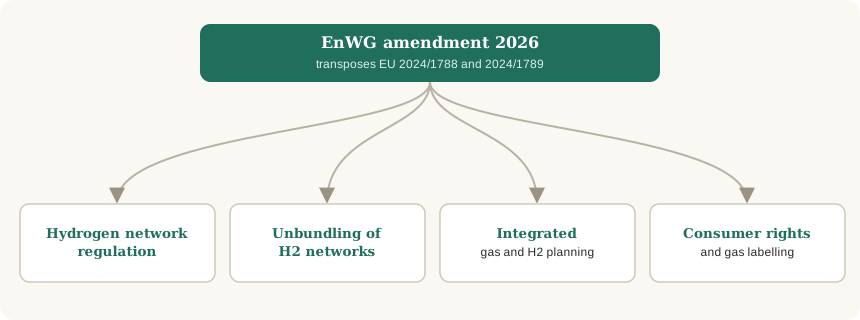
In detail, the four building blocks differ in purpose and reach. The first is hydrogen network regulation, that is a regulated regime for access, connection, certification and tariffs analogous to the gas sector. The second is the unbundling of hydrogen network operators, whose separation from generation and supply becomes binding with the ITO model expiring on 31 December 2030. The third is the integrated network development plan for gas and hydrogen at federal level, in which transmission and hydrogen transport network operators draw up a joint plan with a joint scenario framework every two years, aligned with the electricity network development plan. The fourth are new consumer rights and gas labelling: gas suppliers will in future have to disclose whether they supply renewable, low-carbon or fossil gases, and new protection and notification rules apply for network conversion and decommissioning. These four building blocks are clearly to be distinguished from neighbouring projects. The BNetzA rulings on replacing the GasNZV govern the ruling level, the gas grid transformation plan plans the local distribution grid transformation per network area, and the guarantee of origin certifies green gases. The EnWG amendment, by contrast, creates the overarching statutory framework into which these instruments fit.
Hydrogen in the EnWG and unbundling
The biggest substantive leap is the full integration of hydrogen into the EnWG. Hydrogen networks are regulated like gas networks, and their operators must be unbundled. This affects integrated suppliers in particular. The detailed sections are at draft stage, because the law is still in the legislative procedure.

In detail, the integration means two things. First, hydrogen receives a regulated network access regime analogous to the gas sector, with connection, access, certification and tariff regulation. Included here are not only the transport pipelines but also hydrogen storage and terminals, which thereby also fall under the regulated framework. Second, the unbundling of hydrogen network operators is newly regulated, that is their organisational and legal separation from generation and supply. The draft provides new rules for this in Sections 10g and 10h EnWG. The ITO model, the independent transmission operator within an integrated group, expires for hydrogen on 31 December 2030. After that, ownership unbundling is the target model, that is the full ownership separation of network and generation or supply. For integrated suppliers this is the most far-reaching point, because it can require a restructuring of the group. Since the law is still in the legislative procedure, the concrete exemptions and transitional rules on Sections 10g and 10h are not yet final and can change until adoption.
The legislative process and the deadline
The amendment is legislation under time pressure. The EU deadline of 5 August 2026 drives the pace, and the procedure is not yet concluded. The law is in the legislative procedure, draft stage, and sections and detailed rules can still change until adoption.
For practice this means a tight timetable subject to reservation. After the hearing from 4 November 2025, the cabinet decided on the draft on 25 March 2026, the first reading in the Bundestag followed on 23 April 2026 and the expert hearing on 20 May 2026. Adoption is targeted for the summer of 2026, driven by the transposition deadline of Directive 2024/1788 on 5 August 2026. Unlike the directive, Regulation 2024/1789 applies directly and has been applicable since 5 February 2025, so it does not wait for the national procedure. Decisive for context is that the law is still in the legislative procedure, draft stage. Sections and detailed rules, for example on unbundling, tariff mechanics and decommissioning rules, can still shift in the parliamentary process. Whoever relies on concrete section drafts should do so with this reservation and keep tracking the procedure.
Challenges and risks
The transformation is ambitious and contested. Financing, unbundling and decommissioning carry conflicts. An honest view has to name this, rather than painting the amendment only as orderly progress.

In detail, the risks lie on several levels. First, there is time pressure: the transposition deadline runs out in August 2026, but the parliamentary conclusion is still open, and the law is in the legislative procedure. Delays or short-notice changes to the draft cannot be ruled out. Second, there is a financing gap for the conversion of individual distribution grid sections to hydrogen, because whether and when hydrogen arrives across the area and how the conversion is refinanced is not conclusively settled. Third, there is a dispute over unbundling, namely over the ITO model expiring on 31 December 2030 and the question of which exemptions apply. Integrated suppliers fear a forced restructuring of their group. Fourth, stranded-asset and decommissioning risks loom from the new separation rights and tolerance duties, that is investments in plants that are later no longer refinanced. A balanced view recognises both the value of a uniform, European-anchored hydrogen regulation framework and these real gaps from time pressure, financing, the unbundling dispute and decommissioning.
Watch the procedure status: The law is still in the legislative procedure, draft stage. Sections and detailed rules, for example on unbundling, tariff mechanics and decommissioning, can still shift until adoption in the summer of 2026. Whoever bases investment or structural decisions solely on a single section draft, without factoring in the further course, increases the risk of rework. At the same time, the transposition deadline of Directive 2024/1788 on 5 August 2026 is fixed, so the pressure to adopt remains high.
The EnWG amendment is a sensible step toward a uniform, European-anchored hydrogen regulation framework and at the same time carries considerable uncertainty. The time pressure up to the deadline on 5 August 2026, the financing gap for the conversion of individual distribution grid sections, the unbundling dispute over the ITO expiry in 2030 and the stranded-asset risks from separation rights and tolerance duties belong honestly on the table. Whoever sees both, the value of the framework and the real risks, and keeps in mind that the law is still in the legislative procedure, can do the groundwork in a targeted way.
What companies should do now
The amendment is a regulatory and strategy task with lead time. Whoever sets up unbundling, planning and financing early is prepared when the law takes effect. This turns the running procedure into a concrete plan.
-
Track the legislation
Track the legislative process and factor in shifts of individual sections, because the law is still in the legislative procedure, draft stage. Watch the steps from the expert hearing to the targeted adoption in the summer of 2026 and assign responsibilities that assess changes to the draft. Whoever continuously checks the procedure status avoids basing decisions on outdated section drafts.
-
Check the unbundling path
Check the unbundling path to 2030 and the possible exemptions under Sections 10g and 10h. Since the ITO model for hydrogen expires on 31 December 2030 and ownership unbundling is the target model thereafter, integrated suppliers should clarify early which restructuring of the group may become necessary. As the detailed rules are at draft stage, plan with scenarios rather than with a fixed section draft.
-
Prepare for the integrated NEP
Prepare for the integrated network development plan for gas and hydrogen. Transmission and hydrogen transport network operators will in future draw up a joint plan with a joint scenario framework every two years, aligned with the electricity network development plan. Whoever aligns data management, scenario logic and coordination processes early is connectable at the first planning cycle rather than behind.
-
Build in tariff and amortisation mechanics
Build the tariff and amortisation mechanics for hydrogen networks into your business cases. The hydrogen core network shows, with a ramp-up tariff and an amortisation account up to 2055, how the ramp-up is financed. Whoever calculates this logic per project and quantifies the financing risk of the conversion can justify investment decisions soundly and avoid misinvestment.
Further reading
Frequently asked questions
The EnWG amendment 2026 transposes the EU gas and hydrogen package into German law, namely Directive (EU) 2024/1788 and Regulation (EU) 2024/1789. Both EU acts have been in force since 4 August 2024. At its core, the amendment makes hydrogen for the first time a regulated asset class in the EnWG, regulates the unbundling of hydrogen network operators, introduces an integrated network development plan for gas and hydrogen at federal level and adds consumer rights and gas labelling. It is to be distinguished from the separate electricity EnWG amendment on energy sharing.
The law is still in the legislative procedure, draft stage. After the hearing from 4 November 2025, the cabinet decided on the draft on 25 March 2026, the first reading in the Bundestag was on 23 April 2026 and the expert hearing on 20 May 2026. Adoption is targeted for the summer of 2026, driven by the transposition deadline of Directive 2024/1788 on 5 August 2026. Until adoption, sections and detailed rules can still change.
Hydrogen network operators are unbundled for the first time, that is separated organisationally and legally from generation and supply. The draft provides new rules for this in Sections 10g and 10h EnWG. The ITO model, the independent transmission operator within an integrated group, expires for hydrogen on 31 December 2030. After that, ownership unbundling is the target model. Since the law is still in the legislative procedure, the exact exemptions and transitional rules are not yet final.
Regulation (EU) 2024/1789 applies directly in all member states and has been applicable since 5 February 2025, so it does not first have to be transposed into national law. Directive (EU) 2024/1788, by contrast, sets out objectives that each member state must transpose into its own law, here through the EnWG amendment, with a transposition deadline of 5 August 2026. Together they form the EU gas and hydrogen package.
Companies should track the legislative process and expect individual sections to shift, because the law is still in the legislative procedure. Hydrogen network operators check their unbundling path to 2030 and possible exemptions under Sections 10g and 10h. Transmission and hydrogen transport network operators prepare for the integrated network development plan for gas and hydrogen. And everyone who operates or finances hydrogen networks should build the tariff and amortisation mechanics into their business cases early.