H2 core network financing: the ramp-up charge and the amortisation account under WANDA
This is a practical analysis of the financing mechanism behind the hydrogen core network, not a treatise on the legal framework as such. It sets out the WANDA determination, the capped ramp-up charge of 25 euro/kWh/h/a, the intertemporal amortisation account that bridges the gap to 2055, the KfW pre-financing under a federal guarantee, the self-retention and the 76/24 risk split, and what operators and bookers must calculate now. The neighbouring topics sit close by and are linked, not repeated. Note: WANDA is the financing determination on network charges and the amortisation mechanism; the German ramp-up charge is the Hochlaufentgelt; AMKG is H2 Amortisationskonto GmbH, the account-keeping entity; WaKandA is the sister determination on capacity.
WANDA is the determination on forming the network charges for access to the hydrogen core network and on setting up an amortisation mechanism effective for a certain period. It carries case number GBK-24-01-2#1 and was decided by the BNetzA's large ruling chamber for energy, the Grosse Beschlusskammer Energie, on 6 June 2024, not by ruling chamber 7. It rests on section 29(1) together with section 28o(3) and section 28r EnWG, and the amortisation account itself is anchored in section 28r(3) EnWG. During the market ramp-up users are few and the infrastructure is expensive, so the network charge is deliberately set below a cost-covering level to avoid deterring the first users. The ramp-up charge, in German the Hochlaufentgelt, is capacity-based at 25 euro/kWh/h/a, not a commodity charge in euro/MWh, and is uniform and distance-independent across all entry and exit points. Its level was set in the separate determination GBK-24-02-2#4 of 14 July 2025, is levied from 2025 and is only inflation-indexed. The amortisation account is an intertemporal cost-allocation account: deficits first, surpluses later, balanced by the target year 2055. The KfW provides the liquidity through a credit line of EUR 24 billion under an assignment transaction pursuant to section 2(4) of the KfW Act, so the KfW bears no risk while the federal government grants a full guarantee and indemnity. The account-keeping entity is H2 Amortisationskonto GmbH, AMKG; the first payout of about EUR 172 million reached the 18 core-network operators on 24 March 2025, with the next tranche due in March 2026. If the account is not balanced by 2055 the federal government carries up to 76 percent of the risk and the operators a self-retention of up to 24 percent, with the financing in principle fully private-sector. The approved core network spans 9,040 km and EUR 18.9 billion and is to be complete by 2032.
WANDA: the determination behind core-network financing
WANDA is the BNetzA determination that governs the network charge and the amortisation mechanism of the hydrogen core network. Its full title is the determination on forming the network charges for access to the hydrogen core network and on setting up an amortisation mechanism effective for a certain period, and the short name WANDA is taken from that German title. It carries the case number GBK-24-01-2#1 and the decision was taken on 6 June 2024. WANDA answers the question of who pays for the build-out and who carries the ramp-up risk, the financing counterpart to the capacity rules.
One detail is easy to get wrong and worth fixing at the outset. WANDA is not a ruling chamber 7 procedure. WaKandA, case number BK7-24-01-015, and its balancing sister WasABi sit with ruling chamber 7, but WANDA was decided by a body set up specifically for this task, the BNetzA's large ruling chamber for energy, the Grosse Beschlusskammer Energie. The legal basis is section 29(1) together with section 28o(3) and section 28r(1) sentence 2 and (6) EnWG, while the amortisation account itself is anchored in section 28r(3) EnWG. The overarching legal frame around all of this sits in the EnWG, set out in the article on the EnWG amendment and the EU gas and hydrogen package, which supplies sections 28o and 28r as the underlying provisions.
It helps to keep three things apart. WANDA is the money: the network charge, the ramp-up charge and the amortisation account. The capacity and the network access are governed by WaKandA, the sister determination covered in the article on capacity booking under WaKandA, and the EnWG amendment is the overarching framework. This piece delimits WANDA against WaKandA where it helps the reader, but it does not repeat the capacity products, the booking platform or the nomination process. Its subject is the financing alone.
A second line separates hydrogen from gas. The gas charging regime rests on its own chamber 7 determinations, KARLA among them, covered in the article on the replacement of the GasNZV by the new rulings. The gas regime is a cost-covering charging system without an intertemporal amortisation account. WANDA is the standalone hydrogen counterpart with a very different logic, and one more point is worth flagging here: WANDA settled the mechanism, but the actual level of the ramp-up charge came later, in a separate determination, GBK-24-02-2#4 of 14 July 2025.
The capped ramp-up charge: 25 euro/kWh/h/a
In the ramp-up there are few users and high costs. If the network charge were set at a cost-covering level, the first users would face an off-putting price and the market would struggle to start at all. WANDA therefore caps the charge and deliberately holds it below the cost-covering level. The German term for this capped tariff is the Hochlaufentgelt, the ramp-up charge, and from here on this article uses the English term.
The level matters, and so does its form. The ramp-up charge is set at 25 euro/kWh/h/a. The unit is important: this is a capacity-based charge on the booked entry and exit capacity, comparable to the capacity charges of the gas transmission system operators, not a commodity charge in euro/MWh. It is uniform and distance-independent across all entry and exit points, so a booker pays the same per unit of booked capacity regardless of where in the network the point sits. That level was not fixed in WANDA itself but in the separate determination GBK-24-02-2#4 of 14 July 2025, under the operative provisions of the WANDA decision.
The charge is levied from 2025, stays constant at its core and is only adjusted for inflation, so that transport costs remain plannable over the long horizon of the build-out. A booker can therefore budget against a known charge rather than against a moving cost-covering figure that would rise and fall with the network's annual costs. That predictability is part of the policy intent: the capped charge feeds straight into the off-takers' business case, and a stable number is easier to underwrite than a volatile one.
The difference between the cost-covering charge and the capped charge is not waived. It is shifted in time, onto a later and larger user base. Today's users do not pay the full cost of the network, but the shortfall is not a permanent subsidy either: it is recorded, carried forward and recovered later. The vehicle that records and carries that shortfall is the amortisation account.
The amortisation account: bridging the gap to 2055
The amortisation account is the heart of WANDA. It is an intertemporal cost-allocation account under section 28r(3) EnWG, and its job is to absorb the deficits of the ramp-up and to settle them once the market can carry the full cost. Each year it records the difference between the recognised costs of the network and the revenues from the ramp-up charge.
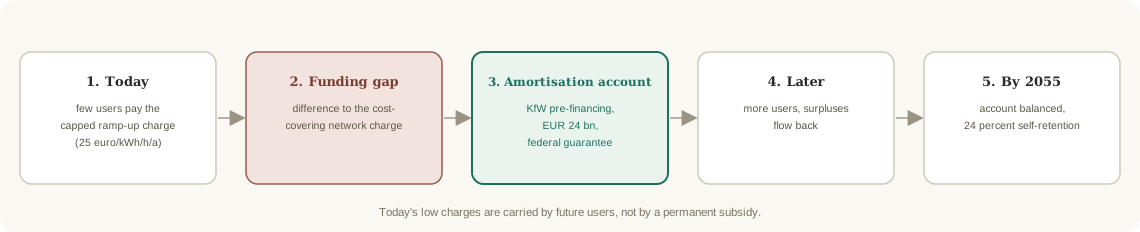
The account runs in two phases. In the first phase the capped charge falls short of the cost-covering charge, so the account fills with deficits: the coverage gap between what the network costs and what the few early users pay. In the second phase, when more users are connected and the network is more heavily utilised, the same charge generates surpluses, because the broader user base now more than covers the costs. Those surpluses flow back into the account and pay down the accumulated deficits.
The account must be balanced by the target year 2055. That long horizon is the whole point: it spreads the heavy initial burden across a much wider future user base, so that the low charges of the early years are co-funded by the users who arrive later rather than by permanent public subsidies. Economically, the mechanism is a bet that the hydrogen market will grow enough to repay its own start-up costs within thirty years, and the credibility of that bet is exactly what operators and bookers have to assess.
KfW pre-financing and the federal guarantee: who provides the liquidity
The amortisation account needs money today that only flows back later. Bridging that timing gap is the role of the KfW, the German promotional bank, and it does so under a full federal guarantee. The KfW finances the amortisation account through a credit line of EUR 24 billion and pays the operators annual compensation for their investment and operating costs, so that the operators are not left to carry the coverage gap on their own balance sheets through the lean early years.

The risk allocation behind that credit line is the key point. Because the financing is structured as an assignment transaction pursuant to section 2(4) of the KfW Act, the KfW itself bears no risk: the federal government has granted a comprehensive guarantee and indemnity that stands behind the credit line. The KfW provides the liquidity, the federal government carries the credit risk, and the operators receive the payments that keep the build-out funded while the account is still in deficit.
The account-keeping entity is H2 Amortisationskonto GmbH, AMKG, which receives the funds and distributes them to the 18 core-network operators. The mechanism is no longer a paper construct: the first payout, of about EUR 172 million, reached the operators on 24 March 2025, and the next tranche is due in March 2026. Those first flows show the machinery working, but they are the beginning of a multi-decade pre-financing, not the end of it.
Self-retention and risk sharing: who is liable if the ramp-up stalls
The pre-financing assumes the market grows. If the ramp-up fails or runs too slowly, a residual deficit remains in the account at 2055, and someone has to bear it. WANDA splits that residual risk clearly between the federal government and the operators rather than leaving it open.
If the account is not balanced by 2055, the federal government bears up to 76 percent of the deficit and the core-network operators hold a self-retention of up to 24 percent. The financing is meant to be in principle fully private-sector: the federal government steps in only as a backstop in the event of default, not as a permanent subsidy. The guarantee makes the build-out financeable, but the 24 percent self-retention keeps the operators in the risk and stops the construction from becoming a fully de-risked public project.
That self-retention is deliberate. It gives the operators an incentive to control their costs and to support the market ramp-up actively, because a slower ramp-up or higher costs translate directly into a larger residual deficit and therefore a larger share for them to absorb. It aligns the operators' commercial interest with the policy goal: get the network used, keep the costs down, close the account by 2055.
For the operators this residual risk is the core of the business case. Up to 24 percent of any final shortfall has to be something they can carry on their balance sheets, which means the size of that potential shortfall, and the probability of it, has to be modelled rather than assumed away. A 24 percent share of a small residual deficit is manageable; a 24 percent share of a large one is not, and the difference between the two depends entirely on how the utilisation curve develops over the next three decades.
What operators and bookers must calculate now
WANDA is not abstract regulation, it is a hard figure in every economic calculation. Both sides, the operators who build and the bookers who transport, should work the mechanism into their planning today rather than treating it as a regulatory footnote. The points below turn the determination into a near-term action list.

- Carry the capped ramp-up charge into transport costs. Bookers should calculate the capped ramp-up charge of 25 euro/kWh/h/a, including its inflation indexation, into their transport costs, and keep it cleanly separate from the WaKandA capacity booking so neither item is double-counted nor lost.
- Model the utilisation and revenue curve to 2055. Operators should model how utilisation and revenue develop to 2055, because that curve decides when the account tips from deficit into surplus and how large the self-retention could ultimately become.
- Track the periodic review and the inflation indexation. Both sides should watch the periodic review and the inflation adjustment of the charge, because the capped charge moves only within narrow limits and any change feeds directly into the cost forecast.
- Keep WANDA and WaKandA separate in the calculation. WANDA and WaKandA belong together but belong calculated apart: capacity on one side under WaKandA, charge and amortisation risk on the other under WANDA, so the cost of access is neither understated nor confused.
Further reading
Frequently asked questions
WANDA is the determination on forming the network charges for access to the hydrogen core network and on setting up an amortisation mechanism effective for a certain period. It carries case number GBK-24-01-2#1 and was decided by the BNetzA's large ruling chamber for energy, the Grosse Beschlusskammer Energie, on 6 June 2024, not by ruling chamber 7. It rests on section 29(1) together with section 28o(3) and section 28r EnWG, and the amortisation account itself is anchored in section 28r(3) EnWG. WANDA governs the money: the network charge, the ramp-up charge and the amortisation account that runs to 2055.
The ramp-up charge, in German the Hochlaufentgelt, is set at 25 euro/kWh/h/a. It is capacity-based on the booked entry and exit capacity, not a commodity charge in euro/MWh, and it is uniform and distance-independent across all entry and exit points. Its level was set not in WANDA itself but in the separate determination GBK-24-02-2#4 of 14 July 2025. It is levied from 2025, stays constant at its core and is only adjusted for inflation.
The amortisation account is an intertemporal cost-allocation account under section 28r(3) EnWG. In the first phase it records the deficits between the cost-covering charge and the capped ramp-up charge. In the second phase, when more users are connected and utilisation is higher, the charge generates surpluses that fill the account back up. The KfW pre-finances the gap through a credit line of EUR 24 billion under a full federal guarantee, and the account must be balanced by the target year 2055.
If the amortisation account is not balanced by 2055, the federal government bears up to 76 percent of the residual deficit and the core-network operators hold a self-retention of up to 24 percent. The financing is in principle fully private-sector: the federal government acts only as a backstop in the event of default, not as a permanent subsidy. The self-retention gives operators an incentive to control costs and to support the market ramp-up actively.
The amortisation account must be balanced by the target year 2055. By then the later surpluses from higher network utilisation are meant to have repaid the initial deficits of the ramp-up. The long horizon spreads the early burden across a broader future user base, so that today's low charges are co-funded by future users rather than by permanent subsidies. The amortisation account must carry the approved core network of 9,040 km and EUR 18.9 billion across that period.