Capacity reservation in the hydrogen core network: what applies since 19 March 2026
This article shows how the reservation works in practice: what the market information package contains, how the First-Come-First-Served workflow looks, what the reservation fee costs and when it turns into a binding booking. It covers the phase before the capacity booking under WaKandA, not the booking itself and not the financing regime around the amortisation account. Here it is about how you secure a place today.
On 19 March 2026 at 1:00 PM, the coordinated capacity reservation process of the hydrogen core network operators went live. It builds on the second market information package of 5 March 2026, which describes the cluster structure, the reservable capacities for 2026 to 2030 and the workflow. Reservation runs through a standard form on First-Come-First-Served, and the timestamp of the fully completed form decides the order. The reservation fee is 1 euro per kWh/h/a, billed monthly, and is creditable up to 100 percent toward later bookings, provided that by the end of the reservation period at least one annual booking matching the reserved capacity is made, with delivery starting within four years. Reservation is possible up to seven years in advance. Review usually takes about ten business days, and an offer that follows must be accepted within seven business days. Reservation is not the binding booking: that runs from 01.10.2026 through the joint booking platform under the BNetzA ruling WaKandA, and the fee paid is then credited. By 23 July 2026, nearly 6 gigawatts of entry and exit capacity had been reserved, a doubling compared with 13 May 2026. The approved core network spans 9,040 kilometres and 18.9 billion euros and is due by 2032. Marketing starts cluster by cluster, because the network is not yet fully connected.
What applies since 19 March 2026
Since 19 March 2026 you can reserve transport capacity in the hydrogen core network in a binding way, up to seven years before any hydrogen flows. At 1:00 PM that day the process went live, coordinated by the hydrogen core network operators. That is the real change: not another rulebook, but an actual market process that runs.
Reserving here means securing priority access to future capacity. It is not yet a transport contract. Anyone who produces, imports or offtakes large volumes claims an early place at a pipeline that in part does not exist yet.
Why now? Because the investment decisions along the hydrogen chain have long lead times. An electrolyser, an import terminal, a converted industrial plant, none of that is planned overnight. The reservation gives these projects an anchor: a committed capacity to calculate against. That is exactly why the process is more than a formality for the regulatory department.
The market information package as a data-transparency instrument
The market information package is the data basis without which the whole process would not work. It describes the cluster structure, the reservable capacities and the standard workflow. Only this transparency makes a sound investment decision possible.
The second package appeared on 5 March 2026, two weeks before the start. It shows how sharply the capacity is meant to grow: on the entry side from 2,859 MWh/h in 2026 to 15,087 MWh/h in 2030, on the exit side from 1,684 MWh/h to 10,835 MWh/h. These are not wish figures, but the planning basis against which reservations are made.
The real value lies in reliability. A company sees in black and white which capacity is available at which point and in which year. That noticeably narrows the information gap between network operators and the market. Without this disclosure, First-Come-First-Served would be a blind flight.
How the reservation works step by step
Reserving follows a clear, standard workflow, and speed matters. Because the First-Come-First-Served principle values the timestamp of the fully completed form, preparation often decides who is first in line.

The steps at a glance
-
Prepare registration and evidence
Before the request come a KYC sanction screening and a capacity verification. Operators recommend registering early, ideally before a reservation round starts. Doing it only on the day of the request wastes time, and under First-Come-First-Served time is money.
-
Submit the request via the standard form
The reservation runs through a single standard form. What counts is the timestamp of the fully completed form, not the moment you started. Completeness beats haste.
-
Wait for the review and accept the offer
Operators usually review incoming requests within ten business days. After a positive review comes an offer, to be accepted within seven business days. Then the reservation fee falls due, 1 euro per kWh/h/a, billed monthly.
Sounds bureaucratic? In part it is. But the standardisation is the price for vending all clusters by the same rules and keeping the order verifiable.
From a reserved place to a binding booking
The reservation is a bridge, not a dead end. The reserved place later turns into a real booking, and the fee paid is not lost in the process.
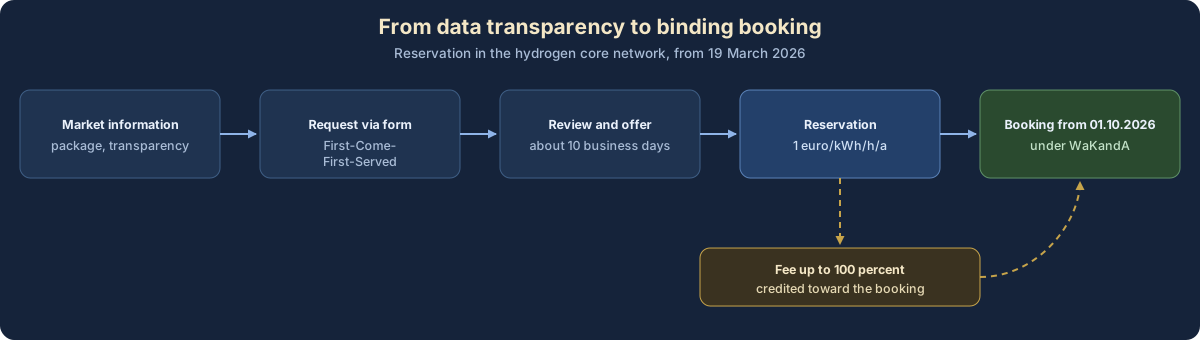
Concretely: reservations are later replaced by capacity bookings. Up to 100 percent of the reservation fee is creditable if, by the end of the reservation period, at least one annual booking matching the reserved capacity is made, with delivery starting within four years. So anyone who plans seriously does not pay twice in the end.
The binding booking itself runs from 01.10.2026 through the joint booking platform. The details are set by the BNetzA rulings WaKandA for capacity and WasABi for balancing. The reservation is the interim phase before that, it bridges the gap until the platform is up.
This distinction matters. Reservation secures priority, booking creates the contract. Anyone who blurs the two terms plans on the wrong level.
Clusters instead of one network: the rollout in stages
The core network is not yet a fully connected network, but a collection of clusters. That is why marketing starts cluster by cluster. Market participants book freely assignable hydrogen capacities at points within an offering zone, and cluster transition transport links the zones while the pipelines between them are still missing.

The schedule shows how gradual that is. By the end of 2026 the clusters Nord-West, Flow, Mitteldeutschland and Burghausen are in place. By the end of 2027 Hannover Ost and Flow 2 join, by the end of 2028 Ingolstadt, by the end of 2029 Aachen and mosaHYc. In 2030 Flow, Flow 2 and Mitteldeutschland merge into the Ost cluster. For you that means: check whether your entry and exit points sit in the same cluster or whether the path between them is already connected.
The uptake is remarkable. By 23 July 2026, nearly 6 gigawatts of entry and exit capacity had been reserved, a doubling compared with 13 May 2026. That is a strong signal for the market ramp-up. It says nothing yet about how much hydrogen actually flows.
Challenges and risks
The strong reservation uptake is a good sign, but not proof. At its core sits the chicken-and-egg problem of the hydrogen economy: network, production and offtake have to ramp up together, otherwise one side is left hanging.
The biggest risk is a network that grows faster than demand. That threatens high costs at low utilisation. The amortisation account cushions early revenue shortfalls, but only offsets them by 2055 at the latest, financed via a KfW credit line of 24 billion euros. A long breath, not a quick balance.
First-Come-First-Served also has a social edge. It favours fast, well-prepared players. A large importer with its own regulatory department has the advantage, a smaller utility can fall behind. And a reservation is not yet a molecule: it secures capacity, not production, imports or the price. The data transparency of the market information package reduces uncertainty, it does not remove it.
What companies should do now
Do not treat the reservation as a distant future. Under First-Come-First-Served, preparation decides access, not good intentions.
Prepare the formal documents first. KYC evidence and capacity verifications belong together early, and you complete the registration before the next round, not on the day of the request. Then model your own capacity demand along the cluster timeline and the offering zones: which points, which year, which volume.
The market information package is your reliable data basis, and if you evaluate it continuously, you miss no shift in the rollout. Factor the reservation fee and the crediting condition cleanly into the investment case, otherwise the business case looks too cheap or too expensive. And plan the move from reservation to booking from 01.10.2026 with clear internal ownership, including who watches the deadlines and forms.
How the green properties of the transported hydrogen are later documented is covered by the analysis of the guarantees of origin for green gases. The legal frame behind it is described by the EnWG amendment for the gas and hydrogen package.
Further reading
Frequently asked questions
The coordinated capacity reservation process of the hydrogen core network operators started on 19 March 2026 at 1:00 PM. It builds on the second market information package of 5 March 2026, which describes the cluster structure, the reservable capacities for 2026 to 2030 and the workflow. Reservation is possible up to seven years in advance. The process is coordinated nationwide and runs on First-Come-First-Served.
The reservation fee is 1 euro per kWh/h/a and is billed monthly. It is creditable up to 100 percent toward later bookings if the customer, by the end of the reservation period, makes at least one annual booking matching the reserved capacity, with delivery starting within four years after the reservation ends. If no booking follows, the fee stays with the network operator.
Reservation is the upstream phase: since 19 March 2026 it secures priority access to future capacity, but it is not yet a binding transport contract. The binding capacity booking runs from 01.10.2026 through the joint booking platform under the BNetzA ruling WaKandA. Reservations are later replaced by bookings, and the fee paid is credited in the process.
The market information package is the data basis published by the core network operators for the reservation. It describes the cluster and capacity development from 2026 to 2030 as well as the request and reservation process. The second package appeared on 5 March 2026 and is updated continuously. It provides the transparency market participants need to match their demand against the available network profile.
By 23 July 2026, nearly 6 gigawatts of entry and exit capacity had been reserved, a doubling compared with the market information package of 13 May 2026. Planned entry capacity grows from 2,859 MWh/h in 2026 to 15,087 MWh/h in 2030. The strong uptake is read as a signal for the market ramp-up, but it says nothing yet about the volumes actually transported.