DATEX II becomes mandatory: what charging infrastructure operators must deliver from April 2026
The data obligation for charging infrastructure has moved from the exception to the rule. The basis is Article 20 of EU Regulation 2023/1804 (AFIR): operators of publicly accessible charging points must provide static and dynamic operational data free of charge and without discrimination. The duty to provide the data has applied since 14 April 2025. Since 14 April 2026 the same data must be delivered in the European DATEX II standard. Static data such as location, connector type and charging power must be updated within 24 hours of a change, dynamic data such as availability and ad-hoc price within one minute. In Germany the Mobilithek, run by the Federal Ministry for Transport, is the national access point. Operators report commissioning and decommissioning through the Mobilithek instead of manually to the Bundesnetzagentur. The market is large: on 1 April 2026 the Bundesnetzagentur counted 200,255 publicly accessible charging points. For operators this is mainly a data project: capture data cleanly, translate it into DATEX II, secure the deadlines technically and monitor quality over time.
What changed on 14 April 2026
Since 14 April 2026 it is no longer enough to provide charging data in some form. It must be available in the European DATEX II standard. This ends the one-year transition period that began with the actual data provision duty on 14 April 2025. For operators of publicly accessible charging points the practical switch is no longer a question for the future, but applicable law.
The legal basis is Article 20 of Regulation (EU) 2023/1804 on the deployment of alternative fuels infrastructure, known as AFIR. The regulation applies directly in all member states and requires operators to make certain operational data accessible free of charge and without discrimination. It affects all operators of publicly accessible charging points, regardless of size or power. The EU is now extending such machine-readable data obligations across several product groups, for instance with the digital battery passport from 2027.
- Until 14 April 2025 the rule was: static and dynamic data must be provided. From 14 April 2026 the rule is: this must happen in the DATEX II format.
- The step from 2025 to 2026 is not a new data set but a format requirement. It is the same data, now in a uniform, machine-readable structure.
- Authentication and payment at the charge point are governed separately. How that works through Plug and Charge is covered in the article on ISO 15118 and Plug and Charge.
What the obligation requires
AFIR Article 20 distinguishes static and dynamic data with different update deadlines. Anyone who misses the deadlines does not formally meet the obligation. That distinction is therefore the starting point of every implementation.

- Static data: geographical location, number and type of connectors, charging power in kilowatts, operating hours, vehicle compatibility and access and payment conditions. Updated within 24 hours of a change.
- Dynamic data: current availability or occupancy, operating status and the current ad-hoc charging price. Updated within one minute.
- Open interface: the data must be accessible through a standardised, freely available interface without registration barriers.
- Exception: charging points that supply electricity for free are exempt from the duty to provide dynamic price data.
From charge point to map app: the data chain
DATEX II is not an end in itself but the common language that makes a German charging station readable for an app in another member state. The chain runs from the operator backend through the national access point to the data users. Knowing the chain also shows where your own implementation fits in. The security of that operator backend is the focus of the BSI report on the IT security of charging infrastructure.
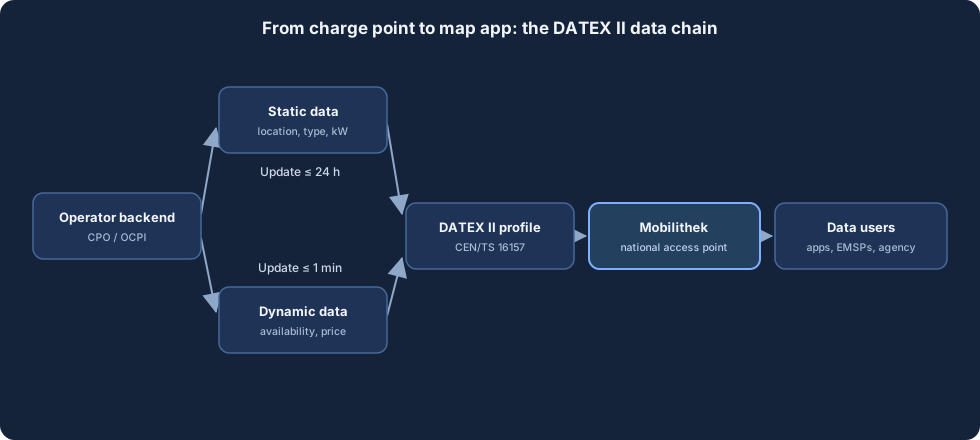
- The operator backend supplies the raw operational data, often from internal systems or through the roaming protocol OCPI.
- This is translated into the DATEX II profile according to the CEN/TS 16157 standard family and provided through an interface.
- The national access point, in Germany the Mobilithek, bundles the data offerings and makes them discoverable.
- Data users such as map and navigation services, e-mobility service providers and authorities access the data. This produces reliable availability and price displays for drivers.
Germany and the EU: the Mobilithek as national access point
Germany implements the AFIR requirements through the Mobilithek and a new law. The reporting route to the Bundesnetzagentur therefore shifts to the central data platform. For operators, not only the format changes, but also the place where they register their offerings and file reports.
To ease the transition, the data profile was adjusted: providing the charging facility ID and operator ID to the Bundesnetzagentur is now optional in the profile. That lowers the entry barrier but does not change the duty to supply location, availability and price data in full.
- The Mobilithek, run by the Federal Ministry for Transport, is the national access point under EU Directive 2010/40/EU on intelligent transport systems.
- In late October 2025 the cabinet launched the draft of an Intelligent Transport Systems Act that integrates the mobility data requirements.
- Operators report the commissioning and decommissioning of charging points through the Mobilithek instead of manually to the Bundesnetzagentur.
- The open charging data foundation is part of larger data space projects. How the EU is building a common energy data space is covered in the article on the European energy data space CEEDS.
Challenges and risks
The obligation sounds technically simple but in practice often fails on data quality and format logic. The effort lies less in the legal text than in the data processes behind it.
- Format translation: many operators deliver via OCPI today. Mapping to DATEX II requires a clean field mapping, otherwise gaps or errors appear.
- One-minute deadline: updating dynamic data every minute sets requirements for backend, monitoring and resilience that smaller operators easily underestimate.
- Data quality: wrong locations, outdated prices or unclear operating states lead to false displays in the apps and undermine driver trust.
- Enforcement: responsibility for penalties lies with the member states. The EU does not impose direct fines, but national law can sanction breaches.
What operators should do now
The deadline has passed and the obligation applies. Anyone who is not delivering yet should make compliance a priority rather than hope for a grace period. Four steps come first.

Four priority steps
-
Take stock of the data
Clarify which data exists where, in what quality and through which interface. Only this picture shows how far the road to DATEX II compliance really is.
-
Connect the DATEX II profile
Implement the DATEX II profile according to CEN/TS 16157 or connect it through a service provider, and register the data offering in the Mobilithek.
-
Secure the deadlines technically
Secure the mapping from OCPI to DATEX II and the update intervals of 24 hours for static and one minute for dynamic data, and monitor them continuously.
-
Check data quality continuously
Establish automated checks for completeness, timeliness and plausibility instead of treating compliance as a one-off setup.
The open data foundation pays off beyond the obligation. The same data later underpins utilisation analysis, pricing strategy and forecasts. How grid and consumption data can be used for predictions is covered in the article on AI-based load and generation forecasting in the distribution grid. Only obligation and benefit together give the full picture.
Further reading
Frequently asked questions
The DATEX II obligation follows from Article 20 of EU Regulation 2023/1804 (AFIR). Operators of publicly accessible charging points must provide static and dynamic operational data free of charge and without discrimination. Since 14 April 2026 this data must be available in the European DATEX II standard and accessible through an open interface. In Germany the Mobilithek, run by the Federal Ministry for Transport, is the national access point.
The duty to provide charging data at all has applied since 14 April 2025. On 14 April 2026 the one-year transition period ended: since then the same data must be delivered in the DATEX II format. No new data fields are added, but a uniform, machine-readable format becomes binding.
Static data covers location, number and type of connectors, charging power, operating hours and access and payment conditions. It must be updated within 24 hours of a change. Dynamic data covers current availability or occupancy, operating status and the current ad-hoc price. It must be updated within one minute. Charging points that supply electricity for free are exempt from the duty to provide dynamic price data.
The Mobilithek is the central mobility data platform of the Federal Ministry for Transport and serves as the national access point under EU Directive 2010/40/EU. Operators register their data offerings there and report the commissioning and decommissioning of charging points through the Mobilithek instead of manually to the Bundesnetzagentur. Data users such as map apps and e-mobility service providers access the data through the platform.
First take stock: which data exists where, in what quality and through which interface. Then implement the DATEX II profile according to CEN/TS 16157 or connect it through a service provider, and register in the Mobilithek. Operators who deliver via OCPI today need a clean mapping to DATEX II. The update intervals of 24 hours for static and one minute for dynamic data must be technically secured and monitored. Data quality is an ongoing process, not a one-off setup.
Let's collaborate
One contact, a team behind it
Thirty minutes on what you're working on, whether grid, metering, market processes, IT architecture or AI. Afterwards you'll know how we'd approach it and who would sit at the table.
Energy and measurement technology since 2010 · innobu GmbH since 2014 · Based in Schleswig-Holstein, Germany
Whoever pitches also delivers: whoever leads the first call stays your contact right through to the steering committee, with established partners in the project. Direct: info@innobu.com