
From assistance to autonomous grid operation: CAISO's AI pilot and what German grid operators can take from it
According to its vendor OATI, the AI platform Genie has been in production in the outage management of the California Independent System Operator (CAISO) since 24 June 2026. In a 2025 survey commissioned by Siemens, 59 percent of energy industry executives said they plan major investments in autonomous grid systems. For German grid operators, whose high-risk AI falls under the AI Act's oversight obligations from 2 December 2027, the project shows how to introduce AI one step at a time.
Autonomous grid operation means a system carries out measures on the grid without a person approving each action beforehand; several steps lie between it and pure assistance. The California grid operator CAISO uses OATI Genie, an AI in outage and maintenance management. It checks maintenance requests and makes suggestions, and operators still decide. CAISO ties any further automation to testing and executive approval. The figure of 59 percent investment intent comes from a 2025 survey commissioned by Siemens. In Germany, the oversight and deployer obligations of Articles 14 and 26 of the EU AI Act apply to high-risk AI under Annex III from 2 December 2027.
What CAISO is actually testing
CAISO doesn't use the AI for real-time switching but in outage and maintenance management. Genie checks new requests for planned maintenance for anomalies, names affected transmission paths and balancing areas, and suggests next steps based on operating procedures and past events. That is how Khaled Abdul-Rahman, Chief Information and Technology Officer, and Gopakumar Gopinathan, Senior Advisor at CAISO, described it on the grid operator's blog on 28 July 2025.
Technically, Genie combines document retrieval (retrieval augmented generation) with several agents, sub-programs that each work through one task on their own. In July 2025, according to Latitude Media, operators were testing four agents individually, among them one for keywords in requests, one that searches for similar historical outages, one that writes nightly reports for operators. Before that came conversations with more than 200 operators, training on CAISO data and synthetic test cases; parallel testing and step-by-step integration into the Outage Management System, where CAISO manages planned outages, were to follow. OATI says the data stays in its own data centres; operation therefore sits with the vendor, which for a German grid operator would fall under IT security pursuant to Section 5c EnWG.
Latitude Media names the success metric as whether the time operators spend reviewing outage requests goes down; in July 2025 the baseline measurement was still being built. Even under a minute per review adds up across 200 or 300 outages, OATI manager Abhimanyu Thakur said, as quoted by t3n; the report gives no time period for that. On 24 June 2026, according to OATI, Genie moved from pilot into production; we found no announcement of this by CAISO itself.
How "co-pilot" became "autonomous"
The report that an AI would soon decide on important grid functions rests on an outlook in the body text; t3n's headline was about fighting power outages. MIT Technology Review, republished by the German tech outlet t3n on 15 July 2025, wrote that Genie was in future also to make autonomous decisions about important grid functions. CAISO puts it more narrowly.
The report describes an option, the blog describes the current state. Today Genie is a recommendation system inside a planning process; whether it will ever trigger a switching action, CAISO has not decided. The vendor thinks bigger: Thakur told Latitude Media there would eventually be "hundreds of agents" on the platform. For a German grid operator, this shows where approval for the next step has to sit: with its own management, not with the vendor.
The steps between assistance and autonomy
Whether an AI is "autonomous" can only be answered per function. Several steps lie between an AI that informs and one that switches; Martin Braun and colleagues described six autonomy levels for grid operation at the VDE ETG Congress in 2021, modelled on the levels used for autonomous driving, and placed today's degree of automation on that scale.
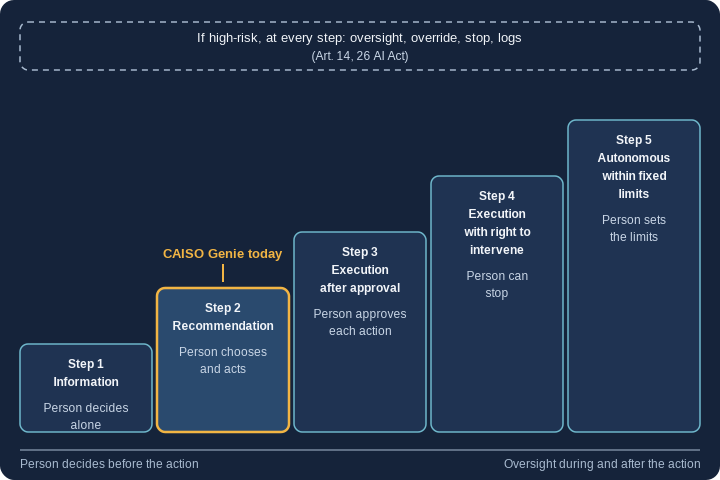
Our staircase is deliberately coarser than the six levels of Braun and colleagues, whose labels we don't reproduce here. It has five steps: information (the person decides alone), recommendation (the person chooses and acts), execution after approval (the person approves each action), execution with a right to intervene (the person can stop) and autonomy within fixed limits (the person sets the limits). It separates by when the person steps in: before the action (steps 1 to 3), during it (step 4) or only through limits set in advance (step 5). Genie at CAISO works at step 2. Vendors describe the same pattern. Thomas Kiessling, CTO of Siemens Smart Infrastructure, describes so-called autonomous zones in the Infrastructure Transition Monitor, where software shifts charging load and reroutes overloaded feeders, and adds that operators still approve the suggestions. A Databricks blog post from May 2026 lays out the same path from recommendation with approval, through a phase in which people step in only on deviations, to autonomous operation within defined parameters.
A grid operator doesn't have one autonomy level but many functions at different steps. The nightly report for operators can be produced without approval while the decision on an outage stays at step 2.
In its July 2025 study on AI in network control technology, VDE ETG, the power engineering society of Germany's electrical engineering association, recommends starting with lower-risk use cases or easily verifiable methods and using AI first as decision support rather than in a closed control loop; qualified staff should remain the final decision-makers. For the introduction VDE proposes four steps: requirement profile, model development, model testing and operation. How they fit Article 14 of the AI Act are covered in our article on AI in grid control and human oversight.
Where investment goes
The Siemens survey measures intentions, not budgets. In the Infrastructure Transition Monitor 2025, published on 17 November 2025, 59 percent of energy industry executives said they plan major investments in autonomous systems for grids. Siemens, a maker of grid software, commissioned the study; it surveyed 1,400 senior executives and government representatives in 19 countries, from energy, buildings and industry.
| Statement | Agree | Who was asked, source |
|---|---|---|
| plan major investments in autonomous systems for grids | 59% | Energy industry executives, press release |
| the benefits of autonomous systems in grids outweigh the costs | 63% | Energy respondents, report |
| the path to autonomous systems in grids is blocked by regulatory constraints | 61% | Energy respondents, report |
| electrification is held back by inadequate grid infrastructure | 73% | Energy respondents, press release |
Neither the press release nor the energy report says how many of the 1,400 respondents came from the energy industry, which countries took part or when the survey ran. Whether Germany is among the 19 countries remains open. More telling than the percentages is a line from the same report: Haldy-Sellmann of SAP, quoted in the report, says there that many utilities' data isn't clean or connected enough for real-time intelligence. At CAISO the work went there first, into data access, operator interviews and testing, not into control. Which AI projects already run on German grids is described in our pieces on AI against blackouts and AI load forecasting in the distribution grid.
What applies legally in Germany
The EU AI Act doesn't ban an AI that switches on its own, but it attaches obligations. If it is a high-risk system under Annex III point 2 of the EU AI Act (critical infrastructure), the requirements on human oversight (Article 14) and the deployer's obligations (Article 26) apply from 2 December 2027, the date set by amending Regulation (EU) 2026/1744.
- Oversight scaled to autonomy: Article 14(3) requires oversight measures commensurate with the risks, the level of autonomy and the context of use. The higher the step, the more oversight has to do.
- What the system must enable overseers to do (a provider obligation): understand capabilities and limits, be aware of the tendency to over-rely on the output (automation bias), interpret the output correctly, override or disregard it, and halt the system through a stop function (Article 14(4)).
- Deployer obligations: assign oversight to people with competence, training and authority, keep automatically generated logs for at least six months, inform workers' representatives and affected workers before putting the system into service (Article 26).
Whether control-room AI is high-risk at all depends, under the Commission's non-binding draft guidelines of 19 May 2026, on two conditions: the AI is a safety component that directly protects the physical integrity of the plant, and the operator is classified as a critical entity. Germany's KRITIS umbrella act (KRITIS-Dachgesetz) has applied since 17 March 2026, while the ordinance setting the thresholds is still pending; until then it's open which grid operators fall under it. IT security of control systems is governed by Section 5c of the Energy Industry Act (EnWG). How that differs for municipal grid companies, large distribution system operators and transmission system operators is covered in our article on the high-risk and KRITIS status of grid operators. For CAISO's current step, that would mean: an advisory AI in maintenance planning doesn't automatically meet the high-risk conditions; an AI that triggers switching actions can meet them if it acts as a safety component and the operator counts as a critical entity. Advisory AI isn't automatically exempt: the draft cites anomaly detection that supports decisions on load distribution or disconnections as a high-risk example, and maintenance planning touches disconnections. The grid operator has to classify each system for its own use.
Objections and limits
Four objections and limits belong next to the example.
- The legal position is blurred: in the same study, VDE ETG warns of over-regulation and considers the AI Act partly not concrete enough to verify compliance; it advises talking to regulators early.
- CAISO hasn't published any effect. The success metric was operators' review time, not grid security.
- Siemens sells grid software and OATI the AI platform; both have an interest in the story of autonomous grid operation.
- The better a recommendation works day to day, the more likely it is accepted unchecked. Article 14 names this automation bias explicitly, especially for systems that give recommendations.
What a grid operator can prepare now
What transfers best is the order in which CAISO proceeded: first a planning process, a recommendation step and a measurable goal, then testing, and only then the question of the next step. For a German grid operator there's an extra point: by 2 December 2027, grid management and network control should have clarified which functions could fall under Annex III.

Six steps for the next twelve months
-
List and classify functions
Grid management and network control list every AI function already running or planned and assign it to a step, from forecasting to switching recommendations.
-
Start with a planning process
The head of grid operations picks a planning process as the first use case: maintenance and outage scheduling, fault analysis or search in operating procedures, not real-time switching.
-
Set the success metric and baseline
System operation and the project lead measure review time per request or the number of follow-up queries, for instance, before the pilot so you can later tell whether it achieved anything.
-
Prepare the data and document base
Network control and IT make sure operating procedures, switching programmes and historical faults are findable and current before an AI searches them; running the platform falls under IT security pursuant to Section 5c EnWG.
-
Practise oversight at the recommendation step
System operation names overseers, sets up override, stop and logging and trains people on them, even while the function isn't high-risk yet; involve the works council or staff council early.
-
Write an approval path for every higher step
As at CAISO: testing and review, then management decides, before the switch and in writing, and at the latest before a function would run as a high-risk system from 2 December 2027.
Further Reading
Frequently Asked Questions
CAISO uses OATI's generative AI platform Genie in outage and maintenance management. It checks new maintenance requests for anomalies, names affected paths and balancing areas, and suggests next steps. According to CAISO the suggestions remain advisory and operators decide. OATI reports production use since 24 June 2026.
No. Reports of future autonomous decisions rest on an option: if the system proves itself, CAISO could automate further functions. CAISO ties every further capability to testing, review and executive approval.
Autonomous grid operation means a system assesses grid states and carries out measures itself, without a person approving each action beforehand. Between pure information and full autonomy lie steps such as recommendation and execution after approval. Braun and colleagues described six autonomy levels for grid operation in 2021, modelled on the levels used for autonomous driving.
It comes from the Siemens Infrastructure Transition Monitor 2025, a survey commissioned by Siemens among 1,400 executives in 19 countries, published on 17 November 2025. 59 percent of respondents from the energy industry plan major investments in autonomous systems for grids. Siemens does not say how many respondents came from the energy industry or which countries took part.
The EU AI Act doesn't ban it, but attaches obligations. If the AI is a high-risk system under Annex III of the EU AI Act, Articles 14 and 26 apply from 2 December 2027: effective human oversight with override and stop, competent overseers and logs kept for at least six months. IT security under Section 5c EnWG and the KRITIS umbrella act come on top.
With planning processes such as maintenance and outage scheduling rather than real-time switching, as CAISO did; VDE ETG recommends starting with lower-risk use cases. Before that, settle a success metric with a baseline, a prepared document base and an approval path for every further step.
Let's collaborate
One contact, a team behind it
Thirty minutes on what you're working on, whether grid, metering, market processes, heat, IT architecture or AI. Afterwards you'll know how we'd approach it and who would sit at the table.
Energy and measurement technology since 2010 · innobu GmbH since 2014 · Based in Schleswig-Holstein, Germany
From the first call to the steering committee: whoever leads the first call stays your contact, with established partners in the project. Direct: info@innobu.com