
BSI TR-03109-1 v2.0: what MUSS+ from 2027 means for procurement, stock and installed gateways
The transition rules of Germany's Federal Office for Information Security (BSI) address manufacturers, since they are the ones who have their gateways certified. That is why a default or competitive metering point operator has nothing to do on 1 January 2027 itself. It still feels the rules directly: in 2027 it buys devices to two standards, holds stock whose old part cannot be installed from 2028, and runs gateways in the field that can move to the new standard by software update, provided the manufacturer delivers one.
MUSS+ is the binding level in version 2.0 of BSI TR-03109-1 for requirements a smart meter gateway must meet from 1 January 2027 to be certified to protection profile and guideline 2.0. According to the BSI, they include the WAN API, registering power metering over the local metrological network (LMN) and factory reset by the service technician. The obligation is on manufacturers; a metering point operator has nothing to do on the deadline itself and feels it through the devices it buys and the systems it runs. Gateways to the old standard (protection profile 1.3, TR-03109-1 version 1.1) may be installed until 31 December 2027; installed devices can migrate to the new standard by software update, provided the manufacturer delivers one. On 24 November 2026 the BSI product list shows five certified gateways, all to the old standard. For 2027 that means: split orders by standard, install old stock before year-end, prepare the gateway administration system and meter data management for TAF 8 (load profile with maximum values) and TAF 15 (registering power metering over the LMN), and decide before the first protection profile 2.0 delivery whether you take responsibility for the supply chain from takeover from the manufacturer (MSB supply chain) or stay with the manufacturer's secure supply chain.
What changes on 1 January 2027
From Friday, 1 January 2027, a smart meter gateway no longer gets a certificate under protection profile BSI-CC-PP-0073 and TR-03109-1 version 2.0 unless it proves the MUSS+ requirements. This is set out in the BSI transition rules, which consist of a single slide. They are aimed at manufacturers, who file the applications and have their devices tested.
Version 2.0 of both documents is dated 13 December 2024 and, in the BSI's words, sets the new state of the art. Since publication the office has accepted no initial certifications to the old standard. Recertification to protection profile 1.3 and TR-03109-1 version 1.1 can still be requested, depending on the device until 31 December 2027 at the latest (see the timeline). Old-standard gateways may be installed until 31 December 2027.
For a metering point operator's planning, one figure from the product list matters more than the date itself. On 24 November 2026 the BSI lists five certified gateways from five manufacturers, and all are based on the old standard: the two most recent security certificates, dated 31 July and 28 September 2026, name protection profile 1.3, and the latest TR certificate, dated 24 March 2026, names TR-03109-1 version 1.1 as its test basis. If no version 2.0 certificate arrives by 31 December 2026, there will be no new-standard device without MUSS+. Only the manufacturers know when the first one arrives, and until then procurement and rollout have to manage with the old standard.
What MUSS+ requires technically
In version 2.0, MUSS+ is a binding level of its own next to MUSS ("must"). A gateway has to prove MUSS requirements at its first certification to version 2.0; MUSS+ requirements could still be missing in certifications until the end of 2026 and have to be in place from 1 January 2027 at the latest. The plus therefore stands for a deferral, not a stricter obligation. The BSI transition rules give three examples: the WAN API, registering power metering (RLM) over the local metrological network (LMN), and factory reset by the service technician. Annex II of the guideline, which specifies the gateway's web service interfaces, shows part of the rest, and more sit in the main document; the table lists a selection.
| Requirement | What it means | Who it affects in-house |
|---|---|---|
| WAN API | A uniform interface through which the gateway administrator manages the device over the wide area network; the data model is defined in DIN VDE V 0418-63-8, edition 2025-01 | Gateway administration system, GWA service provider |
| RLM over LMN (TAF 15) | The gateway processes readings from registering meters; the processing profiles for TAF 15 are MUSS+ | Meter data management, billing of customers with load profile metering |
| TAF 8 | Load profile with maximum values; here too the processing profiles are MUSS+ | Meter data management, billing |
| Factory reset (user data deletion) | A single function in version 2.0 (FA.DoDeleteUserData, MUSS+): the service technician or the gateway administrator deletes user data and profiles so that the device can be removed and installed elsewhere | Field installation, workforce management, returns process |
| Firmware for connected meters | The gateway pushes firmware updates to the meters on the LMN and reads out their firmware version, both MUSS+ | Gateway administration system, meter asset management |
None of these functions works through the device alone. A gateway with a TAF 15 profile only helps once meter data management accepts the readings, and factory reset only helps once the installation process includes it as a step. We cover the other tariff use cases in version 2.0, and why dynamic tariffs run on TAF 7, in the article on the new generation of smart meter gateways; every case from TAF 1 to 16 is in the chapter on tariff use cases of our book "Digitalising the energy transition".
The timeline to the end of 2027
Until the end of 2027, two clocks run side by side. One belongs to the manufacturer and decides when a new-standard device can be delivered; the other is set by the BSI and shows the metering point operator how long an old-standard device may still go into a meter cabinet.
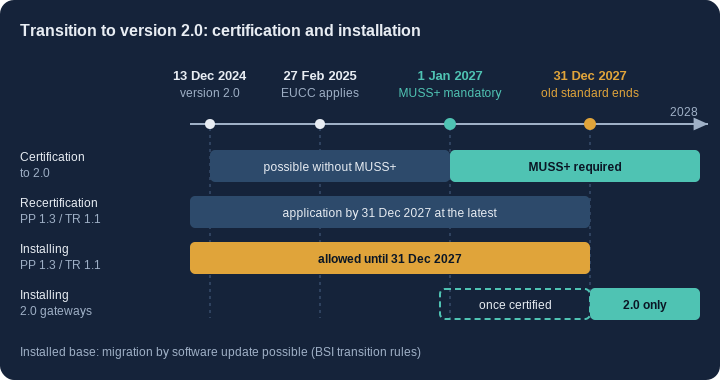
Four dates are enough for planning. Version 2.0, dated 13 December 2024, ended initial certification to the old standard. Since 27 February 2025 the European certification scheme EUCC has applied, and anyone applying for recertification to protection profile 1.3 since then has to move the device's security target to Common Criteria CC:2022. That is the manufacturer's job; you see it only in the scheme (CC or EUCC) named on the certificate. From 1 January 2027, MUSS+ applies to every certification to version 2.0. On 31 December 2027, installation to the old standard ends, and by that day at the latest so does the option to apply for recertification to it.
For recertification applications, the transition rules give "2 years after initial certification, but by 31.12.2027 at the latest" (translated from German). They do not explain which initial certification is meant. The only certainty is that the window closes by 31 December 2027 at the latest; for an individual model it can close earlier. How long a model you still want to call off in 2027 can be recertified therefore belongs in your query to the manufacturer. From 1 January 2028, new gateways go into meter cabinets only to version 2.0.
Procurement: what belongs in contracts and tenders
Anyone ordering gateways in 2027 buys against two dates and knows only one of them: the end of installation on 31 December 2027, and the day their manufacturer receives its version 2.0 certificate. A framework agreement that only fixes a model, a quantity and a unit price does not cover this transition. These points belong in new call-offs and amendments with the manufacturer:
- a delivery date for gateways certified to protection profile and TR-03109-1 version 2.0, including MUSS+, with a rule for what happens if the certificate arrives later;
- a commitment on whether, by when and at what cost delivered old-standard devices can move to version 2.0 by software update, because the transition rules allow that migration but oblige no manufacturer to offer it;
- call-off quantities by standard and quarter, so that no more old-standard devices reach the warehouse than installation can reliably fit by the end of 2027;
- the documents with which the manufacturer enables the MSB supply chain for its device, if you want to take responsibility for storage and transport from takeover yourself (see stock and supply chain).
One commitment is not the manufacturer's to give: that your gateway administrator runs the new device type and the WAN API in its system before the first units arrive. It belongs in the gateway administration contract if a service provider administers your gateways, otherwise in the project plan of your own administration.
From 1 January 2028, every new installation depends on a version 2.0 certificate. With a single supplier, your 2028 rollout hangs on that one manufacturer's certification date. A second supplier costs negotiation and integration effort in the gateway administration system, but it reduces that risk. If you have to tender as a sector contracting authority, the procurement needs lead time; if the second supplier is to deliver from January 2028, autumn 2027 is too late to start.
Stock and supply chain
Whether an old-standard gateway still on the shelf on 1 January 2028 may be installed after a software update to version 2.0, and how it would receive that update, is not explicitly settled in the transition rules; they mention migration only for installed devices. The safe plan is to have old stock installed by 31 December 2027: from autumn 2027 onwards, old-standard stock should not exceed what installation crews can reliably fit by year-end.
To manage that, warehouse management has to know the standard of every device: protection profile and TR version, firmware and certificate ID. The model name is not enough. For one of the five models, the product list shows five TR certificates between 31 January 2022 and 14 October 2025, so one model name covers devices with different certificates, and only the certificate ID shows the standard. Returns from the field belong in the same count, since the transition rules treat the installation of a reused device no differently from a new one.
With protection profile 2.0 you have a choice on the supply chain. You can take responsibility for storage and transport from takeover from the manufacturer through to installation yourself, under the requirements catalogue for the MSB supply chain that the BSI and VDE FNN published in November 2024. Or you stay with the manufacturer's certified secure supply chain (SiLKe). According to VDE FNN, delivery straight from the manufacturer remains under the manufacturer's SiLKe in either case; the MSB supply chain starts at takeover. Operators who choose it have to meet the protection profile's assumption A.Delivery under Annex VIII of the guideline, which describes the life cycle. In Common Criteria, an assumption is a condition on the operating environment under which the certificate's security claim holds; A.Delivery counts as met if the operator implements the catalogue. Under protection profile 1.3, each manufacturer described its own delivery measures, which the operator had to adopt; buying from several manufacturers meant working to several sets of rules side by side.
The catalogue requires a documented security concept, trained staff for storage, transport and installation, a contact point for security incidents and rules for logistics after removal. An external audit of the concept is not required. Since 20 May 2025, VDE FNN has provided a guide with templates for the security concept and training. Operators who do not want the effort stay with the manufacturer's SiLKe.
Rollout planning for 2027 and 2028
Mandatory installation continues, and the old standard can be installed throughout 2027; waiting for the first version 2.0 gateway wastes installation months. According to the Federal Network Agency (BNetzA), 3,172,579 of 54,135,202 metering locations had a smart metering system on 30 June 2026, which is 5.9 percent and around 765,000 more than six months earlier. Supervisory pressure stays on through the transition year: since March 2026 the agency has opened proceedings against 434 companies that missed the 20 percent quota.
The next milestone falls in the middle of the switch. For final consumers under Section 30(1) nos. 2 to 5 and Section 30(2) MsbG, the default metering point operator must, under Section 45(1) sentence 1 no. 4(c) MsbG, have fitted at least 90 percent of the metering points that have to be equipped in 2027 and 2028 by 31 December 2028. In the second half of this period quota, new gateways go into meter cabinets only to version 2.0.

It makes sense to sort installation cases by the device they need. Standard cases without special metering requirements can be served with the old standard in 2027. Where registering power metering is to run through the gateway, plan with version 2.0 devices, because RLM over the LMN is one of the MUSS+ requirements. That affects customers with load profile metering, and it can affect gas as well: Section 40 MsbG requires new gas meters with registering power metering to be connected to existing gateways from 1 July 2028 at the latest. Our article on multi-utility metering over the smart meter gateway shows how the LMN carries several utilities for that.
The gateway administrator has to add every new device type to its system first. A weekly schedule with version 2.0 devices therefore only stands once it has released the type.
Gateways already in the field
For installed gateways, the transition rules set no removal date, but they do name a route: migration from the old to the new standard by software update is possible. For operation, the law requires a valid certificate: under Section 24(4) MsbG, a gateway may only form part of a smart metering system with a valid certificate proven to the administrator, and Section 25(1) MsbG obliges the administrator to use only such gateways. The two most recent EUCC certificates on the list run until 2031 and 2034. Whether such a certificate alone is enough for operation after 2027 is open.
The BSI sources do not answer that question explicitly. The overview page for TR-03109-1 declares the old versions valid until the end of 31 December 2027. Section 19(2) MsbG only allows systems for metering and control processes relevant to the energy industry that satisfy Sections 21 and 22, and under Section 22(2) that is presumed if the protection profiles and technical guidelines are met in their applicable version. Read together, an old-standard device could lose that presumption from 2028; neither the transition rules nor the overview page settle this explicitly. Plan the migration as a project with 31 December 2027 as the target date, as far as your manufacturer delivers an update by then, not as an option for later. How your company assesses the legal question belongs with your legal department.

How many of your devices can migrate is up to the manufacturer: it has to develop the update and have it certified, and only the manufacturer knows whether the existing hardware supports every MUSS+ function. Each new gateway function goes through three steps: the BSI revises the guideline, the manufacturer has its update certified, and the gateway administrator installs it in the field, only with firmware the BSI has released. The slowest step sets the date.
In practice that means keeping an inventory by model, firmware and certificate, getting a written migration commitment from the manufacturer for each model, and planning field updates in waves with the gateway administrator. An update across many thousands of gateways is a rollout of its own, with a test group, a fallback and a check that every device delivers readings again afterwards.
Which systems change in-house
Each MUSS+ feature needs a system on the operator's side that processes it. VDE FNN aligned its requirements specification for gateway functions and processes with version 2.0 on 24 June 2026; you can base your requirements for manufacturers and gateway administration providers on it. Scaling the gateway administration system, head-end and meter data management to large device numbers is the subject of our article on the smart meter gateway back end.
Gateway administration system
WAN API to DIN VDE V 0418-63-8, creating and changing processing profiles for TAF 8 and TAF 15, distributing firmware to meters on the LMN. If administration is outsourced, this is your service provider's roadmap.
Meter data management
Accepts load profiles with maximum values (TAF 8) and readings from registering power metering (TAF 15), validates them and passes them on to billing and market communication.
Field work and workforce management
An order type for factory reset (user data deletion) for devices that are removed and installed elsewhere, plus the service technician's rights in the installation app.
Warehouse management
The standard of each device as master data: protection profile, TR version, firmware, certificate ID. A block from 1 January 2028 on every device whose master data still shows the old standard prevents wrong orders.
Test environment
Run the first version 2.0 device through the administration system, meter data management and installation process end to end before it goes into volume.
Rollout control
Plan installation cases by device need and standard; as a default metering point operator, keep the period quota for 31 December 2028 in the calculation.
Which records to keep
Under Section 24(1) MsbG, the manufacturer presents the certificates to the gateway administrator. Keep the following documents at hand for every device type anyway, because you check the devices at goods receipt and have them installed:
| Record | Who provides it | What to check |
|---|---|---|
| Security certificate under protection profile PP-0073 | Manufacturer, presented to the gateway administrator | Protection profile version (1.3 or 2.0), CC or EUCC scheme, validity |
| TR certificate for TR-03109-1 | Manufacturer | Test basis version 1.1 or 2.0; certifications to 2.0 from 1 January 2027 include MUSS+ |
| Entry in the BSI product list under Section 24 MsbG | BSI | Check at goods receipt, certificate ID per device |
| PTB type examination certificate | Manufacturer | Covers the functions relevant under German calibration law |
| Security concept for the MSB supply chain, with training records | Metering point operator | Only needed if you take responsibility for storage and transport from takeover from the manufacturer yourself |
| Gateway administrator certificate under Section 25 MsbG | Gateway administrator, in-house or service provider | According to the BSI, TR-03109-6 version 2.0 has to be implemented from 2027 at the latest, with the next initial certification or recertification |
For the administrator, version 2.0 of TR-03109-6 changes the audit benchmark; details are in the article on TR-03109-6 for gateway administrators. The book chapter on BSI standards and certification puts device and administrator certification side by side.
What happens without a matching certificate
A manufacturer that cannot prove MUSS+ receives no version 2.0 certificate from 1 January 2027. At the metering point operator, the consequence arrives at the meter cabinet: without a valid certificate, a smart meter gateway may not form part of a smart metering system under Section 24(4) MsbG, and under Section 25(1) MsbG the gateway administrator may not use it. You can therefore only have devices installed whose certificate is valid and whose standard is permitted on the day of installation: under the transition rules, old or new standard until 31 December 2027, only the new one after that. Whether an installed old device with a valid certificate may keep running after 2027 is open (see gateways already in the field). This is a general reading of the provisions, not an assessment of any individual case.
Criticism of the scope and open questions
Bitkom and BDEW criticised the scope of version 2.0 while it was still a draft. In its statement on the second industry consultation in August 2024, Bitkom counted well over 900 requirements in the draft, twice as many as in version 1.1, including well over 700 MUSS. Because of the short time for technical implementation, the new MUSS+ level would bring "only little relief in practice", it wrote, and the many mandatory functions threatened to delay the rollout ramp-up "by several years" (both translated from German). On 9 July 2024 BDEW called for the revision to be "agile and modular" and for whatever speeds up the rollout to come first.
Two years later, a manufacturer looks at the scope from a different angle. Bitkom wanted fewer mandatory functions; Ruwen Konzelmann, managing director of Theben Smart Energy, sees a need for more standardisation because smart meter gateways are turning into volume products (50komma2, 12 June 2026). For 2027 he expects a transition phase in which newly certified gateways enter gateway administration systems step by step, and substantial development effort to bring his own device to version 2.0. For your planning, that means expecting delivery dates that only become clear in the course of 2027.
For metering point operators, four points remain open:
- When the first version 2.0 certificates arrive. EFR called its gateway, certified to the old standard in March 2026, "TR v2.0 ready" in April; according to the company release, that means functions such as control from the gateway can be added by software update. Certification to version 2.0 was said to be in preparation.
- Which installed models can migrate by software update, by when and at what cost.
- Whether old-standard gateways may keep running after 2027 without migration (see the section on gateways already in the field).
- How quickly gateway administration providers add new device types to their systems.
What metering point operators should do now
Preparing for the end of installation in late 2027 starts now, even though nothing has to happen on the deadline itself: contracts and systems need lead time, and a mistake would only show in January 2028, when an installer stands in front of a meter cabinet with an old device.
Next steps until spring 2027
-
Get manufacturer dates in writing
When does each supplier expect its certificate to protection profile and TR-03109-1 version 2.0, which delivered models get a migration update by when, and how long can old-standard models still be recertified?
-
Count the stock
Record inventory by standard and set it against planned installations until December 2027.
-
Draw up a 2027 quantity plan by standard and quarter
Serve standard cases with the old standard and reserve cases with registering power metering, including gas meters with RLM under Section 40 MsbG, for version 2.0 devices. As a default metering point operator, keep the period quota for 31 December 2028 in the calculation.
-
Update contracts
Delivery date for version 2.0 devices with MUSS+, migration commitment, call-off quantities by standard and, if you choose it, the MSB supply chain documents as part of the contract; decide on a second supplier while there is still time for a tender.
-
Decide on the supply chain
MSB supply chain with your own security concept and trained staff, or the manufacturer's SiLKe. The decision has to be made before the first delivery of protection profile 2.0 devices.
-
Test the administration system and meter data management
Agree with the gateway administrator when the new device type, the WAN API and the profiles for TAF 8 and TAF 15 will run in its system, and take the first version 2.0 device once through the whole chain, from installation to reading.
-
Reorganise returns
Add factory reset (user data deletion) as an order step, and schedule removed old-standard devices so that they are reinstalled before the end of 2027.
Deadline, market roles, systems
Applies from BSI TR-03109-1 v2.0: gateway certificates only with MUSS+
Applicability: Addressed to manufacturers that have gateways certified. Metering point operators are affected through procurement and rollout of new devices.
If the deadline is missed: Exclusion or loss of role Without MUSS+ proof there is no version 2.0 certificate from that date; under the BSI transitional rule, gateways under TR v1.1 and protection profile v1.3 may still be installed until 31 December 2027. Without a valid certificate, a smart meter gateway may not be used as part of a smart metering system under Section 24(4) MsbG, and under Section 25(1) MsbG the gateway administrator may only use gateways with valid certificates. Legal basis ↗
- Default metering point operatoraffectedAsks gateway vendors when devices certified under version 2.0 with MUSS+ will be available and plans procurement and rollout for 2027 and 2028 around those dates.Typically affected: Gateway administration and CLS management, Field service and work orders
- Competitive metering point operatoraffectedAsks gateway vendors when version 2.0 devices can be delivered and plans procurement accordingly.Typically affected: Gateway administration and CLS management, Field service and work orders
A classification for typical market roles, not a review of your individual case and not legal advice. Whether an obligation applies to your company (thresholds, exemptions) is for your legal department or counsel to confirm. The calendar doesn't replace your own deadline review. Information as of: 22 November 2026.
Further Reading
Frequently Asked Questions
MUSS+ is a binding level in version 2.0 of BSI TR-03109-1 for smart meter gateway requirements that have to be implemented from 1 January 2027 at the latest. Unlike MUSS requirements, they could still be missing in certifications to version 2.0 until the end of 2026. According to the BSI, MUSS+ covers the WAN API, registering power metering over the local metrological network and factory reset by the service technician, among others. In Annex II of the guideline, the processing profiles for TAF 8 and TAF 15 and firmware updates for connected meters carry the same level; factory reset appears there as user data deletion.
It applies to certifications to protection profile and TR-03109-1 version 2.0, so to the manufacturers who have their gateways certified by the BSI. From that day, such a certificate requires proof of MUSS+. A metering point operator has nothing to do on the deadline itself; it is affected indirectly, through the devices it buys and has installed.
Yes. Under the BSI transition rules, gateways to TR-03109-1 version 1.1 and protection profile 1.3 may be installed until 31 December 2027. From 1 January 2028, only version 2.0 gateways go into new installations. Whether an old-standard device from stock may still be installed after that following a software update to the new standard is not explicitly settled in the transition rules; the safe plan is to have old stock installed by the end of 2027.
The transition rules set no removal date. They state that installed gateways can migrate from the old to the new standard by software update. Whether and when that works for a given model is up to the manufacturer. According to the BSI, the old versions of protection profile and guideline remain valid until the end of 31 December 2027; whether old-standard devices may keep running after that without an update is not stated explicitly in the BSI sources.
No, as of 24 November 2026. The BSI product list under Section 24 MsbG shows five gateways from five manufacturers. All security certificates refer to protection profile 1.3, including the most recent ones from 31 July and 28 September 2026, and the latest TR certificate from 24 March 2026 names TR-03109-1 version 1.1 as its test basis.
A requirements catalogue from the BSI and VDE FNN under which the metering point operator can take responsibility for storage and transport of smart meter gateways from takeover from the manufacturer through to installation. The MSB supply chain is a choice; the alternative remains the manufacturer's certified secure supply chain. For gateways under protection profile 2.0, the protection profile's assumption A.Delivery, a condition on the operating environment, counts as met if the operator turns the catalogue into its own security concept and trains its staff.
Let's collaborate
One contact, a team behind it
Thirty minutes on what you're working on, whether grid, metering, market processes, IT architecture or AI. Afterwards you'll know how we'd approach it and who would sit at the table.
Energy and measurement technology since 2010 · innobu GmbH since 2014 · Based in Schleswig-Holstein, Germany
Whoever pitches also delivers: whoever leads the first call stays your contact right through to the steering committee, with established partners in the project. Direct: info@innobu.com