BNetzA quarterly survey: report supplier switches and disconnections by 15 November
Since May 2025 every electricity and gas distribution system operator in Germany has reported three figures per month each quarter: household supplier switches, move-ins with a supplier other than the default supplier, and disconnections carried out on a supplier's instruction. Monthly figures appear on SMARD and has announced that it will also show them per network area. Then it may show whose figures fall out of line, for instance because an operator draws the line on customer group, repeat switches or completed disconnections differently from the survey form.
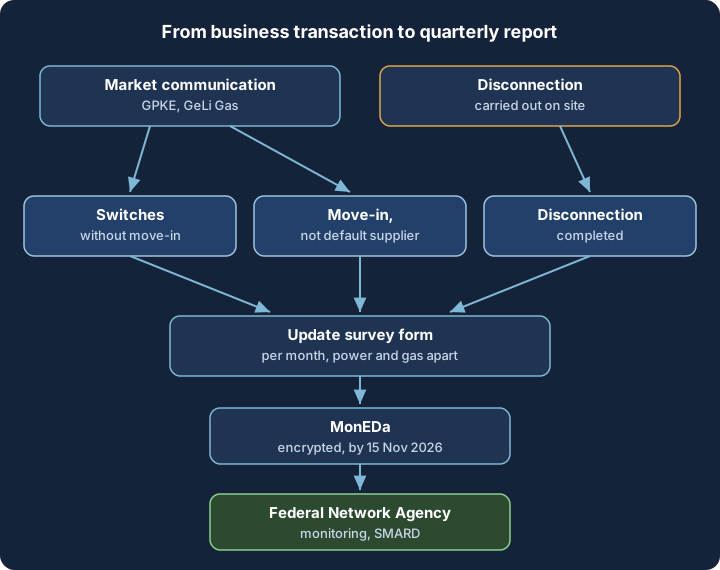
The quarterly survey of the Federal Network Agency (BNetzA) is a monitoring survey under Section 35 of the German Energy Industry Act (EnWG) in which every electricity and gas distribution system operator reports three figures for each month: household supplier switches without a move-in, move-ins where the customer chose a supplier other than the default supplier straight away, and market locations where the operator actually cut off supply on a supplier's instruction. The survey form is due via the MonEDa platform by the 15th of the second month after the quarter ends; for July to September 2026 that is Sunday, 15 November 2026, and the agency names no substitute date. Operators carry the form forward quarter by quarter; earlier values stay in place and may be corrected. Since December 2025 the agency has published the monthly figures on SMARD; for 2025 it counted about 6.7 million electricity and 2.1 million gas switches by households, and almost 254,000 electricity and about 34,000 gas disconnections. If an operator does not deliver, the agency can demand the information by decision under Section 69 EnWG and enforce it with coercive fines.
What the quarterly survey asks for
Since 15 May 2025 the Federal Network Agency no longer asks electricity and gas distribution system operators about supplier switches and disconnections only once a year, but every quarter and month by month. In the first report, operators covered all of 2024 and the first quarter of 2025; since then every operator has carried the same form forward from one quarter to the next. Its legal basis is the monitoring under Section 35 EnWG, whose subsection 1 no. 10 names supplier and product switching and supply interruptions explicitly.
The scope is small: electricity and gas each have an Excel form with three columns per month, plus a field for the operator number from the agency's master data survey and one for the company name. As an official form, it is fixed: its structure, labels and metadata must not be changed, and every cell carries a field name that takes the value into the agency's database.
| Item | Electricity | Gas |
|---|---|---|
| Operator number | 100XXXXX from the master data survey | 12xxxxxx from the master data survey |
| Switch without move-in | under GPKE, household customers excluding heating power | under GeLi Gas, household customers |
| Move-in with another supplier | supply start under GPKE with a supplier other than the default supplier, excluding heating power | supply start under GeLi Gas with a supplier other than the default supplier |
| Disconnections | successful interruption under Section 24(3) NAV | successful interruption under Section 24(3) NDAV |
| Transmission | encrypted via MonEDa | encrypted via MonEDa |
MonEDa requires the operator number, a control number and a key; operators that already hold credentials for the agency's network operator portal can use them here too. Technical questions go by email to monitoring.energie@bnetza.de, subject line "Rückfrage Quartalsabfrage VNB", or through the contact form in MonEDa; the agency names no hotline.
Deadline 15 November 2026: the third quarter
Each quarter's form has to reach the agency by the 15th of the second following month, so for July, August and September 2026 by 15 November. That is a Sunday, and the agency names no substitute date. Whether the deadline moves to Monday, the agency doesn't say; if you submit on Friday, 13 November, you don't have to answer that question. MonEDa adds a detail of its own: the transmission receipt only confirms that the file was sent, and the agency advises checking on the following day whether the transmission succeeded.
Third quarter 2026
July to September, the quarter with the most disconnections.
Fourth quarter 2026
October to December; January, the month with the most switches, only lands in the May report.
First quarter 2027
January to March, again a deadline at the weekend.
Second quarter 2027
April to June.
For the disconnection count, the third quarter is the heaviest. According to SMARD, disconnections peak from July to September and are lowest in December, while supplier switches peak in January. That makes this the quarter where the disconnection extraction is tested hardest, with the largest volumes and the most special cases in field execution. Because the same form also holds July to September 2024 and 2025, a comparison with those quarters shows outliers before you submit.
Three figures and their counting rules
The counting rules sit in the form's filling instructions; no regulatory determination interprets them further, so doubtful cases can only be settled by asking the agency. The rules are short, but at three points stricter than a quick query in the billing system: the customer group, multiple counting, and the question of when a disconnection counts as one.
Switches without a move-in
The form counts market locations of household customers within the meaning of Section 3 no. 57 EnWG (the form still cites the old number 22) where a supplier switch under GPKE or GeLi Gas took place without anyone moving in. For electricity, heating power is excluded. Under the Act a household customer is not only a private household but also a business, farm or practice consuming no more than 10,000 kilowatt hours a year, so a filter on "private customer" in the billing system undercounts. Each business transaction counts separately: if the same market location switches twice in a quarter, each switch counts in its own month.
Move-in with a supplier other than the default supplier
The second column records household customers who chose a supplier other than the local default supplier when they moved in, technically a supply start under GPKE or GeLi Gas assigned to a non-default supplier. For this, the extraction needs the default supplier of the operator's own area as a fixed exclusion. Supply starts with the default supplier never count, not even under a special contract; the form asks about the supplier, not the tariff. Where a sister company in sales is the default supplier, that exclusion belongs explicitly in the query.
Disconnections
The third column takes market locations where the operator successfully cut off supply on the instruction of the default or substitute supplier or another supplier, the case that Section 24(3) NAV and NDAV regulate. By that wording, two groups are not included: interruptions the operator carries out in its own right, for instance in case of danger, consumption bypassing the meter or the operator's own unpaid claims (Section 24(1) and (2) NAV), and orders that were not carried out on site because nobody opened the door, access was missing or the customer paid after all.
In both switching columns a household customer under Section 3 no. 57 EnWG includes small businesses up to 10,000 kilowatt hours, heating power is excluded for electricity, and each switch counts in its own month, including a second one at the same market location. The disconnection column counts every completed supplier order, with no restriction to households.
The form is filled in on a rolling basis. Earlier quarters' values must not be deleted, because deletion overwrites the data in the database; corrections are explicitly allowed. Every report is therefore also a chance to fix older months, for instance when cancellations were booked late. We would record every correction with date and reason in the operator's own documentation, because a monthly value changed after the fact raises questions at the latest when the agency follows up.
Where the figures come from: market communication and field execution
Two of the three figures sit in market communication, the third in field service. Supplier switches and supply starts are GPKE and GeLi Gas business transactions the operator processes anyway, in many companies in SAP IS-U or a comparable billing system with a connected market communication system. Your extraction has to split them by month, sector, customer group and default supplier. Since the 24-hour supplier switch, electricity switches go through within one working day, and for gas GeLi Gas 2.0 has applied since 1 April 2026; which month a switch belongs to should therefore follow one fixed date field, such as the supply start.
Whether rejected or withdrawn registrations count, the form doesn't say explicitly; it refers to the "business transaction of the supplier switch". We would count only switches that led to an assignment and write that rule down. If you're unsure, ask through the agency's mailbox and keep the answer in the same documentation.

The disconnection count needs more than a system query. Orders arrive from the supplier through market communication, but the technician on site is the first to know whether the interruption worked. Depending on the company, the feedback ends up in workforce management, in the order status of the billing system or on a paper slip. Only if it is in the system per market location and with a date can the figure "successfully interrupted" be backed up; otherwise the extraction counts orders instead of disconnections, and the report comes out too high. Operators need the same feedback anyway to tell the supplier the order was executed; if the market location in the order doesn't match the installation on site, that affects master data quality in market communication and the disconnection count alike.
Grid companies running both electricity and gas report two forms with two operator numbers. A disconnection of electricity and gas at the same address is two market locations on two forms, even if the technician did both in one visit.
What the agency does with the figures
On 15 December 2025 the Federal Network Agency published monthly figures on switches and disconnections on SMARD for the first time; before that only annual figures appeared there. It updates the monthly values once a quarter, after each round of operator reports. It has announced figures for individual network areas to make regional differences in disconnections and switches visible; we found no such publication up to the end of October 2026.
With 6.7 million electricity and 2.1 million gas switches, 2025 was by these figures the second-strongest switching year, behind 2024 with 6.9 million electricity and 2.4 million gas switches. The 2025 monitoring report, however, gives about 7.1 million electricity customers who changed supplier in 2024. The sources don't say how the two definitions differ; if you compare your own values with published ones, always name the source.
In its release of 11 March 2026 the agency also writes that it is receiving more and more reports of problems at distribution grid level that make switching harder. With monthly figures per operator it can check such reports against its own statistics, for example whether noticeably few switches go through in one area.
Disconnection figures in the debate: consumer protection and disconnection fees
Of the three figures, the disconnection count draws the most public attention, and with it the operators that carry disconnections out. The Federation of German Consumer Organisations (vzbv) presented a market check of the operators of 58 networks (29 electricity, 29 gas) in densely populated cities in 2026: disconnection and reconnection together cost between 92 and 231 euros for electricity, 145 euros on average, and between 92 and 315 euros for gas, 168 euros on average. It criticises price sheets that are hard to find, cost items shown inconsistently and differing treatment of VAT, and calls for more protection against disconnection in special contracts, stronger arrangements to avert disconnections and a clear definition of "reasonable" costs. Consumer advice centres received over 1,700 complaints about electricity and gas disconnections in 2025, 36 percent more than a year earlier.
The operator doesn't decide on a disconnection for arrears owed to the supplier, it carries it out: under Section 24(3) NAV only if the supplier credibly assures that the conditions are met and indemnifies the operator against damages claims. Whether a disconnection of a household customer is permissible, with notice four weeks ahead, a minimum arrear and a proportionality test, is for the supplier to check under Section 41f EnWG.
Even so, the figure an operator reports each quarter is the one consumer groups and the press work with, and the one that may later appear per network area.
What applies if the report is missing
The quarterly survey page sets no specific consequence. Under Section 35(2) EnWG the powers of Section 69 apply to monitoring: the agency can demand the information by decision (Section 69(1) no. 1 and (7)) and enforce it with coercive fines under Section 94 EnWG. Breaching an enforceable order under Section 69(7) sentence 1 is an administrative offence under Section 95(1) no. 3(a) EnWG, with a fine of up to 100,000 euros (Section 95(2) no. 5). For the annual monitoring survey the agency explicitly announces an information order with a threatened coercive fine for late delivery and says it will monitor deadlines more closely; for the quarterly survey there is no such announcement. In another area, the smart meter rollout under the Metering Point Operation Act, it has already used its powers, with supervisory proceedings against metering operators that fell behind.
What operators should do by 15 November
Sending the file through MonEDa takes minutes; the time goes into defining the disconnection count. If you want to be done by Friday, 13 November, start with access and extraction now.
The next two weeks
-
By Monday, 2 November: settle ownership and access
Name who reports and who stands in, and check that operator number, control number and key for MonEDa are at hand.
-
By Friday, 6 November: run the July to September extraction
Switches and move-ins per month and sector, filtered to household customers under Section 3 no. 57 EnWG including small businesses, without heating power for electricity, with the default supplier excluded for move-ins.
-
By Tuesday, 10 November: check the disconnection count against execution
Only supplier orders with the feedback "interrupted" count. Pull a sample of market locations and compare it with the technicians' reports; Take cases that differ out of the current report and correct the monthly value later once they are resolved; if more than isolated cases differ, fix the field-service feedback before the next report.
-
By 13 November: update and submit the form
Open the previous quarter's form, enter July to September, leave earlier values in place, encrypt it and send it via MonEDa; check receipt the next day.
-
By February: fix the extraction in writing
Document query, filters and counting rules so the report for 15 February 2027 produces the same figure even if someone else runs it. In the medium term the agency plans to move its surveys to the BNetzA Data Hub, with access via the ELSTER business account; it gives no date. That changes the transmission route, the extraction in your own systems stays.
Deadline, market roles, systems
15 November 2026Federal Network Agency quarterly survey: report supplier switches and disconnections (15 February, May, August, November)Regulatory ruling · adopted
Applicability: All electricity and gas DSOs. The basis is the monitoring task under Section 35 EnWG. 15 November 2026 is a Sunday; the agency gives no substitute date.
If the deadline is missed: Regulator can enforce The page sets no specific consequence. Under Section 35(2) EnWG the powers of Section 69 apply to monitoring: the agency can demand the information by decision (Section 69(1) no. 1 and (7)) and enforce it with coercive fines under Section 94 EnWG; breaching an enforceable order under Section 69(7) sentence 1 is an administrative offence under Section 95(1) no. 3(a) EnWG (fine of up to EUR 100,000, Section 95(2) no. 5). Legal basis ↗
- Electricity grid operatorrole obligationExtracts the quarter's monthly switching and disconnection figures from the billing system and uploads the updated survey form to MonEDa.Typically affected: SAP IS-U / S/4HANA Utilities, Regulatory management, controlling
- Gas grid operatorrole obligationReports monthly switching and disconnection figures for the gas network with the updated survey form via MonEDa.Typically affected: SAP IS-U / S/4HANA Utilities, Regulatory management, controlling
A classification for typical market roles, not a review of your individual case and not legal advice. Whether an obligation applies to your company (thresholds, exemptions) is for your legal department or counsel to confirm. The calendar doesn't replace your own deadline review. Information as of: 1 November 2026.
Further reading
Frequently asked questions
A monitoring survey under Section 35 EnWG of all electricity and gas distribution system operators in Germany. They report three figures per month: household supplier switches without a move-in, move-ins where the customer chose a supplier other than the default supplier, and market locations where they cut off supply on a supplier's instruction. Each quarter's form goes to the Federal Network Agency via MonEDa by the 15th of the second following month.
By 15 November 2026. That is a Sunday, and the agency names no substitute date. If you submit by Friday, 13 November, you can still check receipt before the deadline. After that come 15 February, 15 May and 15 August 2027.
Market locations where the operator successfully cut off supply on the instruction of the default or substitute supplier or another supplier (Section 24(3) NAV for electricity, NDAV for gas). By the wording of the form, orders that were not carried out and interruptions the operator makes in its own right, for instance in case of danger, are not included.
Some do. The form asks about household customers as defined in the Energy Industry Act (now Section 3 no. 57 EnWG, cited in the form as no. 22), which includes customers buying energy for professional, agricultural or commercial purposes up to 10,000 kilowatt hours a year. Larger business customers don't count, and for electricity heating power is excluded as well.
Yes. The form is filled in on a rolling basis, and later corrections are explicitly allowed. Earlier values must not be deleted, though, because deletion overwrites the data in the agency's database. The structure, labels and metadata of the official form stay unchanged.
Under Section 35(2) and Section 69 EnWG the agency can demand the information by decision and enforce it with coercive fines under Section 94. Ignoring an enforceable order is an administrative offence, for which Section 95 EnWG provides a fine of up to 100,000 euros. Whether and how the agency acts in a given case is for the agency to decide.
Let's collaborate
One contact, a team behind it
Thirty minutes on what you're working on, whether grid, metering, market processes, IT architecture or AI. Afterwards you'll know how we'd approach it and who would sit at the table.
Energy and measurement technology since 2010 · innobu GmbH since 2014 · Based in Schleswig-Holstein, Germany
Whoever pitches also delivers: whoever leads the first call stays your contact right through to the steering committee, with established partners in the project. Direct: info@innobu.com