Card payment at existing fast chargers: what AFIR requires by 1 January 2027
New charging points have been covered since April 2024; for part of the installed base the rule applies from the turn of the year. Anyone running older fast chargers near a TEN-T exit needs more than a device: a payment service provider, a link to the charging backend, a way to issue receipts and a file of evidence for the Federal Network Agency (Bundesnetzagentur).
From 1 January 2027, Article 5(1) of AFIR (Regulation (EU) 2023/1804) requires a payment card reader or a contactless card device also at publicly accessible, paid charging points of 50 kW and above that were built before 13 April 2024. For this installed base the rule only applies along the TEN-T road network, meaning on the network itself or within 3 km driving distance of the nearest exit, or at a certified safe and secure parking area. One terminal may serve several charging points within a recharging pool. A QR code is only enough below 50 kW, and an operator-only app never is. Under Section 5 of the German Charging Station Ordinance, the Federal Network Agency can request evidence, require a retrofit and prohibit the operation of a charging point. The European Commission's ongoing AFIR review does not change the deadline unless Parliament and Council adopt an amended text.
What Article 5 AFIR requires from 1 January 2027
Since 13 April 2024, operators have had to offer ad hoc charging at every publicly accessible charging point (Article 5(1), first subparagraph), and every point built since then has had to accept a payment instrument widely used in the EU (second subparagraph). For older points, AFIR has not required these payment means so far. The third subparagraph brings part of them in on 1 January 2027: charging points of 50 kW and above along the TEN-T road network and at safe and secure parking areas, which Article 2(63) defines as certified parking areas for drivers carrying goods or passengers. Two kinds of device count there, a payment card reader (point a) or a device with a contactless function that can at least read payment cards (point b). The regulation does not name card types; which cards a terminal accepts is set by the contract with the payment service provider.
What falls short is spelled out in the European Commission's AFIR questions and answers of 17 April 2024. A solution that only accepts the app of the operator or a mobility service provider does not meet paragraph 1 at any power output in the Commission's view, because using the app requires registration and therefore a contract; cash alone is not enough either. A contactless reader that also accepts cards stored in digital wallets is fine. Whether a PIN pad is needed does not depend on the choice of device, the Commission says, but on the payment instrument and its customer authentication rules, so it's worth settling that with your payment service provider before ordering hardware.
The provision pins down the device but not where it goes. For operators of older charging parks, the following sentence is the most useful one, because it spares them from rebuilding every charger:
"A single payment terminal or device referred to in the second subparagraph may serve a number of publicly accessible recharging points within a recharging pool."
Article 5(1), fourth subparagraph, Regulation (EU) 2023/1804"The second subparagraph" refers to the device types listed there. Under Article 2(51) AFIR, a recharging pool is one or more recharging stations at a specific location. Whether two physically separate charging islands on the same premises form one pool or two, the definition leaves open.
Paragraph 2 only concerns charging points with automatic authentication such as Plug and Charge: there, end users must be able to opt out of the automatic route and charge ad hoc or with another contract-based solution instead, and the operator must display that option clearly at the charging point. This duty has applied to existing points too since 13 April 2024, and nothing about it changes on 1 January 2027. Which standard automatic authentication at new points has to use is covered in our article on ISO 15118-20 and Plug and Charge.
Which existing charging points are covered
An existing charging point only falls under the retrofit obligation if five criteria apply together. For publicly accessible points commissioned before 13 April 2024, the current FAQ of the Federal Network Agency say the payment requirements of the German Charging Station Ordinance (Ladesäulenverordnung, LSV) apply in the version in force when they were commissioned. If such a point misses one of the other criteria, that remains the case: no new obligation under Article 5(1) AFIR arises for it on 1 January 2027.
| Criterion | Provision | Question for the installed base |
|---|---|---|
| Publicly accessible | Art. 2(45) AFIR, Section 2(2) LSV | Is the site open to the general public, even if it sits on private land or is only open at certain times? |
| Paid | Art. 5(1), fifth subparagraph | Is a fee charged for charging? Without a fee the obligation does not apply. |
| 50 kW or more | Art. 5(1), third subparagraph; Art. 2(44) AFIR | Does the individual charging point reach 50 kW? AFIR measures the theoretical maximum power of the charging point; the Federal Network Agency's FAQ tie the payment requirements to the largest charging point of the charging device. |
| Built before 13 April 2024 | Art. 5(1), third subparagraph | Was the point built before that day? AFIR does not define "deployed" further; the Federal Network Agency's FAQ refer to commissioning. Where construction and commissioning fall on either side of 13 April 2024, the case is open. |
| Location | Art. 2(3) and 2(63) AFIR | Is the site on the TEN-T road network itself or no more than 3 km driving distance from its nearest exit? Or is it at a parking area for drivers carrying goods or passengers that is certified under Delegated Regulation (EU) 2022/1012? |
The last criterion takes the most work. Under Article 2(3) AFIR, "along the TEN-T road network" means for recharging stations that they are on the network itself or within 3 km driving distance of the nearest exit. For a charging park at a truck stop, the evidence file therefore needs the coordinates, the nearest exit and the length of the driving route, not just the road number. Which roads belong to the network is shown by the maps in Annex I of the TEN-T Regulation (EU) 2024/1679. It replaced the old Regulation 1315/2013 on 18 July 2024, and under its Article 68 the reference in AFIR now points to it as well, so the check runs against the new maps.
No public statistic shows how many charging points in Germany fall under the obligation. On 1 March 2024 the Federal Network Agency counted 25,291 fast charging points, but it counts every point above 22 kW, and its register says nothing about TEN-T location. Points added up to 12 April 2024 also belong to the installed base; points of 50 kW and above built from 13 April 2024 had to offer card payment from the start. Only operators can therefore filter their own master data to find out which older sites are affected.
The obligation lies with the operator, meaning the entity responsible for managing and operating the charging point and providing the charging service (Article 2(39)). Paragraph 11 only requires the owner to provide the operator with the technical features for other Article 5 duties (opting out of automatic authentication, digital connectivity, smart charging, a fixed cable), not for card payment under paragraph 1. If you run charging points on third-party land, or have a service provider acting as operator, settle who buys the terminal and who pays before you place the order.
Small electricity distribution system operators in vertically integrated undertakings with fewer than 100,000 customers connected directly or indirectly (Section 7(2) EnWG) face two deadlines on consecutive days. By 31 December 2026 they must notify the Federal Network Agency of their activities relating to charging points they already developed, managed or operated before 27 July 2021, and cease them, unless the agency has granted approval under Section 7c(2) EnWG (Section 118(34) EnWG; more in our article on unbundling and the end of charging points run by small grid operators). On 1 January 2027 the card rule kicks in. Whoever takes those points over, such as the group's sales or e-mobility company, takes on the retrofit obligation with them, and under Section 4(1) LSV both the previous and the new operator have to report the change of operator without delay.
Three retrofit options: charger, site or replacement
Each affected site offers three routes; which one fits depends on the remaining service life, age and manufacturer of the chargers. For older charging parks with several chargers that are meant to keep running for some years, we recommend a central terminal per site: the fourth subparagraph covers it explicitly, and because the terminal sits outside the charger, its housing stays untouched. Whether firmware or backend need adapting is still worth settling with the manufacturer beforehand.
| Option | What changes | Fits when | Watch out for |
|---|---|---|---|
| Terminal in or on the charger | manufacturer's retrofit kit inside or on the housing | the manufacturer offers a kit for the model and the site has only one or two chargers | agree any intervention with the manufacturer first, including on calibration-law conformity; one terminal and one device contract per charger |
| Central terminal per site | one terminal on a post, wall or information pillar serves several charging points | several older chargers stand at one site and are meant to keep running for some years | mapping terminal to charging point in the backend, any firmware or backend changes, clear guidance on site (pay first, then plug in), protection against weather and vandalism |
| Replacing the charger | new charger with built-in terminal | the charger is near the end of its service life anyway | counts as a newly built charging point: price display under Art. 5(4), smart charging under Art. 5(8) and, from 2027, the ISO 15118-20 standard |
Ionity's fast charging network shows what a site terminal looks like in practice. At older sites whose chargers cannot easily take a terminal, a card terminal hangs on a post and serves every charging point: the driver activates the charger's display, pays contactlessly at the post and then plugs in. According to the company, more than 60 German sites had such a terminal in October 2026, and 464 sites in 22 countries are being retrofitted in total (electrive, 7 October 2026). A site built this way needs a pointer to the terminal on the post at every charger.
Manufacturers and operators publish few reliable retrofit cost figures. The only public figure we found dates from the legislative process: the joint letter from e-mobility companies and associations, published by the European electricity industry association Eurelectric, puts a card terminal for a new charging point of up to 11 kW in Vienna at about €3,000 plus about €600 a year to run it, excluding changes to charger and backend and technical approval. The letter used it to argue that a card reader makes small charging points up to 200% more expensive; it gives no figure for fast chargers. Whatever the amount, the device cost arises once per site with a site terminal and once per charger with the charger option.
Behind the terminal: backend, payment provider, receipt
For a card payment to start a charging session and capture the right amount at the end, four parties have to work together: the terminal, the payment service provider holding the acquiring contract (the contract for accepting card payments), the charging backend and billing. According to the Federation of German Consumer Organisations (vzbv), the vast majority of charging sessions today are contract-based, so a payment flow without a customer account is something many backends and accounting teams have not handled before.
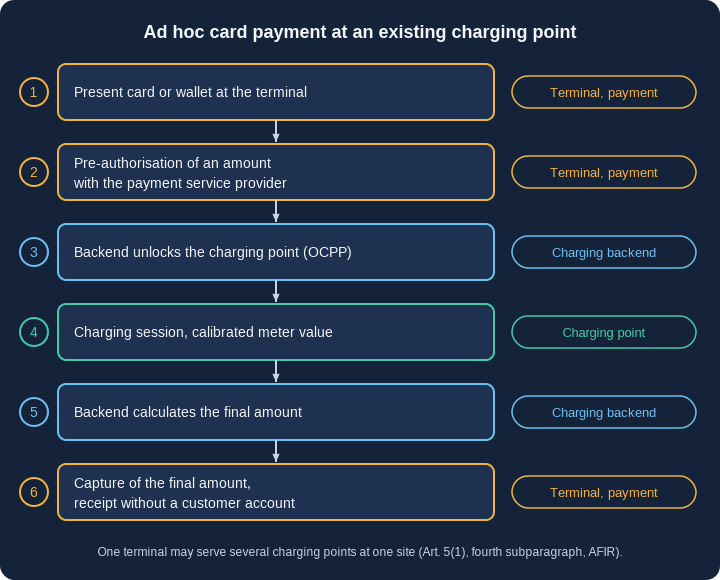
How ready the backend is depends on the version of the Open Charge Point Protocol (OCPP) between charger and backend. The Open Charge Alliance described it in January 2024: OCPP 1.6 needs custom extensions for ad hoc payment via the DataTransfer message, which the protocol provides for vendor-specific functions. OCPP 2.0.1 can transmit card information and costs but also needs a custom message for settlement data. Only OCPP 2.1 standardises the flow including a settlement message. The Alliance itself calls this a minor customisation for 1.6 and 2.0.1. If your older chargers run OCPP 1.6, it is still worth settling with the charger manufacturer and backend provider before ordering whether the terminal connects to the charger or to the backend and who supplies the extension; that depends on OCPP version and firmware, among other things.
An ad hoc payment runs in two steps. Before charging, the terminal reserves an amount on the card through the payment service provider, since the final amount is not yet known; after charging, the backend calculates the price from the calibrated meter value and only that amount is captured. AFIR does not require a receipt after charging, a gap the European consumer organisation BEUC criticised in its paper of 30 July 2026. What is required comes from Section 33(3) of the German Measurement and Calibration Act (MessEG): anyone who uses measured values for invoices must make sure the customer can easily verify them. For contract customers that proof sits with the account and the invoice; ad hoc charging without an account needs its own route, for example a receipt via a QR code on the display or a receipt portal keyed to a transaction number. How calibration-compliant billing is set up in practice is covered in our article on calibration-compliant charging billing.

On price display, AFIR adds nothing for existing points. The duty to show the ad hoc price per kWh and any per-minute fee at the station for charging points of 50 kW and above (Article 5(4)) applies only to points built from 13 April 2024. Section 14(2) of Germany's Price Indication Ordinance (PAngV) already applies today to every payment method for ad hoc charging, web payment via QR code included: the energy price of the charging point has to be stated at or near the point, by print, display or a website that needs no registration. The price display is therefore not new; with the terminal it also has to hold for card payment and match the price in the backend.
The ad hoc price is also dynamic data under Article 20(2) AFIR, which operators deliver to the national access point through an interface. How that works in Germany is explained in our article on the DATEX II charging data obligation.
Evidence for the Federal Network Agency
A new German Charging Station Ordinance of 23 December 2025 (Federal Law Gazette 2025 I No. 367) has applied since 1 January 2026. It has six sections and refers directly to AFIR for most requirements. For the card rule, Section 5(1) is what counts: the Federal Network Agency can regularly check compliance with Article 5(1) AFIR and request suitable evidence. The ordinance does not say what evidence it considers suitable. We therefore recommend an evidence file that answers, for every charging point, whether it is affected and how it meets the obligation.
- Per charging point: commissioning date, charging power, whether a fee is charged, and the result of the location check with coordinates, nearest TEN-T exit and driving distance.
- Per terminal: device type, mounting location, the charging points it serves, its commissioning date and the record of a test payment with receipt.
- For charging points that are not affected: the reason, such as power below 50 kW or a location outside the TEN-T zone, with the date of the check.
- The contracts with the payment service provider and the manufacturer or installer, and for operator models the arrangement with the owner.
The file also helps with the ordinance's second duty. Under Section 4(1) LSV, commissioning, decommissioning and any change of operator have to be reported electronically to the Federal Network Agency, and replacing a charger means decommissioning one charging point and commissioning a new one. A retrofit without replacement is not mentioned in Section 4. According to the Federal Network Agency's FAQ, however, technically relevant changes made during a conversion may have to be reported via a change notification, and its notification asks for the type of payment system.
What happens if the deadline is missed
If a charging point does not meet Article 5(1) AFIR, the Federal Network Agency can require it to be retrofitted under Section 5(2) of the German Charging Station Ordinance and prohibit its operation under Section 5(3). The provision also allows a prohibition where an operator has not met the reporting duty under Section 4(1). The ordinance contains no administrative fine of its own. It sets out what the authority may do; whether and when it steps in for a given charging point cannot be read from the text. For a site that is not finished on 1 January 2027, that leaves two routes, and both are the operator's decision: take the charging point out of operation until the retrofit and check the reporting duty under Section 4(1) LSV, or keep operating it although it does not yet meet the requirement; in that case the agency's powers under Section 5 remain.
The dispute over the card rule in the AFIR review
The retrofit obligation was already contested during the legislative process, and the AFIR review reopened the argument in 2026. Under Article 24(2)(b), the European Commission assesses by 31 December 2026 whether the electronic payment means in Article 5(1) are still appropriate. Its call for evidence ran until 20 April 2026 and the public consultation from 11 May to 3 August 2026; the consultation also asked whether more card acceptance is needed.
During the legislative process, parts of the charging industry considered the terminal rule too rigid. In February 2022 ChargeUp Europe argued that mandatory card terminals and retrofits would "slow down the deployment of infrastructure, reduce options or increase prices for customers", and that web payment and apps already work well. The joint letter, whose signatories describe themselves as representatives of industry and consumers, welcomed limiting retrofits to the TEN-T network at the time, called a timeframe starting in 2030 technically appropriate given normal refurbishment cycles, and asked for clarification that central terminals per site are enough. That last point made it into the text; the timeframe did not. In the 2026 review, CharIN (Charging Interface Initiative) wants the rules on ad hoc payment and price transparency kept stable: in its response of 22 April 2026 it warned that reopening them "risks costly retrofits, inconsistent implementation" and avoidable disruption to ongoing deployments.
Consumer groups pull the other way. In its statement of 28 July 2026, vzbv calls AFIR's focus on fast chargers on the TEN-T network "nicht ausreichend" (not sufficient) and wants the retrofit obligation extended to all publicly accessible charging points above 50 kW. Two days later BEUC asked for card payment at every public charging point, including those below 50 kW, and a receipt after every session.
Our reading for the investment decision: the Commission had not published an amending proposal by 24 November 2026; it is announced for the fourth quarter of 2026. Even a proposal would only change the deadline once Parliament and Council adopt it. None of the 2026 statements we reviewed asks for the obligation on existing points to be scrapped; CharIN wants the rules kept stable, the two consumer organisations want them widened. We therefore consider a terminal at an existing site the safer choice than waiting for a postponement, since the debate has so far pointed the other way.
Roadmap to 1 January 2027
Dependencies set the order: hardware and the payment contract can only be ordered once it is clear which charging points are affected and which route fits each site. The roles and time windows in the steps are our recommendation for a start in late November, not a requirement of the regulation. None of the sources gives lead times for terminals; anyone ordering only now should plan the last step from the outset. The current status of the deadline and related dates is kept in the energy transition deadline calendar.
Five steps to 31 December 2026
-
Filter the installed base and open the evidence file
E-mobility with regulatory management, by early December: pull all publicly accessible charging points from master data and check the five criteria for each. Every point gets its entry in the evidence file straight away, including those not affected, with the reason.
-
Check location
In the same window: for every site of 50 kW and above, record TEN-T membership according to the maps of Regulation (EU) 2024/1679 and the driving distance to the nearest exit. AFIR does not say from which point of the exit the 3 km are measured; borderline cases go to the legal department with a measurement record.
-
Choose and order a route per site
E-mobility with purchasing and accounting, by mid-December: charger, site terminal or replacement. Get delivery and installation dates in writing; the contract, merchant ID (your identifier with the payment service provider) and activation belong in the schedule too.
-
Test end to end
IT and charging backend with accounting, as soon as a terminal is mounted: one real test payment per terminal. The card is presented, the charging point starts, the final amount matches the meter value and the displayed price, the receipt can be retrieved and the payment shows up in the daily reconciliation. Then update the payment systems in the master data.
-
Document delays and decide
By 31 December: record sites that will not be finished in time with the reason, delivery date and current status in the file. Which of the two routes from the section on consequences a site takes is decided by management together with the legal department.
Deadline, market roles, systems
Applies from AFIR: card payment at existing fast chargers from 50 kW
Applicability: Publicly accessible charging points from 50 kW on the TEN-T road network or at safe and secure parking areas, where charging is paid.
If the deadline is missed: Regulator can enforce The Federal Network Agency can regularly check compliance with Article 5(1) AFIR (Regulation (EU) 2023/1804) and require suitable evidence under Section 5(1) of the Charging Station Ordinance. If a charging point does not meet the requirements, it can require retrofitting under Section 5(2) and prohibit operation under Section 5(3). Legal basis ↗
- Charge point operatorrole obligationCharge point operators retrofit affected existing charging points with card readers or NFC terminals and connect payment to backend and billing.Typically affected: Charging backend (OCPP, PKI), Grid usage and customer billing
A classification for typical market roles, not a review of your individual case and not legal advice. Whether an obligation applies to your company (thresholds, exemptions) is for your legal department or counsel to confirm. The calendar doesn't replace your own deadline review. Information as of: 22 November 2026.
Further Reading
Frequently Asked Questions
Publicly accessible, paid charging points of 50 kW and above that were built before 13 April 2024 must offer a payment card reader or a contactless device that can at least read payment cards from Friday, 1 January 2027. This applies if the point is on the TEN-T road network itself, no more than 3 km driving distance from its nearest exit, or at a certified safe and secure parking area. Charging points of 50 kW and above built from 13 April 2024 have had to offer this since they were built.
No. Internet-based payment such as a QR code is a stand-alone option under Article 5(1)(c) AFIR only for charging points below 50 kW. From 50 kW, a payment card reader or a contactless card device is required. A QR code may be offered in addition but does not replace the terminal. In the European Commission's view, an operator-only app is not sufficient at any power output.
No. Under the fourth subparagraph of Article 5(1) AFIR, one payment terminal may serve several publicly accessible charging points within a recharging pool, which Article 2(51) defines as one or more recharging stations at a specific location. A central terminal on a post or an information pillar is therefore permitted by the wording. In practice it has to be able to unlock the charging points, and drivers have to find it on site.
Not under the current text. The retrofit obligation from 1 January 2027 only covers existing points of 50 kW and above along the TEN-T road network and at safe and secure parking areas. For points commissioned before 13 April 2024, the Federal Network Agency's FAQ say the payment requirements of the German Charging Station Ordinance apply in the version in force when they were commissioned. In the ongoing AFIR review, the Federation of German Consumer Organisations (vzbv) calls for a retrofit obligation for all publicly accessible charging points above 50 kW.
Not as a general rule. In its AFIR questions and answers, the European Commission says the choice between a card reader and a contactless device does not decide whether a PIN pad is needed. That depends on the payment instrument and its customer authentication rules. The payment service provider can say what this means for a specific terminal.
Under Section 5 of the German Charging Station Ordinance of 23 December 2025, it can regularly check compliance with Article 5(1) AFIR and request suitable evidence (subsection 1), require a charging point to be retrofitted (subsection 2) and prohibit its operation (subsection 3). The ordinance contains no administrative fine of its own.
Not so far. Under Article 24(2) AFIR, the European Commission reviews by 31 December 2026 whether the payment means in Article 5(1) are still appropriate, among other points. It had not published an amending proposal by 24 November 2026; the proposal is announced for the fourth quarter of 2026. Even then, the 1 January 2027 deadline applies until Parliament and Council adopt an amended text.
Let's collaborate
One contact, a team behind it
Thirty minutes on what you're working on, whether grid, metering, market processes, IT architecture or AI. Afterwards you'll know how we'd approach it and who would sit at the table.
Energy and measurement technology since 2010 · innobu GmbH since 2014 · Based in Schleswig-Holstein, Germany
Whoever pitches also delivers: whoever leads the first call stays your contact right through to the steering committee, with established partners in the project. Direct: info@innobu.com