Offshore wind from 2027: the draft rules for the dynamic bidding procedure
Ruling Chamber 6 published its draft procedural rules under reference BK6-26-477 on 20 November 2026. They set the size of the price steps, when a bidder may name its own bid between two rounds and how the cap is rounded. For utilities that want to bid for offshore projects themselves or through stakes in consortia, this fine print shapes the bidding strategy.
The dynamic bidding procedure for German offshore wind from 2027 is a two-stage round-based auction run by the Federal Network Agency (BNetzA), whose rules Ruling Chamber 6 is consulting on under BK6-26-477 until Friday, 4 December 2026. In the first stage the price for the site rises from €0 in steps of €30,000 per megawatt; if nobody accepts the €0 price in the first round, bidders bid on a contract for difference whose strike price falls from the cap (9.487 or 9.6715 cents per kilowatt hour) by 0.2 cents per round. Each round lasts 20 minutes, and bidding runs Monday to Friday from 9 am to 4 pm. The rules only become binding with the first tender after the amended Offshore Wind Energy Act enters into force, which the Bundestag has not yet adopted.
What the Federal Network Agency is consulting on until 4 December
Up for consultation is a set of 22 numbered rules that Ruling Chamber 6 must set before every offshore wind tender from 2027 and announce together with the tender. Comments are due by Friday, 4 December 2026, as a searchable PDF to poststelle.bk6@bnetza.de, with the reference in the subject line and structured by the numbered points of the draft. If you quote figures from your own project calculation, send a redacted version too: the chamber intends to publish all comments.
It is based on the government bill on optimising and securing offshore wind expansion (BT-Drs. 21/8238 of 28 September 2026), which the cabinet adopted on 2 September and the Bundestag debated at first reading on 8 October. Only the rules the Federal Network Agency sets after the law enters into force and announces with the tender are legally binding (section 23(1) WindSeeG draft). If the Bundestag changes the law, the chamber may adjust the rules; it has expressly reserved the right to do so.
Two questions are asked explicitly: whether €30,000 per megawatt is still appropriate for the first stage, and whether 0.2 cents per kilowatt hour and the way the second bid level is derived fit. Comments on every other point are welcome. Individual replies will not be sent.
The empty round of 2025 and the new two-stage model
This procedure responds to an outcome that German offshore tenders under the Offshore Wind Energy Act (WindSeeG) had never produced before. At the bid date on 1 August 2025, not a single bid came in for the centrally pre-surveyed sites N-10.1 and N-10.2, with 2,500 MW between them. Two years earlier the dynamic procedure for sites not centrally pre-surveyed had raised €12.6 billion for 7,000 MW; in 2024 it brought in €3.02 billion for 2,500 MW on two sites, which took 46 and 55 rounds respectively to award.
In August 2025 the energy industry association BDEW read this as a sign that developer risk had risen considerably and called for two-sided contracts for difference. The 2026 tenders were cancelled. Now the bill combines the dynamic procedure with the contract for difference: the first stage tests whether anyone wants to build on the site without support, financed for instance through long-term power purchase agreements (PPAs). If nobody does, the second stage follows with a two-sided contract for difference (CfD), designed in the amended Renewable Energy Sources Act (EEG). If the market price is below the strike price, the operator receives the difference; if it is above, the operator pays it back. Our piece on contracts for difference in the EEG 2027 explains how the instrument works onshore.
On top of that, the bill extends the permitted operating life of wind farms from 25 to 35 years and keeps the target of 70 GW by 2045. The sites of the empty 2025 round and some of the sites from the cancelled 2026 round will be tendered in 2027, the 2025 sites for the second time, the federal government writes in its reply to the Bundesrat (BT-Drs. 21/8825).
How an auction runs under the draft
An auction under the draft runs to a fixed daily timetable: bidding rounds take place Monday to Friday between 9 am and 4 pm, each round has a 20-minute bidding window, and the last one starts no later than 3:40 pm. Up to 13 rounds fit into a day in the chamber's sample schedule. There are no rounds on national public holidays or on public holidays in North Rhine-Westphalia, where the ruling chamber sits in Bonn. A trial auction to test each admitted bidder's connection takes place at the earliest ten calendar days after the bid date; the first real round follows at the earliest 14 calendar days after the bid date, announced at least three working days in advance.
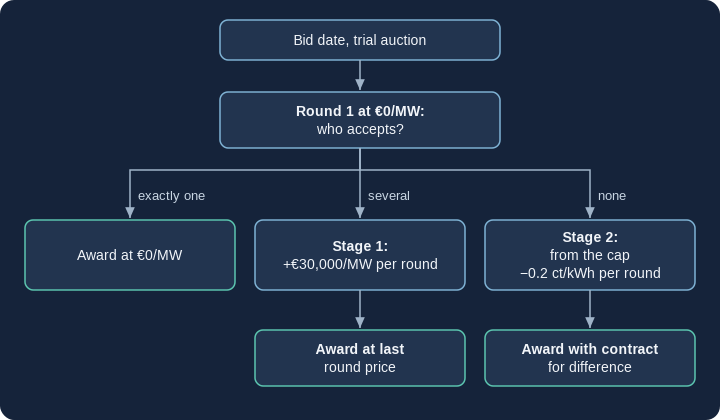
Each bidder gets exactly one bid per site and round, and it is binding: either acceptance of the price called or an intermediate-round bid, which also takes the bidder out of the auction. Bids stay sealed, but before each round bidders learn the stage, the price, the round times and how many bidders are still taking part (round information, point 5). If several sites are tendered at once, the procedures start together and run as synchronously as possible, with each site passing through its stages on its own. One site can already be in the second stage while bidders on the neighbouring site are still competing over the payment.
Under point 1, every bidder must secure its access to the auction system through redundancy in staff, technology and location. If the system goes down for a long time, the chamber aborts the current round and restarts it later from scratch. The draft provides no abort for failures on a bidder's side; what counts is receipt in the auction system (point 7). A bidder that does not accept in time is out of the next round (point 12), so in our reading of the draft a failure of a bidder's own connection is the bidder's risk.

Stage one: paying for the site
Round one calls €0.00 per megawatt. A bidder that accepts declares it wants to build on the site without support. If exactly one accepts, the procedure ends with an award and no payment. If several accept, the round price rises by €30,000 per megawatt from the second round on, or by €15,000 once only two bidders remain, until only one is left; that bidder pays the last round price. Depending on competition, the chamber can change the step and says so in the round information. In the first round all bidders are told as soon as an acceptance has come in, but not from whom. If that first acceptance arrives in the final minute, the window is extended once by five minutes so the others can react.
From the second round, a bidder can name an intermediate-round bid instead of accepting, an amount between the previous and the current round price. If nobody accepts in a round, the highest intermediate bid wins. A tie is decided by lot, as is the case where, after the first round, a round produces neither an acceptance nor an intermediate bid; the award price is then the drawn bidder's last bid (point 15).
Stage two: bidding on the contract for difference
Stage two only starts if no bidder accepts in the first round of stage one. Bidders then no longer bid a payment but the strike price of the contract for difference in cents per kilowatt hour, from the top down, and the round count starts again. Its first round calls the unrounded cap from the bill: 9.487 cents for sites not centrally pre-surveyed (section 19) and 9.6715 cents for centrally pre-surveyed ones (section 53). From the second round, the single decimal place that the bill prescribes for bid levels applies: the chamber rounds down to 9.4 or 9.6 cents (absent a site-specific adjustment of the cap), after which the value falls by 0.2 cents per round, or 0.1 cents with two bidders.
| Feature | Stage one | Stage two |
|---|---|---|
| What is bid | Payment for the site in €/MW, two decimal places | Strike price of the CfD in ct/kWh, one decimal place |
| Start | €0.00/MW | Cap (9.487 or 9.6715 ct/kWh), round 2 rounded down |
| Step per round | +€30,000/MW, +€15,000/MW with two bidders | −0.2 ct/kWh, −0.1 ct/kWh with two bidders |
| Intermediate-round bid | from round 2 | not in round 1; in round 2 only if a one-decimal value lies between the cap and the rounded value (not the case for either cap) |
| Award | last bidder at the last round price | last bidder or lowest intermediate bid |
Rounding has a side effect that the chamber states openly in the consultation paper: with a step of 0.2 cents, exactly one one-decimal value fits between two bid levels; with 0.1 cents, none does. Once only two bidders remain, there is no valid intermediate bid left, and if both drop out in the same round, the award is decided by lot. If only one bidder is admitted for a site and it does not accept in the first round, it receives the award for the second stage straight away at the cap.
Centrally pre-surveyed sites
For sites the state has surveyed in advance, a multiplication factor under section 54a WindSeeG draft applies to the result. It depends on declarations the bidder itself makes with its project description, for instance on the share of permanent magnets from a single non-EU country or on the carbon footprint of the turbines, so the bidder knows before the auction which declarations it has made. Even so, the draft keeps the factor out of the auction: round prices, bid levels and intermediate bids are uniform and nominal for all bidders on a site, and the award and ranking follow the nominal bids. It is only applied after the procedure ends, is not shown in the auction system, and the strike price after multiplication stays capped at the section 53 cap. Each bidder therefore has to build the effect into its own bid limits.
Where a comment can make a difference
With the 3,600 full-load hours the bill assumes for the cap, a step of 0.2 cents per kilowatt hour on one gigawatt is worth about €7.2 million of revenue a year. If a bidder's floor lies between two bid levels, it must either drop out one level higher or accept one level lower than it calculates, and that gap recurs every year over the term of the contract for difference, which the new EEG will set. That makes the stage-two step the point with the largest economic effect, and it deserves its own calculation in any comment. The €7.2 million is our derivation from the bill's figures, not a number from the chamber.
| Point | Rule in the draft | Effect on bidders |
|---|---|---|
| 11 | +€30,000/MW per round, +€15,000/MW with two bidders | On a 1 GW site that is €30 million more payment per round; in 2024 it took 46 and 55 rounds |
| 18 | −0.2 ct/kWh per round, round 2 rounded down to one decimal | Smaller steps reduce the risk of dropping out just below your own limit; round 2 falls by only 0.087 or 0.0715 ct/kWh, and no intermediate bid above 9.4 or 9.6 ct/kWh is possible |
| 20 | Intermediate bids with one decimal place | With two bidders no valid intermediate bid is possible, so the lot decides more often |
| 4 and 6 | 9 am to 4 pm, 20 minutes per round, NRW holidays | Approvals during the auction are barely possible; bid limits have to be decided beforehand |
| 1 | Bidders secure their own access | Responsibility for outages lies with the bidder; the draft has no fallback for failures on the bidder's side |
| 22 | Multiplication factor not shown in the system | Bidders on centrally pre-surveyed sites must build the factor into their bid limits |
In stage one, the €30,000-per-megawatt step matters less for the current sites, because not a single bid came in for N-10.1 and N-10.2 in August 2025. It gains weight if power prices and PPA revenues rise again: then the step helps decide how many rounds an auction takes (46 and 55 in 2024), and with it how many days the bidding team has to stay on standby.
The dispute over the two-stage model in the Bundestag
It is the Bundestag, not the ruling chamber, that decides on the model itself, and positions there are far apart. At the public hearing of the Committee on Economic Affairs and Energy on 2 November 2026, Stefan Thimm of the offshore wind farm operators' association BWO warned against the two-stage model with dynamic bidding and called for a "CfD-only" model to reduce revenue risk. Kerstin Andreae of BDEW called the two-stage award procedure "nicht zielführend" (not fit for purpose) and argued for indexing the strike price.
From the other side, Niclas Wenz of the German Chamber of Commerce and Industry (DIHK) considers contracts for difference unnecessary for offshore wind and called their introduction "ein großer Rückschritt" (a big step backwards). Karl-Martin Ehrhart of the Karlsruhe Institute of Technology (KIT) proposed a middle way: companies should be allowed to choose between CfD protection and a purely market-based solution. The wind energy association WAB, by contrast, sees the two-stage model as a chance to combine market and safety net, but attaches a condition; its managing director Markus Nölke wrote in August that the PPA must not be an option "only on paper". WAB also wants reliable tenders from the first quarter of 2027 and sites of no more than 1 GW.
"Denn die Energiewende gewinnt man mit realisierten, effizienten Windparks." (You win the energy transition with wind farms that are built and run efficiently.)
Karl-Martin Ehrhart, KIT, Bundestag hearing on 2 November 2026 (hib 871/2026)The Bundesrat wants the bill adopted by the end of 2026 so that tenders can go ahead in 2027, but it rejects the two-stage model: it wants to drop the first stage entirely and support offshore wind through contracts for difference alone (BT-Drs. 21/8825). In its reply, the federal government sticks to both stages. The Bundesrat also objects that awards in the second stage would end the payments to marine conservation and fisheries that used to come out of the payment bids. Several associations and the transmission system operator TenneT called at the hearing for a rule allowing projects from the 2023 to 2025 awards to be handed back and re-tendered; according to TenneT, 16 GW are at stake. The bill does not so far provide for a unilateral hand-back. Berlin rejected several of the states' proposals and is examining indexation of the strike price for the planning and construction phase. For the consultation this means points 16 to 21 hang on a stage whose shape is still open in the law. Comments should therefore say which step size they consider right both with and without indexation.
What happens if the deadline passes
Legally, nothing happens: a comment is voluntary, and staying silent costs no rights as a bidder. But anyone who submits nothing by 4 December 2026 can no longer bring objections into this consultation. According to the consultation paper, the ruling chamber considers later comments only where possible, with no entitlement to that. It sets the final rules after the law enters into force and before the tender is announced; whether there will be a second consultation then, the paper leaves open.
What utilities with offshore plans should prepare now
A one-gigawatt offshore project requires around €2.8 billion of investment under the bill's reference case, plus operating costs. For most municipal utilities that is only within reach through stakes in bidding consortia or as a PPA offtaker, and the rules affect them even then: a consortium's bid needs shareholder approval, and the first stage only works if someone takes the power on a long-term basis. For the onshore bid dates in 2027, see our overview of EEG tenders in 2027.
Before the 2027 tender
-
Submit a comment by 4 December
Structure it by numbered point, back the step sizes in points 11 and 18 with your own revenue calculation and attach a redacted version if it contains project figures.
-
Decide bid limits in advance
Set a ceiling on the payment and a floor on the strike price for both stages, plus the point at which the team submits an intermediate bid instead of accepting. In a consortium that usually takes a shareholder resolution before the first round starts, because under the chamber's sample schedule a round starts every 30 minutes, leaving ten minutes between the end of one and the start of the next.
-
Build a redundant bidding team
Two locations, two connections, deputies for every role and a standby plan for Monday to Friday from 9 am to 4 pm; at 50 rounds as in 2024 and up to 13 rounds a day, that is a good week, plus the trial auction.
-
Sort out offtake
Anyone planning to bid in stage one needs a solid PPA strategy before the bid date. For utilities as buyers, the question is whether an offshore profile fits into their own procurement.
-
Follow the legislation
The 2027 bid date has not been set; it depends on the law being adopted by the end of 2026, as the Bundesrat demands. Second and third reading and possible indexation change the numbers for both stages; a hand-back rule for earlier awards would change the supply of sites.
Deadline, market roles, systems
4 December 2026Offshore wind: consultation on the dynamic bidding procedure rules from 2027 closes (BK6-26-477)Consultation · open
Applicability: Only bidders in offshore wind tenders under the Offshore Wind Act. The draft is based on government bill BT-Drs. 21/8238, which has not yet been adopted.
If the deadline is missed: No direct legal consequence Comments are voluntary. Anyone who submits nothing by 4 December 2026 can no longer bring objections into this consultation; the ruling chamber considers later comments only where possible. Legal basis ↗
- Plant operator (generation)check applicabilityPlant operators planning to bid in offshore tenders review the round logic and can comment until 4 December.Typically affected: Plant master data and MaStR, Regulatory management, controlling
A classification for typical market roles, not a review of your individual case and not legal advice. Whether an obligation applies to your company (thresholds, exemptions) is for your legal department or counsel to confirm. The calendar doesn't replace your own deadline review. Information as of: 22 November 2026.
Further Reading
Frequently Asked Questions
A round-based auction in which the Federal Network Agency calls a price each round and bidders have 20 minutes to accept or drop out. Under government bill BT-Drs. 21/8238 it has two stages from 2027: first, bidders bid what they would pay for the site without support. If nobody accepts in the first round, they bid on the strike price of a contract for difference, which falls from the cap downwards.
Friday, 4 December 2026. Comments go as a searchable PDF to poststelle.bk6@bnetza.de, with reference BK6-26-477 in the subject line and structured by the numbered points of the draft. The ruling chamber considers later comments only where possible; there is no entitlement to that.
No. The draft is based on government bill BT-Drs. 21/8238, which the Bundestag has not yet adopted. Only the rules the Federal Network Agency sets after the law enters into force and announces with each tender are binding. If the Bundestag changes the bill, the draft rules may change too.
In the first stage the round price rises by €30,000 per megawatt, or €15,000 once only two bidders remain. In the second stage the strike price falls by 0.2 cents per kilowatt hour, or 0.1 cents with two bidders. The Federal Network Agency can change the step depending on competition and announces this in the round information.
9.487 cents per kilowatt hour for sites not centrally pre-surveyed (section 19 WindSeeG draft) and 9.6715 cents for centrally pre-surveyed sites (section 53 WindSeeG draft). The Federal Network Agency must adjust it by up to 35 percent for individual sites if the expected yield differs substantially from the reference case of 3,600 full-load hours. From the second round of the second stage, the value is rounded down to one decimal place.
If it accepts the round price of €0 per megawatt in the first round, it wins the award without payment. If it does not accept, the draft gives it the award for the second stage straight away at the cap, with no further bidding. There is no trial auction in this case; the ruling chamber runs the procedure in direct exchange with the bidder's appointed representative.
Let's collaborate
One contact, a team behind it
Thirty minutes on what you're working on, whether grid, metering, market processes, IT architecture or AI. Afterwards you'll know how we'd approach it and who would sit at the table.
Energy and measurement technology since 2010 · innobu GmbH since 2014 · Based in Schleswig-Holstein, Germany
Whoever pitches also delivers: whoever leads the first call stays your contact right through to the steering committee, with established partners in the project. Direct: info@innobu.com