Higher ceiling price for N-13.1 and N-13.2: what the Federal Network Agency proposes
On 20 November 2026, Ruling Chamber 6 of the Federal Network Agency (BNetzA) opened proceedings BK6-26-639, whose legal basis so far exists only in the draft amendment of the Offshore Wind Energy Act (WindSeeG). Its figures come from yield modelling by Fraunhofer IWES. For utilities that plan to bid on sites N-13.1 and N-13.2 in 2027, directly or through stakes in a consortium, the upper bound of the business case moves.
A site-specific ceiling price is a cap on the strike price in the contract for difference that the Federal Network Agency raises for individual offshore sites when they are expected to produce materially less power than the reference case, by up to 35 percent. For N-13.1 and N-13.2, Ruling Chamber 6 is consulting on such an increase until Monday, 7 December 2026. The draft proposes 10.9351 cents per kilowatt hour for N-13.1 (up 13.1 percent) and 10.8330 cents for N-13.2 (up 12.0 percent) instead of 9.6715 cents, because Fraunhofer IWES expects 3,184 and 3,214 full-load hours there instead of 3,600. The values are provisional: only a decision taken after the amended WindSeeG (BT-Drs. 21/8238) enters into force will bind, and the Bundestag has not yet passed it.
One ceiling price per site instead of one for all
Ruling Chamber 6 wants to raise the ceiling price for offshore sites N-13.1 and N-13.2 only. Under the government bill, one value applies to all centrally pre-investigated sites, where the state carries out the preliminary site investigation (§ 53(1) WindSeeG draft). A rule obliging the Federal Network Agency to change it for individual sites because of their yield is new in this draft.
N-13.1 is designed for 500 MW and N-13.2 for 1,000 MW. Both lie in the North Sea and belong to the sites that the Federal Maritime and Hydrographic Agency (BSH) has scheduled for the 2027 tender year. Alongside them, N-10.1, N-10.2, N-12.4 and N-12.5 go to tender in 2027; for those four the chamber proposes no adjustment. The BSH moved the tenders planned for 2026 into 2027 with the amendment of the Site Development Plan of 30 January 2026.
How the chamber calculates
The chamber raises the ceiling price in inverse proportion to the full-load hours: if the study expects fewer hours on a site than the 3,600 of the reference case, the ceiling price goes up by exactly enough that hours times ceiling price give the same amount again. Behind this sits an assumption the chamber states openly. Capital and operating costs per megawatt don't depend on yield, so the value per kilowatt hour has to rise when fewer kilowatt hours are produced.
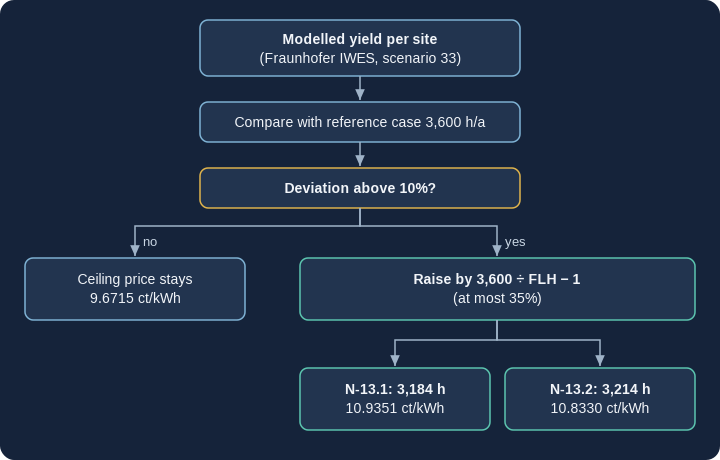
For N-13.1 that is 3,600 divided by 3,184, minus one, or 13.07 percent, and 9.6715 cents times 3,600 divided by 3,184 gives 10.9351 cents. N-13.2, with 3,214 hours, comes out at 12.0 percent and 10.8330 cents. Annual revenue per megawatt at the ceiling price is therefore the same in all three cases, about €348,000 (3,600 hours times 9.6715 cents comes to as much as 3,184 hours times 10.9351 cents).
| Site | Full-load hours (IWES, expansion scenario 33, see below) | Deviation from 3,600 h | Increase | New ceiling price |
|---|---|---|---|---|
| N-13.1 (500 MW) | 3,184 h/a | −11.6% | +13.1% | 10.9351 ct/kWh |
| N-13.2 (1,000 MW) | 3,214 h/a | −10.7% | +12.0% | 10.8330 ct/kWh |
| Reference case § 53(1) | 3,600 h/a | 0 | 0 | 9.6715 ct/kWh |
The reference case comes from the explanatory memorandum to the bill: 3,600 full-load hours a year, capital costs of €2.8 billion per gigawatt, operating costs of 2 percent of the investment a year and a weighted average cost of capital of 5.3 percent. These assumptions stay as they are; the chamber changes only the hours.
Why N-13.1 and N-13.2
The figures come from the Fraunhofer IWES yield modelling for expansion scenario 33, dated 6 October 2026, which the BSH commissioned for updating the Site Development Plan. It calculates the expected full-load hours for each site, assuming all sites are fully built out and using a single weather year. For N-13.1 they come out 11.6 percent below the reference, for N-13.2 10.7 percent; the chamber gives no breakdown by cause.
To decide when a deviation is material, the chamber uses the study itself as the yardstick. IWES gives an uncertainty of up to 10 percent on the full-load hours, partly because of how wake effects are modelled. If the site value departs from the reference by no more than those 10 percent, the chamber does not treat it as a material deviation. Both sites cross the threshold, N-13.2 by just 0.7 percentage points.
The chamber thinks the IWES values are, if anything, too low, because the study rests on a single weather year and assumes every site is fully built out. It raises the cap anyway, using exactly these values. Anyone planning to bid on N-13.2 should therefore allow for comments showing slightly more full-load hours to remove the increase there before the decision.
So far, the legal basis exists only in the draft. Under § 53(2), third sentence, WindSeeG draft, the Federal Network Agency "has to" set a ceiling price up to 35 percent different for individual sites if the forecast electricity yield underlying the Site Development Plan deviates materially from the assumptions of the reference case. Once the chamber finds a material deviation, it has no discretion over whether to raise the cap. What "material" means, the draft leaves open, and the chamber fills that gap with the 10 percent threshold.
What the increase does in the auction
The ceiling price only matters at the second stage. From 2027, the bill has offshore sites awarded in two stages: first the Federal Network Agency asks whether anyone wants to build on the site without support; only if nobody wants to take the site without support at stage one do bidders move to stage two and bid on the strike price of a two-sided contract for difference. There the ceiling price is the starting bid (§ 54(1) WindSeeG draft), from which the value falls round by round until one bidder is left.
Step sizes and rounding are being consulted on in parallel under BK6-26-477, proceedings we describe in our article on the dynamic bidding procedure for offshore wind from 2027. Under that draft, the first round of the second stage calls the unrounded ceiling price; from the second round the value rounded down to one decimal place applies. If the chamber applies that rule to the raised values, round two on N-13.1 stands at 10.9 instead of 9.6 cents and on N-13.2 at 10.8 cents.
According to the study, 500 MW on N-13.1 produce 1,592 gigawatt hours a year; 1.26 cents more per kilowatt hour works out at about €20 million a year, and on N-13.2, with 3,214 gigawatt hours, 1.16 cents comes to about €37 million. That holds only if the award actually lands at the ceiling price, when only one bidder is admitted and it does not accept at stage one, or when only one accepts in the first round of stage two. And because the contract for difference is two-sided, the operator pays back whenever the market value is above the strike price (refinancing contribution under § 21d EEG draft, to which the offshore bill refers). How the same mechanism is set out in the EEG is covered in our article on contracts for difference in the EEG 2027.
What is not settled yet
The values depend on the law. The consultation rests on the federal government's bill of 28 September 2026 (BT-Drs. 21/8238); only the decision the chamber takes after it enters into force will be legally binding. The chamber intends to decide before the 2027 tenders are announced, provided the amendment enters into force in time and without material changes from the draft.
On 8 October 2026 the Bundestag held the first reading, and the Committee on Economic Affairs and Energy heard experts on 2 November. There, BDEW and the German Offshore Wind Energy Association (BWO) rejected the two-stage model, BWO called for a pure CfD model, and the DIHK rejected the contract for difference altogether. Nothing has been passed yet. If the Bundestag changes the auction design, the role of the ceiling price on which this consultation builds can change too.
A second lever is also in § 53(2) WindSeeG draft. If the Federal Network Agency changes the general ceiling price because it is too high or too low overall (by at most 10 percent, § 53(2), first and second sentences, WindSeeG draft), the site-specific adjustment builds on the changed value. The 10.9351 and 10.8330 cents are therefore subject to two caveats: the law, and a possible general redetermination. Even the upper limit is not clear-cut in the draft: the legal text allows a deviation of up to 35 percent, while the explanatory memorandum to § 53 speaks of up to 20 percent. For N-13.1 and N-13.2 that makes no difference, as both are below it.
Where a comment can make a difference
A comment is worth it mainly for bidders who have their own yield study for the sites or will get one by December. The chamber's calculation can be challenged at four points, in both directions.
- Threshold. The chamber equates "material" with the study's uncertainty. You can argue that a deviation of 8 percent already breaks a business case; you can also argue that 10.7 percent against 10 percent uncertainty is not yet a firm deviation.
- Yield basis. A single weather year, full build-out of all sites and the wake assumptions all shift the full-load hours; whether and how the study counts wind farms in neighbouring countries, the consultation document does not say. Anyone with their own measurement series or long-term correlations can put them against it.
- Cost assumption. Its formula assumes a megawatt on N-13.1 costs as much as in the reference case. Water depth, distance to shore and seabed conditions can shift that either way; the draft does not take it into account.
- Other sites. For N-10.1, N-10.2, N-12.4 and N-12.5 the chamber proposes nothing. The consultation document does not give their IWES values; anyone who sees their own yield losses near the threshold there can suggest a review.

Formally, little is required: a searchable PDF to poststelle.bk6@bnetza.de with file number BK6-26-639 in the subject line. All comments are to be published on the chamber's website. If you cite yield data or costs from your own project model, send an additional redacted version (§ 71 EnWG); without one, the chamber assumes you consent to publication. Municipal utilities that hold a stake through a consortium can also feed their points in through the consortium lead or their association, which bundles them; it then needs the input some days before 7 December.
What happens if the deadline passes
Legally, nothing. Comments are voluntary and there is no sanction. Anyone who submits nothing by 7 December 2026 can no longer bring objections into this consultation, though: the chamber considers later comments only where possible, and there is no right to that (consultation document BK6-26-639, item 4).
What bidders should settle by 7 December
Until 7 December 2026 there is time for a short, evidenced comment, not for a new study. An earlier deadline in the parallel proceedings comes first.
By 4 and 7 December
-
First BK6-26-477, by 4 December
The consultation on the bidding rules closes on Friday, 4 December, three days earlier. Rounding, step size and ceiling price work together, and both proceedings hang on the same amendment, whose second and third readings are still to come.
-
Put the studies side by side
Set your own full-load hours for N-13.1 and N-13.2 against 3,184 and 3,214 hours, with weather year, build-out assumption and wake model.
-
Run the business case with both ceiling prices
Once with 9.6715 cents, once with the proposed value, each with the rounded-down value from round two of stage two (9.6 against 10.9 or 10.8 cents). Only that tells you whether a comment is worth the effort.
-
Decide the route
Your own submission, through the consortium or through the association. Consortium partners agree with the lead by when it needs their points.
-
Prepare a redacted version
Black out yield and cost data competitors should not see before sending; otherwise the chamber publishes the full version.
Deadline, market roles, systems
Comments by Offshore wind: consultation on higher ceiling prices for sites N-13.1 and N-13.2 closes (BK6-26-639)
Applicability: Only bidders in the 2027 offshore tenders for sites N-13.1 and N-13.2. The draft is based on government bill BT-Drs. 21/8238, which has not yet been adopted; the values are provisional.
If the deadline is missed: No direct legal consequence Comments are voluntary. Anyone who submits nothing by 7 December 2026 can no longer bring objections into this consultation; the ruling chamber considers later comments only where possible. Legal basis ↗
- Plant operator (generation)check applicabilityPlant operators planning to bid for sites N-13.1 or N-13.2 in 2027 review the values and can comment until 7 December.Typically affected: Plant master data and MaStR, Regulatory management, controlling
A classification for typical market roles, not a review of your individual case and not legal advice. Whether an obligation applies to your company (thresholds, exemptions) is for your legal department or counsel to confirm. The calendar doesn't replace your own deadline review. Information as of: 25 November 2026.
Further Reading
Frequently Asked Questions
A cap on the strike price in the contract for difference that applies to a single offshore site only. Under § 53(2), third sentence, of government bill BT-Drs. 21/8238, the Federal Network Agency must set it up to 35 percent away from the general ceiling price if the site's forecast electricity yield deviates materially from the assumptions of the reference case.
For N-13.1, Ruling Chamber 6 is considering 10.9351 cents per kilowatt hour (up 13.1 percent), for N-13.2 10.8330 cents (up 12.0 percent). Under the bill, the general ceiling price for centrally pre-investigated sites is 9.6715 cents. The values are provisional and only bind once the chamber decides after the amended Offshore Wind Energy Act enters into force.
Monday, 7 December 2026, as a searchable PDF to poststelle.bk6@bnetza.de with the file number BK6-26-639 in the subject line. The chamber considers later comments only where possible. It intends to publish all comments, so trade secrets belong in an additional redacted version.
Because only there do the modelled full-load hours fall below the 3,600-hour reference by more than the study's uncertainty. Fraunhofer IWES arrives at 3,184 hours for N-13.1 (minus 11.6 percent) and 3,214 hours for N-13.2 (minus 10.7 percent). The chamber does not consider deviations within the IWES uncertainty of up to 10 percent to be material.
No. The ceiling price only matters at the second stage of the bidding procedure, so only if nobody wants to build without support in the first round. There it is the starting bid, from which the strike price falls round by round. Competition decides how far. The contract for difference is two-sided: if the market value is above the strike price, the operator pays the difference back.
Then there is no legal basis. The chamber intends to decide on site-specific ceiling prices before the 2027 tenders are announced, but only if the amended Offshore Wind Energy Act enters into force in time and without material changes from the draft. What would then apply to the 2027 tenders, the consultation document leaves open.
Let's collaborate
One contact, a team behind it
Thirty minutes on what you're working on, whether grid, metering, market processes, heat, IT architecture or AI. Afterwards you'll know how we'd approach it and who would sit at the table.
Energy and measurement technology since 2010 · innobu GmbH since 2014 · Based in Schleswig-Holstein, Germany
From the first call to the steering committee: whoever leads the first call stays your contact, with established partners in the project. Direct: info@innobu.com