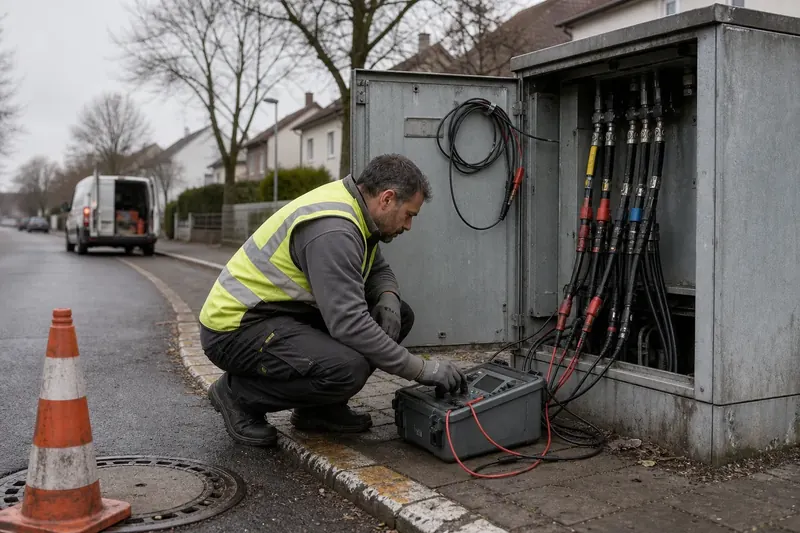
MV Cable Diagnostics: Condition, Not Age
Expensive, buried, not something you can simply look at. That is exactly why the measurement decides which cable run gets replaced and which keeps running.
Cable diagnostics assesses the condition of buried medium-voltage cables without digging up the route. Two methods carry the core: tan delta measures the dielectric dissipation factor across the whole conductor and shows moisture and insulation ageing such as water trees, but cannot locate single defects. Partial discharge measurement detects local defects like voids and surface discharges and locates them along the cable. Both are energised over a VLF test voltage at 0.1 hertz and measured in part at the same time. The reason is the cable base. Medium-voltage cables were originally planned for around 30 years of life, today a median probable life of 60 to 80 years applies, and many routes are already over 50 years old. The replacement value of this cable base runs above 20 billion euros, according to the AMika research project at the University of Wuppertal. Because you cannot replace a cable without knowing it, the diagnosis decides billion-euro budgets. Predictive maintenance in the energy sector cuts unplanned downtime by 30 to 45 percent and maintenance costs by 20 to 25 percent, according to McKinsey. The limits sit in the interpretation: tan delta averages across the conductor, partial discharge detects water trees late, and thresholds are guidelines, not a fixed verdict. Standards such as IEC 60502, IEC 60270 and IEEE 400 set the frame.
Why cable diagnostics decides billion-euro budgets
The buried medium-voltage cable is the most expensive and the least visible part of many distribution grids. You cannot see anything on it. And digging it up just to look is not an option.
So the measurement decides. With a replacement value above 20 billion euros in Germany alone, every avoided misinvestment counts at once. A cable swapped too early costs money that is missing elsewhere. One swapped too late costs an outage. Cable diagnostics works exactly in between.
So cable diagnostics is not a technical luxury. It is the answer to an ageing base that no one can renew in one go. Much like transformer online monitoring, the point is to pull extra safe operating years out of an asset that is already in the ground.
What tan delta and partial discharge measure
Tan delta and partial discharge are not rivals but two views of the same cable. One rates the overall condition of the insulation, the other hunts the single weak spot. Only together do they carry a diagnosis you can plan a renewal on.
Two measurement paths carry most of the diagnosis:
- Tan delta (dissipation factor): measuring the dielectric dissipation factor captures the insulation as an integral value across the whole conductor. It shows moisture and insulation ageing, especially water trees, the most common ageing mechanism of old extruded cables. A single critical section can disappear in the average, though.
- Partial discharge (PD): partial discharge sensors pick up discharges at voids, surface and corona discharges and locate the defect along the route. The catch: PD only detects water trees once they turn into electrical trees, so late.
Both methods run over a VLF test voltage at a very low frequency, usually 0.1 hertz, and can be measured in part at the same time. What gets measured, and how it is read, comes from standards such as IEC 60502 and IEC 60270 for partial discharge. The combination is what counts, because each method alone has a gap.
From the measured value to the maintenance decision
The value comes not from the measurement but from the decision that follows it. Tan delta, partial discharge and a supporting withstand test become a condition rating, and that leads to exactly one of three actions: keep in service, retest and monitor, or replace the joint or section.
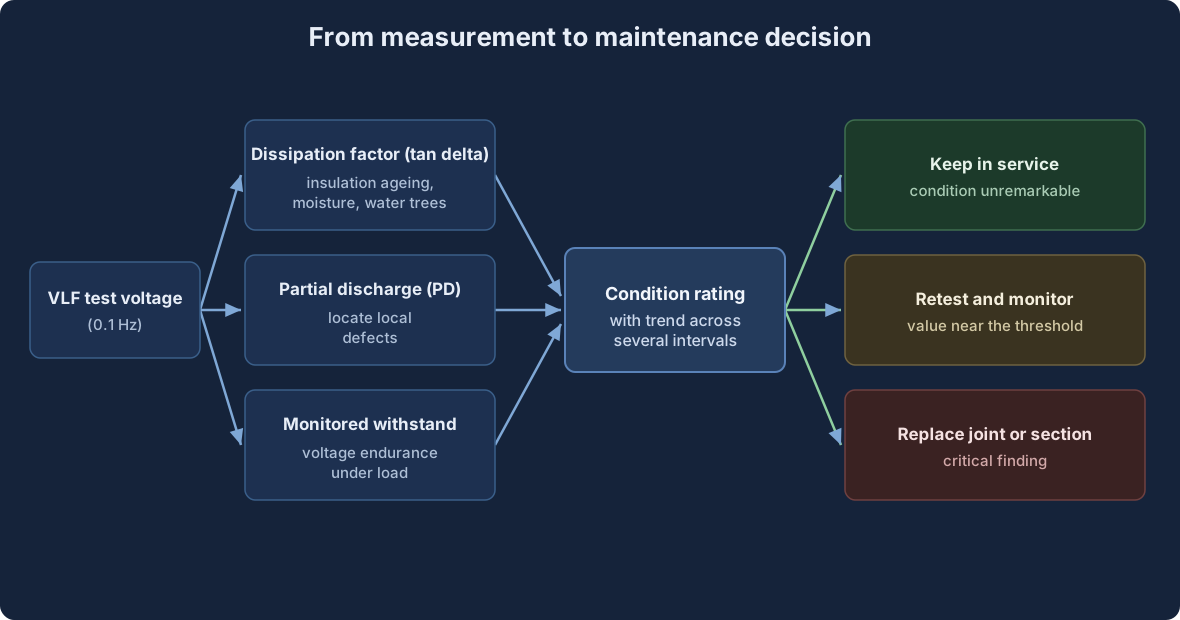

What matters is the trend, not the single point. A cable close to a threshold with a stable history is a different thing from one that crosses the threshold on its first reading. Thresholds are guidelines, and trending over several test intervals says more than any single measurement. That is how the combined diagnosis extends usable life and saves unnecessary renewals, while underground cable monitoring with DTS and RTTR answers the other question, how much current a route may carry right now.
Ageing base, AI and the German practice
In Germany the mix of an ageing base and high investment pressure drives the diagnosis. Grid operators like MITNETZ STROM invest record sums, 531 million euros planned for 2026, much of it in renewal and digitalisation. Where the money goes wants to be evidenced.

That is exactly the approach of the AMika research project at the University of Wuppertal. 24 grid operators, among them Westnetz, Stromnetz Berlin and Stuttgart Netze, supply diagnostic data for statistically solid ageing curves. The condition assessment there runs on evidence theory rather than a plain age or fault reference. The reason: a blanket age verdict does not hold. PE cables from former East German times rarely reach their planned life, while modern XLPE cables hold as expected.
This is where AI comes in. It shifts the diagnosis from the snapshot to a running condition forecast by linking measurement series, grid topology and operating data. According to McKinsey, predictive maintenance in the energy sector cuts unplanned downtime by 30 to 45 percent and maintenance costs by 20 to 25 percent, and some systems flag critical anomalies 7 to 14 days ahead. The benefit is real. It depends on a consistent measurement history, though, and because many methods are laborious and run only at points, the data base is often thin. Much like AI grid simulation, the result stands and falls with the data quality.
Where the diagnosis hits its limits
Cable diagnostics is not an automatism. It calls for interpretation, and a misreading costs either an unnecessary renewal or an avoidable outage. Three points slow the practice down.
First, the averaging. Tan delta gives an integral value across the whole conductor. A small but critical section can vanish in the average while the overall value still looks unremarkable.
Second, the blind spot on water trees. Partial discharge measurement only detects them once they turn into electrical trees, so late. Until then a slow ageing that triggers no PD signal stays under the radar.
Third, the thresholds. They are guidelines, not a fixed verdict. A first-time crossing has to be read differently from a stable course sitting just below the threshold. Add the effort: many measurements need disconnection or special equipment and qualified staff, so they run only at points and the data base stays thin.
What grid operators should do now
The entry works step by step, not with a diagnosis of the whole grid at once. What matters is capturing the measurement data from the start so it is fit for trending and models later. Four steps put a project in shape.
-
Prioritise the diagnosis by risk
Measure the old routes, the critical feeders and the runs with a notable fault history first. A blanket roll-out in one go burns budget where the risk is small.
-
Combine tan delta and partial discharge
Use both methods together, not on their own, and compare the results across the test intervals. Only the combination of integral value and local location carries a solid decision.
-
Store measurement data machine-readable
Save the values in a structured, consistent form so data-driven condition assessment becomes possible at all. Without a clean history every measurement stays a snapshot, and AI only amplifies the noise.
-
Set staff and contracts up for repeatability
Fix the methods, test voltage and interpretation so measurements stay comparable, across service providers and years. Comparability is the precondition for any trending.
As long as a medium-voltage cable is buried and out of sight, the measurement decides billion-euro budgets. Tan delta and partial discharge make the condition visible, together they cover more than either method alone, and the trend over time carries the decision. Prioritise by risk, combine both methods and store the data machine-readable, and you get the most out of it.
Further reading
Frequently asked questions
Cable diagnostics is the non-destructive assessment of the insulation condition of buried medium-voltage cables, without digging up the route. Methods such as tan delta and partial discharge give clues about moisture, ageing and local defects. From the values the grid operator decides whether a cable run stays in service, gets retested or is replaced.
Tan delta measures the dielectric dissipation factor as an integral value across the whole conductor and mainly shows moisture and insulation ageing, such as water trees. It cannot locate single defects. Partial discharge measurement detects local defects like voids or surface discharges and locates them along the route. The two methods complement each other, and only together do they give a solid picture.
VLF stands for very low frequency, a test voltage at a very low frequency, usually 0.1 hertz. It energises the cable for the diagnosis without the large mobile equipment a 50-hertz test would need. Tan delta and partial discharge can be measured over a VLF source, in part at the same time. Standards such as IEC 60502, IEC 60270 and IEEE 400 set the frame.
AI links measurement series, grid topology and operating data and turns the snapshot into a running condition forecast. According to a McKinsey analysis, predictive maintenance in the energy sector cuts unplanned downtime by 30 to 45 percent. The benefit depends on a consistent, well-annotated measurement history, which is often thin for buried cables.
IEC 60502 governs the construction, operation and testing of medium-voltage cables. IEC 60270 is the reference for partial discharge measurement. For testing and fault location on cables after installation, IEEE 400 and the relevant application rules serve as a frame.
Let's collaborate
One contact, a team behind it
Thirty minutes on what you're working on, whether grid, metering, market processes, IT architecture or AI. Afterwards you'll know how we'd approach it and who would sit at the table.
Energy and measurement technology since 2010 · innobu GmbH since 2014 · Based in Schleswig-Holstein, Germany
Whoever pitches also delivers: whoever leads the first call stays your contact right through to the steering committee, with established partners in the project. Direct: info@innobu.com