KONNI 2.1: a conversion fee from L-gas to H-gas, comments due 23 November
On 3 November 2026, Ruling Chamber 7 of the Bundesnetzagentur published a draft of the operative part of its ruling and the amended standard conversion contract. From 1 April 2027, Trading Hub Europe (THE) would be allowed to charge balancing group managers a fee for balancing conversion from L-gas to H-gas as well, capped at EUR 0.45 per megawatt hour in the first period. The chamber takes comments until Monday, 23 November 2026.
KONNI 2.1 is ruling procedure BK7-26-01-006, through which the Bundesnetzagentur changes the conversion system in the THE market area; comments on the draft are due by 23 November 2026, and the change is meant to apply from 1 April 2027. Under the draft, Trading Hub Europe may then charge a conversion fee in both directions: from L-gas to H-gas at no more than EUR 0.45 per MWh until 30 September 2027, after that with a cap THE sets itself and up to two seasonal factors. The trigger is 112 TWh of balancing conversion in gas year 2024/2025 and costs that cut the conversion account by about EUR 140 million to just over EUR 100 million in one year. The new fee is paid only by balancing group managers whose linked groups are long in L-gas and short in H-gas; the level of the fee is open, and zero remains possible.
What the chamber has put forward
The second consultation has two parts: a draft of the operative part of the ruling with four points, and the amended standard conversion contract with its changes in italics. Point 1 holds the obligation. With effect from 1 April 2027, the rules in the annex have to be written "into concluded and newly concluded balancing group contracts". Although addressed to the market area manager, the ruling lands with every balancing group manager in the market area without anyone signing anything.
Ruling Chamber 7 opened the procedure on 15 June 2026 on an application THE filed on 19 May 2026. It amends the 2012 ruling introducing a conversion system (BK7-11-002) as revised on 21 December 2016 (BK7-16-050), on the basis of § 29(2) in conjunction with § 20(4) of the Energy Industry Act (EnWG). Since 2016, the market area manager (today THE) may charge a fee only for the direction from H-gas to L-gas, and that fee currently stands at zero. Points 2 to 4 concern THE itself: an annual evaluation report to the chamber by 1 February, a duty to publish the seasonal factors as well, and the calculation basis for fee, levy, cap and factors, which THE has to disclose.
Why the conversion direction flipped
When NetConnect Germany and Gaspool merged into the THE market area in October 2021, Russian imports ended and more gas came from the Netherlands, the direction turned around. According to THE's application, every conversion cost since 2022 has come from the fee-free direction, L-gas to H-gas. Balancing volumes rose from just over 46 TWh in gas year 2021/2022 to 98 TWh, dipped to 71 TWh and hit a record 112 TWh in 2024/2025; May to July 2025 alone saw up to 17 TWh a month, and gas year 2025/2026 averaged 9.5 TWh up to the application in May.
It gets expensive because THE has to correct the physical imbalance with balancing energy: selling L-gas and buying H-gas, and paying steep mark-ups because the market knows THE has to buy balancing energy regardless of price; in June and July 2025, according to THE, conversion cost about EUR 30 million a month. The opening order also records THE's account that some balancing group managers created the need themselves. They nominated L-gas entries and so overfilled the L-gas network, bought the L-gas THE then sold as balancing energy cheaply, and afterwards lowered their nominated entries again by renominating. FNB Gas wrote in its comments of 22 July 2026 that the Market Transparency Unit is investigating this behaviour.
One countermeasure is in place and a second has been announced. Since 1 April 2026 the Gas Cooperation Agreement (KoV XIV.3) has restricted use of the L-gas order book, and the transmission system operators are cutting firm entry capacity at VIP TTF-THE-L and at L-gas storage sites from 1 October 2026, with the full cut due on 1 April 2027. In the chamber's view that is not enough, because conversion volumes stayed high in summer 2026 despite the steps so far and a shrinking L-gas market is hard to forecast. Whether the capacity cut from April 2027 is enough on its own cannot be shown either way on 23 November; faced with that, the chamber opts for the additional instrument.
Fee, cap, factors: the standard contract
As before, the standard conversion contract uses the method of an incentive-based fee set in advance. What's new is the second direction, a cap that THE sets itself after the short first period (1 April to 30 September 2027), seasonal factors, and a rule for the money left in the conversion account at the end.
| Rule | Content | What it means for balancing group managers |
|---|---|---|
| § 3 Conversion quantity | H and L balancing groups are linked through an accounting group and netted day by day per quality; the fee applies to the smaller of the long and short quantities | Billing uses the final balancing values, day by day |
| § 4 No. 1 Cap | EUR 0.45 per MWh from 1 April to 30 September 2027; after that THE sets its own cap for L to H "once" and publishes it six weeks before it applies | For L to H there is no cap from the ruling from October 2027, only THE's; the draft does not say whether "once" means it holds until the system ends |
| § 4 No. 2 Directions | THE may set a different fee for each direction | H to L can stay at zero while L to H costs money |
| § 4 No. 3 Seasonal factors | THE may apply two seasonal factors per period to the L-to-H fee; the average of the factored fee over the gas year may exceed neither the cap nor the fee set | THE can stagger the fee by season, for example higher in low-demand summer months; the draft leaves the how open |
| § 5 Reduction | deleted | The rule dates from the 2012 ruling, which lowered the fee to zero by 30 September 2016 |
| § 6 Levy | conversion levy on all physical entries, trades at the virtual trading point exempt | Unchanged; it covers what the fee does not |
| § 7 Validity | fee, factors and levy for twelve months from 1 October; for the short period only the L-to-H fee, without factors; an increase within the year, even above the cap, only exceptionally in unforeseeable circumstances and with the chamber's approval, filed at least two weeks before the planned increase | The fee can only be planned gas year by gas year |
| § 8 No. 3 Remaining balance | paid out after the last gas year with L-gas entry capacity, first to those who paid the levy in that year, then to those of earlier years | Whoever paid the levy gets a share of what is left at the end |
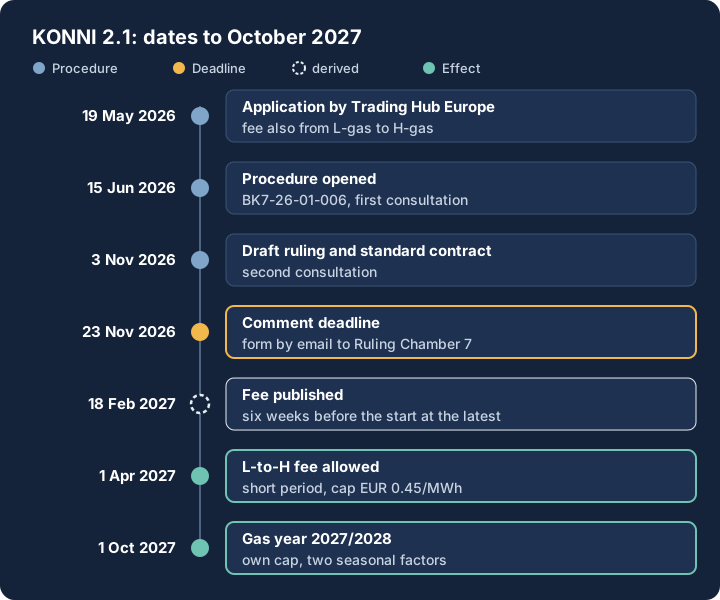
The cap of EUR 0.45 per MWh equals the existing limit of 0.045 cents per kilowatt hour for H to L, but for L to H it applies for six months only. The chamber justifies that short term by arguing that a cap set too low could miss the incentive to balance each quality separately, and that the right level cannot be estimated seriously today. For balancing group managers this means they will learn the cost ceiling for gas year 2027/2028 at the latest six weeks before 1 October 2027, i.e. by 20 August 2027.
Who pays the fee
The fee arises only when a balancing group manager's linked groups are long in L-gas and short in H-gas on a given day. A municipal utility that supplies its L-gas customers with L-gas and its H-gas customers with H-gas does not pay it, and anyone who withdraws more L-gas than they inject ends up in the opposite direction, where the fee is currently zero. The portfolios affected inject L-gas, for example via VIP TTF-THE-L or from an L-gas storage site, and supply H-gas customers; German L-gas production is affected too. The oil and gas association BVEG asked in its comments of 21 August 2026 for production-related conversion to be exempt, since it does not cause the balancing energy need.

Utilities in an area undergoing the L-to-H market conversion have a second case to check. When a network area switches from L-gas to H-gas on its conversion date, its exit points move into the H-gas balancing group. If injections or storage withdrawals stay booked in L-gas, that creates exactly the situation the new fee is aimed at. The daily balances per gas quality in the accounting group, from balancing settlement for 2025 and 2026, show whether it happens in your portfolio. Under § 7 No. 3 of the standard contract, THE sends every balancing group manager all the information needed to check the billing, in a machine-readable format.
Suppliers that buy at the virtual trading point and run no cross-quality balancing group of their own are not hit by the fee directly. The levy hits them, insofar as their balancing groups have physical entries, and so does whatever their upstream suppliers build into their prices. For 2027 tariffs the levy is known until 30 September 2027 at EUR 0.11 per MWh; the fee from April and the levy from October 2027 are not.
The dispute in the first round
The first consultation drew twelve submissions, and they split the market almost exactly along one question: are the existing measures already working? EnBW wrote on 21 August 2026: "According to our observations, conversion costs have fallen significantly since 1 April 2026." An additional intervention was "no longer strictly necessary at present". FNB Gas countered on 22 July 2026 that the measures so far had been "right and necessary" and made "a contribution to containment", "but are not enough on their own". THE itself made clear on 19 August that being able to charge a fee in both directions does not mean "that THE will actually charge a fee > 0 EUR/MWh".
The traders' objection goes deeper. EFET Deutschland wants to drop the balancing separation of H-gas and L-gas "at the earliest possible date, but no later than 01.10.2027", because L-gas sales will then be "more than 75%" below their starting level; Equinor proposes the same and considers high conversion costs from October 2027 "practically ruled out". For 1 April 2027 the chamber rejects this: such a change could not be made by ruling alone, because it would affect the interconnection points with the Dutch TTF market area, which is not under the Bundesnetzagentur. VCI and VIK support the fee but want to prevent a flat rise in the levy, and they ask for more transparency on the conversion account. (Quotes translated from German.)
What you can object to by 23 November
The second round is probably the last chance to change the wording, and it is no longer about whether, only about specific rules. For balancing group managers and suppliers with L-gas exposure, four rules still leave questions open.
The cap from October 2027
§ 4 No. 1 lets THE set the L-to-H cap "once" by itself, with no yardstick for its level and without saying whether it then holds until the system ends. Whether a ceiling, approval by the chamber or a duty to give reasons should apply is a question for your comments.
Date for the short period
Under point 4 a) of the existing ruling, THE publishes fees six weeks before they apply, so by 18 February 2027 for 1 April. For tariffs priced as of 1 January 2027 that is late; EnBW wanted the figures in 2026.
Levy on 1 April
Under § 7 No. 1, only the fee is set separately for the short period. The wording does not provide for an adjusted levy on 1 April, which BDEW and EnBW had asked for; until October 2027 the levy would then rest on a forecast that did not know the new fee, and any surplus or shortfall would only flow back through the cost-revenue reconciliation under § 8.
Exemptions and transparency
The draft has no exemption for production-related conversion. Point 4 requires the calculation basis and steps for fee, levy, cap and factors; it does not mention the liquidity buffer, whose derivation VCI and VIK had criticised. And under § 7 No. 2 THE may raise the fee within the year even above the cap if the chamber agrees; the draft does not define "unforeseeable circumstances".
On form: the chamber asks for its Word template, available on its page for the second consultation (linked under Further reading), sent to Festlegung.Bilanzierung@BNetzA.de, and publishes the comments. Business secrets have to be marked and justified in a table giving page, line and wording, with a redacted version enclosed; colouring the text is not enough. If you don't want to write your own submission, you can feed your points in through an association. BDEW, EFET Deutschland, VCI and VIK were among those who commented in the first round.
What applies if you submit nothing
Comments are voluntary, and there is no legal consequence for balancing group managers or suppliers who stay silent. Anyone who submits nothing by 23 November 2026 can no longer bring objections into this procedure, though; Ruling Chamber 7 then decides on the ruling taking effect on 1 April 2027, and the standard contract then applies to everyone through the balancing group contracts.
What the draft leaves open
Above all, nobody knows the level. The chamber itself writes that a fee of EUR 0.00 per MWh is not ruled out if volumes and costs fall, and THE has committed to nothing. Anyone pricing today works with a range of zero to EUR 0.45 per MWh for the summer half of 2027, and no known limit after that.
Then there's the short lifetime. According to the Bundesnetzagentur's current plan, no Dutch L-gas is to flow into Germany from 1 October 2029, and the conversion system ends with the L-to-H market conversion; under § 8 No. 3 the decisive point is the last gas year with usable L-gas entry capacity. A new fee with its own cap, seasonal factors and payout rule will therefore probably apply for a little over two gas years. BDEW and BVEG cite this as a reason to keep the system as simple as possible; the chamber still holds to 1 April 2027 because it considers the matter urgent. There is also a counter-risk: the smaller the L-gas market, the fewer providers of balancing energy there are, and both the chamber and THE see that as a reason why costs could stay high even as volumes fall.
What balancing group managers and suppliers should do now
There are just over two weeks left until 23 November. What needs settling before then follows from one question: does your portfolio convert from L to H at all?
From the portfolio check to August 2027
-
Analyse your conversion profile
Take the daily balances per gas quality from balancing settlement for 2025 and 2026 and count the days that were long in L and short in H, with the quantity per day and month. The total times EUR 0.45 per MWh gives the upper cost range for a summer half like the last one.
-
Check conversion dates against procurement
If conversion dates are due in 2027 in your own network or for customers you supply, check whether L-gas injections, storage withdrawals or supply contracts stay booked in L beyond that date.
-
Price 2027 tariffs with two values
Zero and EUR 0.45 per MWh for April to September, plus the levy of EUR 0.11 per MWh, which is fixed until 30 September 2027. For October to December 2027 there is no cap yet; only a price reservation or a scenario helps there.
-
By Monday, 23 November: comment or association
Put your own points from the section above into the form, or pass them to your association; ask early when it closes its own intake, because that is before 23 November. Mark business secrets and enclose a redacted version.
-
Note February and August 2027
Under the six-week rule, THE publishes the fee for the short period by 18 February 2027 at the latest, and fee, factors and cap for the gas year from 1 October by 20 August 2027. Then adjust balancing and price sheets.
Deadline, market roles, systems
23 November 2026KONNI 2.1: second consultation on a conversion fee from L-gas to H-gas closesConsultation · open
Applicability: Only the THE market area spanning H- and L-gas. The ruling is addressed to the market area manager; the fee reaches balancing group managers through the balancing group contract.
If the deadline is missed: No direct legal consequence Comments are voluntary. Anyone who submits nothing by 23 November 2026 can no longer bring objections into this procedure; Ruling Chamber 7 then decides on the ruling taking effect on 1 April 2027. Legal basis ↗
- Suppliercheck applicabilityChecks how a conversion fee from L-gas to H-gas changes procurement and pricing for L-gas customers from April 2027.Typically affected: Trading and procurement system (ETRM), Grid usage and customer billing
- Balance responsible partyaffectedUnder the draft pays a conversion fee from April 2027 also for quantities balanced across qualities from L-gas to H-gas, and can comment on the draft until 23 November.Typically affected: Trading and procurement system (ETRM)
A classification for typical market roles, not a review of your individual case and not legal advice. Whether an obligation applies to your company (thresholds, exemptions) is for your legal department or counsel to confirm. The calendar doesn't replace your own deadline review. Information as of: 4 November 2026.
Further reading
Frequently asked questions
KONNI 2.1 is ruling procedure BK7-26-01-006 of Ruling Chamber 7 at the Bundesnetzagentur, which changes the conversion system in the THE market area. Under the draft of 3 November 2026, Trading Hub Europe may charge a conversion fee in both directions from 1 April 2027, so from L-gas to H-gas as well.
Monday, 23 November 2026. The chamber asks for its Word form, sent by email to Festlegung.Bilanzierung@BNetzA.de. Comments are published; business secrets have to be marked and justified, and a redacted version has to be enclosed.
That is not known yet. The draft caps it at EUR 0.45 per MWh from 1 April to 30 September 2027; after that Trading Hub Europe sets the cap for this direction once, itself. The chamber says explicitly that a fee of EUR 0.00 per MWh is still possible.
Balancing group managers whose linked H-gas and L-gas balancing groups are long in L-gas and short in H-gas on a given day. The fee applies to the smaller of the two quantities. A supplier that serves its L-gas customers with L-gas does not cause any conversion from L to H.
Only those who convert on the balance sheet pay the fee, and it is meant to change behaviour. Trading Hub Europe charges the levy on all physical entries into balancing groups to cover the remaining conversion costs; since 1 October 2026 it has been EUR 0.11 per MWh. Trades at the virtual trading point are exempt from the levy.
Under § 8 No. 3 of the draft, Trading Hub Europe pays out the remaining balance after the last gas year with usable L-gas entry capacity, first to the balancing group managers in proportion to the levy they paid in that year, then to those who paid in earlier years. The proposal to move the balance into the balancing levy accounts has been dropped.
Let's collaborate
One contact, a team behind it
Thirty minutes on what you're working on, whether grid, metering, market processes, IT architecture or AI. Afterwards you'll know how we'd approach it and who would sit at the table.
Energy and measurement technology since 2010 · innobu GmbH since 2014 · Based in Schleswig-Holstein, Germany
Whoever pitches also delivers: whoever leads the first call stays your contact right through to the steering committee, with established partners in the project. Direct: info@innobu.com