Industrial Network Charges: the End of the Baseload Privilege
Germany's Federal Network Agency is fundamentally rebuilding the special network charges for industry under §19 StromNEV. The baseload privilege for steady consumption and atypical network use give way to flexibility-based charges coupled to exchange electricity prices and grid congestion. This article explains what §19 StromNEV governs today, why the privilege is falling, the timeline to 2031, what replaces it from 2029, and what energy-intensive companies should do about flexibility marketing now. Many values are proposals and interim positions in an ongoing process, not final.
The Federal Network Agency is ending the decades-old principle that steady electricity consumption is rewarded with low network charges. The baseload privilege under §19 (2) sentence 2 StromNEV so far requires at least 10 GWh of annual consumption and more than 7,000 full-load hours, and delivers up to 90 percent rebate in theory. These reliefs add up to around 1.5 billion euros per year, and the surcharge for special network use rose to 1.558 ct/kWh in 2025, up 142 percent on the previous year. On 22 April 2026 the agency published orientation points on how it will rebuild industrial network charges. A ruling on grid-supporting behaviour already ended at the close of 2025, the remaining privileges expire with the StromNEV at the end of 2028, and for existing customers the baseload rule is extended until 31 December 2031. From 1 January 2029 the new AgNeS methodology applies: for large consumers above 100,000 kWh of annual consumption a capacity price in euros per kW replaces the demand price, supplemented by incentives along the spot market and grid-friendly control. The agency argues that inflexible consumption is economically disadvantageous and can hinder the integration of renewables. It will decide the detailed industry rules in early 2027. For plants with rigid processes, such as an electrolyser or a smelting furnace, there is still no reliable legitimate-expectation protection, and the agency warns of extra costs of several cents per kWh for inflexible consumption. Companies that analyse their load profile today, check their contractual position and invest in metering, load management and automation can treat the new charges as an opportunity rather than a pure burden. All figures cited are interim, not final.
Why the baseload privilege is falling
The baseload privilege is falling because it rewards the wrong thing. A company that draws electricity constantly around the clock pays heavily reduced network charges today. In an electricity system that has to respond to variable wind and solar generation, rigid baseload consumption is no longer an advantage but a problem. On 22 April 2026 the Federal Network Agency published its orientation points on how it will rebuild the special network charges under §19 StromNEV.
The numbers show why the rebuild is under political pressure. The reliefs for energy-intensive companies add up to around 1.5 billion euros per year, financed through the surcharge for special network use. That surcharge rose to 1.558 ct/kWh in 2025, up 142 percent from 0.643 ct/kWh the year before, and so weighs on households and smaller businesses. The Federal Network Agency puts its argument plainly: inflexible consumption is economically disadvantageous and can hinder the integration of renewable energy. That very logic is what the reform shifts, away from a rebate for constancy and towards rewarding flexibility.
What §19 StromNEV governs today
§19 (2) StromNEV holds two privileges that are often confused, even though they work on opposite logic. Both cut individual network charges substantially, but they reward different behaviour. Anyone who wants to understand the reform has to keep the two cases apart.
Atypical network use under sentence 1 rewards plants that deliberately shift their annual peak load into the grid's off-peak periods. The baseload privilege under sentence 2 rewards the opposite, namely constant high draw without large swings. Both are financed through the surcharge for special network use, which jumped in 2025. This structure is part of the larger rebuild that the AgNeS network tariff reform carries out on the entire structure of electricity network charges from 2029. Individual network charges so far benefit almost half of industrial electricity consumption, a lever the agency is now resetting.
The reform timeline
The reform runs in clearly separated phases, and some deadlines are closer than many plants assume. An existing ruling on grid-supporting behaviour already ended on 31 December 2025. The remaining privileges stay in place transitionally, but expire with the network charges ordinance at the end of 2028.

The interim step matters: the agency wants to decide the detailed industry rules only in early 2027, after evaluating ongoing pilot projects. Investments in plant and control systems are running now, though. This gap between the planning horizon and the decision date is the real problem for many companies. All dates are interim positions in an ongoing process.
What replaces the rebate
Flat rebates give way to flexibility-based network charges. For large consumers above 100,000 kWh of annual consumption, a capacity price in euros per kW and year is to replace the previous demand price, with a surcharge as soon as the booked capacity is exceeded. The basic idea: those who tie up grid capacity pay for it, those who stay flexible are relieved.
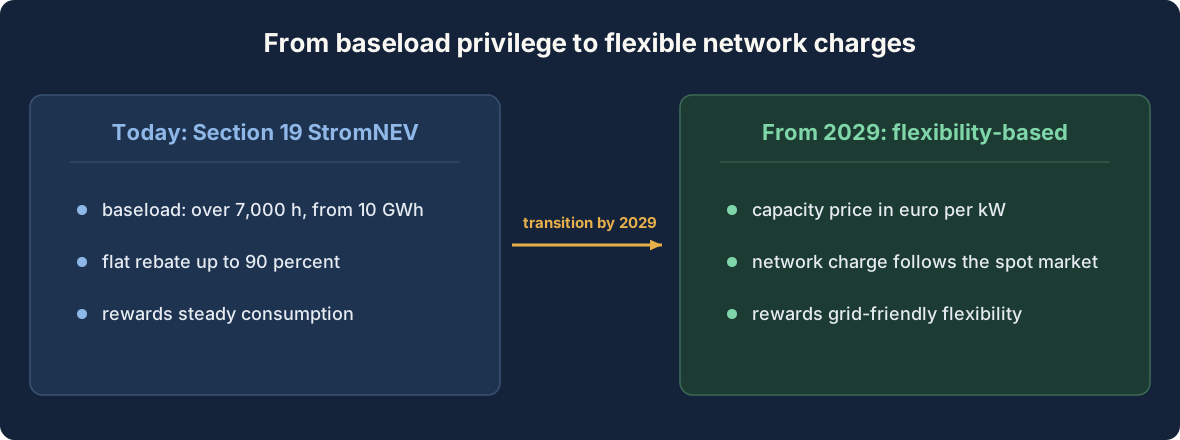
The Federal Network Agency is discussing three approaches that can complement each other. The first couples the network charge to exchange electricity prices: expensive at times of scarcity, cheap during surplus, because the spot price best reflects the current state of the system. The second relieves plants whose consumption avoids congestion and thus lowers redispatch costs. The third lets the grid operator limit load in critical situations, similar to the logic of controllable consumption devices under §14a EnWG. How quickly this flexibility can be marketed is already visible in the market-based congestion management of Redispatch 3.0. The values are firm only with the follow-up determinations.
Challenges and risks
The reform does not hit every plant equally. Where processes can be made flexible, the rebuild is workable. Where they cannot, it becomes a real problem, and that is exactly where reliable protection is still missing.
An electrolyser or a smelting furnace cannot be shut down at will without endangering product quality or the plant itself. For such rigid processes there is so far no reliable legitimate-expectation protection, while the detailed rules only fall in early 2027. This planning uncertainty is the bigger risk than the charge step itself. At the same time the agency warns of extra costs of several cents per kWh if consumption behaviour does not fit the new logic. For energy-intensive plants that is a relevant figure, one that can weigh on location decisions.
Caution with rigid processes: Plants whose load can barely be shifted lose a rebate with the baseload privilege without being able to reach the new flexibility relief. Whether and how legitimate-expectation protection arrives for these cases is decided only in early 2027. All dates and values cited are interim positions in an ongoing process and not yet final.
The §19 rebates do not simply vanish, they change their logic. It is no longer constancy that lowers the network charge, but flexibility. For plants with shiftable load that is an opportunity, for plants with rigid processes a cost risk. Companies that know early which group they belong to plan the transition rather than endure it.
What companies should do now
The reform turns into a concrete plan once you start with your own load rather than with the open rules. Companies that act now can treat the new charges as an opportunity instead of merely paying them. Four steps order the task.
-
Analyse the load profile honestly
Separate the flexible from the rigid consumers. For each major process, check whether and for how long it can be shifted in time or throttled without endangering product quality or plant. Only this assessment shows whether your plant benefits from flexibility-based charges or needs protection for rigid load.
-
Check the contractual position and deadlines
Clarify whether the individual network charges still apply safely in 2026 and whether the 7,000 full-load hours are still reached. Look closely at the contracts with the grid operator, because the ruling on grid-supporting behaviour expired at the end of 2025 and the 2027 network charges go online as early as 15 October 2026. Checking too late here means losing relief that would still be available during the transition.
-
Market your flexibility
Combine the revenue sources instead of looking at one network charge alone. The spot market, balancing power and grid-friendly control can be bundled so that shifted load creates value more than once. The new charge model rewards exactly this behaviour, while the rebate for constancy disappears, and the parallel quality regulation adds reliability and capacity to the revenue side.
-
Build up metering and automation
Invest in metering, load management and the automation of control. Without data-driven control, flexibility stays theoretical, because no one can react to prices and grid signals in real time. This step is the technical precondition for the other three to have any effect at all.

Further Reading
Frequently Asked Questions
The baseload privilege under §19 (2) sentence 2 StromNEV lowers the individual network charges for consumers who draw electricity steadily and predictably. It requires at least 10 GWh of annual consumption and more than 7,000 full-load hours. The rebate can theoretically reach up to 90 percent. The Federal Network Agency is abolishing it because inflexible baseload consumption no longer fits an electricity system driven by variable wind and solar generation.
A ruling on grid-supporting behaviour already ended on 31 December 2025. The remaining §19 StromNEV privileges expire with the network charges ordinance at the end of 2028. The new AgNeS methodology applies from 1 January 2029. For existing customers the baseload rule is extended until 31 December 2031. The Federal Network Agency will decide the detailed industry rules in early 2027. All dates are interim positions in an ongoing process.
Both are privileges under §19 (2) StromNEV, but they follow opposite logic. Atypical network use under sentence 1 rewards those who shift their annual peak load into the grid's off-peak periods. The baseload privilege under sentence 2 rewards steady high consumption over at least 7,000 hours. The reform replaces both with flexibility-based charges, but keeps the atypical-use rebate structure on a transitional basis for very large consumers.
Flat rebates give way to flexibility-based network charges. For large consumers above 100,000 kWh of annual consumption, a capacity price in euros per kW and year is to replace the previous demand price, with a surcharge for exceeding the booked capacity. The Federal Network Agency is discussing three approaches: incentives along exchange electricity prices, relief for grid-friendly behaviour, and the option to limit load in critical situations.
The first step is an honest assessment of your own load flexibility: which processes can be shifted in time and which cannot. Next come checking the contractual position, whether the individual network charges still apply safely in 2026, and building up metering, load management and automation. Without data-driven control, flexibility stays unused. Companies that invest early can treat the new charges as an opportunity rather than a pure burden.
Let's collaborate
One contact, a team behind it
Thirty minutes on what you're working on, whether grid, metering, market processes, IT architecture or AI. Afterwards you'll know how we'd approach it and who would sit at the table.
Energy and measurement technology since 2010 · innobu GmbH since 2014 · Based in Schleswig-Holstein, Germany
Whoever pitches also delivers: whoever leads the first call stays your contact right through to the steering committee, with established partners in the project. Direct: info@innobu.com