Industrial Electricity Price 2026 to 2028: Application and Compliance for Energy-Intensive Companies
Germany's industrial electricity price relieves energy-intensive companies from 2026, but only a narrow group and only against hard conditions. This article explains who qualifies through the KUEBLL list, how the BAFA application works and why the decarbonisation reinvestment duty decides whether the grant turns into a clawback.
The industrial electricity price is a temporary state electricity price subsidy for energy-intensive companies. It caps the power price at 50 euros per megawatt-hour, that is 5 cents per kilowatt-hour, for up to 50 percent of annual consumption, and applies retroactively from 1 January 2026 for the accounting years 2026 to 2028. The European Commission approved the subsidy on 16 April 2026 under the crisis state aid framework CISAF, and the funding guideline appeared in the Federal Gazette on 6 May 2026. Only companies from 91 sub-sectors of the KUEBLL list with a heightened relocation risk qualify, an estimated 2,000 firms. Applications are filed retroactively from 2027 through a BAFA portal, with a main deadline expected on 31 March 2027, and an auditor certificate becomes mandatory from 10 gigawatt-hours of consumption. Recipients must invest at least 50 percent of the subsidy within 48 months in decarbonisation, otherwise a proportional clawback plus 5 percent interest per year applies. The measure costs the federal budget about 3 billion euros, while companies save roughly 4 billion euros by 2027 according to the German Economic Institute. Companies outside the list are excluded and must fall back on electricity tax, the reformed industrial network charges under §19 StromNEV and energy sharing.
What the industrial electricity price is and why it matters now
Five cents per kilowatt-hour. That is how far the industrial electricity price cuts the power bill for energy-intensive companies, but only for half of consumption and only for a while. In legal terms it is a discretionary grant. A subsidy you keep, as long as you meet the conditions. Nothing arrives up front. The money comes once the accounting year is over.
Why now? Because the course is already set. The European Commission approved the subsidy on 16 April 2026, the funding guideline has been in the Federal Gazette since 6 May 2026, and the BAFA keeps updating its guidance. The application only comes in 2027, but eligibility is decided in the running consumption year 2026. Anyone who starts sorting their data in 2027 arrives too late.
The industrial electricity price does not stand alone. It adds to the electricity tax cut to the EU minimum, a temporary relief on network charges and the extended compensation for indirect CO2 costs. For eligible companies these instruments stack, for everyone else only the rest remains.
Who qualifies: the KUEBLL list as a filter
The sector comes first, not the meter. If your business is not in one of the 91 sub-sectors of the KUEBLL list, sub-list 1 to be exact, you cannot apply. Full stop. The list names the sectors where the state sees a real risk that production moves abroad.
Covered sectors include base chemicals, metal production, aluminium, glass and ceramics, cement, paper, plastics, battery cells, semiconductors and parts of mechanical engineering. On top come a German base and consumption points. Excluded are companies in economic difficulty, with open EU recovery orders or listed in debtor registries.
This is exactly where smaller firms fail. A mid-sized machine builder with 80 staff often uses 300,000 to 600,000 kilowatt-hours a year and usually does not belong to the listed sectors. Critics therefore call it a very selective relief. Broader price and market models such as the controllable tariff models 2026 reach further, but work at an entirely different point.
The BAFA application process, deadlines and evidence
The application runs retroactively and digitally through the BAFA. For the consumption year 2026 it is filed for the first time in 2027, with a main deadline expected on 31 March 2027. Miss the deadline or fail to provide the evidence, and you lose the claim for the year. There is no payment on request.
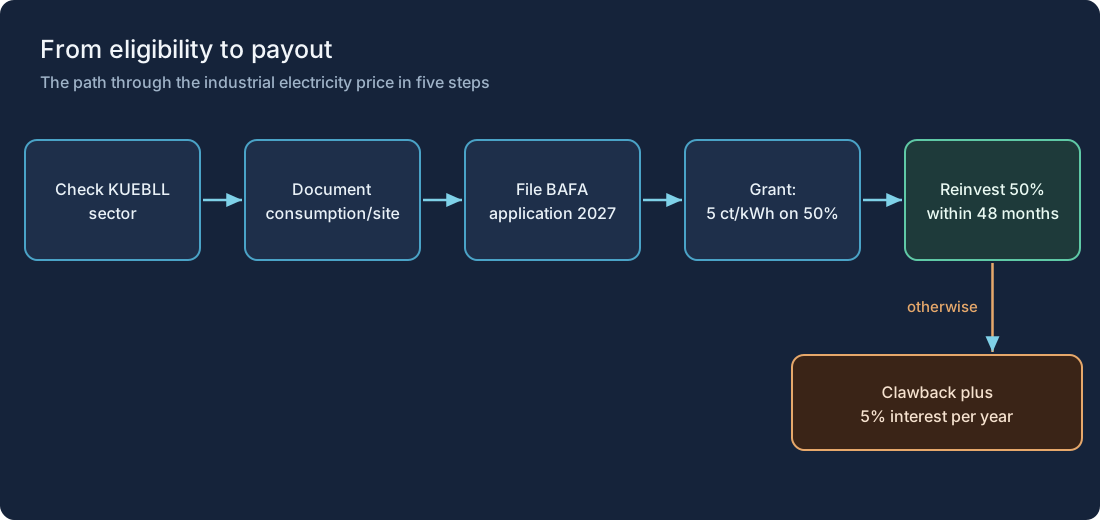
The effort scales with size. For consumption below 10 gigawatt-hours the statistical office classification, a site plan, electricity bills and network usage confirmations plus bank details are enough. From 10 gigawatt-hours of claimed consumption an auditor certificate is added, with a deadline running to 31 May 2027. Anyone also claiming the indirect CO2 cost compensation has until 15 July 2027.

In practice this means the data basis for 2026 is built now, not at the application deadline. Consumption per delivery point, the mapping to the sector and the evidence for the later reinvestment all belong in clean documentation from the start. This evidence burden is where first applications fail most often.
The compliance trap: reinvestment in decarbonisation
The money has a price. At least half of the subsidy must flow into approved decarbonisation within 48 months. Miss the proof and the state takes its share back, with 5 percent interest per year on top. This is no gift. It is an advance on investments you already have ahead of you.

Approved measures include renewable power generation, efficiency measures, infrastructure modernisation and higher demand flexibility. The last point is the most interesting because it couples directly to digitalisation. Load management and flexible consumption control not only cut costs, they can also be evidenced through metering data. That data trail is exactly what you need later for proof.
The reinvestment duty is therefore not an annoying side condition but the core of compliance. It demands an auditable path from the amount received to the concrete measure. Without that path, the payout becomes a risk.
German and EU perspective
The industrial electricity price is a compromise between industrial-policy ambition and the narrow limits of EU state aid law. The European crisis state aid framework CISAF allows the cap of 50 euros per megawatt-hour on 50 percent of consumption, but demands the reinvestment and the time limit in return. The German conditions are not freely chosen, they follow the Brussels framework.
Energy-intensive companies save around four billion euros through the relief by 2027.
The numbers are contested. The subsidy costs the federal budget about 3 billion euros, while industry analyses put the funding volume at roughly 3.8 billion euros for the whole period. The German Chemical Industry Association calls the rule important but no great leap, because it is too small and too selective. How market prices and consumer rights develop in parallel is shown by the reformed EU electricity market design.
Challenges and risks
The group of winners is small, but for them the relief is large. New duties come with it, and the broader economy watches from the sidelines. Both sides belong on the table.
One point is easily missed. The payout only in 2027 and the 48-month window push the risk to the back. A company can receive the subsidy and years later have to repay part of it, because the reinvestment did not happen in time or was not approved. That is exactly why the evidence trail belongs in the plan from the start.
What companies should do now
Even though the application only runs in 2027, eligibility is decided in 2026. These steps help eligible and non-eligible companies alike find the right path.
-
Check eligibility against KUEBLL sub-list 1
Match your own economic-sector classification against sub-list 1. That is the first switch. If your sector is not on it, skip the rest and move straight to the alternatives below.
-
Capture consumption data per delivery point in an auditable way
Build the data basis for 2026 cleanly, split by delivery point and sector. This evidence is the foundation of the application. If consumption exceeds 10 gigawatt-hours, bring in an auditor early.
-
Plan the reinvestment for the 48-month window
Decide now which decarbonisation measures the minimum 50 percent will flow into, and budget them. Demand flexibility and efficiency count and can be evidenced through metering data. Without this plan, the grant becomes a clawback risk.
-
Check alternatives if there is no eligibility
Non-eligible companies combine the reduced electricity tax, the network charge relief and active tariff switching. For local generation and consumption, energy sharing under Section 42c of the Energy Industry Act is added. Together this can add up to noticeable relief depending on the profile.
The industrial electricity price is not automatic. It rewards companies that know their eligibility, document their consumption and plan their reinvestment. Get these three things in order in 2026 and 2027 brings a calm application and a subsidy you keep.
Further reading
Frequently asked questions
The industrial electricity price is a temporary state electricity price subsidy for energy-intensive companies. It caps the power price at 50 euros per megawatt-hour, that is 5 cents per kilowatt-hour, for up to 50 percent of annual consumption. It applies to the accounting years 2026 to 2028 and is paid retroactively by the BAFA as a non-repayable grant.
Eligible companies come from 91 sub-sectors of the KUEBLL list (sub-list 1) with a heightened relocation risk, including chemicals, metals, glass, ceramics, cement, paper, battery cells and semiconductors. They must be based in Germany with consumption points there. Because the sector is the decisive filter, most small and mid-sized firms drop out, with an estimated 2,000 companies benefiting.
Applications are filed after the accounting year ends, first in 2027 for the year 2026, digitally through a BAFA portal. The main deadline is expected to be 31 March 2027, and the deadline for the auditor certificate runs to 31 May 2027. An auditor certificate is mandatory from 10 gigawatt-hours of claimed consumption upwards.
Recipients must invest at least 50 percent of the subsidy within 48 months in approved decarbonisation measures, such as renewable generation, efficiency or higher demand flexibility. If the reinvestment is not documented, a proportional clawback plus 5 percent interest per year applies. On top of that comes the site-binding condition of a German base and consumption.
Companies outside the KUEBLL list receive no industrial electricity price but can combine other relief. This includes the electricity tax cut to the EU minimum, the temporary network charge relief, active tariff switching and energy sharing under Section 42c of the Energy Industry Act. Together this can add up to a noticeable cost reduction depending on the consumption profile.
Let's collaborate
One contact, a team behind it
Thirty minutes on what you're working on, whether grid, metering, market processes, IT architecture or AI. Afterwards you'll know how we'd approach it and who would sit at the table.
Energy and measurement technology since 2010 · innobu GmbH since 2014 · Based in Schleswig-Holstein, Germany
Whoever pitches also delivers: whoever leads the first call stays your contact right through to the steering committee, with established partners in the project. Direct: info@innobu.com