EU Electricity Market Design: The Consumer-Rights Obligations for Suppliers by July 2026
This article sets out which consumer rights the EMD requires, why free supplier choice only applies from 17 July 2026, where Germany has already transposed and what suppliers must deliver operationally and in their IT.
The EU electricity market design, Directive (EU) 2024/1711, had a general transposition deadline of 17 January 2025, but free supplier choice and energy sharing only apply from 17 July 2026. From then, customers may hold several supply contracts at the same time at a single connection point, which for suppliers means sub-metering and allocation logic at one metering point. Germany has pulled parts forward: dynamic tariffs for all suppliers since 1 January 2025 (Section 41a EnWG), the 24-hour supplier switch since 1 January 2026 (Section 20a) and energy sharing from 1 June 2026 (Section 42c). Even so, an infringement procedure has run against Germany and 25 other states since 27 March 2025 over incomplete transposition. In practice the slow smart-meter roll-out holds the new rights back, as only about 5.5 percent of all metering points had a smart meter at the end of 2025. For electricity suppliers this means treating billing, metering and market communication as one programme and planning the July deadline backwards.
Why the EMD deadline hits suppliers now
The EU electricity market design forces electricity suppliers into the last transposition step by 17 July 2026. The main change is free supplier choice: customers may hold several supply contracts at the same time at a single connection point. That sounds like consumer protection, but for suppliers it cuts deep into billing, metering and market communication.
For you as a supplier the bar shifts. This is not one new product but a rebuild of the systems that today map one metering point to exactly one supplier. That is why you should read the July deadline not as a cut-off date but as the end of a programme.
- Directive (EU) 2024/1711 was adopted on 13 June 2024 and entered into force in mid-July 2024.
- The general transposition deadline was 17 January 2025, while free supplier choice and energy sharing apply from 17 July 2026.
- The accompanying Regulation (EU) 2024/1747 applies directly and needs no transposition into national law.
The consumer-rights package at a glance
The EMD bundles several rights that suppliers must offer. The core is choice: between dynamic and fixed prices, between one and several contracts, plus protection against disconnection. Some rights apply above a customer count, others to everyone.
- Dynamic tariff: customers with a smart meter can request a dynamic electricity tariff. The duty binds every supplier with more than 200,000 customers.
- Fixed-price contract: a right to a contract of at least one year, also mandatory above 200,000 customers, with limits on unilateral changes and early-termination fees.
- Free supplier choice: several supply contracts in parallel at one connection point, with separate metering. This rule carries the 17 July 2026 deadline.
- Energy sharing: a right to share self-generated power, for facilities up to 6 MW.
- Disconnection protection: protection from disconnection for vulnerable households and a supplier of last resort.
Not every right is new and not every one hits every supplier. Dynamic tariffs and energy sharing are already regulated in Germany. The real work for July 2026 is free supplier choice with several contracts at one metering point.
Germany: much transposed, the key part open
Germany is not a laggard across the board but selectively ahead. Dynamic tariffs, the 24-hour switch and energy sharing are already in the EnWG. What remains open is the full transposition of the extended end-customer rights, including parallel contract choice.
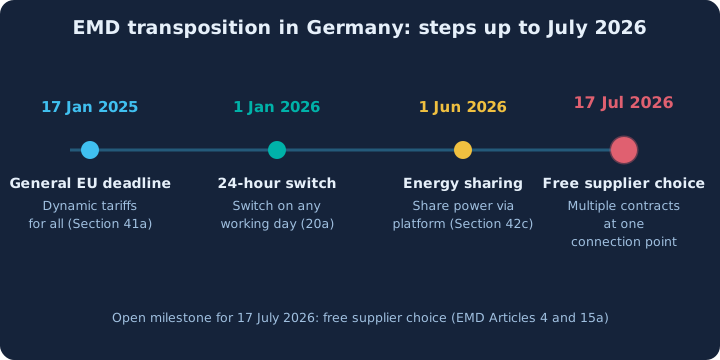
- Section 41a EnWG has required all electricity suppliers to offer dynamic tariffs to smart-meter customers since 1 January 2025, up from a 100,000-customer threshold before.
- The EnWG amendment of December 2025 brought the 24-hour supplier switch (Section 20a, from 1 January 2026) and energy sharing (Section 42c, from 1 June 2026).
- A further amendment at the German economy ministry is to deliver the full end-customer-rights transposition, with no firm timetable as of spring 2026.
- The European Commission has run an infringement procedure against Germany since 27 March 2025; the April 2026 escalation hit only Croatia, Poland and Portugal.
Free supplier choice does not stand alone. It touches the same market processes as the 24-hour switch, which the article on the 24-hour supplier switch describes, and as energy sharing under Section 42c EnWG.
What suppliers must rebuild operationally and in IT
The biggest task lies in metering and billing. Several contracts at one connection point mean splitting consumption across parallel suppliers, so sub-metering and allocation logic at one metering point. That is a genuine change for metering-point administration.

- Billing systems must handle fixed-price, variable and dynamic products in parallel and enforce the duty above 200,000 customers.
- Dynamic tariffs need meter data in quarter-hour resolution and near-real-time price pass-through.
- Market communication is already in flux from the 24-hour switch, with new GPKE, WiM and MPES processes, star-shaped master-data distribution and the metering-point-ID lookup as an API web service.
- Energy sharing under Section 42c runs through a central platform operated by grid operators; settlement of shared volumes must be integrated within the imbalance-settlement period.
- Customer portals need new pre-contract information, a summary of key contract terms and clear risk notices for dynamic tariffs.
How deeply the 24-hour switch already reshapes market communication is shown in the article on the 2026 tariff models . Free supplier choice builds directly on that.
Challenges and risks
The new rights are only worth as much as the infrastructure beneath them. Without smart meters at scale most households can use neither dynamic tariffs nor parallel contract choice in practice. That is the real brake.

- Slow roll-out: about 5.5 percent of all metering points and 23.3 percent of mandatory installation cases at the end of 2025, against a target of 90 percent by 2032.
- Switching risk: consumer bodies warn against hasty moves to dynamic tariffs, since without a heat pump, wallbox or storage the savings are small and the price-spike risk is real.
- Energy sharing stays hard: network charges are not reduced for shared power, and small operators have little incentive.
- Bureaucracy: the BDEW criticises growing monitoring duties without matching digitalisation, layered on top of the parallel market-communication rebuild.
- Data allocation: parallel contract choice with sub-metering raises new questions about data protection and allocation at one metering point.
Why the roll-out matters so much is examined in the article on the smart-meter roll-out . Without that data base the EMD rights stay on paper.
What companies should do now
Suppliers should treat the July deadline as the end of a programme and plan backwards. Anyone who looks at billing, metering and market communication separately loses time. The three tasks belong together.
Four priority steps
-
Run a gap analysis
Mirror your own products, portals and processes against the EMD rights. Where is the fixed-price contract missing, where the pre-contract information, where the ability to hold several contracts at one metering point.
-
Prepare metering and billing
Move the metering-point and billing logic to parallel contracts, including sub-metering and clean allocation. That is the technical core of the July deadline.
-
Bundle the projects
Combine the 24-hour switch, energy sharing and the EMD programme into one market-communication effort instead of running three parallel tasks.
-
Plan the roll-out in
Treat the smart-meter roll-out as a precondition and align customer communication with it. Without meters every new right stays without effect.
The EMD is a building block of the digital energy transition, not a stand-alone topic. It touches the same digitalisation as the market processes around the EnWG amendment . Only right, market process and metering together give a complete picture.
Further reading
Frequently asked questions
The EU electricity market design is the reform of the internal electricity market directive through Directive (EU) 2024/1711. Adopted on 13 June 2024, it strengthens consumer rights in the electricity market: dynamic and fixed-price tariffs, free supplier choice with multiple contracts at one connection point, energy sharing and protection against disconnection. Most rules applied from 17 January 2025, but free supplier choice and energy sharing only from 17 July 2026.
From 17 July 2026 the deadline for free supplier choice and energy sharing expires. Customers may then hold several supply contracts at the same time at a single connection point, with separate metering. For suppliers this means splitting consumption across parallel suppliers, so sub-metering and allocation logic at one metering point.
Partly. Dynamic tariffs have applied to all electricity suppliers since 1 January 2025 (Section 41a EnWG), the 24-hour supplier switch since 1 January 2026 (Section 20a) and energy sharing from 1 June 2026 (Section 42c). Still open is the full transposition of the extended end-customer rights, including free supplier choice. The European Commission has run an infringement procedure against Germany and 25 other states since 27 March 2025.
The EMD gives customers a right to a dynamic electricity tariff where a smart meter is installed, a right to a fixed-price contract of at least one year, the right to hold several supply contracts at one connection point, a right to energy sharing and protection against disconnection for vulnerable households. The fixed-price and dynamic obligation binds every supplier with more than 200,000 customers.
First run a gap analysis against the EMD rights and check which products, portals and processes are missing. Then prepare the metering-point and billing logic for several parallel contracts, including sub-metering. Bundle the market-communication projects for the 24-hour switch and energy sharing with the EMD programme instead of running them twice, and plan the smart-meter roll-out as a precondition.
Let's collaborate
One contact, a team behind it
Thirty minutes on what you're working on, whether grid, metering, market processes, IT architecture or AI. Afterwards you'll know how we'd approach it and who would sit at the table.
Energy and measurement technology since 2010 · innobu GmbH since 2014 · Based in Schleswig-Holstein, Germany
Whoever pitches also delivers: whoever leads the first call stays your contact right through to the steering committee, with established partners in the project. Direct: info@innobu.com