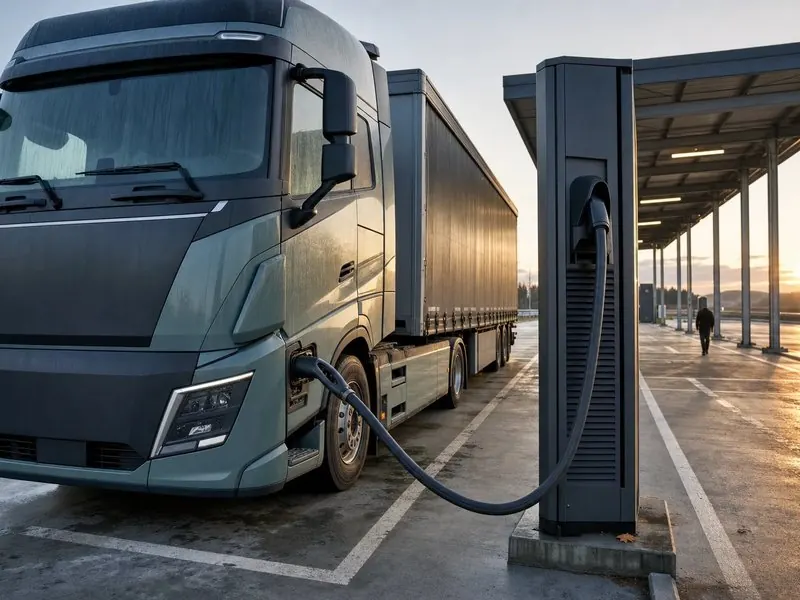
Megawatt Charging System for electric trucks: the standard and the rollout 2026
This article frames megawatt charging for heavy road freight: why it is arriving now, what the new IEC TS 63379 standard defines, where the rollout stands in Germany and the EU, why the grid connection decides the business case, where the risks are, and what companies should do now.
The Megawatt Charging System (MCS) is a charging standard for heavy electric trucks and buses with charging power up to 3.75 MW at 1,250 volts and 3,000 amperes of direct current. With it, a long-haul truck recharges enough for hundreds of kilometres within the mandatory 45-minute driving break. The international specification IEC TS 63379 was published on 9 February 2026, driven by the CharIN industry alliance, and it creates the basis for interoperability between vehicles and charge points from different manufacturers. The rollout has begun: on 29 September 2025 the HoLa project opened Germany's first public MCS charge point with up to 1.2 MW at the A2 Lipperland Sued services, operated by EnBW mobility+. The operator Milence is building a corridor network of 284 MCS charge points at 71 sites across ten EU countries in its MILES project, and the European AFIR mandates truck charging pools along the TEN-T corridors. The real bottleneck is not the charging technology but the grid connection: an MCS hub needs a direct medium-voltage connection and dedicated transformers, and small and medium logistics firms wait five to six years for a connection for depot charging, according to dena. Whether a site is viable therefore depends on the digital control layer for load management, buffer storage, booking and billing. For companies this means: request the grid connection early, plan load management and storage from the start, and build the AFIR obligations into the site strategy.
Why megawatt charging is arriving now
Megawatt charging makes long-haul electric road freight practical. A heavy truck runs on a battery of several hundred kilowatt-hours, and until now that had to be charged either overnight or not fast enough. The Megawatt Charging System delivers enough power that the legally mandated 45-minute driving break is sufficient to recharge.
For you as an energy, fleet or logistics decision-maker, the core question shifts. The vehicle's range is no longer the bottleneck. Instead the question is whether enough power reaches the destination from the grid, and who controls the charging process.
- A CCS connection typically delivers 350 to 400 kW, MCS aims for a multiple of that.
- The drivers are CO2 fleet limits, falling total cost of ownership and the obligations of the European AFIR.
- In 30 to 45 minutes an MCS point recharges enough for hundreds of kilometres of range, the result from the HoLa project.
- The e-truck share of new registrations reached 7.1 percent in Germany and 4.7 percent across the EU in 2025, according to an analysis by Strategy& (PwC).
The standard: IEC TS 63379 and CharIN
Since February 2026 there is an international standard for megawatt charging. On 9 February 2026 the IEC published the technical specification IEC TS 63379, driven by the CharIN industry alliance. It defines the connector, vehicle inlets and cables for conductive direct-current charging in the megawatt range, making vehicles and charge points from different manufacturers compatible.
The difference from a patchwork of proprietary solutions is a market you can plan for. Anyone building a charging hub or buying a truck can rely on the connector and communication fitting together. The table shows how MCS differs from the familiar CCS.
| Feature | CCS (Combined Charging System) | MCS (Megawatt Charging System) |
|---|---|---|
| Charging power | 350 to 400 kW typical | up to 3.75 MW |
| Voltage / current | up to around 1,000 V | up to 1,250 V / 3,000 A |
| Current type | direct and alternating current | direct current only |
| Connector | Combo 2 | seven contacts (2 power, 4 communication, 1 protective earth) |
| Target group | cars, light commercial vehicles | heavy trucks, buses |
| Communication | ISO 15118 | ISO 15118-20 |

Two standards complement the specification. IEC 61851-23-3 describes the charging equipment, ISO 15118-20 governs the communication between vehicle and charge point. That puts MCS on the same communication foundation as the digital charging of cars described in the article on ISO 15118 and Plug and Charge .
Rollout: first stations and the AFIR
The rollout is no longer an announcement, it is under way. In the HoLa research project (high-power charging in long-haul trucking) the first public MCS charge point in Germany went into operation with up to 1.2 MW at the A2 Lipperland Sued services on 29 September 2025, operated by EnBW mobility+ with technology from ABB. In parallel the operator Milence is building a European corridor network, and the AFIR sets the pace.
| Date | Event | Significance |
|---|---|---|
| 29 Sep 2025 | First public MCS point in DE, A2 Lipperland Sued | up to 1.2 MW, EnBW mobility+, HoLa |
| 09 Feb 2026 | IEC TS 63379 published | international MCS standard |
| by 2027 | Milence MILES: 284 MCS points, 71 sites, 10 countries | European corridor network |
| from 2025 | AFIR: truck charging pools every 60 to 100 km on TEN-T corridors | 900 kW per pool, rising to 1,800 kW by 2030 |
| by 2030 | Masterplan Ladeinfrastruktur: approx. 350 sites | approx. 4,200 MCS and CCS points, Deutschlandnetz Lkw |
HoLa covers four sites on German motorways and is funded with around 12 million euros from the German transport ministry and the EU, with partners including Daimler Truck, MAN, Scania, Volvo, Siemens and Heliox. Milence has announced 284 MCS charge points at 71 sites across ten EU countries by 2027 in its MILES project and opened a first MCS site in the port of Antwerp-Bruges with up to 1,440 kW.
The AFIR requires member states to build truck charging pools along the TEN-T corridors, every 60 kilometres on the core network and every 100 kilometres on the comprehensive network. The minimum power per pool rises from 900 kW in 2025 to 1,800 kW by 2030. The gap behind that matters: according to the ICCT these targets cover only 53 to 69 percent of the public charging demand that the EU fleet of battery-electric trucks will have by 2030.
Grid connection and digitalisation
An MCS hub is less a car park with pillars than an energy project. At up to 3.75 MW per charge point it needs a direct medium-voltage connection and dedicated transformers, and several trucks charging at once quickly reach the connected load of a small industrial site. Whether a site pays off is therefore decided less by the hardware than by energy planning and digital control.
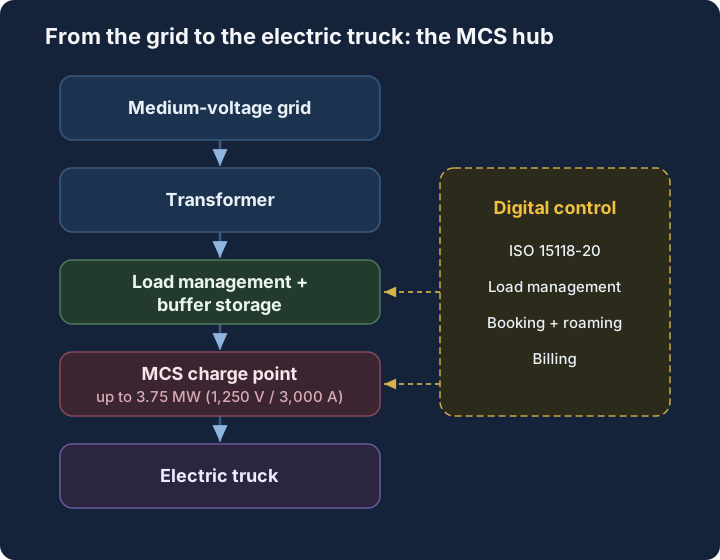
The decisive lever is load management. It caps power peaks and thereby lowers the expensive connected load the operator pays for continuously. A battery buffer between grid and charge point allows more charge points on the same connection because it absorbs short peaks. How such storage works directly on the grid is shown in the article on grid-scale storage in co-location .

Depot charging and public fast charging follow different logic. At the depot the fleet charges overnight and predictably, which is easy to control and remains the main charging case according to the ICCT. The public hub on the motorway, by contrast, has to absorb peak load when several trucks stop at the same time for the driving break. Above both lies a digital layer of communication over ISO 15118-20, the OCPP protocol, standardized as OCPP 2.1, booking and reservation, and roaming between operators. The energy transition knows the same grid-serving control from Section 14a of the German Energy Act , because a charge point is at heart a controllable consumption device.
Challenges and risks
The standard is set, the ramp-up is not. The biggest bottleneck is not the charging technology but the grid connection. Small and medium logistics firms wait five to six years on average for a connection for depot charging, according to dena, and speeding up these procedures is a central political problem.
On top of that come economic and strategic uncertainties. Megawatt chargers are capital-intensive and only pay off at high utilisation, which is far from certain in the early phase of the ramp-up. The market is also not firmly committed to MCS: in China, battery swapping dominates heavy e-trucks with a market share of 60 to 80 percent, and the hydrogen truck remains a competing bet, albeit with a much slower ramp-up. The coverage gap of 53 to 69 percent described by the ICCT shows that the planned public infrastructure will not fully carry demand in 2030.
The biggest risk is not the individual charging cabinet but the grid connection and utilisation. Whoever requests the connection early, models the load realistically and plans load management plus storage from the start makes a site resilient. Whoever waits for finished public infrastructure plans too late.
What companies should do now
Because grid connections take years, early site and energy planning is the decisive lever. That applies to fleet operators as much as to energy utilities and motorway service operators building new business models. Five steps are the priority.
Five priority steps
-
Request the grid connection early
Apply for the medium-voltage connection with the grid operator as early as possible and model the required connected load realistically. The lead time of several years is the critical path of the whole project.
-
Plan load management and storage in
Plan load management and a buffer storage from the start rather than retrofitting them. They lower the expensive connected load and allow more charge points on the same connection.
-
Combine funding and the AFIR
Check funding programmes, such as the federal charging infrastructure funding for e-trucks and the KsNI scheme for the vehicles, and build the AFIR obligations into the site choice rather than treating them as separate topics.
-
Set up digital control as a project
Plan energy management, booking and billing, and roaming as a project in its own right. Communication over ISO 15118-20 and OCPP decides the running operation, not just the commissioning. How exposed this communication still is today is shown by the BSI report on the IT security of charging infrastructure.
-
Couple the TCO calculation
Calculate total cost of ownership together with the AFIR-driven charging build-out and the CO2 fleet limits. That shows from when long-haul electric road freight is cheaper than diesel in your own network.
Megawatt charging does not stand alone. It reaches into the same digitalisation as bidirectional charging , the control under Section 14a of the German Energy Act and the charging communication under ISO 15118 .
Further reading
Frequently asked questions
The Megawatt Charging System (MCS) is a charging standard for heavy electric trucks and buses with charging power up to 3.75 MW at 1,250 volts and 3,000 amperes of direct current. It recharges a large vehicle battery within the mandatory 45-minute driving break far enough for hundreds of kilometres of range. The international specification IEC TS 63379 was published on 9 February 2026.
CCS (Combined Charging System) delivers a typical 350 to 400 kW and handles both direct and alternating current. MCS aims for a multiple of that, up to 3.75 MW, works with direct current only and uses a dedicated connector with seven contacts. MCS is designed for heavy trucks and buses, CCS for cars and light commercial vehicles. Communication in MCS runs over ISO 15118-20.
Yes. On 29 September 2025 the HoLa research project opened Germany's first public MCS charge point with up to 1.2 MW at the A2 Lipperland Sued services, operated by EnBW mobility+ with technology from ABB. HoLa covers four sites on German motorways and is funded with around 12 million euros.
A single MCS charge point draws up to 3.75 MW, and several trucks charging at once quickly reach the connected load of a small industrial site. That requires a direct medium-voltage grid connection and dedicated transformers. According to dena, small and medium logistics firms wait five to six years on average for a grid connection for depot charging. That is why early site and energy planning matters more than the hardware.
The European AFIR requires member states to build truck charging pools along the TEN-T corridors, every 60 kilometres on the core network and every 100 kilometres on the comprehensive network. The minimum power per pool rises from 900 kW in 2025 to 1,800 kW by 2030. According to the ICCT, however, the AFIR targets cover only 53 to 69 percent of public charging demand by 2030.
Let's collaborate
One contact, a team behind it
Thirty minutes on what you're working on, whether grid, metering, market processes, IT architecture or AI. Afterwards you'll know how we'd approach it and who would sit at the table.
Energy and measurement technology since 2010 · innobu GmbH since 2014 · Based in Schleswig-Holstein, Germany
Whoever pitches also delivers: whoever leads the first call stays your contact right through to the steering committee, with established partners in the project. Direct: info@innobu.com