Charging Infrastructure for E-Trucks: Germany's 1-Billion-Euro Program
Since May 2026 Germany's Federal Ministry for Transport has been paying for charging infrastructure for battery-electric trucks. A billion euros over four years, 200 million of it for 2026, up to 500 euros per kilowatt. This piece walks through how the three funding calls work, what you can claim, how applications are picked, and what logistics firms, utilities and charge point operators should line up now.
On 4 May 2026, Germany's Federal Ministry for Transport launched a funding program for charging infrastructure of battery-electric trucks. One billion euros is provided over four years, with 200 million euros initially available for 2026. Funding covers up to 500 euros net per installed kilowatt of charging capacity, at private depots and at publicly accessible sites alike. Beyond the charging points, the required grid connection, battery storage and charging load management are eligible too. The program consists of three funding calls. Small and medium-sized enterprises can apply for non-public charging infrastructure from 5 June 2026 on a first-come basis. For all companies with non-public infrastructure and for publicly accessible infrastructure, a competitive process runs with an application window from 26 May to 7 July 2026. In the competitive calls, the funding euro per installed charging capacity decides. The program is delivered by Projektträger Jülich together with the National Charging Infrastructure Control Center. It complements the KsNI vehicle purchase scheme and helps meet the AFIR requirements for truck charging points along the European core network. The biggest bottleneck remains the grid connection, which industry reports say can take up to 2.5 years.
What the federal program delivers
One billion euros. That is what Germany has put on the table so battery-electric trucks finally find somewhere to plug in. The money runs over four years, and 200 million of it is on offer for 2026. The rate per kilowatt is generous by German standards: up to 500 euros net for every kilowatt of charging capacity a company installs.
Why now, though? The trucks exist. The charging points do not. An e-truck pulls many times the power of a car, and if you cannot count on charging back at the depot, the whole fleet business case falls apart. Federal Transport Minister Patrick Schnieder said as much: heavy road freight only goes electric with capable infrastructure, and that is where the money is aimed.
Two worlds get money here. Private depots, where most trucks sit and charge overnight. And publicly accessible sites for the long haul. Between them they cover how an electric fleet actually spends its day, from the yard gate to the motorway rest area.
The three funding calls in detail
The program is split into three funding calls. They differ by company size, by how accessible the charging points are, and by the selection method. Knowing which call fits means filing the right application and wasting no time.
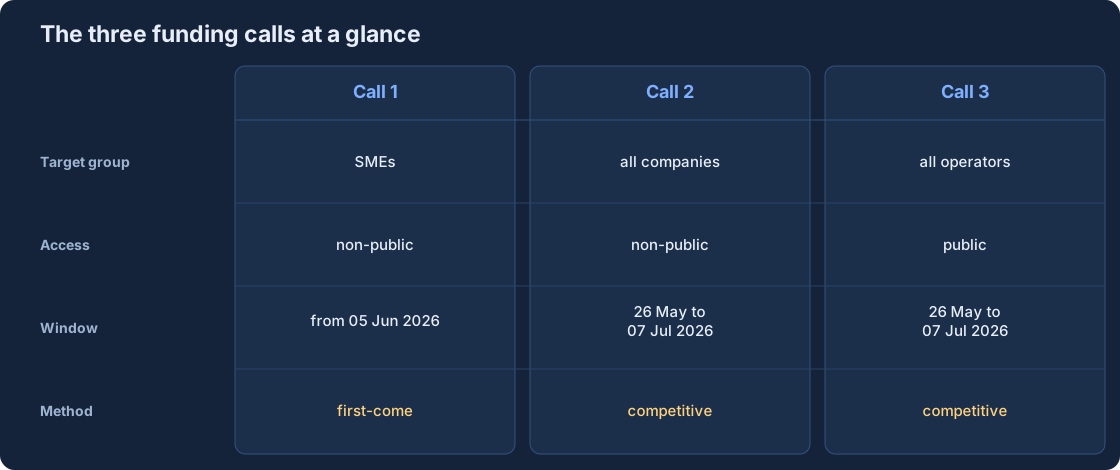
The first call targets small and medium-sized enterprises that charge on their own site. It runs on a first-come basis, so the flat-rate funding is granted in order of application. Applications open on 5 June 2026. Whoever files early and complete has the advantage.
The second and third calls work differently. They are competitive and share a fixed application window from 26 May to 7 July 2026. Call two covers non-public charging infrastructure of all companies, including the large ones. Call three funds publicly accessible charging infrastructure that any truck can approach. In both, what counts is not the timing of the submission but the economics of the application.
What is funded and how selection works
Here is the part that matters most. The funding does not stop at the charging point. It reaches all the way to the grid. At a big charging park the pillar is rarely the expensive bit, the connection and the load management are, and those are exactly the items you can claim.

What counts as eligible: the charging points, the grid connection they need, battery storage, and charging load management. Storage and load management are not decoration. They shave off load peaks and cut how much grid you have to build, which drags down the cost per kilowatt. Plan them in and your application also looks better in the contest, because the funding euro per charging capacity is what the assessors score.
Mind the difference between the two routes. Small and medium-sized firms get a flat-rate grant, handed out in the order applications arrive. In the two competitive calls, projects fight for the pot, and only the most economical get through. Projektträger Jülich runs the whole thing together with the National Charging Infrastructure Control Center.
AFIR, TEN-T and the distinction from KsNI
The federal program does not stand alone. It meets European requirements and complements a second scheme that is often confused with it. Both belong together.
At European level, the AFIR regulation requires member states to provide truck charging points at fixed intervals along the TEN-T core network. The federal program helps reach those targets. In parallel, a separate tender model runs for the truck fast-charging network at motorway rest areas. The technology behind it, megawatt charging, we covered in a separate article on megawatt charging for e-trucks. This program supplies the money, that standard the plug technology.
Second, the distinction from KsNI. The KsNI guideline funds the purchase of climate-friendly commercial vehicles and is administered by the Federal Office for Logistics and Mobility. The new program instead funds the charging infrastructure and runs through Projektträger Jülich. One finances the vehicles, the other the places where they charge. Anyone electrifying a fleet should look at both together.
The grid connection bottleneck
Money on its own builds nothing. The real chokepoint is not the funding rate, it is the grid connection. And whether a billion euros turns out to be enough hangs on how fast the ramp-up actually arrives.

The numbers from the field are sobering. A grid connection for a large charging park can take up to two and a half years, and network operators say openly that they are at their limit. Then there is a problem the sector made for itself: operators fire off connection requests for several candidate sites at once, hoping one lands. That locks up capacity and slows down everyone behind them in the queue.
By 2030 the National Charging Infrastructure Control Center puts the truck fast-charging network at rest areas at 354 sites and roughly 4,200 charging points. Set a billion euros against that and it looks more like a first push than full financing. The competitive route adds its own uncertainty. An application is not an approval. Only the most economical projects per kilowatt make it, which rewards careful planning and punishes expensive one-off builds.
What operators and utilities should do now
The deadlines are tight, the grid connection is slow. Anyone who wants to use the funding should not wait for the next call but start the preparation now. Four steps bring a project into shape.
-
Identify the right funding call
First clarify which call your project belongs to: a small or medium-sized enterprise with its own depot, a larger company with non-public charging infrastructure, or a publicly accessible site. The deadline and method depend on it.
-
Request the grid connection early
The connection is the long road. File the request as early as possible, plan for realistic waiting times, and choose a site where the grid has enough capacity. A well-chosen site beats three parallel emergency requests.
-
Plan storage and load management in
Battery storage and charging load management are eligible and lower the cost per kilowatt. They cap load peaks and make the application stronger in the competition, because the funding euro per charging capacity is the selection criterion.
-
Do the economics properly
Set up the application documents and the cost calculation early. In the competitive calls, charging capacity per funding euro decides. Planning this precisely raises your chance of a grant noticeably.
The federal program takes the most expensive item off the electrification of truck freight, the charging infrastructure including grid connection and storage. Whoever now picks the right call, requests the grid connection early and maximises charging capacity per funding euro gets the most out of the billion.
Further reading
Frequently asked questions
Germany's Federal Ministry for Transport provides one billion euros over four years. For 2026, 200 million euros are initially available. Funding covers up to 500 euros net per installed kilowatt of charging capacity, at private depots as well as publicly accessible sites.
There is one call for non-public charging infrastructure of small and medium-sized enterprises, opening on 5 June 2026 on a first-come basis, one call for non-public charging infrastructure of all companies, and one call for publicly accessible charging infrastructure. The latter two run competitively with an application window from 26 May to 7 July 2026.
Eligible items include not only the charging points themselves but also the required grid connection, battery storage and charging load management systems. The program therefore covers the whole chain up to the grid, because grid connection and load management often form the largest cost block.
In the two competitive calls, the funding euro per installed charging capacity is the central selection criterion. Applications that build the most charging capacity per funding euro win. The call for small and medium-sized enterprises instead runs on a first-come basis by order of application. The program is delivered by Projektträger Jülich together with the National Charging Infrastructure Control Center.
The KsNI guideline funds the purchase of climate-friendly commercial vehicles and is administered by the Federal Office for Logistics and Mobility. The new program instead funds charging infrastructure, meaning charging points, grid connection and storage. The two complement each other: one finances the vehicles, the other the places where they charge.
Let's collaborate
One contact, a team behind it
Thirty minutes on what you're working on, whether grid, metering, market processes, IT architecture or AI. Afterwards you'll know how we'd approach it and who would sit at the table.
Energy and measurement technology since 2010 · innobu GmbH since 2014 · Based in Schleswig-Holstein, Germany
Whoever pitches also delivers: whoever leads the first call stays your contact right through to the steering committee, with established partners in the project. Direct: info@innobu.com