
AI Act Article 50: what German utilities must label in chatbots and voicebots by 2 December 2026
Customer service is where most of the AI in the German energy industry now runs: a PwC study puts 29 percent of deployments there. Article 50 of the AI Act has applied to these systems since 2 August 2026, and the Commission's guidelines on it came out on 20 July. Bots that were already live before August still have one deadline left. It falls in just over six weeks.
Article 50 of the AI Act requires providers of chatbots and voicebots to tell people in the dialogue that they are dealing with an AI, and providers of generative AI to mark the output in machine-readable form; the notice has applied to all systems since 2 August 2026, and marking applies from 2 December 2026 to systems already on the market before that date. The grace period sits in Article 111(4), inserted by Regulation (EU) 2026/1744, and according to the Commission guidelines of 20 July 2026 it covers marking only, not the notice. A German municipal utility that develops a chatbot or has one developed and runs it under its own name is a provider and carries both duties. Agent assist for staff is outside the notice duty; call transcription and smart meter readings are outside the marking duty. Breaches can be fined under Article 99 up to EUR 15 million or 3 percent of annual turnover, with the Federal Network Agency (BNetzA) as the competent authority.
What ends on 2 December 2026, and what doesn't
Only one thing ends on 2 December 2026: the grace period for machine-readable marking of generative systems that were on the market before 2 August 2026. The notice saying "you are talking to an AI" has applied to every bot since 2 August, however old it is.
That deadline arrived late. The Digital Omnibus, Regulation (EU) 2026/1744 of 8 July 2026, inserted a new paragraph 4 into Article 111 of the AI Act: providers of generative systems placed on the market before 2 August 2026 "shall take the necessary steps to comply with Article 50(2) by 2 December 2026". Four months, then. Recital 38 says the point is to let providers adapt "without disrupting the market". Published in the Official Journal on 24 July, the regulation has applied since 27 July.
A chatbot is both things at once. It interacts, and it generates text. For exactly this case the Commission guidelines of 20 July 2026 are blunt: such systems benefit from the transition period "only with regard to the marking obligation", while the disclosure that people are interacting with an AI had to be in place from 2 August (paragraph 153).
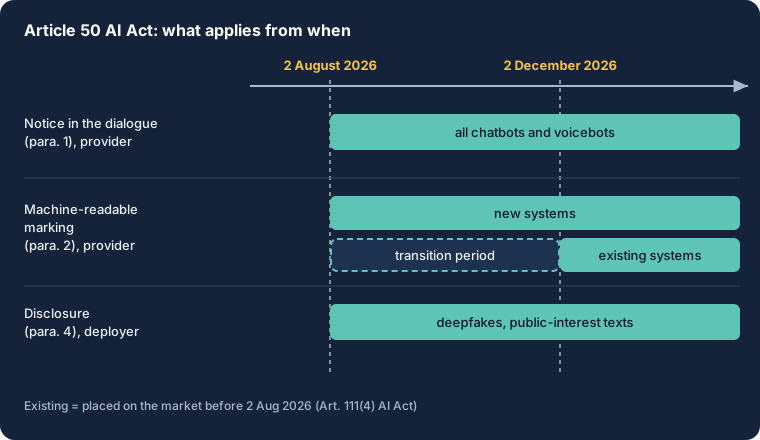
Anyone treating 2 December as the deadline for the chatbot notice is already eleven weeks late.
There is some relief. Nobody has to go back and mark what was generated before 2 August 2026, whether images, audio or text (paragraph 154). One catch: a text generated earlier but published afterwards falls under the new rules. Both dates are in our energy transition deadline calendar.
Provider or deployer: who carries the duty
Notice and marking are provider duties. Whether a utility is the provider isn't decided by its contract with the integrator. It turns on who develops the system or has it developed, and under whose name it is put into service.
The guidelines work through examples. An organisation that develops a chatbot in-house and puts it into service for its own use under its own name is a provider. So is anyone who modifies an existing generative system with new training data and runs it under their own name; they become the provider of the new system (paragraph 11). A deployer decides on the purpose and manner of use and needs no technical control to qualify (paragraph 12).
And the typical case at a Stadtwerk? An integrator builds a bot on a large language model that answers questions on instalments, moving house and meter readings, with the utility's name and logo on the website. "Has it developed" plus "own name": on the wording, the provider role is close. It looks different when a vendor supplies a finished customer service product under its own brand and the utility only configures it. Each company has to make that call for its own system, with its legal department.
Paragraph 74 offers some help. A provider may rely on the marking supplied by the model provider or a third party. Responsibility for proving compliance stays with the provider all the same. If you are counting on the model vendor's watermark, get the commitment in writing.
For the other role-based duties, from AI literacy to high-risk, see our overview EU AI Act for energy utilities.
The notice in the dialogue since 2 August
People must be able to see the notice clearly at the first interaction at the latest, and it has to meet accessibility requirements (Article 50(5)). Chatbots in customer support and complaints handling, along with voice assistants, appear in the guidelines as explicit examples (paragraph 31).
Paragraph 37 describes what that can look like, separately for text and phone. In chat: a prominent banner or a first message such as "you are chatting with an AI system", ideally close to the input field. On the phone: a spoken sentence right at the start, with reminders in longer calls, especially after interruptions or when the AI changes its role. A tone helps visually impaired users but isn't enough on its own.
One detail from paragraph 40 matters for utilities. A single notice usually suffices, but not in riskier contexts, and the Commission counts complaints handling among them. If your bot takes complaints about higher instalments or disconnection warnings, it should remind people during the conversation.
Utilities can hardly rely on the "obvious" exception. The guidelines read it narrowly. Where consumers are part of the audience, including older people and people with little experience of AI, it does not apply (paragraph 45). An internal assistant for trained staff is another matter.
Agent assist is clearly outside. When an AI suggests replies to customer service staff, the customer is talking to a human, and Article 50(1) does not apply (paragraph 30). Yet the mere possibility that a human could step in somewhere doesn't turn a bot into a person. Same paragraph.
Machine-readable marking: what has to be in place by December
Article 50(2) asks for two things. The output carries a mark that software can read without human help, and there is a tool that detects the mark. One without the other does not meet the duty (paragraphs 69 and 70).
How to do it technically is set out in the Code of Practice on marking and labelling AI-generated content, which the Commission published on 10 June 2026. Signing is voluntary. Signatories commit to at least two layers for images, audio and video, typically signed metadata plus an imperceptible watermark. Free-form text cannot carry metadata, so one technique is enough there: the watermark. The Code exempts very short texts from it and expressly requires it for free-form text longer than 200 tokens. Detection tools should in principle be free and interoperable by 2 February 2027.
Synthetic speech counts as audio under paragraph 2. A utility running a voicebot as provider needs a statement from the speech synthesis vendor on what it marks and how the mark is detected. In telephony, where metadata rarely survives the trip through the network, that's a real engineering question. Paragraph 88 allows an exception for real-time content consumed immediately and not stored, where marking is technically not feasible and people know they are dealing with AI. Its examples are video games and virtual reality. Whether a hotline call fits is open, and a utility that records its calls will struggle to rely on it.
Not every AI output needs a mark. Paragraph 92 exempts spelling correction, translation and call transcription. Summaries and rewrites are covered. So the tool that writes a call note after the conversation is in scope, while the plain transcript is not.
One passage hits the energy sector directly. Paragraph 66 names consumption recorded by AI-enabled smart meters, along with grid frequency and voltage measurements, as output that needs no marking. Paragraph 68 adds short sequences and UI labels, source code and output that passes only between machines. A load forecast read only by grid planning and the control room may fall under the narrow exception for strictly technical internal output (paragraph 87). All three conditions there must be met, including that nothing leaves the company. Measured values, then, are out of scope. The bot on the website is not.
Which customer service systems are affected
All three Article 50 duties show up in a utility's customer service, though rarely in the same system. The table places typical applications against the guidelines. It is no substitute for checking an individual system.
| System | Notice (para. 1) | Marking (para. 2) | Disclosure (para. 4) |
|---|---|---|---|
| Chatbot on the website or customer portal | yes, from the first message | yes, text; existing systems from 2 Dec 2026 | no |
| Voicebot on the outage or meter reading hotline | yes, spoken at the start | yes, synthetic speech | no |
| Agent assist, reply suggestions for staff | no, customer talks to a human | with the tool's provider | no |
| Transcription of customer calls | no | no, exception under para. 92 | no |
| Summary of customer calls | no | yes, with the provider | no |
| AI text on a supply interruption on the website or social media | no | with the tool's provider | likely, unless reviewed by a human with editorial responsibility |
| AI avatar of the managing director in a video | no | with the tool's provider | yes, deepfake |
| Meter readings and grid measurements | no | no, para. 66 | no |
| Load forecast for internal grid planning only | no | narrow exception under para. 87 possible | no |
Two rows need a word. The disclosure duty for AI text applies to published texts that inform the public on matters of public interest. The guidelines count public services, public security and consumer safety among them, and their example is a weather service's storm warning on social media (paragraph 131). An AI-drafted notice about a supply interruption sits close to that. The duty falls away if a human reviews the text and someone holds editorial responsibility. An advert with no claims on safety or sustainability is outside.
As for the avatar, it comes straight from the guidelines: an AI-generated video in which the CEO congratulates staff on the year's results is a deepfake. Planning one for the staff meeting? Label it.
Customer acceptance: 12 percent would cancel
The notice is a legal duty, and it's also a question of trust. In Simon-Kucher's energy customer study 2026, 12 percent of respondents in Germany said they would cancel their electricity contract if their supplier used AI to control their power. One in three electricity customers is open to switching anyway.
That figure is about AI steering electricity, not about chatbots. It transfers only with care. What it does show is how thin the trust is on which a utility introduces AI into customer contact. In spring 2026 PwC found that 79 percent of German energy companies had introduced AI, 61 percent of them still experimentally (ZfK, 13 April 2026).
Our view: the notice doesn't cost customers. A bot that sounds human and then gets found out does. In paragraph 39 the guidelines themselves warn about "banner blindness". One short, honest sentence at the start works better than a paragraph of legal text. How AI in customer service can reduce cancellations is covered in our piece on AI in customer service and churn prevention; who is liable when a bot gets it wrong is in our article on AI liability for chatbots.
What the law provides if the deadline is missed
The AI Act provides for fines for breaches of Article 50. Under Article 99(4)(g) they can reach EUR 15 million or 3 percent of worldwide annual turnover, whichever is higher; SMEs and, since the Omnibus, small mid-caps face the lower amount. That covers providers that fail to mark existing systems after 2 December 2026 and deployers that fail to disclose deepfakes.
In Germany, the competent authority as a rule is the Federal Network Agency (BNetzA), under Section 2(1) KI-MIG. According to its announcement of 29 July 2026 it also supervises the transparency duties and acts as the central complaints body for breaches of the AI Act. What the agency can request and test is explained in our article on the KI-MIG and the BNetzA as AI supervisor. Whether a fine is imposed in a given case, and how high, depends on the circumstances listed in Article 99(7). That weighing is for the authority, not for this article.
Limits and open questions
The duty is clearer than the technology behind it. Text watermarking is the weakest point. The Code of Practice itself concedes that free-form text cannot carry metadata, and it expressly requires a watermark only for free-form text longer than 200 tokens. Very short texts are exempt, with no figure for where that starts. Plenty of customer service bot replies stay under 200 tokens. What remains as a mark in that case, the Code doesn't spell out. Article 50(2) asks for the solution only "as far as technically feasible", and where that half-sentence ends will be drawn by supervisors.
Then there's the wording. Article 111(4) refers to systems "placed on the market" before 2 August. A utility that uses its bot only for itself has put it into service rather than placed it on the market. The guidelines read the transition rule broadly and include systems put into service (paragraph 153). But guidelines bind no one, and no court has ruled on the point yet.
And the supply chain: a provider that depends on a platform vendor's marking is tied to that vendor's roadmap. According to the Commission, about 190 organisations had signed the Code by the end of July. For the section on marking output, the one that matters here, its list shows 95 signatories (as of 17 October 2026). Whether your vendor is among them takes one email to find out.
Roadmap to 2 December: systems and evidence
A little over six weeks remain until 2 December. That's enough if the work starts with a list rather than a tender. The steps below give it an order; they don't replace a legal review of each system.

Seven steps to December
-
List every system with customer contact
Chat on the website and in the portal, a voicebot on every hotline, AI in the email inbox, social media tools, video production. Note for each system when it went live. That date decides whether the grace period applies at all.
-
Record the role for each system
Provider or deployer, with one sentence of reasoning: who developed it, and under whose name does it run?
-
Test the notice, today
This isn't a December task; the duty has applied since August. Start a chat, call the hotline, simulate a complaint. Keep a dated screenshot and a recording of the greeting.
-
Ask the vendor in writing
Four questions will do. Which technique marks the output? Which tool detects it? Has the company signed the Code of Practice? From when is it active in your system? The answer goes into the file; a verbal promise won't help much in a review.
-
Retrofit in-house systems
Where the utility is the provider, the mark has to be in the output: metadata in the API response, the speech synthesis watermark, plus a way to detect them. For text under 200 tokens it remains, as noted above, an open question.
-
Set an editorial path for published AI text
Who checks an AI-drafted outage notice before it goes online, and who is responsible for it? By name.
-
Open the evidence file
System list, role reasoning, test records, vendor replies, editorial path and a named owner. Article 50 asks for no more than that as a document. If the BNetzA sends a request, though, it's what you will want to hand over.
The file doesn't need a new tool. If you already keep an AI inventory, add three columns there. How inventory, approval path and roles fit together at a utility is described on our page on AI governance for utilities. Duties by role and deadline are collected in our AI regulatory matrix, and every article on the subject sits under the topic AI in the energy industry.
This article sets out how Article 50 of the AI Act and the Commission guidelines apply to typical roles at German energy utilities. It is not legal advice and not a review of your individual case. Whether your company is the provider of a particular system and which marking is sufficient should be clarified with your legal department or legal counsel. Status: 17 October 2026.
Deadline, market roles, systems
2 December 2026EU AI Act: labelling duty extends to AI already in useLaw · adopted
Applicability: Art. 50(2) of the AI Act addresses providers of generative AI systems. Companies that only use bought-in systems are deployers and mainly face disclosure duties under Art. 50(4).
If the deadline is missed: Fine possible If a provider of generative AI placed on the market before 2 August 2026 does not mark its output in machine-readable form by 2 December 2026 (Art. 50(2) and Art. 111(4) AI Act), the breach can be fined under Art. 99(4)(g) up to EUR 15 million or 3% of worldwide turnover, with the lower amount for SMEs. The same range applies to deployers for disclosing deepfakes (Art. 50(4)). Legal basis ↗
- Company-wide, several rolescheck applicabilityDetermines for each generative AI system whether the company acts as provider and, if so, marks outputs in machine-readable form.Typically affected: AI systems and chatbots, Customer and grid connection portal
A classification for typical market roles, not a review of your individual case and not legal advice. Whether an obligation applies to your company (thresholds, exemptions) is for your legal department or counsel to confirm. The calendar doesn't replace your own deadline review. Information as of: 11 October 2026.
Further reading
Frequently asked questions
Article 50 regulates transparency. Providers of systems that interact directly with people must make sure those people learn they are dealing with an AI. Providers of generative AI must mark the output in machine-readable form and make it detectable. Deployers must disclose deepfakes and AI-generated texts that inform the public on matters of public interest, unless a human has reviewed the text and someone holds editorial responsibility.
No. The transition period in Article 111(4) covers only machine-readable marking under Article 50(2). The notice telling customers they are talking to an AI has applied to every chatbot and voicebot since 2 August 2026, older ones included. Paragraph 153 of the Commission guidelines of 20 July 2026 says so explicitly.
It depends on who develops the system or has it developed, and under whose name it is put into service. Under paragraph 11 of the guidelines, an organisation that develops a chatbot in-house and puts it into service for its own use under its own name is a provider. A utility that uses a third-party product unchanged is a deployer. Each company settles the classification of its own system with its legal department.
Yes. The guidelines name voice assistants and customer service systems explicitly. For telephony they recommend a spoken notice at the start of the call and reminders during longer calls. A tone on its own is not enough, according to paragraph 37.
Measured values do not. Paragraph 66 of the guidelines expressly excludes consumption recorded by smart meters and grid frequency and voltage measurements from Article 50(2), and paragraph 68 excludes output exchanged only between machines. A load forecast used only internally can fall under the narrow exception for technical output in paragraph 87 if all three conditions there are met.
Article 99(4)(g) provides for up to EUR 15 million or 3 percent of worldwide annual turnover, whichever is higher. For SMEs and small mid-caps the lower amount applies. In Germany the Federal Network Agency (BNetzA) is the competent authority as a rule, under Section 2 KI-MIG.
Let's collaborate
One contact, a team behind it
Thirty minutes on what you're working on, whether grid, metering, market processes, IT architecture or AI. Afterwards you'll know how we'd approach it and who would sit at the table.
Energy and measurement technology since 2010 · innobu GmbH since 2014 · Based in Schleswig-Holstein, Germany
Whoever pitches also delivers: whoever leads the first call stays your contact right through to the steering committee, with established partners in the project. Direct: info@innobu.com