aFRR at the Czech border: what FOX and TIGER now put on record
ALPACA went live on 3 September 2025. On 2 September 2026, one day before the one-year deadline ran out, the TSOs of Germany, Austria and the Czech Republic filed a description of their forecasting tools. Ruling Chamber 6 took comments until 16 October. It matters to the control rooms of the four German TSOs and, through the price, to anyone offering aFRR in Germany.
The probabilistic method under Article 33(6) of the EB Regulation is how the TSOs in the aFRR cooperation ALPACA calculate, every day, how much secondary reserve capacity they may exchange across the Czech borders with Germany and Austria; it has applied since go-live on 3 September 2025. Amendment BK6-26-473 of 2 September 2026 puts on record for the first time how the two forecasting tools work: FOX averages historical risks, TIGER estimates available cross-zonal capacity with gradient-boosted trees fed by at least nine forecasts. The Bundesnetzagentur consultation ran until 16 October 2026, and only the approved version becomes binding. According to Austrian Power Grid, Germany is the largest importer in the cooperation, with 14,831 MW of upward and 20,265 MW of downward aFRR from the Czech Republic in the first weeks.
What the Bundesnetzagentur is consulting on
Case BK6-26-473 opened on 2 October 2026. Filing it were the control-area TSOs of Germany, Austria and the Czech Republic: 50Hertz, Amprion, TenneT and TransnetBW together with APG and ČEPS.
It's an amendment. Approval of the calculation steps came on 5 November 2024. What is new is the part that was missing: a binding description of the two forecasting tools, their algorithms and their inputs. Changes are highlighted in colour in the proposal, and the English version is the reference text.
Two borders use the method today, Czech Republic to Germany and Czech Republic to Austria. Germany and Austria keep their own aFRR cooperation rules, and the ruling chamber says explicitly that the proposal does not touch it.
Sounds like paperwork. Not entirely. Until now, anyone asking why 40 MW of exchange was allowed one day and 10 MW the next got an answer from tools whose inner workings were not part of the approval.
How the exchange limit is set
Once a calendar day, before the aFRR auction closes, the tools run for every border, every direction, every product and each of the six four-hour blocks. Out comes one number in megawatts.
Everything runs through scenarios, which according to APG run from 0 to 100 MW per direction and product. Each scenario faces two questions. How likely is it that less cross-zonal capacity turns up than assumed? And how likely is it that the importing country needs more aFRR than it bought at home?
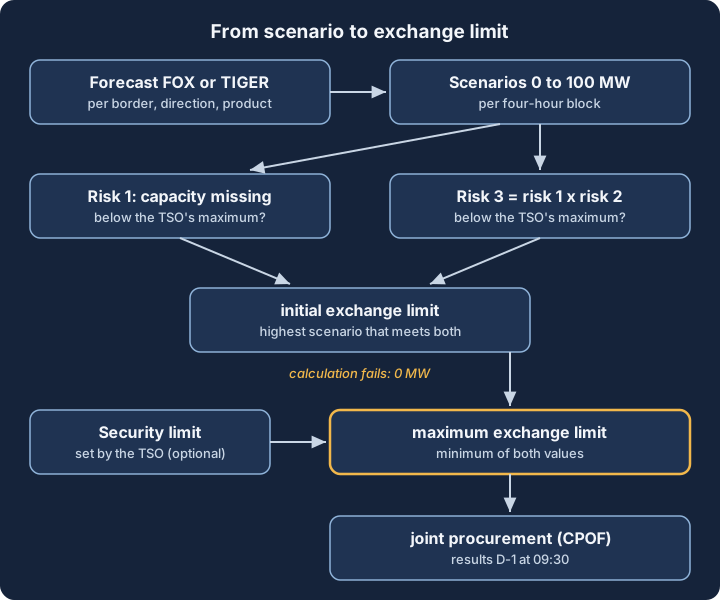
Multiply the two and you get the risk of insufficient reserve. An example in the explanatory note runs on the Austria to Czech Republic border. At 10 MW, capacity is missing with a probability of 12 percent and demand exceeds the domestic volume with 8 percent, which makes 0.96 percent. ČEPS's ceiling in the example is 1 percent. So 10 MW passes, and 20 MW at 1.8 percent does not.
Each affected TSO sets its own ceilings for both risks, as static parameters. Whichever scenario is highest while respecting both wins. A TSO may add a security limit on top, and the lower of the two becomes the maximum exchange limit fed into the common procurement optimisation.
What if the calculation isn't done by gate closure? Then the limit is 0 MW. No exchange that day, on that border.
What FOX and TIGER put on record
Two tools run in parallel. Each TSO names one as its priority, and if it fails the other may step in. ENTSO-E lists 50Hertz and APG as the operators of the tools.
FOX is plainly simple. It takes the average of what really happened in the same four hours on previous days. If capacity between midnight and 4 am sat at 0 MW for two hours and at 70 MW for two hours, a 50 MW scenario was uncovered half of the time in that block.
TIGER is the opposite: a learning model weighting nine forecast series that all move with cross-zonal capacity but as little as possible with each other. The explanatory note claims a "comparably high forecasting accuracy" for it (our translation). It gives no figures.
For the TSOs, putting this on record mainly means one thing. The data feeds become part of the approval. If a forecast series disappears or changes resolution, that will touch the approved method, not just an internal tool. Whether the words "at least the following inputs" leave enough room will show at the first data outage.
Where the obligation comes from
Nobody volunteered this. Regulators of the region asked for it on 31 May 2024, when they sent the first proposal of 14 December 2023 back for amendment.
First proposal filed
Method and procurement rules for the Germany to Czech Republic border, after a TSO consultation from 7 August to 25 September 2023.
Regulators request amendments
Add rules on how the forecasting tools are applied, describe inputs better, file an amendment after one year of operation.
Approval BK6-23-333
Ruling Chamber 6 approves the amended proposal dated 5 September 2024, subject to revocation.
First day of application
ALPACA goes live, and the one-year clock for describing the tools starts.
Amendment BK6-26-473
Complete on 21 September 2026, open for comments until 16 October 2026.
Article 4(6) of the approved method sets the deadline no later than one year after the first day of application, which was 3 September 2025. And the proposal is dated the day before. Cutting it close.
Reporting runs alongside. Three, six, nine and twelve months after go-live, the TSOs give the regulators an ex-post comparison of forecast risk against actual risk, plus any fallbacks used and what they cost. None of these reports is public.
What a year of ALPACA shows
Clear direction. Czech Republic exports, Germany imports. For the first weeks after go-live, APG reports imports from the Czech Republic into Germany of 14,831 MW of upward and 20,265 MW of downward aFRR; Austria took 325 and 1,177 MW.
Why? It's on the same slide: German capacity prices peaked above 3,500 euros per MW and hour. For September and October 2025, APG puts the savings across the whole cooperation at roughly 11 million euros, most of it in Germany and 147,000 euros in Austria.

In October 2025 the Czech trade portal oEnergetice found the minimum prices in the night blocks of both countries almost identical. In 2025, upward aFRR averaged around 20 euros per MW and hour in the Czech Republic and around 15 in Germany. Peaks are still set by the German daily market.
It hasn't run without errors. On 3 November 2025 the optimiser awarded downward aFRR for the 16:00 to 20:00 block at more than the lowest cost; APG blames a fault in the optimisation algorithm involving paradoxically rejected bids and has added plausibility checks since. For providers in Germany, that's the real news. Their award depends on two calculations they never see: the limit and the optimiser.
For the platforms that exchange balancing energy alongside capacity procurement, see our piece on MARI and PICASSO.
Forecast or insurance
There has been a dispute at the heart of the method since 2023, and the approval papers barely mention it.
The European Federation of Energy Traders pushed back in its response to the TSO consultation on 21 September 2023. Balancing capacity is insurance, EFET argued, and basing insurance on a forecast of cross-zonal capacity doesn't fit. Forecast quality matters more here than in market-based allocation because system security is at stake. And the method must not cut day-ahead capacity.
TSOs see it differently. In its post-launch review, APG writes about the Czech border (our translation): "no reduction of capacity for the day-ahead and intraday market".
The Bundesnetzagentur, for its part, recorded on 5 November 2024 (our translation): "No objections were raised by the market against either the original or the amended proposals." It did in fact receive no comments in either of its 2024 consultations. The traders' criticism went to the ENTSO-E consultation, not to Bonn.
The method answers the insurance question with Article 6. If risk changes between gate closure and activation, the affected TSO has to trigger local fallback procedures. Risk sits with the buyer. No reservation covers it.
Whether more comments came in this time is not known. The Bundesnetzagentur reserves the right to publish them.
What happens after 16 October
With the window closed, the regulators of Germany, Austria and the Czech Republic coordinate their decision. Last time it took a little over ten months from filing on 21 December 2023 to approval, including one request for amendments. No date for BK6-26-473 has been published.
What happens if the deadline is missed: Commenting was voluntary. Anyone who did not comment by 16 October 2026 does not bring their objections into this procedure. Only the method approved by the Bundesnetzagentur becomes binding.
Once approved, the TSOs publish the amended method without delay (Article 9(1)). The maximum exchange limit per product, border and direction keeps appearing no later than the procurement results, which per ENTSO-E come out at 09:30 on the day before delivery.
Since 2024 the real lever has been the revocation clause. In the chamber's reasoning, a later amendment procedure could replace the products, the settlement or the capacity procedure. In the proposal's own words, the probabilistic method is an alternative "in particular before" the market-based allocation methods of the EB Regulation are developed and implemented. A bridge, then. Not the destination.
What operators and providers should do now
Before the approval
-
Document the data chain behind each tool
For every FOX and TIGER input, pin down who supplies it, at what resolution and what happens when it drops out. Once approved, that stops being an internal matter. The 4-second PICASSO data and third-party forecasts deserve their own check path, because one missing series can end up meaning 0 MW.
-
Revisit the risk ceilings
They are static, and each TSO owns its own.
-
Use the reports to steer
Under Article 9(3), the ex-post comparison shows whether the forecast under- or overestimates risk. It is a sound basis for choosing between FOX and TIGER per border.
-
As a provider, put the limit into your price forecast
Municipal utilities and direct marketers with prequalified CHP units, batteries or pools bid into the same four-hour blocks as Czech providers. Look at the published maximum exchange limit: it tells you how much foreign capacity may help cover German demand. If you price bids, know the history of that number, including for battery storage marketing.
-
Watch Ruling Chamber 6
Approval, any published comments and the tool statement one month before application are the three dates that matter.
We track the deadline and the roles in the energy transition deadline calendar.
Deadline, market roles, systems
16 October 2026aFRR at the Czech border: consultation on the capacity method closesConsultation · open
Applicability: Concerns the control areas bordering the Czech Republic; the German-Austrian aFRR cooperation is not affected.
If the deadline is missed: No direct legal consequence Commenting is voluntary. Parties that do not comment by 16 October 2026 do not bring their objections into this procedure; only the method approved by the Federal Network Agency becomes binding. Legal basis ↗
- Transmission system operatorcheck applicabilityCan comment on the amendment proposal until 16 October and checks whether cross-border aFRR procurement at the Czech border changes.Typically affected: Grid control system / SCADA, Trading and procurement system (ETRM)
A classification for typical market roles, not a review of your individual case and not legal advice. Whether an obligation applies to your company (thresholds, exemptions) is for your legal department or counsel to confirm. The calendar doesn't replace your own deadline review. Information as of: 14 October 2026.
Further reading
Frequently asked questions
A method TSOs use to calculate how likely it is that cross-zonal capacity is still available for exchanging balancing capacity after intraday gate closure. From that they derive an exchange limit per border, direction, product and four-hour block, without reserving capacity. The Bundesnetzagentur approved the method for the Czech borders with Germany and Austria on 5 November 2024.
ALPACA is the cooperation of the transmission system operators of Germany, Austria and the Czech Republic for joint procurement of aFRR balancing capacity. It went live on 3 September 2025 and extends the German-Austrian cooperation of 2020 to the Czech borders.
The amendment does not change the calculation steps. It describes the two forecasting tools in binding terms: FOX as an averaging method over historical risks and TIGER as a machine-learning method with at least nine forecast inputs. Algorithm and input data thereby become part of the approved method.
Comments could be sent by email to Ruling Chamber 6 of the Bundesnetzagentur until 16 October 2026. Commenting was voluntary. Only the approved version becomes binding.
No. The Bundesnetzagentur states that the existing aFRR procurement cooperation between Germany and Austria is not affected by the amendment. On that border, capacity is allocated through a cost-benefit analysis.
The exchange limit decides how much Czech and Austrian aFRR may cover German demand. A higher limit means more competition in the German four-hour blocks. The TSOs publish the maximum exchange limit no later than the procurement results.
Let's collaborate
One contact, a team behind it
Thirty minutes on what you're working on, whether grid, metering, market processes, IT architecture or AI. Afterwards you'll know how we'd approach it and who would sit at the table.
Energy and measurement technology since 2010 · innobu GmbH since 2014 · Based in Schleswig-Holstein, Germany
Whoever pitches also delivers: whoever leads the first call stays your contact right through to the steering committee, with established partners in the project. Direct: info@innobu.com