
Standard balancing group contract BK6-23-102: what changes for balancing group responsibles
The StBKV is the framework contract that decides what a balancing group responsible has to deliver every day: schedules on time, a correct declaration and a security deposit that holds. The BK6-23-102 version, in force since 1 October 2024, replaces the 2019 contract and anchors the rules in European law. Many teams confuse this with the steps before and after it, so the distinction matters: settlement of aggregated time series and imbalance energy sits in MaBiS and the MaBiS hub, while metering and quarter-hour balancing at the end-consumer level sits in the ZSG quarter-hour balancing. This article explains what the StBKV regulates, what is new in BK6-23-102, how the security deposit and the declaration work, what schedule management and the urgent call demand, how it differs from MaBiS and ZSG, and what companies should do now.
The standard balancing group contract (StBKV) is the framework contract between the balancing group responsible (BRP) and the transmission system operator (TSO) for each control zone. It governs schedule management, declaration, the security deposit, data exchange and sanctions. The current version, approved by the Federal Network Agency under the case reference BK6-23-102, applies since 1 October 2024 and fully replaces the 2019 predecessor BK6-18-061. Its legal basis is the EB Regulation, Regulation (EU) 2017/2195, which makes the StBKV a European approval of the modalities for balancing group responsibles rather than a purely national ruling. BK6-23-102 is an evolution, not a revolution: the big content leap came with the 2020 predecessor, and the new version consolidates the rules and refines availability, declaration and plausibility checks. The declaration in Annex 1.1 is the central control variable, because it is the basis for the plausibility check of the schedules and for the size of the security deposit. The deposit is appropriate if it does not exceed one week of energy supplied to grid connections (FC-CONS) plus 48 hours of schedule export, each multiplied by the average reBAP of the last 12 calendar months, so price spikes in imbalance energy raise the required deposit and tie up liquidity. In schedule management, the BRP must be reachable until a confirmation report exists for all time series, the internal balance must be settled at the latest 15 minutes before delivery starts, an urgent call can be triggered until 16:00 and final schedules are due by 10:00 the next day. Two formal warnings plus one further breach within 12 months can lead to termination. The StBKV sits between metering (ZSG) and settlement (MaBiS), and the touch point with both is the 15-minute cadence, not the responsibility. Whoever migrates to BK6-23-102, declares Annex 1.1 with the five-working-day lead, simulates the security-deposit exposure and tests urgent-call readiness is prepared for daily operation.
What the standard balancing group contract regulates
The standard balancing group contract is the framework contract between the balancing group responsible and the transmission system operator. It sits in the middle of the balancing group chain, between metering and settlement, and sets out which duties a balancing group responsible has to fulfil every day.
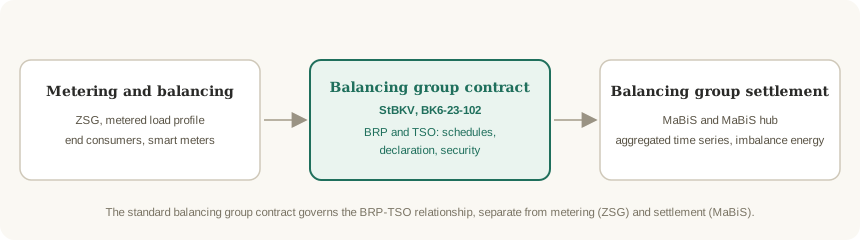
At its core, the StBKV is the contract between the balancing group responsible and the transmission system operator for each control zone. It governs schedule management, the declaration, the security deposit, the data exchange and the sanctions that apply when duties are breached. The current version was approved by the Federal Network Agency under the case reference BK6-23-102 and has applied since 1 October 2024. Because Germany is divided into four control zones, run by 50Hertz, Amprion, TenneT and TransnetBW, a balancing group responsible that is active in several zones concludes the matching contract with each transmission system operator, even though the contract text is standardised across them.
The StBKV does not stand alone, and it is worth placing it precisely. It sits between two neighbouring stages. Before it comes metering and quarter-hour balancing at the end-consumer level, which the ZSG covers. After it comes balancing group settlement, where aggregated time series and imbalance energy are settled under MaBiS and the MaBiS hub. The StBKV is the contractual middle stage that ties these together: it is where the balancing group responsible commits to schedules, declaration and security, and where the transmission system operator commits to accept and process them. What forecasting and analytics change about the resulting cost is the subject of AI in balancing group management.
What is new in BK6-23-102
BK6-23-102 is an evolution, not a revolution. The big content leap came with the 2020 predecessor. The new version consolidates the rules, anchors them in European law and refines the everyday duties.
In detail, BK6-23-102 fully replaces the 2019 predecessor BK6-18-061. Its legal basis is the EB Regulation, Regulation (EU) 2017/2195, which means the StBKV is now an approval of the modalities for balancing group responsibles under European law rather than a purely national ruling. That shift matters for how the contract can change in future, because the framework now follows the European balancing rules rather than a standalone German process. For balancing group responsibles, the practical change is less in the headline structure and more in the refinements: the rules on availability, on the declaration and on the plausibility checks of schedules have been made more precise.
The contract can be concluded in written or electronic form, and the annexes that carry the operational detail are maintained through the transmission system operators' portals. That keeps the framework standardised across the four control zones while letting each balancing group responsible update its own data without renegotiating the contract each time. The combination of a single European legal basis and portal-based annex maintenance is the quiet but real change: it lowers the friction of keeping the contract current and raises the importance of disciplined data maintenance.
- Fully replaces the 2019 predecessor BK6-18-061.
- Legal basis is the EB Regulation, Regulation (EU) 2017/2195.
- Refined rules on availability, declaration and plausibility checks.
- Contract conclusion in written or electronic form, annex maintenance via the TSO portals.
Declaration and the security deposit
The declaration in Annex 1.1 is the central control variable. It is the basis for the plausibility check of the schedules and for the size of the security deposit, and this is exactly where a liquidity risk arises.

In Annex 1.1 the balancing group responsible declares generation, consumption and schedule export. These figures are not a formality: they are the basis on which the transmission system operator checks the plausibility of the schedules and on which the size of the security deposit is set. Adjustments to the declaration take effect with a lead time, so they have to be filed at least five working days before they take effect, and the de minimis thresholds in the contract decide when a change has to be declared at all. Keeping Annex 1.1 accurate and current is therefore not housekeeping but a direct input into both the daily schedule check and the deposit calculation.
The security deposit is considered appropriate if it does not exceed the energy supplied to grid connections (FC-CONS) over one week plus the schedule export over 48 hours, each multiplied by the average reBAP of the last 12 calendar months. The construction has a consequence that is easy to miss: because the deposit tracks the reBAP, a period of high imbalance energy prices feeds straight into a higher required deposit. To put the swing in context as a market figure, the reBAP averaged around 35 euro per MWh in 2019 and 2020 but around 158 euro per MWh in the first months of 2022, according to Vattenfall Energy Trading. A jump of that order roughly quadruples the deposit driver, which is a real liquidity risk for a balancing group responsible that has to hold the deposit while it is bound.
- Annex 1.1 declares generation, consumption and schedule export.
- Adjustments take effect with a lead of at least five working days; mind the de minimis thresholds.
- The deposit is appropriate up to one week of FC-CONS plus 48 hours of schedule export, each times the 12-month average reBAP.
- Imbalance energy price spikes raise the required deposit and tie up liquidity.
Schedule management, availability and the urgent call
Schedule management is the operational core of the contract. Availability is mandatory, and where the transmission system operator suspects a problem it can trigger an urgent call that puts the balancing group responsible under time pressure.

The availability duty is concrete. The balancing group responsible must be reachable until a confirmation report exists for all registered time series, and any disadvantage that results from being unreachable falls on the unreachable party. That makes the staffing of the schedule desk a contractual matter, not just an operational convenience. Intraday, the internal balance of the balancing group must be settled at the latest 15 minutes before delivery starts, which is the point at which the quarter-hour cadence becomes a hard deadline rather than a planning rhythm.
The daily timeline adds two fixed points. An urgent call, the transmission system operator's prompt when something looks wrong, can be triggered until 16:00, and the final schedules for the next day are due by 10:00 the following morning. Missing these duties is not without consequence. Breaches can be met with a formal warning, and two formal warnings plus one further breach within 12 months can lead to termination of the contract. The escalation is therefore gradual but real, which is why a balancing group responsible needs both the process discipline to meet the deadlines and the documentation to show it did.
- Availability is required until a confirmation report exists for all time series; disadvantages fall on the unreachable party.
- Intraday the internal balance must be settled at the latest 15 minutes before delivery starts.
- The urgent call can be triggered until 16:00; final schedules are due by 10:00 the next day.
- Two formal warnings plus one further breach within 12 months can lead to termination.
How it differs from MaBiS-Hub and ZSG
The StBKV is often confused with balancing group settlement or with quarter-hour balancing. It is worth keeping the three building blocks cleanly apart, because they are different stages with different actors.
The StBKV is the contract between the balancing group responsible and the transmission system operator. It is where schedules, the declaration and the security deposit live. MaBiS and the MaBiS hub are the next stage: balancing group settlement, where aggregated time series are formed and imbalance energy is settled. The ZSG is the stage before: metering and quarter-hour balancing at the end-consumer level. Each stage answers a different question, the contract, the settlement and the measurement, so a problem in one is not the same as a problem in another.
The touch point between the three is the 15-minute cadence and the data exchange that carries it, not the responsibility. The quarter hour is the common clock: it is the interval at which consumption is balanced, at which schedules are settled and at which the settlement aggregates time series. But the responsibility stays separate, the balancing group responsible for the contract and the schedules, the transmission system operator for the settlement, the metering side for the measurement. The market communication that moves the data between all of these is itself a subject in its own right, which the MaKo 2026 EDIFACT to API migration covers. Keeping the cadence and the responsibility apart is the key to not confusing the StBKV with what comes before or after it.
- StBKV: the contract between the balancing group responsible and the transmission system operator, covering schedules, declaration and security deposit.
- MaBiS and the MaBiS hub: balancing group settlement, aggregated time series and imbalance energy.
- ZSG: metering and quarter-hour balancing at the end-consumer level.
- The touch point is the 15-minute cadence and the data exchange, not the responsibility.
What companies should do now
Implementing the new StBKV cleanly avoids schedule rejections, formal warnings and unnecessarily tied-up liquidity. An honest review of availability and of the security deposit belongs at the start. Direct marketers in particular should align this with their remote-control duties, which the direct marketing and remote control over the smart meter gateway article sets out.
- Conclude or migrate to StBKV BK6-23-102 and maintain the annexes electronically. Make sure the current version is in place for each control zone and that annex maintenance runs through the transmission system operator portals rather than ad hoc paper changes.
- Declare Annex 1.1 correctly with the five-working-day lead. Set up the process so that generation, consumption and schedule export are declared accurately and that any change is filed at least five working days before it takes effect, with the de minimis thresholds in view.
- Simulate the security-deposit exposure and hold liquidity. Model the deposit against the FC-CONS and schedule-export drivers and the 12-month average reBAP, stress it against a price spike, and keep enough liquidity available so a higher required deposit does not catch you out.
- Organise availability and test urgent-call readiness. Staff the schedule desk so the balancing group responsible is reachable until the confirmation report, and run a drill of the urgent call and the intraday deadline so the process holds under time pressure.
Further reading
Frequently asked questions
The standard balancing group contract (StBKV) is the framework contract between the balancing group responsible (BRP) and the transmission system operator (TSO) for each control zone. It governs schedule management, declaration, the security deposit, data exchange and sanctions. The current version was approved by the Federal Network Agency under the case reference BK6-23-102 and applies since 1 October 2024. It sits between metering (ZSG) and balancing group settlement (MaBiS).
BK6-23-102 fully replaces the 2019 predecessor BK6-18-061 and anchors the contract in European law, the EB Regulation, Regulation (EU) 2017/2195. It is an evolution rather than a revolution, since the big content leap came with the 2020 predecessor. It refines the rules on availability, declaration and plausibility checks, and it allows the contract to be concluded in written or electronic form with annex maintenance via the TSO portals.
The security deposit is considered appropriate if it does not exceed the energy supplied to grid connections (FC-CONS) over one week plus the schedule export over 48 hours, each multiplied by the average reBAP of the last 12 calendar months. Because the figure tracks the reBAP, imbalance energy price spikes raise the required deposit and tie up liquidity. The declaration in Annex 1.1 is the basis for this calculation.
The balancing group responsible must be reachable until a confirmation report exists for all registered time series, and any disadvantages caused by being unreachable fall on the unreachable party. Intraday, the internal balance must be settled at the latest 15 minutes before delivery starts. An urgent call can be triggered until 16:00, and final schedules are due by 10:00 the next day.
The StBKV is the contract between the balancing group responsible and the transmission system operator: schedules, declaration and security deposit. MaBiS and the MaBiS hub cover balancing group settlement with aggregated time series and imbalance energy. The ZSG covers metering and quarter-hour balancing at the end-consumer level. The touch point is the 15-minute cadence and the data exchange, not the responsibility.