Battery Storage Grid-Fee Exemption: the Window to 2029
Under Section 118(6) of the German Energy Industry Act (EnWG), electricity storage is exempt from grid fees on drawn electricity for 20 years. The full exemption is only secured by commissioning the asset by 4 August 2029, and the real bottleneck is the final investment decision before the new rules take effect. After that, the AgNeS network tariff reform replaces the blanket exemption with a capped capacity price. This article explains what the exemption covers, which two cut-offs apply, what follows grandfathering, how hard it hits the economics, and what storage operators should do now. Many values are proposals and interim positions in an ongoing process, not final.
Battery storage is exempt from grid fees on drawn electricity for 20 years from commissioning under Section 118(6) EnWG. Within the AgNeS network tariff reform, the Bundesnetzagentur keeps this exemption and does not apply it retroactively to already protected projects, weighting investor protection higher than an early reset. The full exemption is only secured, though, by commissioning the asset by 4 August 2029 and by making the final investment decision before the new rules take effect, at the earliest in early 2027. Under discussion is an FID deadline of 31 December 2026 with proof to the grid operator by 31 March 2027; the decision counts as final with binding component orders of at least 50 percent of the investment volume plus a binding grid connection. Miss that earlier cut-off and the project drops out of grandfathering, even if it goes live before 2029. New storage without protection faces a capped capacity price, deliberately without an energy-based component, of around 5,000 euro per MW per year within a discussed range of 4 to 7 thousand euro per MW per year, roughly 10 percent of the residential level per kW. Residential PV storage stays permanently exempt. Model calculations show that even a charge of 7 thousand euro per MW per year lowers the internal rate of return of a four-hour storage asset by only about 0.5 percentage points, so the charge itself is manageable and the planning uncertainty in the ongoing process weighs more. Those who plan the FID date backwards, secure the grid connection, model the economics with and without the exemption, and prepare the evidence keep the transition manageable. All the values named here are interim, not final.
What the storage grid-fee exemption is
A battery draws electricity in order to feed it back in later. It does not consume it. That is why Section 118(6) EnWG exempts electricity storage from grid fees on that draw, so the same kilowatt-hour is not charged twice. The exemption runs for 20 years from commissioning and is one of the reasons for the current storage build-out.
The exact scope matters. What is exempt is the grid-fee share on drawn electricity, not every grid-cost item. The construction cost contribution for the grid connection is a separate question, and for storage it is being reworked right now. The exemption is also not a permanent state for everyone: for new assets it hangs on a fixed window. That window is exactly what the AgNeS network tariff reform reorders as it rebuilds the structure of power grid fees from 2029. How hard any single storage asset is affected depends on whether it reaches grandfathering in time. The storage build-out itself, visible in the boom of virtual power plants, still assumes this exemption.
The window: two cut-offs, not one
Most projects plan toward 4 August 2029. That is a mistake. Grandfathering requires two conditions at once, and the second falls much earlier. Anyone looking only at the commissioning deadline misses the real bottleneck.
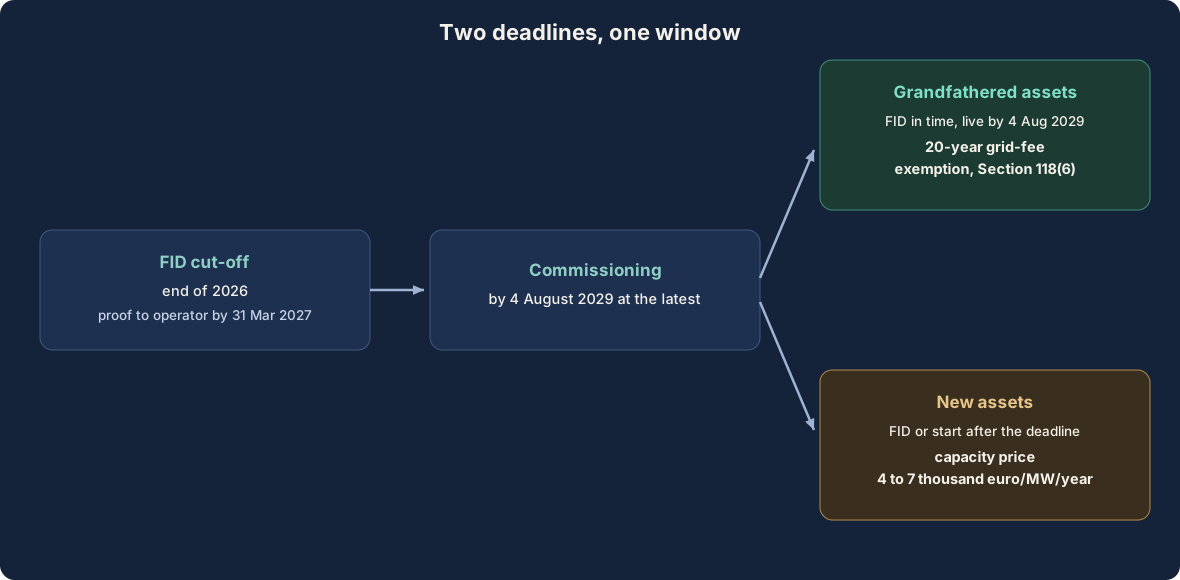
The first cut-off is the final investment decision, or FID. It must be made before the new rules take effect, at the earliest in early 2027. Under discussion is an FID deadline of 31 December 2026 with proof to the grid operator by 31 March 2027. Under the draft, the decision counts as final when binding component orders of at least 50 percent of the investment volume are in place and the grid connection is binding. The second cut-off is commissioning by 4 August 2029. Only meeting both secures the full 20-year exemption. Miss the FID and the project drops out of grandfathering, even if the storage asset goes live before 2029. So the decisive date is not 2029 but roughly two and a half years earlier. That sharply shortens the time for site control, grid connection planning, and financing. All dates are interim positions in an ongoing process.
What follows grandfathering
The exemption does not simply vanish. A new pricing model takes its place, the one the AgNeS network tariff reform sets out for storage. The difference is in the form: no more blanket zero, but a capped and calculable charge.
New storage without grandfathering faces a capped capacity price, deliberately without an energy-based component. That omission is central: a charge per kilowatt-hour would act like a levy on every charge and discharge cycle and distort dispatch. A pure capacity price per MW avoids that. The Bundesnetzagentur models around 5,000 euro per MW per year, with a discussed range of 4 to 7 thousand euro per MW per year from 2029. That is about 10 percent of what residential customers pay per kW in capacity charges. Residential PV storage stays permanently exempt from grid fees, and dynamic grid fees are to be phased in between 2030 and 2033. This storage rule is part of the larger overhaul that the AgNeS network tariff reform makes to the entire structure of power grid fees from 2029. The concrete values are proposals and only become firm with the follow-up rulings.
What it means for the economics
The decisive question for any project is: how hard does losing the exemption hit the return? The answer is surprisingly reassuring, but it shifts the focus onto the real risk.

Model calculations show the capacity price hits the economics less hard than often feared. Even a charge at the upper end of 7 thousand euro per MW per year lowers the internal rate of return of a four-hour storage asset commissioned in 2030 by only about 0.5 percentage points. The reason is the deliberate omission of an energy-based component, which would burden trading far more. For most projects the pure charge step is therefore bearable. The real risk lies elsewhere: in the planning uncertainty while values and design are interim, and in whether a project reaches the early FID cut-off. Run the numbers with and without the exemption and it quickly shows that the schedule decides more than the future charge rate.
Risks and open points
As clear as the direction is, much remains open. Two points deserve particular attention because they bear directly on planning certainty: the question of retroactivity and the new grid connection procedure.
First, retroactivity. The Bundesnetzagentur invokes discretion under Section 118(6) sentence 12 EnWG that could allow a retroactive change. Possible cut-off dates on the table were 2 September 2021, the date of the ECJ ruling C-718/18, and 29 December 2023. In the end the authority decided against retroactivity for already protected projects and weighted investor protection higher. For new projects, though, the early FID condition remains the hard filter. Second, the grid connection procedure: since 1 April 2026, storage faces a structured process instead of first come, first served, with an application fee of 50,000 euro per project and a deposit of 1,500 euro per MW credited toward the connection cost. Both raise the bar on seriousness and lead time. Anyone who does not secure the grid connection early and bindingly risks being unable to provide the FID evidence.
Caution on the schedule: Many projects plan toward 4 August 2029, even though the decisive cut-off is the final investment decision before the new rules take effect, at the earliest in early 2027. Anyone who only decides bindingly in 2028 can lose grandfathering, even with commissioning before 2029. All the deadlines and values named here are interim positions in an ongoing process and not yet final.
The storage grid-fee exemption stays, but it becomes a timing game. What decides grandfathering is not the level of the future capacity price but whether a project reaches the early final investment decision and commissioning by 2029. The charge step itself, at about 0.5 percentage points of return, is manageable; the planning uncertainty and the early cut-off are the real risk. Those who separate the two plan the project right.
What storage operators should do now
The reform turns into a concrete plan as soon as you think backwards from the cut-off. Those who act now secure grandfathering instead of narrowly missing it. Four steps order the task.
-
Plan the FID date backwards
Set the latest point for the final investment decision and plan back from there. If the FID deadline is 31 December 2026 with proof by 31 March 2027, then component orders of at least 50 percent of the investment volume and the binding grid connection must be in place before it. Factor in procurement and permitting lead times honestly, and it becomes clear how little buffer remains.
-
Secure the grid connection bindingly
Secure the grid connection early and bindingly, because since 1 April 2026 the new procedure requires an application fee, a deposit, and proof of seriousness. Without a solid grid connection, the final investment decision cannot be cleanly evidenced. This step is therefore not only a technical prerequisite but part of the grandfathering proof.
-
Model the economics with and without the exemption
Run the project both ways, with grandfathering and with the capacity price. For the unprotected case, apply the discussed 4 to 7 thousand euro per MW per year and check how the internal rate of return shifts. Usually the numbers show the charge step is bearable while the missed cut-off gets expensive. These figures are the basis for the timing decision.
-
Prepare the evidence
Prepare the documentation with which you evidence the final investment decision to the grid operator. That includes the binding orders, the grid connection contract, and the timestamp of the decision, all of it handled by the same people who publish the 2027 network charges in October. Structuring the proof early avoids losing grandfathering on a formal question while the process is still running.

Further reading
Frequently Asked Questions
Section 118(6) EnWG exempts electricity storage from grid fees on the electricity drawn from the grid for 20 years from commissioning. The purpose is to avoid double charging and to encourage investment, because a storage asset does not consume the electricity it draws but feeds it back in. The exemption covers the grid-fee share on the drawn electricity, not automatically the construction cost contribution for the grid connection.
The full exemption is only secured by commissioning the storage asset by 4 August 2029 at the latest. The truly tight cut-off falls earlier: the final investment decision must be made before the new rules take effect, at the earliest in early 2027. Under discussion is an FID deadline of 31 December 2026, with proof to the grid operator by 31 March 2027. Values are interim positions in an ongoing process.
Because grandfathering ties two conditions together: commissioning by 4 August 2029 and a final investment decision before the AgNeS rules take effect. Under the draft, the decision counts as final when binding component orders of at least 50 percent of the investment volume are in place and the grid connection is binding. Projects that miss this earlier cut-off drop out of grandfathering, even if they go live before 2029.
New storage without grandfathering faces a capped capacity price, deliberately without an energy-based component so no charge falls on every charging cycle. The Bundesnetzagentur models around 5,000 euro per MW per year, with a discussed range of 4 to 7 thousand euro per MW per year. That is about 10 percent of what residential customers pay per kW. Residential PV storage stays permanently exempt. All values are proposals, not final.
Operators should plan the FID date backwards from the cut-off, secure a binding grid connection, model the economics with and without the exemption, and prepare the evidence for the grid operator. Because model calculations show the capacity price lowers the internal rate of return by only about 0.5 percentage points, planning uncertainty is the bigger risk than the charge itself. Those who calculate early keep the transition manageable.
Let's collaborate
One contact, a team behind it
Thirty minutes on what you're working on, whether grid, metering, market processes, IT architecture or AI. Afterwards you'll know how we'd approach it and who would sit at the table.
Energy and measurement technology since 2010 · innobu GmbH since 2014 · Based in Schleswig-Holstein, Germany
Whoever pitches also delivers: whoever leads the first call stays your contact right through to the steering committee, with established partners in the project. Direct: info@innobu.com