Grid-Scale Storage: the 226 GW Queue and Co-Location with AI Data Centres
At the turn of 2024/2025, the four German transmission grid operators held around 650 connection requests for grid-scale battery storage with a combined capacity of roughly 226 gigawatts; across all voltage levels the Bundesnetzagentur counted almost 10,000 requests totalling about 400 gigawatts. Only around 2.3 gigawatts were actually on the grid at the end of 2024. A large share of the requests is speculative: Amprion calls around 65 percent of them phantom projects.
At the turn of 2024/2025 the four German transmission grid operators held around 650 connection requests for grid-scale battery storage with a combined capacity of roughly 226 gigawatts; across all voltage levels the Bundesnetzagentur counted almost 10,000 requests totalling about 400 gigawatts and 661 gigawatt-hours for 2024. These are connection requests, not built capacity: only around 2.3 gigawatts were on the grid at the end of 2024, and the Bundesnetzagentur projects a realistic fleet of only about 24 gigawatts by 2037. A large share is speculative. Amprion states that around 65 percent of submitted projects are not pursued further, only about 25 gigawatts of the 2024 requests received a connection commitment, and the transmission grid operators introduced a coordinated 50,000 euro fee per request. From 1 April 2026 a zone-wide maturity process replaces the first-come-first-served principle, prioritising requests by demonstrated maturity. In parallel, co-location is emerging as a site model: generation, storage and a large load such as an AI data centre share one grid connection point. The largest German example, Project Jupiter in Brandenburg, combines 500 MW of storage, up to 150 MWp of solar and a planned 500 MW hyperscale data centre on a 380 kV line, though co-location remains early-stage and today solar paired with storage dominates. The United States provides a regulatory lead through the FERC order on PJM of December 2025 and the Texas SB 6 and ERCOT reforms. The shared capability is keeping connection requests, maturity and co-location site data clean, comparable and process-ready.
The 226-gigawatt wave: what is piling up in front of the grids
A wave of connection requests is piling up in front of Germany's grids that breaks every prior storage plan. At the turn of 2024/2025 the four transmission grid operators held around 650 connection requests for grid-scale battery storage with a combined capacity of roughly 226 gigawatts; across all voltage levels the count rose to almost 10,000 requests totalling about 400 gigawatts. Against this stood only around 2.3 gigawatts actually on the grid at the end of 2024, a ratio that shows how far the paperwork sits from reality.

One number matters more than its size: 226 gigawatts is a count of connection requests (Netzanschluss, grid connection), not of secured construction. The figure is real and recorded, but it should be read as demand to enter the interconnection queue, not as a fleet that will exist. The Bundesnetzagentur projects a realistic storage fleet of only about 24 gigawatts by 2037, roughly a tenth of the requested transmission-level capacity. That distance between request and reality is what the rest of this article works through.
Why so many requests come in, and why most are phantoms
Most of the wave is speculative, and the cause is one economic pull and one regulatory loophole. Storage increasingly pays, and the previous first-come-first-served procedure rewarded reserving grid capacity early and without commitment. The result is duplicate requests and projects filed with no serious intent to build. Amprion states that around 65 percent of submitted projects are not pursued further, and only about 25 gigawatts of the capacity requested in 2024 received a connection commitment.
The Anschlusswarteschlange (interconnection queue) is clogged with phantom projects: requests filed at several sites in parallel to hold a place, without a serious intention to build. To dampen non-binding reservations, the four transmission grid operators introduced a coordinated fee of 50,000 euros per connection request. The fee is a filter, not a cure: it raises the cost of speculative reservations but does not by itself free the capacity they block.
The economics behind the rush, such as price volatility, negative exchange prices and the grid-fee exemption under Section 118 of the Energy Industry Act (EnWG), are only touched on here. How storage operators actually stack revenues across markets is a separate subject, explained in our analysis of virtual power plants and battery storage. The point for the queue is narrower: when reserving capacity is nearly free, far more is requested than will ever be built, and the grid operators are left to tell the real projects from the phantoms.
Co-location with AI data centres: one connection, two worlds
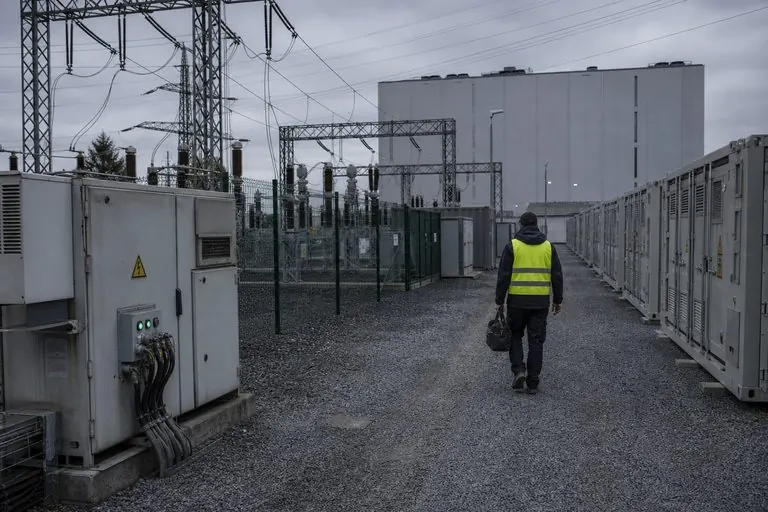
Co-location couples generation, storage and load behind one shared grid connection point instead of connecting them separately, increasingly with an AI data centre as the consumer. The largest German example is Project Jupiter in Brandenburg: 500 MW and 2,000 MWh of storage, up to 150 MWp of solar and a planned 500 MW hyperscale data centre on a 380 kV line. The storage smooths the fluctuating data-centre load, uses curtailed renewable power, and shares the connection, the site and the cable route. This is still early-stage; today solar paired with storage dominates, and the data-centre pairing is the newer development.
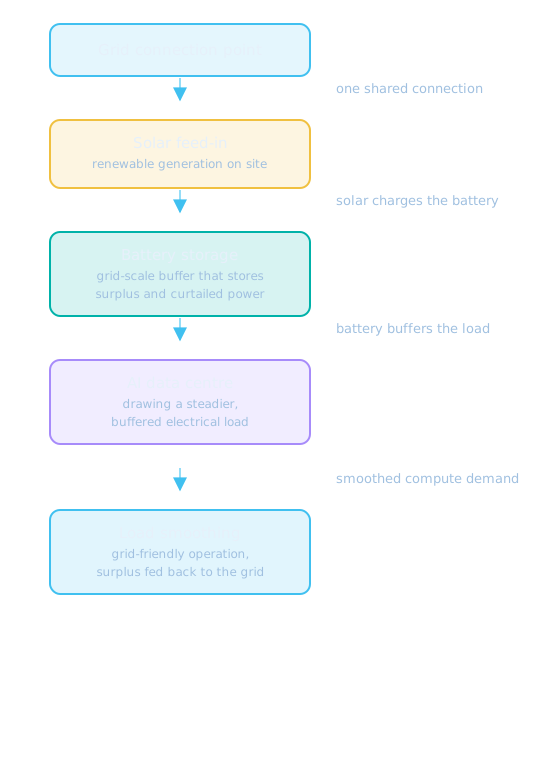
A shared grid connection point for generation, storage and load saves connection cost and time and raises the chance of being connected at all, which is part of why co-location is attractive while the queue is congested. Project Jupiter (developed by WBS Power, sold to Prime Capital and announced on 3 December 2025, with 50Hertz as the grid operator) is the largest German storage-and-solar co-location project with an attached hyperscale data centre, an investment of around 500 million euros with construction expected at the turn of 2026/2027. Here the storage acts as a buffer, a kind of power-as-a-service for compute, not as a frequency guardian; the stability risks of data centres are a separate matter, covered in our analysis of the NERC alert on AI data centres and grid stability.
The grid and market response: maturity instead of first-come-first-served
Grid operators and regulators are responding to the wave by reordering the queue. From 1 April 2026 a zone-wide maturity process replaces the first-come-first-served (Windhund) principle: connection requests for storage and large consumers are prioritised by demonstrated project maturity, not by the date they were filed. The Bundesnetzagentur has published a FAQ catalogue on storage connection and is preparing its determination on the market integration of storage and charging points (MiSpeL).

The United States provides a regulatory lead worth studying. On 18 December 2025 the Federal Energy Regulatory Commission found PJM's tariff unjust and unreasonable because it did not clearly regulate co-located data-centre loads, and set PJM compliance deadlines in early 2026. In Texas, Senate Bill 6 reworks the rules for large loads and co-located generation from 75 MW, and ERCOT moves to a batch-study interconnection process from 1 August 2026. Europe is not bound by these rulings, but they map the same questions that the German queue is now facing.
Risks: ghost queues, grid stress and fairness
Useful as co-location and the maturity process are, they do not resolve three risks on their own. Ghost queues block capacity that will never be built; a concentration of large, coupled loads can overload local grids; and a preference for well-capitalised co-location projects can disadvantage smaller developers. Whoever steers the wave has to address these distributional questions openly rather than assume the new process settles them.
None of these risks is hypothetical. The gap between the roughly 226 to 400 gigawatts requested and the around 24 gigawatts the regulator expects by 2037 is the ghost-queue problem in one line. Large co-located loads move both grid planning and the network charges others pay, which is exactly what the PJM and ERCOT disputes are about. And if connection priority effectively follows capital, the maturity process can sharpen fairness questions even as it shortens the queue.
What grid operators, developers and data-centre operators should do now
Regardless of the individual project, everything comes down to the same capability: keeping connection requests, maturity evidence and co-location site data clean, comparable and process-ready. Whoever builds queue transparency, maturity records and a data architecture for shared connection points early can connect without a break, rather than retrofitting under time pressure once the rules bite.
-
Grid operators: digitalise queue and maturity management
Treat the interconnection queue as a data system, not a spreadsheet. Document connection requests so they are comparable and traceable, score maturity consistently, and detect phantom requests early, so the new process rests on evidence rather than on filing order.
-
Developers: consolidate maturity and site data early
Bring maturity evidence and site and land data together before filing, and design co-location as one shared connection rather than as separate plants. A coherent data set is what turns a request into a credible, high-maturity project under the new ranking.
-
Data-centre operators: plan load, storage and connection together
Plan the load profile, the storage sizing and the connection-point data as one design, so the buffer actually smooths the compute load. Treat the storage as a shared asset behind the connection point, not as an afterthought bolted on later.
-
Everyone: watch the regulation actively
Track the maturity process, the MiSpeL determination and the international precedents (the FERC order on PJM, Texas SB 6 and ERCOT). The rules being written now will define the terms of every future connection and co-location.
The wave will only be steered on a data foundation that exists before it is needed. Whoever builds queue transparency, maturity records and a shared-connection data architecture now turns a congested queue into a usable basis. The same flexible, data-coordinated grid logic underlies the legislative reform of the connection right in our grid package and EEG reform analysis and the congestion management explained in our Redispatch 3.0 analysis.
Further reading
Frequently asked questions
At the turn of 2024/2025 the four German transmission grid operators held around 650 connection requests for grid-scale battery storage with a combined capacity of roughly 226 gigawatts; across all voltage levels the Bundesnetzagentur counted almost 10,000 requests totalling about 400 gigawatts and 661 gigawatt-hours for 2024. This figure is connection requests, not built capacity. Only around 2.3 gigawatts were actually on the grid at the end of 2024, and the Bundesnetzagentur projects a realistic storage fleet of only about 24 gigawatts by 2037.
A phantom project is a connection request filed to reserve grid capacity without a serious intention to build, often at several sites in parallel. Amprion states that around 65 percent of submitted projects are not pursued further. Of the capacity requested in 2024, only about 25 gigawatts received a connection commitment. To dampen non-binding reservations, the transmission grid operators introduced a coordinated fee of 50,000 euros per connection request.
Co-location couples generation, grid-scale battery storage and a large load such as an AI data centre behind one shared grid connection point, instead of connecting them separately. The storage smooths the fluctuating data-centre load, uses curtailed renewable power and shares the connection, the site and the cable route. The largest German example is Project Jupiter in Brandenburg: 500 MW of storage, up to 150 MWp of solar and a planned 500 MW hyperscale data centre on a 380 kV line. Co-location is still early-stage; today solar paired with storage dominates.
From 1 April 2026 a zone-wide maturity process replaces the first-come-first-served (Windhund) principle for storage and large consumers. Connection requests are prioritised by demonstrated project maturity rather than by the date they were filed, supported by the 50,000 euro fee as a filter. The Bundesnetzagentur has published a FAQ catalogue on storage connection and is preparing its determination on the market integration of storage and charging points.
On 18 December 2025 the United States Federal Energy Regulatory Commission found PJM's tariff unjust and unreasonable because it did not clearly regulate co-located data-centre loads, and set PJM compliance deadlines in early 2026. In Texas, Senate Bill 6 reworks the rules for large loads and co-located generation from 75 MW, and ERCOT moves to a batch-study interconnection process from 1 August 2026. These provide a regulatory lead Europe can study.
Let's collaborate
One contact, a team behind it
Thirty minutes on what you're working on, whether grid, metering, market processes, IT architecture or AI. Afterwards you'll know how we'd approach it and who would sit at the table.
Energy and measurement technology since 2010 · innobu GmbH since 2014 · Based in Schleswig-Holstein, Germany
Whoever pitches also delivers: whoever leads the first call stays your contact right through to the steering committee, with established partners in the project. Direct: info@innobu.com