Seasonal Thermal Storage: Aquifer and TTES in Digitalized District Heating
Aquifer stores, pit stores and tanks can hold renewable summer heat for months. In Berlin-Adlershof, Bad Salzuflen and Meldorf, the first large projects leave the lab in 2026. This article sorts the four storage types, shows the German flagship projects and explains why forecasting, model predictive control and digital twins decide the economics.
Seasonal thermal stores solve the core problem of the heat transition: renewable heat is available in summer, needed in winter. Four designs share the field. Tank stores (TTES) are proven and heated to around 95 degrees, while pit (PTES) and aquifer (ATES) stores are the real long-term options. In Berlin-Adlershof, Germany's first high-temperature aquifer store reached its test phase in November 2025 and is set to feed the BTB district heating network by 2027, with a target of about 30 GWh. In Meldorf, a pit store of 50,000 cubic metres holds up to 1,500 MWh. Denmark has run such basins for over a decade, the largest in Vojens at 203,000 cubic metres. The decisive point sits not underground but in software: a seasonal store only pays off if forecasting, model predictive control and a digital twin find the right charge and discharge schedule across months. The physics is solved, the payoff hangs on digital operation.
Why seasonal thermal stores are reaching the grid now
The reason is a timing problem. Solar heat, waste heat and cheap summer power arrive when almost nobody is heating. A seasonal store carries that heat into January. It decouples generation and demand not over hours like a buffer tank, but over months.
District heating covers around 14 percent of German heat demand and is meant to be climate-neutral by 2045. Without long-term storage, every summer surplus goes to waste, and in winter the gas runs again. This is where the store steps in: less expensive peak load, more renewable coverage.
Policy adds a tailwind. Municipal heat planning is now a legal duty, and public funding for efficient heat networks supports storage. For the first time there is a solid frame for projects that only pay off over decades. How that municipal duty works is covered in the piece on municipal heat planning . A store is the logical complement to renewable heat generation, for instance from power-to-heat and large heat pumps .
The four storage types compared
Four designs share the field, with very different costs, temperatures and sizes. Tank stores are proven and quick to build. Pit and aquifer stores are the real long-term options. What gets built in the end is decided by the site, more precisely the geology, not the wish list.
| Type | Principle | Key figures | Role |
|---|---|---|---|
| TTES (tank) | Built vessel of concrete or steel | from 1,000 m3, up to 95 degrees, annual loss under 10 percent | Short-term buffer today, too small for seasonal use |
| PTES (pit) | Insulated earth basin with floating lid | 1,500 to 230,000 m3, around 5 metres deep | Long-term store, proven in Denmark |
| ATES (aquifer) | Warm water in a groundwater layer | high capacity, low investment, geology-dependent | Long-term store, cheapest option where the ground fits |
| BTES (boreholes) | Heat in the ground via borehole fields | Crailsheim: 80 boreholes, 55 m, up to 65 degrees | Covers up to 60 percent of annual demand there |
The difference in one line: the tank is the costly precision tool for the day, the aquifer the cheap workhorse for the year. An aquifer store uses an existing groundwater layer instead of digging a basin. That makes it cheap, but also dependent on a geology that does not exist everywhere.
German flagship projects in 2026
Several projects leave the lab in 2026. The most important stands in Berlin-Adlershof. There, the GeoSpeicher Berlin living lab is building Germany's first high-temperature aquifer store, feeding a real district heating network through a large heat pump.

High-temperature aquifer store in Adlershof, run by BTB, GFZ and TU Dresden. Test phase since November 2025, grid connection by 2027, around 30 GWh target. Germany's largest underground heat store.
A pit store for stable heat prices, supported by the Hamburg Institut and Fraunhofer IEG. The aim is affordable, resilient district heat over the coming decades.
First large seasonal pit store on the Danish model: 50,000 cubic metres, up to 1,500 MWh of summer heat for winter.
The aquifer store of the parliament buildings has run for years: around 20,000 cubic metres, wells about 300 metres deep, up to 100 cubic metres per hour. Proof that the technology works in real operation.
One pattern stands out. The new projects do not add the store in isolation, but tie it through heat pumps and a digital control system into an existing network. That is the leap beyond the pure demonstration plant. The research object becomes a building block of supply.
Why digitalization decides the economics
The store is physics, the payoff is software. A seasonal store only pays off if operation makes the right call across months: charge when heat is cheap and in surplus, discharge when it turns expensive. That call is made weeks ahead, not by current temperature.
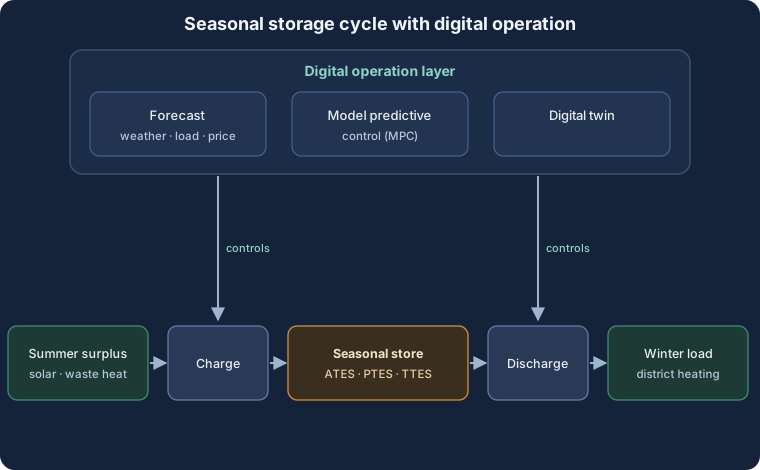
That needs three building blocks. Forecasts for weather, heat load and power price give the outlook. Model predictive control turns them into a schedule over a rolling horizon, instead of reacting to the current value. And a digital twin couples the plant model with a subsurface model to predict long-term stability. Research does exactly this, coupling a surface plant model with a reservoir model of the groundwater layer.
It is the same logic that already drives the digital operation of large heat pumps , only over a far longer horizon. And it needs a control system that does more than log temperatures: it has to watch the thermal, hydraulic, geochemical and microbiological interactions in the store. The control is similarly tight in cold district heating .
Without this digital layer, an expensive store stays below its utilisation. With it, the full cost per kilowatt-hour falls noticeably. The edge sits not in the deepest borehole, but in the best schedule.
Denmark as a model
Denmark has shown for over a decade that large pit stores work with solar heat. The plants deliver cheap heat and serve the German projects as a blueprint. Not a lab test, but routine operation.
The transfer to Germany is not one to one. Danish networks are smaller and municipal, permitting is simpler, the solar fields are there. Still, the model works as proof: the technology is mature, the question is delivery within the German frame.
Challenges and risks
A seasonal store is no sure thing. Payback is long, permitting is complex, and groundwater protection sets hard limits. Underestimate that, and you plan past reality.
One point is often missed. High-temperature operation can trigger geochemical and microbiological reactions underground, such as mineral precipitation or bacterial growth at the wells. This is manageable, but only with continuous monitoring. That is exactly why digital operation is not a nice-to-have, but part of the operating permit.
What utilities should do now
Whoever runs a district heating network should plan the store and its control together, not one after the other. Geology decides the type, data quality decides the payoff. Four steps help.

-
Check the geology first
Whether aquifer, pit or tank is decided by the ground. An early geological survey saves costly redesigns and tells you whether ATES is even an option.
-
Design the control in from the start
Forecasting, model predictive control and monitoring belong in the first design, not as a retrofit. The store delivers its value only with a schedule that looks weeks ahead.
-
Use funding and heat planning
Public funding for efficient heat networks and municipal heat planning set the frame. Tie both together early to secure financing for a project that only pays off over decades.
-
Build the data foundation
A digital twin is only as good as its data. A clean network load profile and a digital heat cadastre are the basis for judging operating risks before construction.
Further reading
Frequently Asked Questions
A seasonal thermal store takes in surplus heat in summer and releases it in winter. Unlike a buffer tank, which smooths daily swings, it shifts energy across months. The main types are aquifer (ATES), pit (PTES), tank (TTES) and borehole (BTES) stores. This lets solar heat, waste heat or cheap summer power be carried into the cold season.
An aquifer store uses a natural groundwater layer as the storage medium. Through two wells, warm water is pumped into a water-bearing rock layer and later withdrawn. Because no tank has to be built, ATES is one of the cheapest long-term storage options where the geology allows. In Berlin-Adlershof, Germany's first high-temperature aquifer store is being connected to a district heating network by 2027.
TTES is a built tank store, usually of concrete or steel, heated to around 95 degrees and established today as a short-term buffer. PTES is a pit store with an insulated lid, up to 203,000 cubic metres in Denmark. ATES uses a groundwater layer with no built basin, offering high capacity and low investment but tied to the geology. The site decides the type, not the wish list.
A seasonal store only pays off if it charges and discharges at the right time across months. That decision needs forecasts for weather, heat load and power price, plus model predictive control that plans the schedule over a rolling horizon. Digital twins couple the surface plant model with a subsurface model. Without this software layer, an expensive store stays below its possible utilisation.
For large plants, payback periods often exceed 20 years. The economics rest on several effects at once: less expensive peak load with fossil gas, higher use of solar and waste heat, and public funding for efficient heat networks. In Danish reference projects, heat prices reach as low as 3 to 4 cents per kilowatt-hour.