Cold district heating: why 5GDHC networks need digital control
This article places cold district heating in seven steps: what sets it apart from conventional district heating, why digital control becomes a precondition, what technology sits behind it, how German pilot projects implement it, which legal framework applies, where the risks lie and what operators should do now.
Cold district heating, technically a fifth-generation heat network or anergy network, distributes heat close to ambient temperature, typically between 5 and 35 degrees Celsius. The medium is too cold to heat directly, so a decentralised heat pump in each building lifts the level to the required flow temperature. That is the break with conventional district heating, which delivers ready-to-use heat from a central source. Sources are low-grade heat such as groundwater, borehole fields, wastewater, industrial waste heat or waste heat from data centres, carried through cheap, often uninsulated plastic pipes with low losses. The decisive difference in operation: the network temperature is not held at a fixed set point but floats with source and weather, and many buildings draw and feed in at the same time. A cooling building gives off heat while another heats. These bidirectional prosumer flows can only be balanced in real time with digital control, with sensors, AI load forecasting and model-predictive control. The AGFW communication guideline names a data cadence of around 10 seconds for automated pump control, far tighter than the 15-minute cadence of conventional meters. Several projects run in Germany: Bochum MARK 51 degrees 7 with mine water, Bad Nauheim Süd with a digital twin, Bamberg Lagarde with geothermal and wastewater heat, Mertingen with an AI-based twin. Cold networks count as an admissible supply option in municipal heat planning and are funded through the federal programme for efficient heat networks. The mandatory shares under Section 29 of the Heat Planning Act require 30 percent renewable energy and waste heat from 2030 and 80 percent from 2040. Open issues remain: high upfront investment, operational complexity, the electricity-price dependence of heat pumps, IT security and a missing system standard. For operators this means: plan the control question from the start, define the data architecture in the feasibility study and consider cold networks where low-grade sources and new build meet.
What sets cold district heating apart from conventional district heating
Cold district heating is a fifth-generation heat network, also called an ambient loop or anergy network. It carries heat close to ambient temperature, typically between 5 and 35 degrees Celsius. The medium is too cold to heat buildings directly. The lift to the required flow temperature is done by a decentralised water-to-water heat pump in each connected building. That is the break with generations 1 to 4, which delivered ready-to-use heat from a central source.
The story of these generations is one of falling temperatures. The first generation used steam at up to 200 degrees, later networks pressurised hot water and pre-insulated pipes below 100 degrees, the fourth generation 50 to 70 degrees. The fifth generation sits close to ground temperature and is bidirectional. It uses low-grade, often unused heat: groundwater, borehole fields, wastewater at around 20 degrees, industrial waste heat, solar thermal and waste heat from data centres.
Because the medium sits close to ground temperature, cheap, often uninsulated plastic pipes are enough, and the network can even take up heat from the soil. Network losses are far lower than in high-temperature networks, industry figures cite under 3 percent against 10 to 25 percent. In return, the small temperature spread of 5 to 10 kelvin forces high flow rates, and decentralised pump and heat-pump electricity is needed, which sets the overall efficiency.
Why digital control becomes a precondition for operation
In conventional district heating the operator holds a central flow temperature at a fixed set point. In a cold network that set point does not exist. The temperature floats with source and weather, and many buildings draw and feed in at the same time. This balance can only be held digitally, in real time and across the whole neighbourhood.
A building that cools in summer gives off heat to the network while another heats. Heating and cooling loads partly cancel out, but only if the control knows both sides. The small spread means high flow rates and noticeable pump energy. Pump electricity and the efficiency of the heat pumps, the COP, set the overall efficiency directly, and the control has to track both continuously.
The EU project D2Grids describes cold district heating explicitly as a demand-driven smart grid. Two of its five core principles are pure digital-operation topics: the decentralised, bidirectional exchange at the transfer points and the digital control that coordinates the whole. Without this layer a cold network stays a pipe system without a beat.
The technology of control: sensing, forecasting, regulating
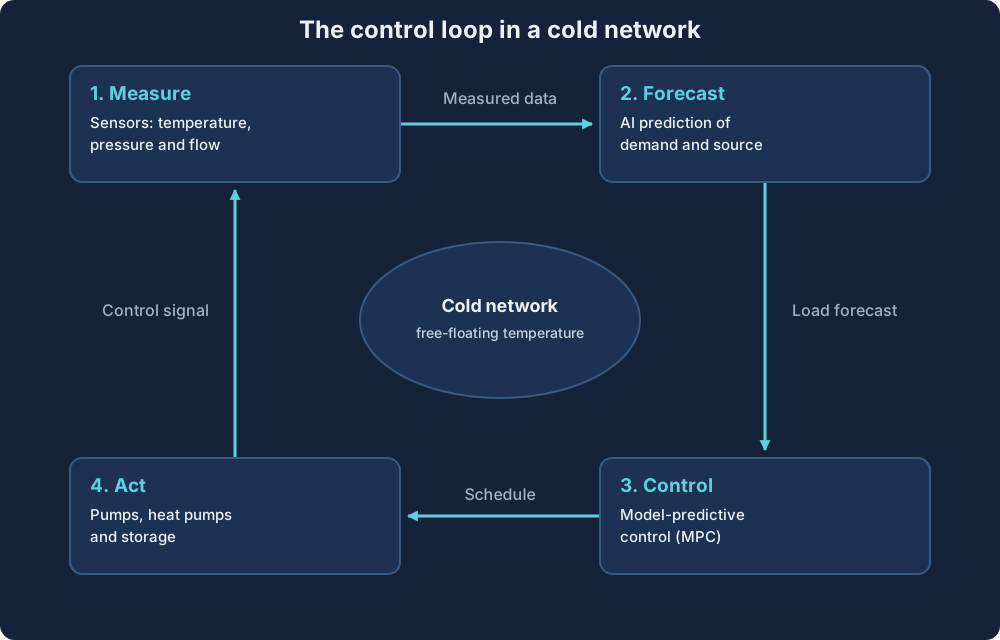
The control of cold networks has four layers: measure, forecast, regulate, act. Each layer can be built with proven technology today. The overall efficiency depends on the interplay, not on the single component.

Measurement uses bidirectional ultrasonic heat meters together with pressure, flow and temperature sensors. In Hameln, 360 meters are read over NB-IoT, with a payback of around 2.5 years. The AGFW communication guideline assigns the radio technology by use case: LoRaWAN for remote reading, NB-IoT for pressure monitoring, faster mobile links for pump control at a 10-second cadence.
Forecasting uses AI models that estimate heat demand and yield. In Mertingen a digital twin decides on this basis how the heat pump runs and how full the storage is. Regulation uses model-predictive control. Studies cite savings of around 7 to 12 percent, more with storage, above all a seasonal thermal storage, while real field demonstrations were sometimes lower. The figures should be read as a range, not a fixed promise. Action runs through remotely controllable transfer stations and network nodes that switch bypasses, pumps and storage.
German practice: pilot projects and their control approaches
Cold district heating is no longer theory in Germany, it runs in several neighbourhoods. The projects show how far the digital share reaches, from simple remote reading to an AI-based twin.

In Bochum the MARK 51 degrees 7 quarter uses mine water from around 300 and 820 metres depth, at 27 to 28 degrees and around 17 degrees. It covers 70 to 75 percent of heat and cooling demand and saves around 3,200 tonnes of CO2 per year. The operator is a subsidiary of the Bochum municipal utility, supported by Fraunhofer IEG. Even the 17-day pumping test ran on continuous monitoring of temperature, pressure and water composition.
Bad Nauheim Süd has supplied around 400 residential units since 2021 through a ground collector. In a research project a digital twin is being built there as a transferable blueprint for other municipal utilities. Bamberg runs a 5.5-kilometre cold network from geothermal and wastewater heat at the Lagarde Campus for around 1,200 households, with storage management and digital control. Mettingen and Schleswig operate borehole and ice-storage networks, with Schleswig adding a sector-coupled energy management for electricity, heat and cooling.
Regulatory framework: heat planning, building energy law, funding and Section 14a EnWG
Cold district heating sits in the same legal framework as any other heat-network option, but it benefits from several funding and obligation mechanisms. Anyone planning now should know the deadlines, because they set the pace.
The German Heat Planning Act requires cities above 100,000 inhabitants to submit a heat plan by 30 June 2026, smaller municipalities by 2028. Cold networks count as an admissible supply option in designated heat-network areas. The decarbonisation obligation under Section 29 prescribes at least 30 percent renewable energy and waste heat from 2030, 80 percent from 2040 and greenhouse-gas neutrality by the end of 2044. With geothermal or waste heat and a building-side heat pump, a cold network reaches these shares with ease as a rule.
On the funding side, the federal programme for efficient heat networks covers up to 40 percent for systemic measures, feasibility studies are funded at 50 percent. In cold networks, source, network and decentralised heat pumps can be eligible together. Section 14a EnWG plays its own role: the decentralised heat pumps are controllable consumption devices. They receive reduced grid fees but can be dimmed temporarily to 4.2 kilowatts during local overload. The control has to account for this sector coupling to the power grid, for example by running heat pumps when there is surplus electricity.
Challenges and risks
Cold district heating is not a sure thing. The advantages in efficiency and source flexibility face real hurdles that operators should plan for soberly.
The upfront investment is high, because each transfer station contains a heat pump and the high flow rates make the pumping infrastructure more expensive. Control is more demanding than in a high-temperature network, it requires subsurface simulation and operating experience that is still missing in many places. The decentralised heat pumps need electricity continuously, so the economics hang on the electricity price. Digitally controlled networks create new attack surfaces, above 250,000 supplied households the critical-infrastructure regime applies, and NIS2 widens the requirements. And a coherent system standard for 5GDHC is still missing, as are enough skilled workers in the heating and renewables sector.
The biggest danger is the order of steps. Whoever first taps the source and lays the pipes and adds the control later ends up with a network that stands technically but does not run smoothly in operation. It is wiser to treat the data architecture and the control strategy as part of the design, not as a retrofit.
What operators should do now
Municipal utilities and network operators that consider cold district heating should plan the control question from the start. Four steps are the priority.
Four priority steps
-
Think about source and neighbourhood together
Consider cold networks where low-grade sources such as groundwater, wastewater or industrial waste heat meet new build. In an existing stock with high flow temperatures the conversion is hard, in efficient new build the concept plays to its strengths.
-
Define the data architecture early
Set the control layer already in the feasibility study: sensors, data platform, forecasting and regulation. These decisions shape later efficiency more than the choice of any single component.
-
Build on references and open platforms
Use pilot projects and open platforms as a template instead of building every control from scratch. A digital twin from a research project or an open-source operating platform saves time and lowers the risk.
-
Carry IT security and Section 14a along
Plan the link to the power grid under Section 14a EnWG and a solid IT-security concept into the control system from the start. That keeps the network controllable and ready to connect when requirements get stricter.
Cold district heating does not stand alone. It feeds into the same planning as municipal heat planning, complements the electrification of district heating with large heat pumps and draws on the federal funding for efficient heat networks. Whoever sets up the digital control cleanly also builds the basis for the digital twin in the municipal utility and the flexibility under Section 14a EnWG.
Further reading
Frequently asked questions
Cold district heating is a fifth-generation heat network, in technical terms 5GDHC, ambient loop or anergy network. It distributes heat at a level close to ambient temperature, typically 5 to 35 degrees Celsius. The medium is too cold to heat buildings directly. So in each connected building a dedicated heat pump lifts the level to the required flow temperature. Sources are low-grade heat such as groundwater, borehole fields, wastewater or industrial waste heat.
Unlike conventional district heating, the network temperature is not held at a fixed set point but floats with source and weather. Many buildings draw and feed in at the same time, a cooling building gives off heat while another heats. These bidirectional flows must be balanced in real time. That only works with sensors, AI load forecasting and forward-looking control. Digital control is therefore not an add-on but a precondition for operation.
Conventional district heating supplies ready-to-use heat from a central source, with flow temperatures of 90 degrees and more in older networks. Cold district heating works close to ground temperature and leaves the lift to heating temperature to decentralised heat pumps in each building. The network is bidirectional, uses cheap, often uninsulated plastic pipes and has low network losses, but needs decentralised pump and heat-pump electricity as well as active digital control.
The decentralised heat pumps of a cold network are controllable consumption devices under Section 14a of the German Energy Industry Act. They receive reduced grid fees but can be dimmed temporarily to a minimum of 4.2 kilowatts during local overload in the electricity grid. The heat network control has to account for these interventions and the sector coupling to the power grid, for example by running heat pumps when there is surplus electricity.
Yes, several neighbourhoods are in operation or under construction. Bochum MARK 51 degrees 7 uses mine water and covers 70 to 75 percent of heat and cooling demand. Bad Nauheim Süd supplies about 400 residential units and is developing a digital twin. Bamberg Lagarde, Mettingen and Schleswig run further networks. Across Europe only about 40 such networks have been studied so far, and a coherent system standard is still missing.