Large heat pumps: digital dispatch optimization
In a hybrid energy centre, heat pump, power-to-heat, storage and a peak-load boiler sit side by side and compete for the load. Which unit delivers the cheapest kilowatt-hour of heat depends on the electricity price, the ambient temperature and the state of charge of the store. That is a software problem, not a plant problem. This article walks through the hourly merit order, the lever of forecasting, the store as a degree of freedom, model predictive control and what utilities should set up now.
In a hybrid energy centre it is not the plant but the software that decides which unit runs when. The merit order of large heat pump, power-to-heat, thermal store and peak-load boiler shifts every hour, because the marginal cost of the heat pump moves with the electricity price and the COP. The biggest lever is forecasting: in a case study with 22,000 MWh of annual demand, a 5 MW heat pump and 2,000 cubic metres of storage, a one-day optimization cuts annual costs by about 20 percent, a three to seven day horizon by about 27 percent. The thermal store, in large networks also built as a seasonal thermal storage, decouples generation from consumption, and in case studies roughly half of the heat is used flexibly through it. Model predictive control beats rule-based control by 25 to 60 percent, and marketing the flexibility on the balancing market cuts expected costs by a further 28 to 59 percent. In Dresden-Friedrichstadt the digital operation has run since November 2025. For utilities the lesson is simple: data, forecasting and storage belong together, not the plant alone.
Why the hybrid energy centre becomes a calculation
In classic district heating, a combined heat and power plant ran on a fixed schedule. That era is over. As soon as several generators stand in parallel, operation turns into an optimization task, and that has become the norm: large heat pump, power-to-heat, thermal store and peak-load boiler compete for the same load, hour by hour.
The assets and the regulation behind them, how power-to-heat and large heat pumps decarbonize district heating, are a separate topic and assumed here, as is the AI-driven network optimization of the heat network. The consequence is what matters. The heat pump is only the cheapest source when the electricity price is low and its COP is high. Both change daily, sometimes every quarter hour.
On top of that comes price pressure from the emissions side. The national carbon price under the German fuel emissions trading act stands at 55 euros per tonne in 2026 and makes every fossil peak-load kilowatt-hour more expensive. That shifts the optimal operating point further towards electricity and storage. A fixed rule such as heat pump first leaves real money on the table, because it does not know the price peaks and COP troughs.
The plant fleet as an hourly scheduling problem
The heart of the optimization is a merit order that cannot be set once and for all. It is determined anew for every hour, from the variable cost of each unit in its current operating state. The optimizer compares the marginal cost of heat from each source and stacks them accordingly.
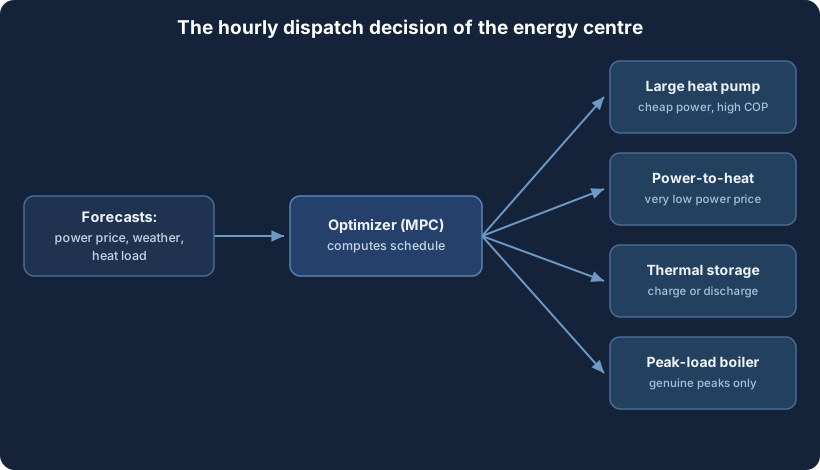
Marginal cost equals the electricity price divided by the COP. The COP is not a constant, it depends on source and supply temperature. In mild weather the same plant delivers far more heat per kilowatt-hour of electricity.
Worse in efficiency than the heat pump, but fast and cheap to modulate. The unit of choice when the electricity price is very low or even negative and every kilowatt-hour has to go somewhere.
The expensive fallback for genuine peaks and cold spells, made dearer by the carbon price. The goal of the optimization is to minimize its running hours without risking security of supply.

Cold district heating networks push this principle to the limit, because there generation comes almost entirely from electricity and ambient heat, and the digital control of cold district heating dispatches each source individually. The logic is the same everywhere: nobody knows the right order in advance, it falls out of the calculation.
Forecasting is the biggest lever
Optimization without prediction is blind. The value of the whole system stands or falls with the quality of the forecasts for price, weather and load, and the effect is measurably large. A Danish case study ran the numbers for an energy centre with 22,000 MWh of annual demand, a 5 MW heat pump and 2,000 cubic metres of storage.
So the benefit saturates. A seven-day horizon delivers barely more than three days, because the store cannot pre-charge arbitrarily far ahead. That is good news: you do not have to know the weather two weeks out to capture the bulk of the saving.
The thermal store as a degree of freedom
Without a store, generation would have to follow demand, hour by hour. The store breaks that coupling. The heat pump produces when power is cheap, and the store bridges the hours when it is expensive. A rigid process becomes a movable optimization problem.

In case studies, roughly half of the heat produced is used flexibly through the store. Without it, forecast-free operation cannot exploit cheap price windows at all, the tank stays empty and the saving unused. Only the store makes pre-production plannable and thus makes the forecast valuable. The two levers only work together.
Case in point, Dresden-Friedrichstadt: since November 2025 a modular large heat pump feeds around 2,100 MWh of renewable heat per year into the network and saves about 273 tonnes of CO2. SachsenEnergie and the city of Dresden couple it with a thermal store and a digital model of the network, which is what makes the demand-driven, time-shifted control possible in the first place. That combination of storage and digitalization is exactly the difference between producing heat and producing heat well.
From control to optimization: MPC and marketing
The technical answer to the scheduling problem is model predictive control. It optimizes not the current state but the whole schedule over hours to days, and adjusts it as new forecasts arrive. The optimization runs against a plant model, the digital twin of the energy centre.
A review of AI-enhanced model predictive control for heat pumps documents energy and cost savings of 25 to 60 percent over rule-based control. Distributed MPC approaches keep sensitive data decentralized and stay scalable, instead of pulling everything into one central calculation.
Whoever uses the flexibility not only internally but also offers it to the market lowers expected costs further. A multistage stochastic optimization for large-heat-pump district heating puts the cost reduction from bids on the balancing market at 28 to 59 percent. Coupling the heat pump with an electrode boiler raises the available flexibility, because two units give more room than one.
The step that counts: moving from control to optimization means no longer holding the plant at a setpoint, but computing a schedule against the future. The same software that makes operation cheaper turns the energy centre into a tradable flexibility package on the side. How far such flexibility can already be pooled into virtual power plants is shown in the dedicated article.
What to set up now
The path from an installed plant to an optimized operation is not a technology purchase but a data project. The order of the steps decides whether the saving is captured at all. Five steps, roughly in this sequence.
The roadmap for optimization
-
Build the data foundation
Bring meter, operating and state data from heat pump, store and boiler together in a time-series base, clean and gap-free. Without reliable data every optimization runs against noise. A solid digital data foundation for heat supply is the prerequisite, not the extra.
-
Build forecasting capability
Integrate or buy price, weather and load forecasts, with particular care for the ambient temperature because of the COP effect. Forecasting is the single biggest lever, so this is where care pays off most.
-
Create the plant model
Build a digital twin of the energy centre with the characteristic curves of each unit, against which the optimization runs. The model has to capture the COP curve and the storage dynamics, otherwise it optimizes past reality.
-
Pilot the optimizer
Run model predictive control first as a schedule proposal alongside the existing control, compare results, then hand over. That proves the benefit before responsibility changes hands.
-
Clarify market access
Check whether the pooled flexibility can be offered on the day-ahead and balancing markets, alone or through a marketer. The store belongs in the optimization as a degree of freedom, not just as a buffer in the basement.
Digital dispatch optimization is not a plant topic but a data topic. Whoever thinks data, forecasting, plant model and storage together captures double-digit cost shares, instead of running an expensive heat pump below its worth on a fixed rule. How AI takes over grid operation itself is explored in the article on agentic AI in grid management.
Further reading
Frequently asked questions
A hybrid energy centre produces district heat from several units at once, typically a large heat pump, a power-to-heat unit, a thermal store and a peak-load boiler. Each unit has different costs and different strengths. Which one delivers the cheapest heat at any hour depends on the electricity price, the ambient temperature and the state of charge of the store, so it has to be recomputed continuously.
A large heat pump is only the cheapest source of heat when the electricity price is low and its COP is high. Both change daily, sometimes every quarter hour. A fixed rule such as heat pump first does not know the price peaks and COP troughs and leaves money on the table. The right order of units has to be calculated for every hour, not set once.
In a case study with 22,000 MWh of annual demand, a 5 MW heat pump and 2,000 cubic metres of storage, even a rolling one-day optimization cuts annual costs by about 20 percent against a forecast-free operation, and a three to seven day horizon by about 27 percent. A review puts the saving of AI-enhanced model predictive control over rule-based control at 25 to 60 percent.
The thermal store decouples generation from consumption. The heat pump can produce when power is cheap, and the store bridges the expensive hours. In case studies, roughly half of the heat produced is used flexibly through the store. Only the store makes pre-production plannable and thus makes the forecast valuable, the two levers only work together.
Model predictive control does not optimize the current state but the whole schedule over a horizon of hours to days, and adjusts it as new forecasts arrive. The optimization runs against a plant model, the digital twin of the energy centre. Distributed approaches keep sensitive data decentralized and remain scalable.