Gas WACC: 3.76 percent from 2028, and the cost review is already running
This article sets out what Germany's draft ruling changes methodically, why the order of the procedural steps is a planning problem, which points remain open, and what gas distribution operators should work with until the end of 2026.
A standardised rate of return is the single rate at which Germany's Federal Network Agency remunerates capital tied up in gas grids inside the revenue cap; it applies to gas distribution and transmission system operators from the fifth regulatory period, 2028 to 2032. The draft of 14 August 2026 puts the WACC rate at 3.76 percent, built from a pre-tax cost of equity of 5.76 percent and a cost of debt of 2.43 percent, on an assumed structure of 40 percent equity and 60 percent debt. Chamber 9 takes comments until 14 September 2026 and the ruling is expected at the end of 2026. Cost applications for the same period were already due on 1 July 2026 under the standard procedure, and run until 1 October 2026 under the simplified one. So anyone planning today is working with a number that is not yet fixed.
What the regulator proposes
On 14 August 2026 Germany's Federal Network Agency published a draft ruling on a standardised rate of return in the gas sector. It names a WACC rate of 3.76 percent that will carry the revenue caps of every gas distribution and transmission system operator from 2028. Chamber 9 accepts comments until 14 September 2026. After that, no further public round is planned.
Klaus Müller, who heads the agency, framed the goal as an appropriate return that keeps investment in gas grids financeable and attractive to investors. That is one reading of the number. Industry reads the same number differently, and we come to that below.
One detail matters for anyone sorting this into their own roadmap: the draft covers neither hydrogen network operators nor electricity network operators. Separate electricity procedures are announced for 2027. Run gas and power in one company and you now have two timetables side by side, much as with the AgNeS network charge reform on the electricity side.
What changes methodically
This is not a new number inside the old system. It is a change of system. Until now the regulator examined each operator's financing structure and remunerated old and new assets at different rates. From 2028 one assumed structure covers everyone.

Start with the part that hurts. Capital structure is standardised at 40 percent equity and 60 percent debt, whatever the individual operator's balance sheet shows. Finance yourself differently and you still get the assumption.
Alongside that, the split between old and new assets disappears, a split that in the fourth period meant 5.07 percent for new assets and 3.51 percent for old ones. Equity is still derived through the capital asset pricing model. What people argue about is the base rate, the market risk premium and the risk surcharge, not the model.
Which leaves the comparison that almost every report drew: 5.76 against 5.07 percent, so an increase. That comparison does not hold. Both are pre-tax rates, and from 2028 corporation tax drops by one percentage point a year, from 15 percent to 10. With lower tax, the same post-tax return needs a lower pre-tax rate. Read those 0.69 percentage points as a concession and you have quietly credited the regulator with a tax reform.
The cost review runs, the rate is missing
The practical difficulty is not the level of the rate. It is the order. Cost review for the fifth period has long been under way. The rate that will remunerate the reviewed capital comes afterwards.
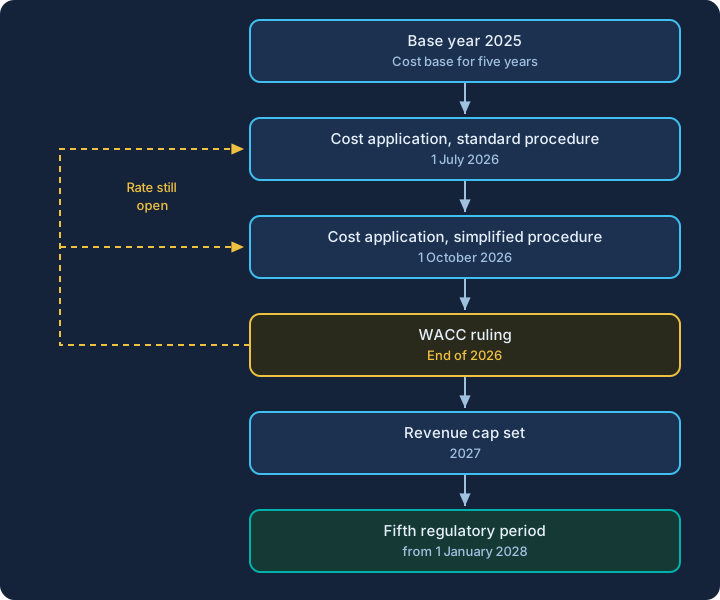
Base year is 2025. Every cost item from that single financial year sets the starting level for five years. Documents were due on 1 July 2026 under the standard procedure, while the simplified procedure runs until 1 October 2026. For the first time the new framework applies: RAMEN Gas, ruled by the Grand Chamber on 8 December 2025, together with the gas network charge ruling GasNEF.
That has consequences well beyond the rate question. Consultancy BET expects every cost item to be reassessed from scratch under the new legal position, with narrower discretion for the regulators than before. Cost items not cleanly reported in the base year's unbundling accounts drop out of the starting level. Not for one year. For the whole period.
Operators in the simplified procedure get the only good news in this article: their application is still open, and documentation of the capital base can still be tidied up before 1 October.
Two positions, no compromise
Regulator and operators read the same figure in opposite directions, and both argue it cleanly.
None of this resolves into one number. A return at the level of debt makes equity unattractive, precisely while conversion and decommissioning need funding, with hydrogen readiness on top. A higher return raises charges for the customers still connected to the gas grid. Both statements are true. Chamber 9 still has to write down a figure.
Open points
Three things belong in a comment now rather than in an appeal later.
The standardised capital structure
An operator with an equity ratio above 40 percent has the excess remunerated at the debt rate of 2.43 percent. Municipal shareholders who hold high equity ratios for good reasons lose out. This is the sharpest economic point in the draft, and the one where a single utility with its own figures can contribute most.
Asymmetry between the sectors
Hydrogen and electricity grids get their own procedures, electricity only in 2027. VKU is arguing in parallel for fair financing conditions for hydrogen distribution operators too. For utilities planning a staged conversion of their gas grid under the EnWG gas and hydrogen package , it is unclear which regime will remunerate a converted section in the end.
The courts offer little
Experience from the fourth period dampens hope of a judicial correction. Düsseldorf's Higher Regional Court struck down the rate ruling of that period on 30 August 2023, because the regulator had not additionally corroborated a market risk premium derived purely from historical data series. Germany's Federal Court of Justice overturned that decision after a hearing in December 2024 and raised the bar for such objections. Waiting for a court is probably waiting for nothing.
Fallbacks: planning without a final rate
Until the end of 2026 every utility works with an assumption. The mistake is not the assumption. It is hiding it inside the model.
Four steps before the ruling
-
Hold capital cost as a parameter
Put the capital cost line of the revenue cap model in its own cell rather than hard-coding it into a formula. Adjusting after the ruling then takes hours instead of weeks.
-
Run two scenarios
The draft value of 3.76 percent and a lower stress case. The difference in euros per year is the number your management needs in every further conversation, in the supervisory board and with the municipality.
-
Give investments a recall point
Which measure gets deferred if the capital return lands below plan? And by when does that call have to be made so procurement and materials can still follow? Both belong before the ruling, not after it.
-
Bring shareholders in early
Municipal dividend expectations rest on a return that is currently up for decision. One sentence about it in autumn is easier than a correction in spring.
The dilemma underneath
Behind the rate debate sits a problem no regulatory chamber solves. In a gas grid, fixed costs spread across a shrinking number of connections as buildings and industrial processes leave. Whoever holds on to their gas connection longest carries a growing share of those fixed costs.
Every decision on capital return therefore becomes a choice between two risks. Set the rate high and the downward spiral in connection numbers speeds up. Set it too low and you slow the very grid conversion meant to cushion that spiral. This is not a bargaining game; it is the real ground on which municipal heat planning and the gas grid transformation plan have to set their assumptions.
And the next round comes early: the sixth period is meant to shorten to three-year cycles. Debate about the rate after next begins before the fifth period is half over.
What utilities should do now
14 September is the last moment when influence costs nothing but effort.

- Comment. Through BDEW, VKU or GEODE if you like, but with your own figures: a documented equity ratio and a concrete investment plan carry more weight than an association position alone, because the chamber can calculate with them.
- Work out how sensitive your own revenue cap is to the WACC, in euros per year.
- Check the 2025 unbundling accounts against what RAMEN Gas requires, while corrections in the procedure are still possible.
- Prepare asset accounting for the disappearing split between old and new assets. If you modelled that split in master data and valuation, you need a migration concept, and it does not get written in December.
- Put end of 2026 and the 2027 electricity procedures next to each other in the regulatory roadmap.
The rate is only fixed at the end of 2026, yet the cost base it applies to went in over the summer. Hold the capital cost line as a parameter now, know your sensitivity, and you lose no week in January.
Further reading
Frequently asked questions
WACC stands for weighted average cost of capital, the blended cost of equity and debt. Under incentive regulation this rate decides how much capital return enters the revenue cap as a cost item, and therefore how much may be earned through network charges. Germany's draft ruling of 14 August 2026 puts the gas figure at 3.76 percent.
It applies to gas distribution and transmission system operators from the fifth regulatory period, which runs from 2028 to 2032. Hydrogen network operators and electricity network operators are not covered. Separate procedures for electricity are announced for 2027.
Arithmetically yes, economically not necessarily. Both figures are pre-tax rates, and from 2028 German corporation tax falls by one percentage point a year, from 15 percent down to 10 percent. A lower tax rate lowers the pre-tax rate needed for the same post-tax return, so the two numbers are not directly comparable.
Until 14 September 2026. Comments go to Chamber 9 of the Bundesnetzagentur at konsultation.bk9@bnetza.de. No further public round is planned after that, and the ruling is expected at the end of 2026.
The regulator will assume 40 percent equity and 60 percent debt for everyone, regardless of how an operator is actually financed. Anyone carrying more equity than that has the excess remunerated at the debt rate. For municipal shareholders who traditionally hold high equity ratios, this is the sharpest economic point in the draft.