
HEDWIG: the new energy market data reporting duty under § 111g EnWG
For a grid operator this is not another report next to the old ones. It is a new data path out of your own systems, with deadlines that also run on a Sunday.
HEDWIG is the German regulator's ruling on the release of energy market data under § 111g EnWG. It obliges energy suppliers, grid operators and plant operators from 1 megawatt upwards to report generation, consumption, transport and trading data automatically through the BNetzA Data Hub, as a rule in JSON and, depending on the collection, down to a 15-minute cadence. The proceeding has been running since 2 July 2025 under case number 4.17.04, and the draft of 18 April 2026 was open for comment until 13 May 2026. Two items cost lead time: the one-off backfill of historical data, reaching back to 1 January 2022 at most, and the flagging of trade and business secrets. Leave a field unflagged and consent to publication is presumed. The national transparency platform has to be live by 29 December 2026 under § 111g(3).
What HEDWIG is and why it matters now
HEDWIG stands for the release of energy market data for transfer and information. Behind the name sits a ruling under § 111g EnWG, and behind that a simple idea. The regulator wants the data it collects today through many channels to arrive through one interface instead. Automated, at higher resolution, at steady quality.
Germany put the legal basis in force on 29 December 2023. Bonn opened the proceeding on 2 July 2025 under case number 4.17.04. The draft ruling followed on 18 April 2026, with comments due by 13 May 2026. What is new for a municipal utility is not in the operative part. It is in the annex, where every single data collection carries its own frequency, its own deadline and its own start date.
Time pressure here does not come from the ruling. It comes from the statute. Under § 111g(3) sentence 1 EnWG the national transparency platform has to be operating by 29 December 2026 at the latest. A platform without data would be an empty shell. So the regulator pushes the pace while the industry asks for more lead time.
What gets reported, and how often
Coverage runs across electricity, gas and hydrogen: generation, consumption, transport, trading, sales, plus non-availability and forecasts. The operative part states the duty in three words that can get expensive in daily operations: on time, complete, error-free.
What that means in practice sits in the annex, collection by collection. Unit and decimal places. Granularity and resolution. Retrieval time, deadline, start date. And the historical provision, meaning the date from which a gapless time series has to be delivered once. If that date lies in the past, 1 January 2022 for instance, it is not a typo. It is a small project.
| Requirement | What the draft says | What it means in the company |
|---|---|---|
| Format | JSON as a rule, standards follow existing market standards | rebuild exports from source systems, not just rename them |
| Frequency | differs per collection, down to every 15 minutes | reporting runs in operations, not at month-end |
| History | one-off backfill, no earlier than 1 January 2022 | gather old data, prepare it, explain the gaps |
| Corrections | without undue delay once known or once requested | a defined route instead of a phone call, with cover |
| Access | the company's ELSTER organisation certificate | sort out permissions before the first deadline runs |
There is one concession. If an error surfaces outside business hours, on a public holiday or at the weekend, the correction can wait until the next working day. It reads like a footnote. For a utility without an on-call rota it is the difference between workable and not.
The reporting cascade: who files, who is liable
Not every company has to upload every figure itself. Where the annex allows it, primary data owners may delegate reporting to a central body, for example to transmission system operator platforms or the DVGW. Much of that data already sits there anyway, from balancing group settlement, from Redispatch 2.0 or from European regulations.
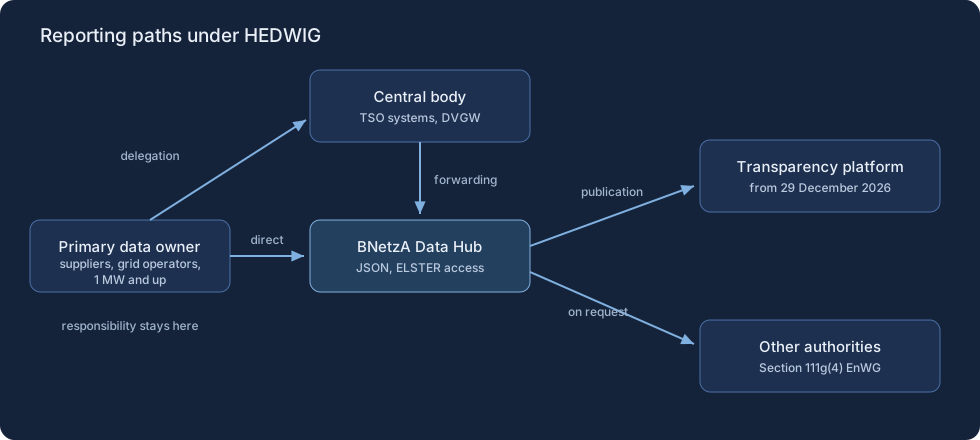
In legal terms the delegation is a discharging performance by a third party, modelled on § 362(2) of the German Civil Code. Deliver to the central body and you have met your duty. But only the duty to file. The primary data owner stays responsible for accuracy and completeness, while the central body is liable for forwarding on time. That is the point where a convenient shortcut turns awkward under audit.

The regulator works out who has to report from the master data in the Marktstammdatenregister, Germany's core market data register. Sloppy registrations now surface in a new place. Newly identified parties get a notification in the Data Hub, the duty starts immediately, and a grace period without deadline notices leaves room for one decision: file yourself or delegate.
Trade secrets become your job to flag
The draft asks companies to flag trade or business secrets per data collection. Sounds like paperwork. It is a reversal of the burden of proof.
Without a flag, the regulator presumes consent to publication, unless it happens to know of circumstances that argue against it. So a field somebody forgets to mark in daily operations may end up published. For flagged data the agency weighs whether to publish it aggregated or disaggregated with a delay. Personal data is not published.
In practice: the list of protected fields belongs before the first reporting run, not after. And it does not belong to IT alone. The person who can judge whether a feed-in time series points back to a single customer sits in sales or in grid operations, not at the interface.
What changes inside the company
Effort rarely lands where reporting happens today. It lands on the systems the figures come from, and on the operations team that will watch the filings from now on.
One-off filings turn into continuous operations. Deadline notices need an addressee, corrections need a defined route, delegated tasks need confirmation from both sides. Existing channels such as MonEDa and the energy data portal are meant to move into the Data Hub, which calls for a migration list per report. And the circle of reporting parties reaches past the obvious roles: railway power grids, site networks, industrial grids and closed distribution systems are covered explicitly. In a group structure that surfaces subsidiaries nobody had on the reporting list.
For anyone rebuilding market communication right now, this is not bad news. Those data paths overlap with what the ongoing development of market communication, with EDIFACT, AS4 and API web services, already requires. Plan the two separately and you build twice.
Where it gets difficult
Industry criticism is not aimed at market transparency. It is aimed at effort and at open questions.
In its comment of 13 May 2026 the BDEW, Germany's energy industry association, objected that the new collection arrives without naming which existing reporting duties fall away. That misses the once-only principle, even though the explanatory memorandum to § 111g EnWG names exactly that consolidation. The association also argues a platform could be filled from data that already exists, without collecting more.
Four more points come up again and again in the comments. The 15-minute cadence, which can force an on-call rota because deadlines do not wait for office hours. The backfill to 2022, which ties up capacity once. The protection of security-sensitive data on a public platform. And identification through ELSTER certificates, which would have to be handed to more people inside the company. Some commenters asked for AS4 certificates instead, the kind market communication has used for years.
If a report stays missing, arrives late or comes in incomplete, the Federal Network Agency can impose a coercive or administrative fine under the general principles of the EnWG. The Data Hub warns automatically before that. Which is fair. It does assume the warning reaches somebody who can act on it.
What grid operators should do now
A final ruling is still pending. The preparation can happen anyway, because it falls due regardless of how individual deadlines land.

The next steps
-
Work through the annex and assign owners
Go through the annex collection by collection and note three things per line: which system holds the data, who owns it internally, at what cadence it has to go out. That table is the actual basis of the project. Everything else hangs off it.
-
Check your entries in the market data register
The regulator derives the reporting obligation from that register. Errors there become visible now.
-
Decide on delegation early
Settle per collection whether a central body files or you do. Document the decision together with the formats and transmission routes that body prescribes. And write down that responsibility for accuracy stays in house, so nobody remembers it differently later.
-
Sort out ELSTER access and cover
Without an organisation certificate nobody gets into the Data Hub. Clarify early who uses it, who covers, and how access is handed over when someone leaves.
-
Draw up the secrets list before the first run
Define which fields get flagged as trade or business secrets, and have sales and grid operations confirm it. Without a flag, consent to publication is presumed.
-
Treat the backfill as its own project
Check which collections reach back to 2022 and whether the old data exists without gaps at all. Where it does not, you need an explanation, not an improvisation shortly before the start date.
Further reading
Frequently asked questions
HEDWIG is the German regulator's ruling on the release of energy market data for transfer and information under § 111g EnWG. It obliges energy supply companies, grid operators and plant operators to report their generation, consumption, transport and trading data automatically through the BNetzA Data Hub. Most of that data is then published on a national transparency platform.
The addressees are energy supply companies, market area managers, operators of generation and consumption facilities above 1 megawatt of installed capacity, operators of railway power grids and closed distribution systems, plus the exchanges EEX and EPEX SPOT. For single data categories such as non-availability, facilities between 100 kilowatts and 1 megawatt are covered as well. The regulator identifies who reports from the master data in the Marktstammdatenregister.
Yes, where the description of the individual data collection allows it. Delegating to a central body, for example to transmission system operator platforms or the DVGW, releases the company from its own reporting duty. The construction follows the discharging performance by a third party under § 362(2) of the German Civil Code. The primary data owner stays responsible for accuracy and completeness, the central body is liable for forwarding on time.
Each data collection starts with a one-off backfill as a gapless time series. The start date sits in the annex for that collection. The regulator goes back no further than 1 January 2022, because it takes existing retention periods into account. After the backfill, reporting continues at the defined frequency and deadline.
The Data Hub notifies the reporting party automatically when a deadline passes, and the report can usually be filed afterwards. If it stays missing, late or incomplete, the Federal Network Agency can impose a coercive or administrative fine under the general principles of the EnWG. Newly identified reporting parties get a grace period without deadline notifications first.
Let's collaborate
One contact, a team behind it
Thirty minutes on what you're working on, whether grid, metering, market processes, IT architecture or AI. Afterwards you'll know how we'd approach it and who would sit at the table.
Energy and measurement technology since 2010 · innobu GmbH since 2014 · Based in Schleswig-Holstein, Germany
Whoever pitches also delivers: whoever leads the first call stays your contact right through to the steering committee, with established partners in the project. Direct: info@innobu.com