Hydrogen cavern storage: the H2CAST Etzel pilot and the acceleration framework from 2026
This is a practical analysis of hydrogen storage in salt caverns, the H2CAST Etzel pilot as the industrial proof of concept, the storage need of the hydrogen system and the acceleration and funding framework from 2026 for storage. It is not a treatise on the permitting law in general. It sets out why the system needs bulk storage, how salt caverns work, what H2CAST proves and on what timeline, and how the framework from 2026 accelerates the storage ramp-up: the WasserstoffBG for permitting, referenced and linked rather than repeated, and the BMWE hydrogen storage white paper as the storage-specific framework. The neighbouring topics, the network cluster and the production and import auctions, sit close by and are linked, not repeated.
Salt caverns are the key technology for large-volume, long-term and seasonal hydrogen storage: gas-tight, fast and multi-cycle, present in large numbers in north-west Germany and partly convertible from existing natural-gas and oil caverns. The German hydrogen storage need rises from about 2 to 7 TWh in 2030 to about 76 to 80 TWh in 2045, and EU-wide up to about 161 TWh by 2050; the drivers are industry and the re-electrification of hydrogen in H2-ready power plants. The H2CAST Etzel pilot is the leading industrial proof of concept: coordinator STORAG ETZEL, with Gasunie running the surface facility and the filling and DEEP.KBB handling engineering and tests, plus HARTMANN Valves, SOCON, DLR and TU Clausthal. H2CAST uses two existing salt caverns below 1,000 m depth at the Etzel site (about 75 caverns in total), about 150,000 m3 per test cavern, expandable to about 600,000 m3, with a long-term target of up to 1 TWh. From May 2025 (start 9 May 2025) the two caverns were filled with about 90 t of hydrogen (about 300,000 m3) at about 170 bar, supplied by Plug Power from Werlte; filling was completed in mid-March 2026 with 100 percent gas-tightness proven, the surface purification plant goes into operation in spring 2026 and results follow by the end of 2026. Funding came through READY and INVEST (Lower Saxony) and PROVE (BMWE, about EUR 3.39 million). The conversion of existing stores (potential up to about 36 TWh, about 31 TWh from natural-gas and about 5 TWh from oil caverns) can cover about 20 to 50 percent of the German need by 2040, since for hydrogen the usable working-gas volume drops to about one fifth versus natural gas; new build is then also required. The acceleration framework from 2026 is not a single law of that name but two elements: the WasserstoffBG (in force since 2 April 2026), which lists hydrogen storage in its scope and places it in the overriding public interest and so accelerates permitting, and the BMWE hydrogen storage white paper, the Weissbuch Wasserstoffspeicher (17 April 2025), as the storage-specific framework calling for a competitive storage market plus funding. Because conversion takes 4 to 6 years and new build 10 to 12 years, investment decisions must fall in 2026 and 2027 for the volumes to stand by 2045.
Why the hydrogen system needs bulk storage
The hydrogen system has its largest gap not in production or transport but in storage. Hydrogen from electrolysis and from imports does not arrive at a steady rate, and the demand of industry and power plants swings with the seasons. Without large-volume underground storage in the order of several dozen terawatt-hours, a resilient hydrogen system cannot be run. Storage is the component that turns a fluctuating supply and a fluctuating demand into a reliable balance, and it is the part of the ramp-up that is most often left out of the picture.
The numbers make the scale concrete. The German hydrogen storage need rises from about 2 to 7 TWh in 2030 to about 76 to 80 TWh in 2045, and EU-wide up to about 161 TWh by 2050. These are not the figures of a niche application but of a system-wide function: a hydrogen economy of that size cannot be operated without underground stores measured in dozens of terawatt-hours. The drivers are industry, which needs a steady feedstock, and above all the re-electrification of hydrogen in H2-ready power plants, which call hydrogen up precisely when there is little renewable power on the grid.
What storage does here is bridge time, not smooth out flicker. A cavern store balances days to whole seasons, summer surplus against winter demand, where a battery balances seconds to hours. That is a different job from the short-term flexibility most of the public debate focuses on, and it is the reason an electricity system full of batteries still cannot carry the seasonal swing of a hydrogen system on its own. The seasonal balance is the structural task that only large-volume gas storage can carry.
Storage sits downstream of the rest of the ramp-up and depends on it. It comes after production, addressed by the EU Hydrogen Bank, after import, addressed by H2Global, and after the network, addressed by the H2 core network, to which the stores are connected as access points. Treating storage as a distinct asset, with its own technology, its own lead times and its own framework, is the precondition for closing the gap rather than assuming it will close itself.
Salt caverns: gas-tight, fast-cycling, abundant in the north-west
Salt caverns are the key technology for large-volume hydrogen storage, and the reason lies in the rock itself. A salt cavern is a cavity solution-mined deep in the rock salt, connected to a surface wellhead through a borehole that runs down through the overburden. Rock salt is practically gas-tight and self-healing, which makes it well suited to the small, mobile hydrogen molecule and to high operating pressures. That combination, a sealed cavity that can hold hydrogen under pressure, is what allows a single cavern to store a large volume safely.
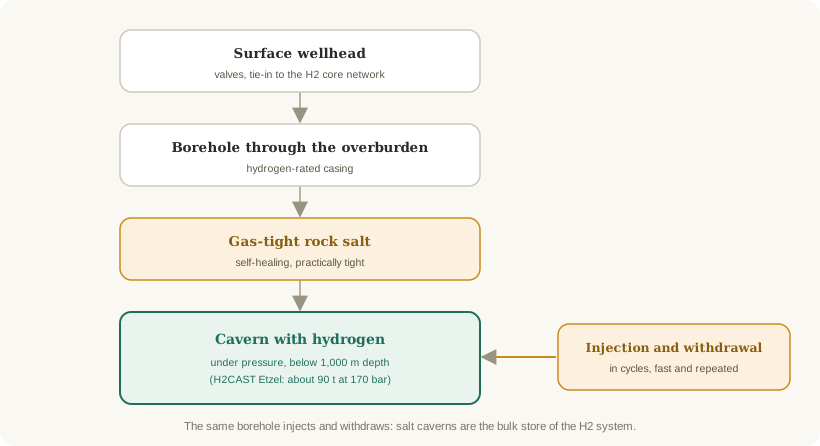
Caverns also suit the rhythm of a renewable hydrogen system. They allow fast, frequent load changes, that is multi-cycle operation, with hydrogen injected when there is a surplus and withdrawn when it is needed, through the same borehole. This responsiveness matches a fluctuating generation profile far better than slower geological options, and it is the operational reason caverns are favoured for the bulk, flexible store rather than for a static long-term reserve alone.
The geography is a second advantage. Salt caverns exist in large numbers in north-west Germany, and some existing natural-gas and oil caverns can be converted to hydrogen. That existing stock is the fastest route to capacity, since converting a proven cavity is quicker and cheaper than mining a new one. The H2CAST Etzel site, where the leading pilot runs, sits squarely in this salt province, which is why the north-west is the natural centre of the German storage build-out.
One physical limit has to be priced in from the start. Because of its low energy density, hydrogen stores far less energy in the same cavity than natural gas does: the usable working-gas volume for hydrogen drops to about one fifth versus natural gas. A cavern that held a given amount of energy as natural gas holds only about a fifth of that energy as hydrogen, so the number of caverns needed for a target storage volume rises accordingly. This factor of five runs through every conversion and new-build plan and is the reason the storage task is larger than a simple swap of gas for hydrogen would suggest.
H2CAST Etzel: the industrial proof of concept
H2CAST Etzel is currently the most important pilot for hydrogen cavern storage, and its purpose is precise: to demonstrate at industrial scale that an existing salt cavern can store pure hydrogen gas-tight, multi-cycle and at the required quality. It is not a laboratory experiment but a working facility on a commercial storage site, which is what makes its results a credible design basis for the large stores that have to follow.

The consortium combines an operator, an integrator and specialist suppliers and research institutes. The coordinator is STORAG ETZEL, the cavern operator at the Etzel site in Friesland, Lower Saxony. Gasunie is responsible for the surface facility and the hydrogen filling, and DEEP.KBB handles condition assessment, engineering, test execution and analysis. They are joined by HARTMANN Valves for hydrogen-ready downhole safety and SOCON for measurement technology, with DLR contributing system modelling and TU Clausthal storage integrity. This mix means the pilot covers the whole chain, from the rock and the well to the surface plant and the system view.
The scale is set by the site and the caverns. The Etzel site has about 75 caverns in total; H2CAST uses two existing salt caverns below 1,000 m depth. The geometric volume per test cavern is about 150,000 m3, expandable to about 600,000 m3. The long-term target of the partners is a flexible underground store of up to 1 TWh of hydrogen, connected to the H2 core network and the Wilhelmshaven energy hub, which places the pilot in the line of sight of a genuinely system-scale store rather than a one-off demonstration.
The funding runs through three strands. H2CAST READY and H2CAST INVEST are supported by the Lower Saxony environment ministry, and H2CAST PROVE is funded by the BMWE with about EUR 3.39 million over the project term. This split mirrors the technical phases, with the readiness and investment work carried by the state and the proof of normal operation carried by the federal programme, which is the structure that the timeline in the next section follows.
From filling to proof: phases and timeline
H2CAST runs in clear phases, from the suitability check through the filling to the proof of normal operation. READY covers the proof of the caverns' suitability and tightness; PROVE covers the proof of normal operation and the required hydrogen quality. Reading the project along these phases matters, because the value of the results lies precisely in moving from "the cavern holds hydrogen" to "the cavern can be run as a working store at the right quality".

The filling is the centrepiece of the work so far. From May 2025, with a symbolic start on 9 May 2025, the two caverns were filled with about 90 t of hydrogen, equivalent to about 300,000 m3, at about 170 bar. The hydrogen was supplied by Plug Power from Werlte, about 90 km to the south. This was the step that took the pilot from a prepared cavity to a cavern actually holding pure hydrogen under pressure, on a commercial site rather than a test rig.
The filling was completed in mid-March 2026, with 100 percent gas-tightness proven. That single result, a fully gas-tight cavern after filling, is the headline of the project to date: it confirms that an existing salt cavern can hold pure hydrogen without loss, which is the precondition for everything that follows. The surface purification plant, covering gas cleaning, compression and quality monitoring, goes into operation in spring 2026, taking the project from tightness into the question of withdrawn quality.
An intensive test phase then follows, with results expected by the end of 2026. These results are intended as the design and safety reference for building large hydrogen stores in north-west Europe. In other words, the value of H2CAST is not only the tight cavern at Etzel but the data set it produces: the operating, quality and safety parameters that the next, far larger stores will be designed against, on the timeline that the storage need demands.
The acceleration framework from 2026: permitting and storage strategy
The acceleration framework for hydrogen storage from 2026 is not a single law of that name but the interplay of two elements: a permitting lever and a storage-specific policy framework. Keeping them apart is important, because they do different things, and a storage operator has to plan against both at once rather than waiting for one instrument to carry the whole task.
The first element is the permitting lever. The hydrogen acceleration act (WasserstoffBG), in force since 2 April 2026, lists hydrogen storage explicitly in its scope (section 2) and places its construction and operation in the overriding public interest (section 4), with fixed shorter deadlines and a fully electronic procedure. For storage, this is what speeds the approval of a project from a question of years to a far tighter window. The detailed mechanics of the act sit in a separate article on the WasserstoffBG and the permitting of storage and are not repeated here; what matters in this context is simply that storage is squarely inside its scope.
The second element is the storage-specific framework. The BMWE hydrogen storage white paper, the Weissbuch Wasserstoffspeicher (hydrogen storage white paper) published on 17 April 2025, names the storage need and the conversion potential and calls for a competitively organised storage market plus funding to cover the early investment risks. It is set out as the basis for the work of the federal government in the 21st legislative period, that is from 2026, which makes it the reference point for how the storage market and its support are designed in the years that follow. Where the WasserstoffBG accelerates the permit, the white paper addresses the business case.
The conversion potential is the quantitative core of the storage strategy. The BMWE puts the conversion potential of existing stores at up to about 36 TWh, about 31 TWh from natural-gas caverns and about 5 TWh from oil caverns, drawing on about 29 natural-gas cavern sites concentrated in the north-west. Converting this stock can cover about 20 to 50 percent of the German need by 2040. Conversion is also the faster and cheaper route, at about 4 to 6 years against about 10 to 12 years for new build, so the strategy leans first on converting what exists and only then on building new caverns to close the remaining gap.
What storage operators and H2 players should do now
The technical proof is maturing with H2CAST, the permitting framework is in place, and the storage market is taking shape; because of the long lead times, storage investment decisions have to be prepared now rather than later. For storage operators and large hydrogen players the questions are concrete: which caverns to convert, how to size the volume against the reduced working-gas factor, how to run permitting and the forming market design in parallel, and how to use the H2CAST results as a design reference.
The single hardest constraint is time. Because conversion takes about 4 to 6 years and new build about 10 to 12 years, investment decisions must fall in 2026 and 2027 for the needed capacity to stand by 2045. That window is short relative to the volumes involved, and it is the reason the storage question cannot be deferred until the rest of the system is finished: the lead times mean that waiting for certainty would already mean missing the 2045 target.
The points below turn the storage logic into a near-term action list for operators and large hydrogen players.
- Take the time window seriously. Because conversion runs about 4 to 6 years and new build about 10 to 12 years, prepare storage investment decisions for 2026 and 2027 so the volumes are in place by 2045; treat the lead time, not the technology, as the binding constraint.
- Screen conversion candidates and sites. Assess existing natural-gas and oil caverns, their connection to the H2 core network and their site suitability, and factor in the reduced working-gas volume for hydrogen, about one fifth of the natural-gas figure, when sizing the usable capacity.
- Plan permitting and market design in parallel. Run the permit through the WasserstoffBG (overriding public interest, fixed deadlines) and track the forming storage-market and funding design from the hydrogen storage white paper at the same time, rather than treating them in sequence.
- Use the H2CAST results and keep the asset distinct. Use the H2CAST data due by the end of 2026 as a design and safety reference, and keep storage clearly separate, as its own asset, from the network (capacity booking under WaKandA, network financing under WANDA) and from production and import (EU Hydrogen Bank, H2Global).
Further reading
Frequently asked questions
Hydrogen from electrolysis and from imports does not arrive at a steady rate, and the demand of industry and H2-ready power plants swings seasonally. Without large-volume underground storage in the order of several dozen terawatt-hours, a resilient hydrogen system cannot be run. Storage bridges days to seasons, summer surplus to winter demand, not seconds like a battery. The German storage need rises from about 2 to 7 TWh in 2030 to about 76 to 80 TWh in 2045, and EU-wide up to about 161 TWh by 2050. The main drivers are industry and, above all, the re-electrification of hydrogen in H2-ready power plants when little renewable power is available. Storage is the most frequently overlooked gap in the ramp-up, downstream of production, import and the network.
Salt caverns are the key technology for large-volume hydrogen storage because the rock salt is practically gas-tight and self-healing, ideal for the small, mobile hydrogen molecule and for high operating pressures. A salt cavern is a solution-mined cavity deep in the rock salt, connected through a borehole to a surface wellhead. Caverns allow fast, frequent load changes, that is multi-cycle operation, which fits fluctuating generation. They exist in large numbers in north-west Germany, and existing natural-gas and oil caverns can in part be converted. Because of the low energy density, however, the usable working-gas volume for hydrogen drops to about one fifth versus natural gas, so the number of caverns needed rises accordingly.
H2CAST Etzel is the leading pilot that demonstrates at industrial scale that an existing salt cavern can store pure hydrogen gas-tight, multi-cycle and at the required quality. The coordinator is STORAG ETZEL, with Gasunie running the surface facility and the filling and DEEP.KBB handling engineering and tests, plus HARTMANN Valves, SOCON, DLR and TU Clausthal. It uses two existing salt caverns below 1,000 m depth at the Etzel site, which has about 75 caverns in total, with about 150,000 m3 per test cavern, expandable to about 600,000 m3. From May 2025 the two caverns were filled with about 90 t of hydrogen at about 170 bar, supplied by Plug Power from Werlte; filling was completed in mid-March 2026 with 100 percent gas-tightness proven. The surface purification plant goes into operation in spring 2026 and the test results follow by the end of 2026, providing the design basis for large hydrogen stores.
The German hydrogen storage need rises from about 2 to 7 TWh in 2030 to about 76 to 80 TWh in 2045, and EU-wide up to about 161 TWh by 2050. The conversion of existing gas and oil stores has a potential of up to about 36 TWh, about 31 TWh from natural-gas caverns and about 5 TWh from oil caverns, and can cover about 20 to 50 percent of the German need by 2040. Beyond that, new build is also required, because the usable working-gas volume for hydrogen drops to about one fifth versus natural gas, so the same cavity holds far less energy as hydrogen than as natural gas.
There is no single law of that name. The acceleration framework for hydrogen storage from 2026 is the interplay of two elements. First, the hydrogen acceleration act (WasserstoffBG), in force since 2 April 2026, lists hydrogen storage explicitly in its scope (section 2) and places its construction and operation in the overriding public interest (section 4), with fixed shorter deadlines and a fully electronic procedure; that is the permitting lever for storage, covered in a separate article and only referenced here. Second, the BMWE hydrogen storage white paper, the Weissbuch Wasserstoffspeicher published on 17 April 2025, is the storage-specific policy framework: it names the storage need and the conversion potential and calls for a competitively organised storage market plus funding to cover the early investment risks. Because conversion takes 4 to 6 years and new build 10 to 12 years, investment decisions must fall in 2026 and 2027 for the volumes to stand by 2045.