The Hydrogen Acceleration Act: faster permitting for H2 plants since April 2026
This is a practical analysis of the permitting-acceleration mechanism behind the hydrogen ramp-up, not a treatise on administrative law as such. It sets out the WasserstoffBG, its scope across the whole supply chain, the overriding public interest as a weighting directive, the fixed shorter deadlines, the fully electronic procedure via a single point of contact, and the removal of the suspensory effect of lawsuits, together with what developers should do now. The neighbouring topics sit close by and are linked, not repeated. Note: WasserstoffBG is the permitting-acceleration law; "ueberragendes oeffentliches Interesse" is introduced once and then used in its English form, overriding public interest; WaKandA is the capacity determination and WANDA the financing determination.
The Hydrogen Acceleration Act, official short name WasserstoffBG, full title "Act on the planning and permitting acceleration of the production, storage, import and transport of hydrogen", has been in force since 2 April 2026. It was published in the Federal Law Gazette, BGBl. 2026 I No. 84 of 1 April 2026, was signed on 29 March 2026, ran through the cabinet on 1 October 2025 and was adopted by the Bundestag on 26 February 2026, while the neighbouring EnWG amendment is still in procedure. It is modelled on the LNG Acceleration Act (LNGG, in force since 25 May 2022) and is not a funding or regulatory law but a pure acceleration law. Its scope under section 2 covers onshore and offshore electrolysers, hydrogen storage, import terminals for hydrogen and derivatives such as ammonia and methanol, hydrogen pipelines and power-to-liquid plants, extended in the parliamentary procedure to low-carbon hydrogen. Section 4 places construction and operation in the overriding public interest, the English gloss of "ueberragendes oeffentliches Interesse", and in the interest of public safety until climate neutrality in 2045, a weighting directive comparable to section 2 EEG for renewables. The deadlines are fixed and shorter: seven months for the water-law permit, extendable once by up to three months (section 11c WHG), seven months for the plan approval and twelve months for the plan determination (section 70b WHG), and an objection period cut from one month to two weeks. There is no deemed approval on deadline expiry. The procedure becomes fully electronic: exclusively electronic submission of the environmental impact assessment documents (section 5), a fully electronic procedure including public participation (section 16c BImSchG new), handled via a single point of contact. Section 8 removes the suspensory effect of objections and actions by third parties, so construction may begin despite a lawsuit, and first-instance jurisdiction is moved to the higher administrative courts (sections 48, 50 VwGO). The driver is the target of at least 10 GW of domestic electrolysis by 2030 and an approved core network of 9,040 km.
The WasserstoffBG: an acceleration law, not a funding law
The Hydrogen Acceleration Act governs not money and not network access, but how quickly hydrogen plants and pipelines are permitted. Its official short name is WasserstoffBG and its official title is the "Act on the planning and permitting acceleration of the production, storage, import and transport of hydrogen". It was published in the Federal Law Gazette, BGBl. 2026 I No. 84 of 1 April 2026, was signed on 29 March 2026 and has been in force since 2 April 2026. This is not a draft and not a mere announcement: it is applicable law.
The procedural path is worth fixing in mind, because it marks the decisive contrast with the neighbouring article. The cabinet decided on the act on 1 October 2025, the Bundesrat delivered its opinion with 32 proposed changes on 10 December 2025, and the Bundestag adopted the act on 26 February 2026 with the votes of the CDU/CSU and the SPD. By contrast, the EnWG amendment and the EU gas and hydrogen package is still in procedure and sets the regulatory framework. The two should not be confused: one orders how the network is regulated, the other how fast plants and pipelines are permitted.
The act is modelled on the LNG Acceleration Act (LNGG), which has been in force since 25 May 2022. The WasserstoffBG transfers that acceleration logic from LNG terminal construction to the entire hydrogen supply chain, from production through storage and import to transport. The same toolkit returns: a statutory designation of public interest, fixed deadlines, leaner environmental procedures and a reduced suspensory effect of lawsuits. What worked to bring LNG terminals online in a single winter is now applied to electrolysers, terminals and pipelines.
It helps to keep the hydrogen cluster apart. The WasserstoffBG handles permitting. Capacity and network access are governed by WaKandA, covered in the article on capacity booking under WaKandA; the financing of the core network is governed by WANDA, covered in the article on the ramp-up charge and the amortisation account under WANDA; and the EnWG amendment is the overarching regulatory framework. This piece delimits the WasserstoffBG against those topics where it helps the reader, but it does not repeat the capacity products, the financing mechanism or the network charges. Its subject is permitting alone.
What gets accelerated: the scope
The act does not pick out single plant types, it captures the whole chain from production to transport. The scope decides which project benefits from the new pace, so it is the first thing a developer should check. Under section 2 the WasserstoffBG covers onshore and offshore electrolysers, hydrogen storage, import terminals for hydrogen and for derivatives such as ammonia and methanol, and hydrogen pipelines together with their ancillary installations.

Plants for synthetic fuels, power-to-liquid, also fall under the act, which matters for shipping and aviation where direct electrification is hard and liquid hydrogen derivatives carry the decarbonisation. Bringing power-to-liquid into the same accelerated regime as electrolysers and pipelines keeps the chain from the molecule to the finished fuel under one permitting logic rather than splitting it across slower regimes.
In the parliamentary procedure the scope was widened. Originally aimed at green hydrogen, it was extended to low-carbon hydrogen, so projects that are not yet fully renewable-based but still cut emissions are not shut out of the faster procedures during the ramp-up. That widening reflects a pragmatic reading of the market: in the early years the supply mix will not be purely green, and a scope limited to green hydrogen alone would have left much of the first wave of projects on the slow track.
One delimitation is worth flagging. Storage caverns are covered only as one permitting subject among several, alongside electrolysers, import terminals and pipelines. Their own pilot and acceleration questions are a separate topic and are not treated here. Likewise, the parallel Geothermal Acceleration Act (GeoBG) sits in the same legislative acceleration trend but is a separate law for a different technology and is not the subject of this article.
Overriding public interest as a weighting directive
The central legal lever is a statutory value judgment. Section 4 of the WasserstoffBG places the construction and operation of the covered plants and pipelines in the "ueberragendes oeffentliches Interesse", which translates as the overriding public interest, and in the interest of public safety, until climate neutrality is reached in 2045. From here on this article uses the English term, overriding public interest. The designation is not a slogan: it changes the weights in every administrative balancing exercise.
The mechanism works as a weighting directive. In permitting and court decisions, hydrogen interests now carry particular weight, comparable to the status that renewable energy enjoys under section 2 EEG. Where an authority or a court has to weigh the project against competing interests, the project starts from a stronger position than before. This does not invent a new outcome by fiat, but it tilts the scale that authorities and judges were already obliged to use.
The protected interests themselves remain in place. Water law still protects public drinking-water supply, nature conservation still applies, and the substantive protection standards are not swept aside. What changes is the outcome of the balancing in case of doubt: where the interests are genuinely in equipoise, the directive tips the decision in favour of the hydrogen project rather than against it. The designation runs until 2045 because that is the date by which Germany aims to reach climate neutrality, after which the special urgency, and with it the directive, falls away.
For project developers the practical reading is precise. The overriding public interest gives them a better hand in the weighting, not a free pass against substantive protection requirements. A project that fails on the merits, on emissions, on water protection or on safety, does not pass because of section 4. But a project that is sound on the merits and was previously vulnerable to a marginal balancing now has the statutory weight on its side, and that is exactly where many contested permits are won or lost.
Fixed, shorter deadlines: the hard numbers
The act replaces open-ended processing times with statutory decision deadlines. That is the change that makes permitting time plannable for the first time, because a developer can now anchor an investment timetable to a date the authority is bound to, rather than to an estimate that could slip by years. The numbers are concrete and verified.
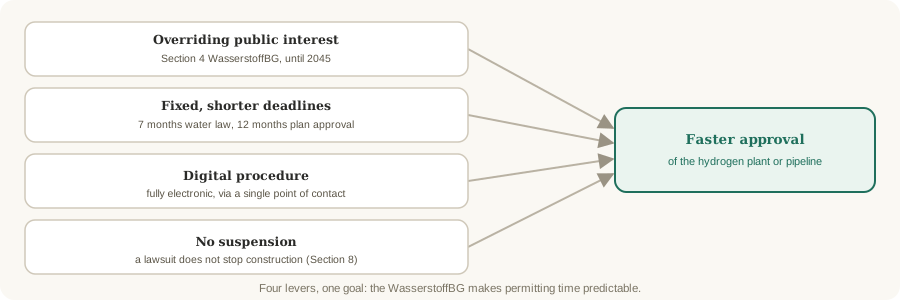
For the water-law permit and licence the act sets a decision deadline of seven months, extendable once by up to three months (section 11c WHG new). For the plan approval the deadline is seven months and for the plan determination twelve months, each extendable once (section 70b WHG new). These are hard statutory periods, not internal targets, and they cover precisely the procedures that used to be the slowest links in the chain: the water consent for cooling and the plan-determination procedure for a pipeline route.
Participation is tightened as well. The objection period in the emissions-control procedure under the BImSchG falls from one month to two weeks, and the discussion hearing can be dropped. The faster track shifts the burden onto objectors to react quickly and onto the authority to run a tight procedure, but it removes one of the classic sources of multi-month delay.
One precision matters more than any single number, because it cuts against a widespread assumption. The WasserstoffBG contains no deemed approval, no Genehmigungsfiktion, on deadline expiry. A plant is not automatically deemed permitted if an authority overruns its deadline. The acceleration runs through fixed deadlines, digitalisation, shorter participation periods and the removal of the suspensory effect of lawsuits, not through an automatic approval when the clock runs out. Developers should plan around the statutory periods, not around an approval that the law does not grant.
Digitalisation and a single point of contact: the procedure goes electronic
Alongside the deadlines, the act forces the procedures into electronic form and bundles them in one place. This is the operative lever in the daily work of the authorities, because it removes the paper handling and the parallel filing that quietly consumed weeks in every procedure. The environmental impact assessment documents must be submitted exclusively electronically (section 5 WasserstoffBG), and the procedure runs fully electronically including public participation (section 16c BImSchG new).

The procedure is handled via a single point of contact that bundles and coordinates it. Instead of an applicant chasing several authorities in parallel, one body channels the procedure, which shortens the coordination overhead and gives the developer a single counterpart for the whole permit. That single point of contact is also where the statutory deadlines and the electronic procedure come together in practice: it is the place that has to run the clock and the digital file.
It is important to place digitalisation correctly. It is mandatory, but it is only one of four levers, alongside the overriding public interest, the fixed deadlines and the removal of the suspensory effect of lawsuits. The act does not make digitalisation an end in itself: it uses electronic procedures to make the other three levers bite, by stripping out the manual handling that would otherwise eat into the fixed deadlines.
For authorities and applicants alike the practical consequence is immediate. Both sides have to move their processes to purely electronic submission and participation, and that takes preparation now, before the next application is filed. An organisation still set up for paper files will struggle to meet a seven-month deadline in a fully electronic procedure, so the readiness to file and to process electronically becomes part of the project schedule rather than an afterthought.
Immediate enforceability, legal recourse and what developers should do
The act also reaches into legal protection, to take the braking effect out of lawsuits. Section 8 of the WasserstoffBG removes the suspensory effect of objections and actions by third parties against approval decisions: immediate enforceability applies by force of law, so construction can begin even while a lawsuit is pending. An urgent application under section 80(5) VwGO has to be filed within one month, which keeps the dispute focused and time-bound rather than open-ended.
For larger projects the act also moves first-instance jurisdiction up to the higher administrative courts (sections 48, 50 VwGO), shortening the chain of instances. A challenge that would once have started at the administrative court and worked its way up now begins higher, so a final decision is reached sooner. Together with the removed suspensory effect, this is designed to ensure that litigation no longer dictates the construction timetable.
None of this is abstract regulation. For a developer it is a hard set of dates and rights that belong in the project plan today rather than in a legal memo for later. The points below turn the act into a near-term action list.
- Plan actively around the fixed deadlines. Developers should build the seven and twelve-month statutory periods, with their single extension, into the investment timetable, and remember there is no deemed approval to fall back on if a deadline slips.
- File complete and electronic from the start. Prepare the environmental impact assessment documents and the whole application for exclusively electronic submission via the single point of contact, because an incomplete or paper-based filing forfeits the speed the act offers.
- Use the overriding public interest in the balancing. Argue the project's case explicitly against section 4, so that the statutory weight in favour of hydrogen is brought to bear in the permitting and in any litigation, while still meeting the substantive protection standards.
- Keep the cluster cleanly separated. The WasserstoffBG accelerates permitting, WaKandA books the capacity, WANDA carries the financing, and the EnWG amendment sets the regulatory framework. Treat each on its own track so none of the four is missed in the project plan.
Further reading
Frequently asked questions
The Hydrogen Acceleration Act, official short name WasserstoffBG, has been in force since 2 April 2026. It was published in the Federal Law Gazette, BGBl. 2026 I No. 84 of 1 April 2026, and was signed on 29 March 2026. The procedural path ran from the cabinet decision on 1 October 2025 through the Bundesrat opinion on 10 December 2025 to adoption by the Bundestag on 26 February 2026. This is a key difference from the neighbouring EnWG amendment, which is still in procedure: the WasserstoffBG is already applicable law.
Under section 2 the scope covers the whole hydrogen supply chain: onshore and offshore electrolysers, hydrogen storage, import terminals for hydrogen and derivatives such as ammonia and methanol, hydrogen pipelines together with their ancillary installations, and plants for synthetic fuels (power-to-liquid). In the parliamentary procedure the scope was extended beyond green hydrogen to low-carbon hydrogen. Storage caverns are covered only as one permitting subject among several; their own pilot and acceleration questions are a separate topic.
Section 4 places the construction and operation of the covered plants and pipelines in the overriding public interest, in German the "ueberragendes oeffentliches Interesse", and in the interest of public safety until climate neutrality is reached in 2045. The designation works as a weighting directive: hydrogen interests carry particular weight in permitting and court decisions, comparable to the status of renewable energy under section 2 EEG. The protected interests remain in place, for example public drinking-water supply under water law, but in case of doubt the balancing tips in favour of the project. It is a better hand in the weighting, not a free pass against substantive protection requirements.
The act replaces open processing times with statutory decision deadlines. The water-law permit and licence must be decided within seven months, extendable once by up to three months (section 11c WHG). The plan approval has a deadline of seven months and the plan determination twelve months, each extendable once (section 70b WHG). The objection period in the BImSchG procedure is cut from one month to two weeks, and the discussion hearing may be dropped. For the first time the permitting time becomes plannable.
No. The WasserstoffBG contains no deemed-approval mechanism, in German no Genehmigungsfiktion. This is an important correction against a common assumption: a plant is not automatically deemed approved if an authority overruns a deadline. The acceleration runs through fixed deadlines, mandatory digitalisation, shorter participation periods and the removal of the suspensory effect of lawsuits, not through an automatic approval when a deadline expires.