The EU Hydrogen Bank: the fixed-premium auctions and, for the first time, low-carbon hydrogen
This is a practical analysis of the production-support auction, not a treatise on certification or quota law. It sets out how the fixed-premium model works through ranking and pay-as-bid, what the pilot auction revealed about how low the premium can go, how the second auction IF24 is structured with its maritime topic, what changed with the third auction IF25 and its low-carbon line, and how the Auctions-as-a-Service lever adds national budgets on top. The neighbouring topics sit close by and are linked, not repeated. Note: RFNBO certification, the entry ticket a project must hold to bid at all, is handled in the separate piece on RFNBO certification; this article keeps the production auction and the low-carbon opening as its subject.
The EU Hydrogen Bank is the central EU instrument for hydrogen production support: a competitive auction run by the executive agency CINEA and funded from the Innovation Fund (EU ETS revenues). The award is not an investment grant but a fixed premium per kilogram, paid for up to 10 years on every produced and certified kilogram; producers bid the premium they need and the cheapest bids win (pay as bid). The pilot auction (IF23) was decided on 30 April 2024: about EUR 720 million for 7 projects, bids EUR 0.37 to 0.48 per kilogram against a EUR 4.5 ceiling, in Spain, Portugal, Norway and Finland; Germany was the first Auctions-as-a-Service state, adding EUR 350 million. The second auction (IF24) ran from 3 December 2024 to 20 February 2025 with EUR 1.2 billion including a dedicated EUR 200 million maritime topic, 61 bids from 11 countries, about four times oversubscribed; results on 20 May 2025: 15 projects, EUR 992 million, bids EUR 0.20 to 0.60 per kilogram in the general topic and EUR 0.45 to 1.88 per kilogram in the maritime topic; the ceiling was lowered to EUR 3.5 per kilogram, commissioning shortened to 3 years and the completion guarantee raised to 10 percent. The third auction (IF25) ran from 4 December 2025 to 19 February 2026 with EUR 1.3 billion in three topics (RFNBO EUR 600 million, RFNBO and low-carbon EUR 400 million, maritime and aviation EUR 300 million) and, for the first time, opened to low-carbon electrolytic hydrogen with at least a 70 percent lifecycle greenhouse-gas reduction, not blue reformer hydrogen, sharing the EUR 400 million Topic 2 with RFNBO rather than receiving a separate full budget; results on 7 May 2026: 9 projects from 7 countries, EUR 1.09 billion, about 1.1 GW, bids EUR 0.44 to 3.49 per kilogram, low-carbon winners Cloudberry (Finland, EUR 0.44 per kilogram) and Lotse (Germany), with Topic 2 weakly subscribed at 5 bids. Auctions-as-a-Service lets member states top up qualified projects with national funds: IF24 Austria about EUR 400 million, Lithuania EUR 36 million, Spain; IF25 Germany about EUR 1.3 billion and Spain about EUR 415 million, lifting IF25 to about EUR 3 billion. RFNBO certification is a precondition. The EU Hydrogen Bank (EU-wide, fixed premium, domestic production) is distinct from H2Global (German, double auction, import).
The EU Hydrogen Bank: the fixed-premium auction for domestic hydrogen production
The EU Hydrogen Bank is the lever the EU uses to get domestic hydrogen production off the ground, and it does so by paying for output rather than buildings. It is a competitive auction, put into practice by the executive agency CINEA and funded from the Innovation Fund, which draws on the revenues of the EU emissions-trading system. The award is deliberately not an investment grant: it is a fixed premium per kilogram of produced hydrogen. A producer therefore does not bid for a one-off capital subsidy but for an operating support that follows every kilogram it actually makes, which keeps the incentive pointed at production rather than at the construction of an asset that might never run.
The mechanism is straightforward in principle. Producers bid the premium per kilogram they need on top of the market price, the cheapest bids win, and winners are paid that premium for up to 10 years on every kilogram they produce and certify. That single design choice, a fixed per-kilogram premium awarded by competitive bidding, is what makes the Hydrogen Bank readable as a market and price instrument: it produces an EU-wide price signal for what domestic hydrogen production actually costs, expressed in euro per kilogram, round after round.
The audiences sit on the production side of the market. Hydrogen producers and project developers decide which round and topic to enter and at what bid level; industry and utilities planning their own electrolysis weigh the premium against their cost of production; and member states decide whether to add national funds on top through Auctions-as-a-Service. With the second auction IF24 the budget reached EUR 1.2 billion with a dedicated maritime topic, and with the third auction IF25 it reached EUR 1.3 billion and opened, for the first time, to low-carbon electrolytic hydrogen alongside renewable RFNBO hydrogen.
It is worth drawing the line to the neighbouring instrument early. The EU Hydrogen Bank is an EU-wide, one-sided fixed premium for domestic EU production. H2Global is a German double auction that builds an import bridge, signing long-term purchase agreements abroad and reselling through short-term sales auctions, and bridging the price gap with a contract for difference. The two complement each other, but they are different instruments with different designs, and a producer that operates on both sides should treat them as such rather than as interchangeable.
The fixed-premium model: bid, rank, award, pay for ten years
At the core of the Hydrogen Bank is a pay-as-bid process built from four steps. Each producer bids a single price per kilogram, the premium it needs in addition to the market price, capped by a ceiling price, EUR 4.5 per kilogram in the pilot and EUR 3.5 per kilogram from IF24 onward. The ceiling sets the outer limit of what the public budget is willing to pay per kilogram; below it, the bid is the producer's own estimate of the gap between its cost of production and the price it can realise on the market.
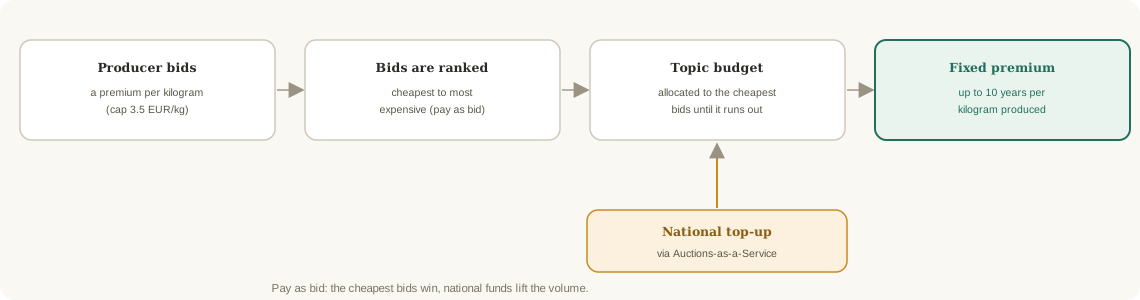
The Commission then ranks all bids from cheapest to most expensive and allocates the topic budget to the lowest bids first, working up the list until the budget is exhausted. Because the cheapest bids win, the instrument rewards producers that can deliver hydrogen at the lowest additional cost, and the marginal bid that just fits inside the budget effectively sets the cut-off for the round. This ranking is what turns a pot of money into a competitive price discovery rather than a queue of equal grants.
Winners receive their bid premium, without indexation, for up to 10 years on every verified and certified kilogram produced. The premium is fixed at the bid level for the whole support period, so a producer carries the risk that its own costs move over the decade while the premium does not. That fixed, output-linked payment is the heart of the model: support flows only against kilograms that are actually made and certified, not against promises.
Firm conditions secure the build-out behind the bids. From IF24 a completion guarantee of 10 percent backs the commitment, and commissioning must follow within 3 years of the award rather than the 5 years allowed in the pilot. These tightened obligations are there to filter out projects that bid low to win and then fail to deliver, and they are the reason the bid level alone does not decide whether a project is realistic. A separate, downstream node sits alongside the four steps: a national top-up through Auctions-as-a-Service, which can fund a qualified project that ranked just outside the EU budget.
The pilot auction as a reference: EUR 720 million, bids from EUR 0.37 per kilogram
The pilot auction delivered the first hard price signal for renewable hydrogen in the EU and showed just how low the premium can go. It opened in November 2023 and was decided on 30 April 2024. Seven projects shared about EUR 720 million, with bids between EUR 0.37 and 0.48 per kilogram, far below the ceiling of EUR 4.5 per kilogram. That gap between the bids and the cap is the headline of the pilot: producers asked for a fraction of what the budget was prepared to pay, which is the clearest evidence that competitive bidding squeezes the premium hard.
The geography and volumes fill in the picture. The winning projects sat in Spain (3), Portugal (2), Norway (1) and Finland (1), with planned production of 1.58 million tonnes of renewable hydrogen over 10 years. The spread across the Iberian Peninsula and the Nordics tracks where cheap renewable power and electrolysis projects were furthest advanced, and the per-kilogram bids in those locations are the reference point against which every later round is read.
The pilot also introduced the lever that later rounds leaned on heavily. Germany was the first member state to use Auctions-as-a-Service, adding EUR 350 million of national funds on top of the EU budget to support qualified projects that did not secure an Innovation Fund award. That single move, one bid feeding two funding sources, is the template that Austria, Lithuania and Spain then followed in the second auction and that Germany and Spain scaled up again in the third. The pilot, in other words, set both the price benchmark and the funding pattern for everything after it.
The second auction IF24: EUR 1.2 billion and a dedicated maritime topic
The second auction scaled the budget and, for the first time, carved out a dedicated topic for hard-to-electrify shipping. It launched on 3 December 2024 and closed on 20 February 2025 with a budget of EUR 1.2 billion from the Innovation Fund, of which EUR 200 million was ring-fenced as a maritime topic. The maritime carve-out is the structural novelty of IF24: rather than letting shipping projects compete head-on with general renewable hydrogen, the EU gave them their own pot, recognising that the cost of decarbonising maritime fuel sits at a different level.
Demand outran the budget by a wide margin. The auction drew 61 bids from 11 countries, with the requested volume roughly four times the available budget, so the round was about four times oversubscribed. That oversubscription is itself a signal: by the second round, the pipeline of certifiable renewable hydrogen projects in the EU had grown well beyond what a single round could fund, which is precisely the condition that makes national top-ups attractive.
The results on 20 May 2025 awarded 15 projects a combined EUR 992 million. Bids ran from EUR 0.20 to 0.60 per kilogram in the general topic, lower at the bottom end than the pilot, and from EUR 0.45 to 1.88 per kilogram in the maritime topic, where the higher range reflects the steeper cost of maritime-grade supply. The contrast between the two ranges is the clearest demonstration of why the maritime topic was separated out: a head-to-head auction would have left those projects unfunded against cheaper general bids.
IF24 also tightened the obligations behind the bids. The ceiling price fell from EUR 4.5 to EUR 3.5 per kilogram, the commissioning deadline went from 5 to 3 years, and the completion guarantee rose from 4 to 10 percent. Together these changes raise the bar for a credible bid: a producer now has to be ready to build faster and to back its commitment with a larger guarantee, which is meant to ensure that the awarded budget translates into hydrogen on the ground rather than into lapsed awards. RFNBO compliance remains the entry ticket, covered in the separate piece on RFNBO certification and mass balancing.
The third auction IF25: EUR 1.3 billion and, for the first time, low-carbon hydrogen
The third auction opened, for the first time, to low-carbon electrolytic hydrogen alongside renewable RFNBO hydrogen, though within the same pot rather than as a separate full budget. IF25 launched on 4 December 2025 and closed on 19 February 2026 with a budget of EUR 1.3 billion from EU ETS revenues, split into three topics: RFNBO with EUR 600 million, RFNBO and low-carbon electrolytic hydrogen sharing EUR 400 million, and a maritime and aviation topic of EUR 300 million. A frequent misreading is worth correcting: the EUR 1.1 billion figure quoted in earlier coverage was an early planning number, and the round that actually launched carried EUR 1.3 billion.

The low-carbon line needs to be read precisely. It is explicitly low-carbon electrolytic hydrogen, not blue reformer hydrogen made from natural gas with carbon capture, and it must demonstrate at least a 70 percent lifecycle greenhouse-gas reduction against the fossil comparator. It does not receive a budget of its own: it shares the EUR 400 million Topic 2 with RFNBO. The opening is therefore a real policy shift, in line with the Clean Industrial Deal, but a measured one, since low-carbon hydrogen competes for a slice of one topic rather than commanding a dedicated pot.
The results on 7 May 2026 awarded 9 projects from 7 countries a combined EUR 1.09 billion, about 1.1 GW of electrolysis and more than 1.3 million tonnes of hydrogen over the first 10 years, with bids of EUR 0.44 to 3.49 per kilogram. In the low-carbon Topic 2 two projects prevailed: Cloudberry (Finland, 500 MW, EUR 0.44 per kilogram, the lowest bid of the entire round) and Lotse (Germany, 120 MW, about EUR 1.10 per kilogram). The fact that the cheapest bid of the round came from a low-carbon project is notable in its own right.
The topic-level demand tells the more cautious story. Topic 2 drew only 5 bids worth over EUR 800 million, far weaker than the RFNBO Topic 1, which attracted 50 bids worth EUR 7.3 billion. The first low-carbon opening, in other words, met a thin field rather than a rush, which suggests that for now the renewable RFNBO route remains the centre of gravity and that the low-carbon line is an option being tested rather than a flood of new supply. The volumes awarded here will in turn feed the downstream off-take market addressed by the RFNBO sub-quota in the GHG quota.
What producers and project developers should do now
The EU Hydrogen Bank is established, the Auctions-as-a-Service lever can roughly double the volume of a round, and the next round will follow, so anyone who intends to bid has to fix the topic, the bid level and the deadlines now rather than later. For producers and developers the questions are concrete: which topic and region to enter, how to calibrate the bid against the strike prices seen so far, whether the project qualifies as renewable RFNBO or, if electrolytic and below the threshold, as low-carbon, and whether a national top-up is available on top of the EU budget.

The dividing line between the EU Hydrogen Bank and H2Global runs through the strategy of any producer that operates on both sides. The EU Hydrogen Bank is an EU-wide instrument that pays a one-sided fixed premium per kilogram for domestic EU production through the Innovation Fund; H2Global is a German double auction that builds an import bridge through long-term purchase and short-term sales agreements and bridges the price gap with a contract for difference. The two complement each other, but they have different designs, and a project should be matched to the instrument that fits it rather than treated as eligible for both interchangeably.
The points below turn the auction mechanics into a near-term action list for producers and project developers.
- Pick the topic and region, then calibrate the bid. Decide whether the project is renewable RFNBO or, if electrolytic and below the 70 percent threshold, eligible for the low-carbon topic, and set the bid level against the strike prices seen so far, from EUR 0.37 per kilogram in the pilot up to the round ceiling of EUR 3.5 per kilogram.
- Check the national Auctions-as-a-Service lever. One bid can draw on two funding sources, the EU Innovation Fund plus a national top-up, so confirm whether your member state is adding budget for the next round; a top-up markedly raises the chance of an award for a qualified project that ranks just outside the EU pot.
- Secure the delivery obligations early. Plan for the 10 percent completion guarantee and commissioning within 3 years of the award, and treat RFNBO certification as the precondition for bidding at all, since support is paid only on certified kilograms.
- Keep the EU Hydrogen Bank and H2Global apart in the funding strategy. Use the EU Hydrogen Bank as a fixed-premium subsidy for domestic EU production and H2Global for importing through the double auction, and decide deliberately which one fits each project; for the supporting infrastructure, see the H2 core network.
Further reading
Frequently asked questions
The EU Hydrogen Bank is the central EU instrument for hydrogen production support. It is a competitive auction run by the executive agency CINEA and funded from the Innovation Fund, which is fed by EU ETS emissions-trading revenues. Instead of an investment grant, it awards a fixed premium per kilogram of produced hydrogen: producers bid the premium they need on top of the market price, the cheapest bids win, and winners are paid that premium for up to 10 years on every produced and certified kilogram. It supports domestic EU and EEA production. With the second auction (IF24) the budget rose to EUR 1.2 billion with a dedicated maritime topic, and with the third auction (IF25) to EUR 1.3 billion, opening for the first time to low-carbon electrolytic hydrogen.
The auction is a pay-as-bid process. Each producer bids the price per kilogram it needs in addition to the market price, capped by a ceiling price (EUR 4.5 per kilogram in the pilot, EUR 3.5 per kilogram from IF24). The Commission ranks all bids from cheapest to most expensive and allocates the topic budget to the lowest bids until it is exhausted. Winners then receive their bid premium, without indexation, for up to 10 years on every verified and certified kilogram produced. Firm delivery conditions secure the build-out: from IF24 a 10 percent completion guarantee and commissioning within 3 years of the award.
The second auction ran from 3 December 2024 to 20 February 2025 with a budget of EUR 1.2 billion from the Innovation Fund, including for the first time a dedicated EUR 200 million maritime topic for hard-to-electrify shipping. It drew 61 bids from 11 countries, about four times oversubscribed. The results on 20 May 2025 awarded 15 projects a combined EUR 992 million, with bids of EUR 0.20 to 0.60 per kilogram in the general topic and EUR 0.45 to 1.88 per kilogram in the maritime topic. IF24 also tightened the conditions: the ceiling price fell from EUR 4.5 to EUR 3.5 per kilogram, the commissioning deadline went from 5 to 3 years, and the completion guarantee rose from 4 to 10 percent.
The third auction ran from 4 December 2025 to 19 February 2026 with a budget of EUR 1.3 billion from EU ETS revenues, split into three topics: RFNBO EUR 600 million, RFNBO and low-carbon electrolytic hydrogen EUR 400 million, and maritime and aviation EUR 300 million. For the first time the EU opened to low-carbon electrolytic hydrogen, which must demonstrate at least a 70 percent lifecycle greenhouse-gas reduction against the fossil comparator. It is explicitly electrolytic, not blue reformer hydrogen from natural gas with CCS, and it shares the EUR 400 million Topic 2 with RFNBO rather than receiving a separate full budget. The results on 7 May 2026 awarded 9 projects from 7 countries a combined EUR 1.09 billion, about 1.1 GW of electrolysis, with bids of EUR 0.44 to 3.49 per kilogram; the low-carbon winners were Cloudberry (Finland, EUR 0.44 per kilogram) and Lotse (Germany), and Topic 2 was clearly less subscribed than RFNBO, with only 5 bids.
Auctions-as-a-Service lets member states award their own national funds, through the EU auction platform, to projects that qualify but miss an Innovation Fund award because the EU budget is exhausted, using a single bid and a simplified procedure. Germany was the pioneer, adding EUR 350 million in the pilot. For the second auction (IF24) Spain, Lithuania (EUR 36 million) and Austria (about EUR 400 million) took part. For the third auction (IF25) Germany again topped up, with about EUR 1.3 billion for RFNBO, and Spain with about EUR 415 million, which lifted the total volume of the round, including national top-ups, to about EUR 3 billion.