H2Global: the second auction 2025 and EEX as the trading platform for H2 derivatives
This is a practical analysis of the import and trading instrument, not a treatise on certification or quota law. It sets out how the double auction works through HINT.CO's HPA and HSA contracts, what the pilot auction with Fertiglobe revealed about prices, how the second auction 2025 is structured into five lots with a German-Dutch budget, and what EEX actually does as the execution platform alongside its HYDRIX index and H2EX. The neighbouring topics sit close by and are linked, not repeated. Note: RFNBO certification, the entry ticket every imported molecule must hold, is handled in the separate piece on RFNBO certification; this article keeps the import auction and the trading platform as its subject.
H2Global is Germany's state-funded double-auction import instrument, run by the intermediary HINT.CO. On the supply side HINT.CO signs long-term purchase agreements (HPA, fixed price, up to about 10 years) with producers abroad; on the demand side it resells the same volumes through short-term sales agreements (HSA) to European off-takers. Public funding bridges the difference, a contract-for-difference structure. The first, pilot auction (about EUR 900 million, three product lots: ammonia, methanol, e-SAF) was decided in July 2024: Fertiglobe (ADNOC/OCI) supplies green ammonia from Egypt Green Hydrogen at a delivered price of EUR 1,000 per tonne, net FOB about EUR 811 per tonne, maximum contract value EUR 397 million, deliveries from 2027 via Rotterdam; the e-SAF lot received no bids. The second auction launched on 19 and 20 February 2025 with a base budget of EUR 2.5 billion, approved up to EUR 3 billion under EU state aid rules, and for the first time co-funded by Germany and the Netherlands. It has five lots: four regional product-open lots (Africa, Asia, South America and Oceania, North America, at least EUR 484 million each, for green H2, ammonia or methanol) plus one global vector-open lot (at least EUR 567 million) for molecular H2 carried by any vector. Delivery must go to Germany or the Netherlands, RFNBO-compliant, with at least 73 percent greenhouse-gas saving and at least 5 MW of electrolysis. The request to participate was due by 12 September 2025, binding final bids are expected by March 2026, scoring 90 percent average price and 10 percent extra volume; results were not yet published as of mid-June 2026. EEX is the technical execution platform for the HSA sales auctions, after a letter of intent on 27 June 2023; the first HSA sales auction is expected in 2026, about 12 months before the first delivery in 2027. Separately, EEX has run the weekly HYDRIX index (EUR per MWh) since 24 May 2023 and is building H2EX and a spot market; in 2025 the BMWK chose HYDRIX as its CCfD reference. RFNBO certification is a precondition. H2Global (German, double auction, import bridge) is distinct from the EU Hydrogen Bank (EU-wide, fixed premium, domestic production).
H2Global and EEX: Germany's import instrument and its trading platform
H2Global is the lever Germany uses to organise the import of green hydrogen and its derivatives, and it does so by bridging a price gap that no private buyer would carry alone: the green molecule is expensive to produce abroad, while European demand will pay only a market price. H2Global is a state-funded double-auction import instrument, put into practice by the state-owned intermediary HINT.CO, the Hydrogen Intermediary Company. HINT.CO buys the molecule cheaply for the buyer and expensively for the producer at the same time, and public funding closes the resulting difference. That single mechanism is what turns an otherwise uneconomic import into a bankable contract for both sides of the market.
The second auction 2025 is where the model stops being a pilot and becomes a scaled instrument. It launched in February 2025 with a base budget of EUR 2.5 billion, approved under EU state aid rules to rise up to EUR 3 billion, and for the first time it is funded jointly by Germany, through the ministry then known as the BMWK and now the BMWE, and the Netherlands, through the KGG ministry. The pilot ran with about EUR 900 million and three product lots; the second auction multiplies the budget and reorganises the lots into a geographic structure, which is the structural change that matters most for anyone deciding whether and where to bid.
EEX, the European Energy Exchange, is the second piece of the architecture and is easily misdescribed. EEX is not primarily a free derivatives spot market for H2Global; it is the technical execution platform on which HINT.CO runs the sales auctions, the HSA side of the double auction. Alongside that role, but separate from it, EEX operates the weekly HYDRIX price index for green hydrogen and is building further trading instruments. Keeping the two apart matters: the auction execution serves H2Global directly, while HYDRIX and the emerging spot market are standalone transparency and trading offerings.
The audiences sit on three sides of the same market. Producers abroad decide whether and in which lot to bid, weighing a fixed price held for up to a decade against their own cost of production. Importers and off-takers from industry and the utilities decide whether to buy firm volumes at calculable prices through the HSA sales auctions. Traders watch EEX as the emerging price reference. For all three, the instrument, the second auction and the role of EEX are the practical questions, and they sit cleanly apart from the certification and quota strand and from the EU Hydrogen Bank.
The double auction: how HINT.CO bridges the price gap with HPA and HSA
The core of H2Global is a contract-for-difference structure built from two contracts that point in opposite directions. On the supply side HINT.CO signs a Hydrogen Purchase Agreement (HPA): a long-term, fixed-price contract with a term of up to about 10 years. That long horizon and fixed price are what give a producer abroad the off-take certainty it needs to finance an electrolyser and the export chain behind it, because the revenue is locked in regardless of how the spot market moves over the contract's life.
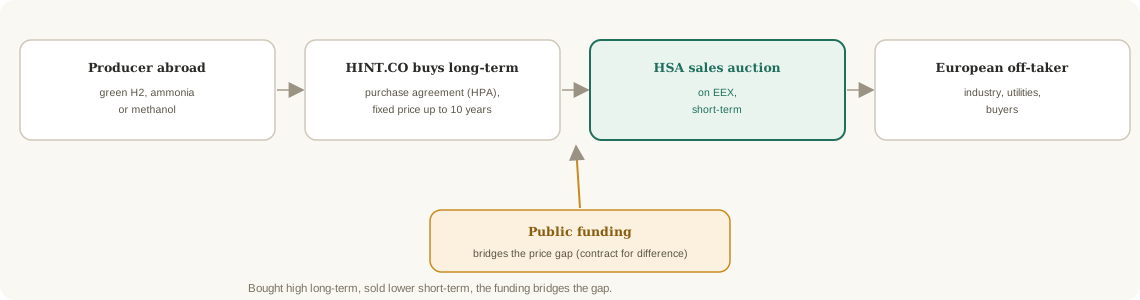
On the demand side HINT.CO resells the same volumes through a Hydrogen Sales Agreement (HSA): a short-term contract sold to European off-takers through a sales auction, with HINT.CO acting only as the intermediary rather than taking a market position of its own. The off-taker therefore gets firm volumes at a short-term market price, without having to commit for a decade, while the producer keeps its decade-long certainty. The intermediary stands between the two and never carries the commodity risk itself.
Public funding closes the gap between the two prices. Because the long-term purchase price under the HPA is high and the short-term sales price under the HSA is lower, a difference remains, and that difference is exactly what the public budget pays. This is the contract-for-difference logic: the subsidy is the spread between a high, financeable purchase price and a lower, market-clearing sales price, not a flat payment per unit. The size of the budget therefore caps how much of that spread the instrument can absorb across all the contracts it signs.
The result is a market that serves both sides at once. The producer gets a fixed off-take over up to 10 years, the off-taker gets calculable volumes at short-term prices, and the public purse carries the bridge in between. That is the design that lets imports of green hydrogen and its derivatives start before a liquid private market exists, and it is the same design that the second auction 2025 scales up and the first auction first tested in practice.
The first auction as a reference: Fertiglobe, ammonia from Egypt Green
The pilot auction delivered the first hard price signal and showed concretely what an award looks like, from the strike price through to delivery via Rotterdam. It ran with a budget of about EUR 900 million and was structured into three product lots: ammonia, methanol and e-SAF, the synthetic aviation fuel. That product-lot structure is the one the second auction later abandoned, which is why it is worth fixing here: the three product lots belong to the first auction, not the second.
The winner of the ammonia lot, decided in July 2024, was Fertiglobe, the producer backed by ADNOC and OCI, supplying green ammonia from Egypt Green Hydrogen. The headline figure was a delivered price of EUR 1,000 per tonne into Europe, which corresponds to a net FOB price of about EUR 811 per tonne once transport is stripped out. The maximum contract value runs to EUR 397 million, with deliveries from 2027 through the port of Rotterdam, after which the volumes are resold to European off-takers through the HSA sales auctions.
Two facts from the pilot are worth carrying into any reading of the second auction. The first is that the strike price was real and high: EUR 1,000 per tonne delivered is the order of magnitude that the public budget has to bridge against a much lower European market price. The second is that the e-SAF lot received no bids at all, which is why e-SAF was not put out again in the second auction. The absence of bids on the synthetic aviation fuel lot is a signal in its own right about which derivatives were ready to compete and which were not.
The second auction 2025: five lots, up to EUR 3 billion, German-Dutch
The second auction changes the structure fundamentally: not product lots any more, but geographic lots, with a larger budget and for the first time a shared pot with the Netherlands. It has five lots in total. Four of them are regional and product-open: Africa, Asia, South America and Oceania, and North America, each backed by at least EUR 484 million, and each open to green hydrogen, ammonia or methanol so that bidders can choose the derivative that fits their project rather than the lot dictating it.

The fifth lot is global and vector-open, backed by at least EUR 567 million. It targets molecular hydrogen carried by any vector, for example ammonia or a liquid organic hydrogen carrier, that is converted back to H2 before delivery. This global lot is the one that carries the new German-Dutch joint funding: Germany and the Netherlands fund it together, which is the first time two states have pooled budget inside a single H2Global auction. The split between four regional lots and one global lot is the structural signature of the second auction.
The eligibility conditions are firm. Delivery must go to Germany or the Netherlands, the hydrogen must be RFNBO-compliant with at least 73 percent greenhouse-gas saving, and the underlying project must run at least 5 MW of electrolysis. The RFNBO compliance is a precondition rather than a detail: only certified molecules can be delivered into the instrument, which is why the upstream certification, covered in the separate piece on RFNBO certification and mass balancing, is the entry ticket to bidding at all.
The timeline and scoring are settled even if the awards are not. The request to participate for the regional lots was due by 12 September 2025, and binding final bids are expected by March 2026. Bids are scored 90 percent on the volume-weighted average price and 10 percent on additional volume offered, so price dominates but extra capacity earns a margin. As of mid-June 2026 the awards and strike prices of the second auction had not yet been published; this remains an ongoing process rather than a closed result, and the imported volumes will in turn feed the downstream off-take market addressed by the RFNBO sub-quota in the GHG quota.
EEX as the execution platform: HSA sales auctions, HYDRIX and H2EX
EEX is not a free derivatives market for H2Global; it is the technical exchange through which HINT.CO runs its sales auctions, and it is at the same time the source of an emerging price reference. EEX and HINT.CO signed a letter of intent on 27 June 2023, and on that basis EEX built the platform that technically executes the HSA sales auctions for hydrogen and its derivatives, ammonia, methanol and aviation fuel, as standardised products with annual delivery. The exchange supplies the auction machinery; HINT.CO remains the intermediary that decides what is sold.

The first HSA sales auction is expected in 2026, the resale of the pilot ammonia, about 12 months before the first delivery in 2027. That sequence matters for off-takers: the sales auction on EEX is where they can secure firm volumes at a short-term price, roughly a year ahead of physical delivery, and it is the moment at which the demand side of the double auction actually clears. Until that first sales auction runs, the demand side remains a design on paper; from 2026 it becomes a live procurement channel.
Separate from the auction role, EEX runs the HYDRIX price index, which it has published weekly, every Wednesday, in euro per megawatt-hour since 24 May 2023. HYDRIX is a transparency instrument rather than a trading venue, and it has gained policy weight: in 2025 the BMWK chose HYDRIX as the reference for its Carbon Contracts for Difference, which turns the index into a funding-policy benchmark and not only a market signal. The index and the auction execution are two distinct functions that happen to sit under the same exchange.
Beyond HYDRIX, EEX is building H2EX, a browser-based trading platform, together with a spot market run over its gas trading system. These are the elements that, over time, could turn EEX from an auction executor and index provider into a fuller hydrogen exchange. For now the distinction holds: the HSA execution serves H2Global directly, while HYDRIX, H2EX and the spot market are EEX's own standalone market-transparency and trading offerings that producers, importers and traders will watch as the price reference firms up.
What importers, producers and off-takers should do now
The instrument is live, the second auction is in its final-bid phase and the first HSA sales auctions are imminent, so all three sides of the market have to fix their position now rather than later. For producers abroad the question is which lot and region to bid into; for importers and off-takers it is how to prepare for the HSA sales auctions on EEX; and for everyone the RFNBO certification is the precondition that has to be in place before any of it counts. None of this is abstract: it is a concrete set of choices that belong in the plan today.
The dividing line between H2Global and the EU Hydrogen Bank runs through the strategy of any producer that operates on both sides. H2Global is a German double auction that builds an import bridge through HPA and HSA contracts and is aimed at importing from third countries and within the EU; the EU Hydrogen Bank is an EU-wide instrument that pays a fixed premium per kilogram for domestic EU production through the Innovation Fund. The two complement each other, but they have different designs, and a producer should decide deliberately which one fits a given project rather than treating them as interchangeable.
The points below turn the auction mechanics into a near-term action list for all three sides of the market.
- Producers: choose the lot and region and price the 10-year fixed contract. Producers abroad should match their project to a regional or the global lot, calculate the fixed price they can hold for up to 10 years against their cost of production, and lock in RFNBO compliance and at least 73 percent greenhouse-gas saving at the point of delivery.
- Importers and off-takers: prepare for the HSA sales auctions on EEX. Importers and off-takers should get ready to bid in the HSA sales auctions executed on EEX, expected from 2026, and benchmark the short-term purchase price they would secure there against alternative sourcing.
- Secure RFNBO certification as the precondition for any delivery. H2Global hydrogen has to be delivered RFNBO-certified, so RFNBO certification is the precondition for participating at all; without it the molecule cannot be counted toward the instrument or its downstream off-take.
- Separate H2Global from the EU Hydrogen Bank in the funding strategy. Keep the two instruments apart in planning: H2Global for importing through the double auction, the EU Hydrogen Bank as a fixed-premium subsidy for domestic EU production, and decide deliberately which one fits each project.
Further reading
Frequently asked questions
H2Global is Germany's state-funded double-auction import instrument for green hydrogen and its derivatives, run by the intermediary HINT.CO. On the supply side HINT.CO signs long-term purchase agreements (HPA, fixed price, up to about 10 years) with producers abroad; on the demand side it resells the same volumes through short-term sales agreements (HSA) to European off-takers. Public funding bridges the difference between the high long-term purchase price and the lower short-term sales price, a contract-for-difference structure. With the second auction 2025 the model scaled from a pilot with three product lots to five lots and a budget of up to EUR 3 billion, for the first time co-funded with the Netherlands.
The double auction has two sides. On the supply side HINT.CO signs a Hydrogen Purchase Agreement (HPA): a long-term, fixed-price contract with a term of up to about 10 years that gives the producer abroad off-take certainty. On the demand side HINT.CO resells the same volumes through a Hydrogen Sales Agreement (HSA): a short-term contract sold to European off-takers via a sales auction, with HINT.CO acting only as the intermediary. Because the long-term purchase price is high and the short-term sales price is lower, public funding bridges the difference. That gap is the contract-for-difference and is what H2Global pays out.
The second auction launched on 19 and 20 February 2025 and changes the structure. Instead of three product lots, it has five lots: four regional product-open lots (Africa, Asia, South America and Oceania, North America, at least EUR 484 million each, for green H2, ammonia or methanol) plus one global vector-open lot (at least EUR 567 million) for molecular H2 carried by any vector. The base budget is EUR 2.5 billion, approved up to EUR 3 billion under EU state aid rules, and for the first time it is co-funded by Germany and the Netherlands. Delivery must go to Germany or the Netherlands, RFNBO-compliant with at least 73 percent greenhouse-gas saving and at least 5 MW of electrolysis. The request to participate was due by 12 September 2025 and binding final bids are expected by March 2026.
EEX is the technical execution platform for the HSA sales auctions, not primarily a free derivatives spot market for H2Global. EEX and HINT.CO signed a letter of intent on 27 June 2023, and EEX built the platform that technically runs the sales auctions for hydrogen and its derivatives (ammonia, methanol, aviation fuel). The first HSA sales auction is expected in 2026, about 12 months before the first delivery in 2027. Separately, EEX has run the weekly HYDRIX price index (EUR per MWh) since 24 May 2023 and is building H2EX and a spot market; in 2025 the BMWK chose HYDRIX as the reference for its Carbon Contracts for Difference.
They are two different instruments. H2Global is a German instrument, a double auction that builds an import bridge through HINT.CO's HPA and HSA contracts and bridges the price gap with a contract for difference, aimed at importing hydrogen from third countries and within the EU. The EU Hydrogen Bank is an EU-wide instrument that pays a fixed premium per kilogram for domestic EU production through the Innovation Fund. H2Global is a double-auction import bridge; the Hydrogen Bank is a fixed-premium subsidy for domestic production. The two complement each other, but their auction design, bid prices and budgets are separate topics.