RFNBO certification: mass balancing as the market-access condition for renewable hydrogen
This is a practical analysis of the RFNBO certification mechanism itself, not a treatise on EU sustainability law as such. It sets out RFNBO as the proof of sustainability and market-access condition, the two delegated acts that define when electricity counts as renewable, the 70 percent greenhouse-gas threshold, mass balance as the mandatory chain of custody, the recognised schemes and the German register at the UBA plus the EU Union Database, together with what producers and offtakers should do now. The neighbouring topics sit close by and are linked, not repeated. Note: the guarantee of origin, the book-and-claim counterpart, is the main delimitation; this piece keeps RFNBO certification, the sustainability proof, as the subject and the guarantee of origin only as the contrast.
RFNBO certification is the hard entry ticket for renewable hydrogen: without it, hydrogen cannot be sold as renewable, funded or credited against the EU targets. RFNBO stands for Renewable Fuels of Non-Biological Origin, the EU-law term for renewable hydrogen and its derivatives such as ammonia and methanol, and certification is the precondition for issuing the proofs of sustainability that every EU market mechanism requires. The test criteria come from two EU delegated acts of 10 February 2023, in force since 10 July 2023: Commission Delegated Regulation (EU) 2023/1184 defines through additionality and temporal and geographic correlation when the electricity used counts as renewable, while (EU) 2023/1185 sets the greenhouse-gas methodology with a minimum 70 percent saving against the fossil comparator of 94 gCO2eq/MJ, about 3.4 kg CO2e per kg of hydrogen. Temporal correlation is monthly until 31 December 2029 and hourly from 1 January 2030; geographic correlation requires the same bidding zone; additionality runs through the 36-month rule, with an exemption until 1 January 2038 for electrolysers operational before 1 January 2028. Under RED III Article 30 mass balance is the mandatory chain-of-custody model, and book-and-claim is not permitted, the hard difference from a guarantee of origin. Compliance is proven through voluntary schemes recognised by the Commission, the first three on 19 December 2024: ISCC EU, REDcert and the CertifHy EU RFNBO Scheme. The operative German RFNBO register for transport is run by the Umweltbundesamt (UBA) under the 37th BImSchV, alongside entry into the EU Union Database; the dena is a coordinator and exchange forum, not the register operator, and Nabisy, run by the BLE, is the biofuel system. The market started in 2025 with about 30 first certifications and Air Liquide as the first provider, and from 2030 at least 42 percent of industrial hydrogen must be RFNBO.
RFNBO certification: the hard entry ticket for renewable hydrogen
Renewable hydrogen does not sell itself as renewable. Before a single molecule may be sold under that name, funded or credited against a target, it has to be certified as an RFNBO. RFNBO stands for Renewable Fuels of Non-Biological Origin, in plain terms renewable fuels not made from biomass, and it is the EU-law term for renewable hydrogen and its derivatives such as ammonia and methanol. The certification is the proof of sustainability for that hydrogen, and it is the condition for getting into the market at all, not an optional badge of quality on top.
The reason certification weighs so heavily is that it gates every EU market mechanism for renewable hydrogen at once. A valid certificate is the precondition for issuing the proof of sustainability, in EU terms the proof of sustainability or sustainability documentation, and that document is what every downstream mechanism wants to see. Anyone who was not certified in 2025 could neither draw down a Hydrogen Bank award nor credit a molecule against the RED III industry targets. The certificate is the gate, and the funding, the quota and the supply contracts all sit behind it.
It is worth fixing the one delimitation that runs through this whole article. The guarantee of origin for gas and hydrogen proves marketing under the book-and-claim principle, where the green attribute is detached from the molecule and traded freely. RFNBO certification proves sustainability under mass balance, where the attribute stays physically attached to the molecule along the supply chain. They are opposite instruments: the guarantee of origin is marketing and book-and-claim, RFNBO is sustainability and mass balance. This piece makes RFNBO certification the subject and uses the guarantee of origin only as the contrast.
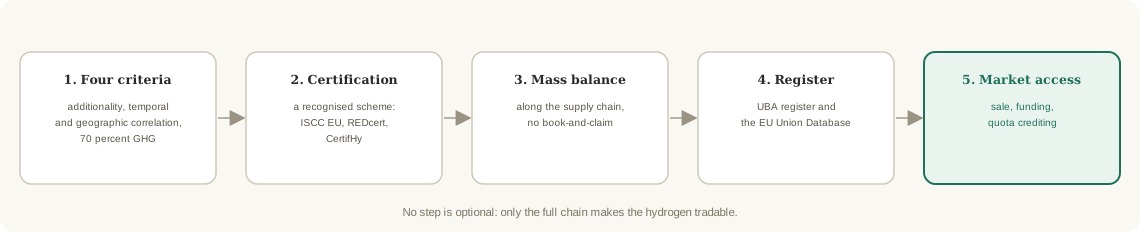
The rest of this article follows the chain shown above. First the four criteria of the two delegated acts decide whether the electricity and the carbon balance qualify. Then a recognised scheme certifies the plant, mass balance tracks the compliant hydrogen along the supply chain, and the documentation is entered into the register and the EU Union Database. Only at the end of that chain does market access follow: the right to sell as renewable, to receive funding and to be credited against a quota.
The two delegated acts: when electricity counts as renewable
The heart of the RFNBO definition sits in two EU delegated acts. Both are Commission Delegated Regulations of 10 February 2023, published in the Official Journal on 20 June 2023 and in force since 10 July 2023, twenty days after publication. Commission Delegated Regulation (EU) 2023/1184 is the first delegated act and answers a single question: when does the electricity fed into the electrolyser count as fully renewable. Commission Delegated Regulation (EU) 2023/1185 is the second delegated act and supplies the greenhouse-gas methodology, covered in the next section. Together they set the criteria that a plant has to satisfy before its hydrogen can be RFNBO at all.

The first test is additionality. The generation plant supplying the electricity may have come into operation at most 36 months before the electrolyser and must not have received operating or investment aid, so that the renewable hydrogen draws on genuinely new renewable capacity rather than crowding out existing demand. There is one important grace window: for electrolysers that go into operation before 1 January 2028, the additionality requirement is waived until 1 January 2038, a transitional exemption that gives the first wave of projects room to build out while new renewable capacity catches up.
The second test is temporal correlation, the requirement that the electricity is actually generated in the same period it is consumed. Until 31 December 2029 the matching is monthly, which is the looser regime of the ramp-up phase. From 1 January 2030 the matching becomes hourly, so each hour of electrolysis has to be backed by renewable generation in the same hour. That tightening is already on the horizon and it pushes producers towards storage, flexible operation and firmer renewable supply well before the date arrives.
The third test is geographic correlation: the generation and the electrolyser have to sit in the same bidding zone, so that the renewable electricity claimed could physically reach the plant over the grid rather than being notional. Taken together, additionality, temporal correlation and geographic correlation are the three pillars on which the renewable status of the electricity rests, and a plant that fails any one of them cannot have its hydrogen certified as RFNBO, however clean the rest of the chain may be.
The 70 percent threshold: the second delegated act on the GHG balance
The first delegated act decides whether the electricity is renewable, the second decides whether the hydrogen is clean enough. Commission Delegated Regulation (EU) 2023/1185, the second delegated act, sets the life-cycle greenhouse-gas methodology and the threshold the hydrogen has to clear. The requirement is a minimum 70 percent greenhouse-gas saving against the fossil comparator, which is fixed at 94 gCO2eq/MJ. In hydrogen terms that comes out at roughly 3.4 kg CO2 equivalent per kg of hydrogen across the whole life cycle.
The methodology is a life-cycle calculation, not a snapshot at the electrolyser gate. It captures every stage: the electricity generation, the conversion in the electrolyser, the compression, the transport and the storage. Emissions that arise anywhere along that path count against the saving, so a project cannot present a clean electrolyser and then ignore the carbon attached to moving and storing the molecule afterwards. The 70 percent has to be met on the full chain, measured against the same fossil comparator for every project.
Because the threshold is calculated over the whole life cycle, it feeds directly back into the plant design. The choice of electricity supply, the location, the efficiency of the electrolyser and the way the hydrogen is compressed, transported and stored all move the number, and a configuration that looks marginal on paper can fail the test in practice. The 70 percent is therefore not only a compliance hurdle at the end, it is a design constraint that shapes how the plant is built and operated from the outset.
The two delegated acts work as a pair. The first delegated act qualifies the input, the renewable electricity, through additionality and correlation, and the second delegated act qualifies the output, the carbon balance, through the 70 percent saving. A plant has to pass both: renewable electricity that nonetheless fails the greenhouse-gas balance is not RFNBO, and a strong carbon balance built on electricity that fails additionality or correlation is not RFNBO either. Only when both acts are satisfied does the hydrogen reach the certification stage.
Mass balance instead of book-and-claim: the mandatory chain of custody
Once a plant meets the criteria, the question becomes how the RFNBO property is carried down the supply chain to the buyer. Here RFNBO parts company sharply with the guarantee of origin. Under RED III Article 30, mass balance is the mandatory chain-of-custody model for RFNBO, and book-and-claim is not permitted. The sustainability attribute stays physically tracked along the supply chain rather than being detached from the molecule and traded on its own. That single rule is the hard difference between a sustainability proof and a marketing certificate.
Mass balance works as a running account of the molecule. It tracks generation, purchase, storage and sale, and it keeps RFNBO-compliant hydrogen separated in the books from non-compliant and from other hydrogen. Where compliant and non-compliant volumes are physically mixed, for example in shared storage, the RFNBO share is allocated arithmetically rather than guessed, and the inputs and outputs have to match at the end of each balancing period. The attribute can move with the molecule through the chain, but it can never exceed the volume that genuinely entered the account.
The contrast with book-and-claim is the whole point. In a book-and-claim system, of the kind that underpins the guarantee of origin for gas and hydrogen, the green attribute is split off from the physical hydrogen and can be bought and sold independently, so a buyer can hold the certificate without ever touching the molecule. RED III deliberately rules that out for RFNBO. The sustainability attribute and the molecule travel together, which is exactly why mass balance, and not book-and-claim, is the prescribed method.
For producers and traders this is an operational requirement, not a theoretical distinction. A mass-balance system has to be set up and audited, with the inflows, the storage and the outflows documented so that an auditor can reconstruct the RFNBO share at any point in the period. The same care that a producer puts into meeting the delegated acts has to extend into the bookkeeping of the chain of custody, because a sound molecule with a broken mass balance still cannot be sold as RFNBO.
Recognised certification schemes and the German register
Compliance with the criteria is not self-declared, it is proven through voluntary certification schemes recognised by the European Commission. The first three were recognised on 19 December 2024: ISCC EU, REDcert (by Implementing Decision 2024/3194) and the CertifHy EU RFNBO Scheme. Certification providers such as TUEV Rheinland certify on the basis of CertifHy. A plant has to hold a valid certificate under one of these recognised schemes before any proof of sustainability can be issued for its hydrogen, so the choice of scheme is one of the first decisions a producer makes.

The documentation does not stop at the certificate. The sustainability documentation and the certificates have to be entered into the EU Union Database, the EU-wide register for RFNBO, so that the proofs can be tracked and double counting prevented across the single market. The Union Database is the European backbone of the system, and entry into it is part of what turns a certified plant into hydrogen that can actually be credited and traded under EU rules.
The German side is where one common assumption needs correcting. The operative German RFNBO register for the transport sector is run by the Umweltbundesamt (UBA, Federal Environment Agency) as the competent authority under the 37th BImSchV, the German ordinance for electricity-based fuels. The UBA recognises and supervises the certification bodies and operates the register for electricity-based fuels. It is the UBA register, alongside the EU Union Database, that carries the operative German function, not a hydrogen register run elsewhere.
Two further bodies are easy to confuse with the register and should be placed correctly. The dena is a coordinator and exchange forum: on behalf of the BMWE, and together with the NOW GmbH, it organises the regular dialogue between ministries, authorities and private certification schemes, but it does not operate an RFNBO register or a mass-balance database. Nabisy, run by the BLE, is the established biofuel proof system, and although the dena and the BLE are working on an interface for automatic data matching, Nabisy is not the RFNBO hydrogen register. The correct picture is therefore the UBA register plus the EU Union Database, with the dena as coordinator and Nabisy as the biofuel system alongside.
Market access in practice: what producers and off-takers should do
The market has already started, which makes the certification chain a near-term task rather than a future one. In 2025 there were about 30 first certifications in Germany, with Air Liquide as the first provider: it sold RFNBO-certified renewable hydrogen, certified under ISCC EU on 2 April 2025, from its 20 MW PEM electrolyser in Oberhausen. That first wave is the practical proof that the system works end to end, from the delegated acts through the scheme to the register.
The pressure to certify only grows from here. RFNBO certification is the precondition for EU Hydrogen Bank awards and for crediting against the RED III industry targets, where from 2030 at least 42 percent of the hydrogen used in industry has to be RFNBO. Transport is a further offtake market with its own sub-quota, which is a separate topic in its own right, but the same logic applies: the certification is the precondition, and the quota crediting is the downstream use. With hourly temporal correlation arriving in 2030 as well, the producers that build the chain early are the ones that will be ready when the requirements tighten.
None of this is abstract. For producers and offtakers it is a concrete set of choices that belong in the project plan now. The points below turn the certification chain into a near-term action list.
- Choose a recognised scheme early. Producers should pick one of the recognised systems, ISCC EU, REDcert or CertifHy, at the start, because the scheme shapes the audit, the documentation and the route into the register.
- Secure electricity by additionality and correlation. Lock in an electricity supply that meets the 36-month additionality rule, the same bidding zone and the temporal correlation, with the hourly matching from 2030 already in view rather than as an afterthought.
- Build the mass balance from day one. Set up and audit the chain-of-custody bookkeeping so that the RFNBO share can be reconstructed at the end of every balancing period, because a sound molecule with a broken mass balance cannot be sold as RFNBO.
- Keep sustainability and marketing cleanly separated. RFNBO certification proves the sustainability, the guarantee of origin proves the marketing; offtakers and traders should run both strands connected but free of double marketing.
Further reading
Frequently asked questions
RFNBO stands for Renewable Fuels of Non-Biological Origin, the EU-law term for renewable hydrogen and its derivatives such as ammonia and methanol. RFNBO certification is the proof of sustainability for that hydrogen and the precondition for issuing the sustainability documentation that every EU market mechanism requires. Without certification, renewable hydrogen cannot be sold as renewable, funded or credited against the RED III targets.
The test criteria come from two EU delegated acts of 10 February 2023, in force since 10 July 2023. Commission Delegated Regulation (EU) 2023/1184 defines when the electricity used counts as renewable, through three tests: additionality (the generation plant operational at most 36 months before the electrolyser and without operating or investment aid, with an exemption until 1 January 2038 for electrolysers operational before 1 January 2028), temporal correlation (monthly matching until 31 December 2029, hourly from 1 January 2030) and geographic correlation (generation and electrolyser in the same bidding zone). Commission Delegated Regulation (EU) 2023/1185 sets the greenhouse-gas methodology with a minimum 70 percent saving against the fossil comparator of 94 gCO2eq/MJ, about 3.4 kg CO2e per kg of hydrogen.
A guarantee of origin is a marketing instrument under the book-and-claim principle: the green attribute is separated from the molecule and traded freely, so it can change hands independently of the physical hydrogen. RFNBO certification is a sustainability instrument under mass balance: the sustainability attribute stays physically tracked along the supply chain and cannot be traded free of the molecule. A guarantee of origin documents marketing, RFNBO certification documents sustainability, and the two strands must be kept connected but free of double marketing.
Under RED III Article 30 mass balance is the mandatory chain-of-custody model for RFNBO, and book-and-claim is not permitted. Mass balance keeps the sustainability attribute physically tracked along the supply chain: it records generation, purchase, storage and sale, separates RFNBO-compliant, non-compliant and other hydrogen, and requires that inputs equal outputs at the end of the balancing period. Book-and-claim, which would trade the green attribute free of the molecule, is exactly what is ruled out. This is the hard difference from a guarantee of origin.
The operative German RFNBO register for the transport sector is run by the Umweltbundesamt (UBA, Federal Environment Agency) as the competent authority under the 37th BImSchV: the UBA recognises and supervises the certification bodies and operates the register for electricity-based fuels. In addition, the sustainability documentation has to be entered into the EU Union Database. The dena is a coordinator and exchange forum that organises the dialogue between ministries, authorities and private certification schemes, but it is not the register operator. Nabisy, run by the BLE, is the existing biofuel proof system, not the RFNBO hydrogen register.