The RFNBO sub-quota in transport from 2026: the GHG quota and triple counting
This is a practical analysis of the quota mechanism in transport, not a treatise on EU sustainability law. It sets out how the GHG quota works, the new RFNBO sub-quota from 2026, the triple counting that lifts the value of every kilogram of RFNBO, the resulting quota value and the penalties on both layers, together with what fuel suppliers and RFNBO producers should do now. The neighbouring topics sit close by and are linked, not repeated. Note: the upstream entry ticket, whether a molecule is even RFNBO, is handled in the separate piece on RFNBO certification; this article keeps the downstream use, the business value of RFNBO in the quota system, as its subject.
The greenhouse-gas reduction quota (THG-Quote, here the GHG quota) is the central market and compliance instrument in German transport: it obliges fuel suppliers placing fossil fuel on the market to cut the greenhouse-gas intensity of the energy they sell, on a path from 12.1 percent in 2026 (statutory base 12 percent) to 25 percent in 2030 and to 65 percent in 2040 in the Bundestag version, against 59 percent in the cabinet draft. The legal basis is sections 37a ff. BImSchG, with the 37th BImSchV governing electricity-based fuels and the 38th BImSchV governing quota accounting. New from 2026 is a dedicated RFNBO sub-quota, a non-substitutable minimum share of electricity-based fuels, renewable hydrogen and e-fuels, of 0.1 percent in 2026, about 1.2 percent by 2030 and 8 percent by 2040, partly cited as 10 percent. RFNBO counts toward the overall GHG quota at factor 3, triple counting, until 2036, then tapering to 1 by 2040, but toward the RFNBO sub-quota itself it counts 1:1, so factor 3 does not apply there. Aviation and maritime carry a separate RFNBO factor of 1.5; charging electricity, a different compliance option that may not substitute the sub-quota, has its own factors under the 38th BImSchV, with cars initially at 3 and heavy e-trucks and buses from 2027 at factor 4, both tapering to 1 by 2040. Non-compliance costs 600 euro per tonne of CO2 not saved, plus 120 euro per GJ for a missed RFNBO sub-quota. At about 400 euro per tonne of CO2 and including triple counting, the quota value currently reaches up to about 10 to 10.50 euro per kg of RFNBO hydrogen, a second revenue stream alongside the molecule price. The double counting of advanced biofuels is removed retroactively from 1 January 2026. The Bundestag adopted the reform on 23 and 24 April 2026, the Bundesrat on 8 May 2026. Any crediting requires RFNBO certification plus entry into the UBA register and the EU Union Database.
The GHG quota and the RFNBO sub-quota: what changes for fuel suppliers in 2026
The greenhouse-gas reduction quota, in German the THG-Quote and here the GHG quota, is the lever Germany uses to decarbonise transport, and in 2026 it gains a hard new component: a dedicated RFNBO sub-quota that cannot be substituted away. The GHG quota obliges fuel suppliers placing fossil fuel on the market, the Inverkehrbringer, to cut the greenhouse-gas intensity of the energy they sell, and in doing so it creates a tradable quota market: a supplier that overshoots can sell its surplus, a supplier that falls short can buy compliance or a recognised option. That market has run for years, but the 2026 reform changes its inner logic.
The change that matters most is the RFNBO sub-quota. Until now the GHG quota could be met with whatever mix of options was cheapest, and electricity-based fuels competed on price against biofuels and charging electricity. From 2026 a binding minimum share of electricity-based fuels, renewable hydrogen and e-fuels, is carved out as a separate obligation that cannot be met with biofuels or charging electricity. That single carve-out turns a fungible market into one with a protected slice for RFNBO, and it is the reason the reform is significant for producers and suppliers alike.
The legal architecture sits in three places. The quota itself is anchored in sections 37a ff. BImSchG, in particular 37a, 37c and 37h. The 37th BImSchV governs electricity-based fuels and therefore the RFNBO accounting and its sustainability criteria, while the 38th BImSchV governs the quota accounting itself, the crediting of electricity in vehicles and the multipliers. Reading the reform means reading all three together: the duty in the BImSchG, the eligibility of RFNBO in the 37th BImSchV and the counting rules in the 38th BImSchV.
The timeline is settled. The Bundestag adopted the reform on 23 and 24 April 2026 and the Bundesrat followed on 8 May 2026, with effect from the 2026 quota year. The same reform also removes the double counting of advanced biofuels retroactively from 1 January 2026, which tightens the competition for compliance and pushes more weight onto electricity-based options. For both sides of the market the question is no longer whether these rules apply, but how to set up procurement, certification and accounting against them.
How the GHG quota works: obligation, path and penalty
The GHG quota is a reduction target measured per unit of energy sold, and it rises every year. The obliged parties are the fuel suppliers placing fossil fuel on the market, the oil majors and independent filling stations, and the accounting is done in greenhouse-gas intensity per energy unit rather than in volumes. Each supplier has to show that the average intensity of the energy it places on the market falls below the year's threshold, and it can do so by blending in lower-carbon energy or by buying recognised compliance options and quota surpluses from others.

The path is steep and now reaches further than before. The reduction duty stands at 12.1 percent in 2026, on a statutory base value of 12 percent, and rises to 25 percent by 2030. With the 2026 reform the path was extended and lifted to 2040: the Bundestag version sets 65 percent for 2040, where the original cabinet draft had foreseen 59 percent. The commonly cited 25 percent by 2030 is correct, but the long horizon to 65 percent is the figure that reshapes the long-term planning of every obliged party.
The penalty is what gives the whole market its price. Missing the quota costs 600 euro per tonne of CO2 not saved, which sets the ceiling: as long as compliance options or surplus quotas cost less than that, buying them is the economically rational choice, and that is precisely what turns the quota into a liquid market. The penalty is not a fine in the ordinary sense but the backstop price against which every compliance decision is measured.
The compliance options are biofuels, charging electricity and RFNBO. The reform reshuffles their relative weight: by removing the double counting of advanced biofuels retroactively from 1 January 2026, it lowers the contribution that biofuels make per physical unit and shifts the balance toward electricity-based options. That reshuffle is the backdrop against which the new RFNBO sub-quota has to be read, because it is no longer just one option among equals but a separately protected obligation.
The new RFNBO sub-quota: a non-substitutable minimum share
Unlike the overall quota, the RFNBO sub-quota can be met only with RFNBO. It is the real innovation of the 2026 reform and the reason a guaranteed demand for renewable hydrogen now exists in law. The sub-quota is a minimum energetic share of electricity-based fuels, renewable hydrogen and e-fuels, that every obliged party has to place on the market, and crucially it cannot be discharged with biofuels or charging electricity. A supplier that meets the overall GHG quota comfortably with biofuels still has to meet the RFNBO sub-quota separately with RFNBO.
The level starts low and climbs fast. The sub-quota begins in 2026 at 0.1 percent of the energy sold in transport, rises to about 1.2 percent by 2030 and reaches 8 percent by 2040, with 10 percent cited in some readings of the final Bundestag version. It is worth correcting a common misreading here: the figure of about 1.25 percent that circulated in several press accounts is not the 2026 starting value but a reference point from the debate over the existing minimum share. The statutory entry value for 2026 is 0.1 percent, and the rough one-percent-by-2030 corridor from RED III is the loose band, not the precise figure.
The penalty gives the sub-quota its bite. On top of the 600 euro per tonne of CO2 that backs the overall quota, missing the RFNBO sub-quota costs an additional 120 euro per GJ of the shortfall. The separate, energy-based penalty makes the sub-quota a hard, non-negotiable obligation: a supplier cannot buy its way out of the RFNBO requirement with cheaper options, because those options do not count toward it at all, and the only alternatives are sourcing RFNBO or paying per gigajoule short.
The purpose of the design is to protect the market ramp-up of electricity-based fuels against displacement by cheaper options. By ring-fencing a minimum share that only RFNBO can fill, the sub-quota guarantees that renewable hydrogen and e-fuels have a floor of demand regardless of how the price competition among the other options plays out. That floor is what turns the certification of a molecule, the upstream entry ticket covered in the separate piece on RFNBO certification and mass balancing, into a concrete business value downstream.
Triple counting and multipliers: why a tonne of RFNBO counts several times
Multipliers decide what a molecule is worth, and the factor 3 in road transport is what lifts the RFNBO revenue well above its energy value. The rule has to be read carefully, because the factor applies in one place and not in another. Toward the overall GHG quota, RFNBO in road transport counts at factor 3, the triple counting, so one physical unit covers three units of compliance obligation. This applies until 2036, after which the factor tapers down step by step to 1 by 2040. Older drafts had set 2031 as the end of triple counting; the adopted version extends it to 2036, which materially lengthens the high-value window.
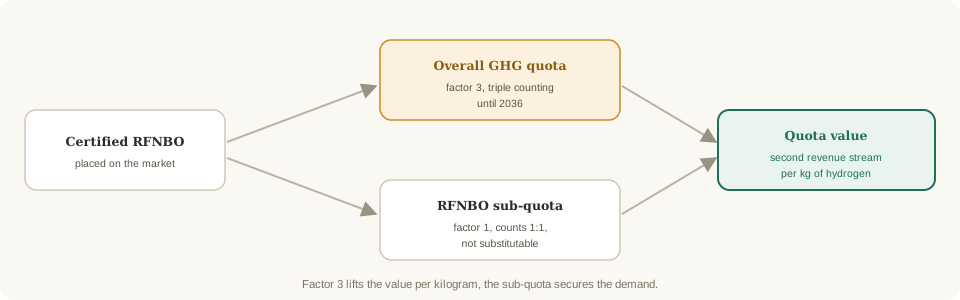
The critical point, and the one most easily got wrong, is that factor 3 does not apply to the RFNBO sub-quota. When meeting the sub-quota itself, RFNBO counts 1:1, so the triple counting is not applied there. The reason is structural: if a tonne of RFNBO could discharge three units of the sub-quota, a small physical volume would satisfy a much larger paper requirement and the sub-quota would lose its steering effect. Factor 3 therefore applies to the contribution toward the overall GHG quota, while the sub-quota is met one for one.
Outside road transport the multipliers differ. In aviation and maritime, RFNBO carries a separate factor of 1.5, recognising the value of electricity-based fuels in sectors that are otherwise hard to decarbonise without lowering the integrity of the sub-quota design. The 1.5 factor is its own regime and should not be confused with the road-transport triple counting or with the charging-electricity multipliers that sit alongside it.
Charging electricity is a different compliance option entirely, not RFNBO, and it may not substitute the sub-quota, but it carries its own multipliers under the 38th BImSchV. Charging electricity for cars stays at factor 3 initially and then falls through the mid-2030s to 2 and on to 1, while charging electricity for heavy e-trucks and buses starts in 2027 at factor 4 and tapers to 1 by 2040. These factors steer demand toward electrification of road transport, but they belong to the charging-electricity option and never count toward the RFNBO sub-quota, which only RFNBO can fill.
The quota value: guaranteed demand and a second revenue stream
Out of obligation and multiplier comes a price. Because the sub-quota can be met only with RFNBO, fuel suppliers either have to source RFNBO or pay the 120 euro per GJ penalty, and that non-substitutable demand is what gives producers planning certainty. The producer is no longer selling into a market where its molecule competes purely on energy price against biofuels; it is selling into a market with a legally protected floor of demand that nothing else can fill. That is the structural difference the sub-quota makes.

The triple counting lifts the revenue per kilogram well above the energy value. At a CO2 quota price in the region of 400 euro per tonne, and including the factor 3 triple counting toward the overall quota, the quota value currently reaches up to about 10 to 10.50 euro of additional revenue per kilogram of RFNBO hydrogen. That is a second revenue stream that sits alongside the molecule price, and it can rival or exceed the value of the energy content itself, which is what makes the certified molecule so sought after as a compliance option.
The quota value is one revenue stream among several, and it is worth placing it correctly. It sits alongside the molecule price and alongside possible funding from auctions such as H2Global and the EU Hydrogen Bank, which are separate topics in their own right. This article treats the funding auctions only as a second possible revenue source and does not cover their auction design, bid prices or budgets. The point here is narrower: the quota system itself, through the sub-quota and the triple counting, generates a revenue stream that producers can build into their business case today.
The price is market-driven and therefore moves. Over 2026 the market price for GHG quotas ranged from roughly 308 to 450 euro per tonne of CO2, driven by demand, and the quota value per kilogram tracks that price together with the applicable multiplier. As the triple counting begins to taper after 2036 and the multiplier falls toward 1 by 2040, the quota value per kilogram will compress even if the underlying CO2 price holds, which is a planning fact that both sides of the market have to build into their longer-term models.
What fuel suppliers and RFNBO producers should do now
The mechanism is adopted and the 2026 quota year is already running, so both sides have to set up procurement, certification and accounting now rather than later. For fuel suppliers the new sub-quota is a separate obligation that has to be managed apart from the overall quota; for producers the quota value is a second revenue stream that has to be built into the business case and tracked through the taper after 2036. None of this is abstract: it is a concrete set of choices that belong in the plan today.
The dividing line between the two layers of the quota runs through every decision. The overall GHG quota can be met with a mix of options, but the RFNBO sub-quota can be met only with RFNBO, and the multipliers apply differently on each layer. Keeping those two strands cleanly separated, RFNBO for the sub-quota at factor 1 and the wider option mix for the overall quota with triple counting where it applies, is the practical core of compliance under the new rules.
The points below turn the quota mechanics into a near-term action list for both sides of the market.
- Calculate the sub-quota separately and benchmark against the penalty. Fuel suppliers should model the RFNBO sub-quota apart from the overall quota, secure RFNBO volumes on long-term contracts and compare procurement against the 120 euro per GJ penalty, because cheaper options do not count toward the sub-quota at all.
- Build the quota value into the business case and plan the taper. RFNBO producers should treat the quota value as a second revenue stream alongside the molecule price, and plan for the triple counting tapering after 2036 so that the longer-term model does not rely on a factor 3 that is set to fall to 1 by 2040.
- Secure RFNBO certification as the precondition for any crediting. Crediting requires RFNBO certification together with entry into the UBA register under the 37th BImSchV and into the EU Union Database; without that documentation the molecule cannot be counted toward either layer of the quota.
- Keep the compliance options cleanly separated. Both sides should ring-fence the options: RFNBO for the sub-quota, biofuels and charging electricity only for the overall quota, so that the accounting reflects which option counts where and at which multiplier.
Further reading
Frequently asked questions
The RFNBO sub-quota is a dedicated minimum share of electricity-based fuels, renewable hydrogen and e-fuels, within the German greenhouse-gas reduction quota (GHG quota) in transport. It is non-substitutable: it can be met only with RFNBO, not with biofuels or charging electricity. It sits inside the wider GHG quota, which obliges fuel suppliers placing fuel on the market to cut the greenhouse-gas intensity of the energy they sell, and it ring-fences a guaranteed slice of demand for electricity-based fuels.
The RFNBO sub-quota applies from the 2026 quota year. It starts very low, at 0.1 percent of the energy sold in transport, and then rises steeply: to about 1.2 percent by 2030 and to 8 percent by 2040, with 10 percent for 2040 cited in some readings of the final Bundestag version. The often quoted figure of about 1.25 percent is not the 2026 starting value but a reference point from the debate over the existing minimum share.
Triple counting means that a tonne of RFNBO in road transport counts toward the overall GHG quota at factor 3, so one physical unit covers three units of compliance obligation. This applies until 2036, after which the factor tapers down to 1 by 2040. Triple counting lifts the value of every kilogram of RFNBO hydrogen in the quota market well above its plain energy value, because each kilogram does triple duty against the overall quota.
No. Factor 3 applies only to the contribution toward the overall GHG quota. When meeting the RFNBO sub-quota itself, RFNBO counts 1:1, so the factor 3 is not applied there. If triple counting were applied to the sub-quota, the sub-quota would lose its steering effect, because a small physical volume would already satisfy a much larger paper requirement. Aviation and maritime carry a separate RFNBO factor of 1.5.
Missing the overall GHG quota costs a penalty of 600 euro per tonne of CO2 not saved. Missing the RFNBO sub-quota costs an additional 120 euro per GJ of the shortfall. The separate penalty on the sub-quota makes it a hard, non-negotiable obligation: a fuel supplier cannot simply buy its way out of the RFNBO requirement with cheaper compliance options, but must either source RFNBO or pay the penalty per gigajoule short.