The Power Plant Security Act and H2-ready power plants: from the KWSG to the StromVKG
This is a practical analysis of the legislative path from the failed KWSG to the StromVKG and, above all, of the hydrogen readiness of the new dispatchable power plants: the design for 100 percent hydrogen operation, the conversion concept as a bid requirement, the old KWSG eight-year rule against the softer StromVKG solution with differential contracts, and the funding logic of an investment grant plus differential costs. It is not a treatise on the capacity-market mechanics. It sets out why the plants have to be H2-ready, what hydrogen readiness actually requires, when and how the switch happens, how the extra costs are funded and what operators and investors should decide now. The neighbouring topic, the capacity-market auction design, sits close by and is touched in only one contrasting passage, not repeated.
The Power Plant Security Act (Kraftwerkssicherheitsgesetz, KWSG) never entered into force as a standalone law: the key points were set out on 5 July 2024, the draft went into consultation from 11 September 2024, and the project stalled at the collapse of the coalition in November 2024. The new government re-scoped it, reached an agreement in principle with the EU Commission on the key points on 15 January 2026 with the state-aid procedure not yet concluded, presented a draft on 24 April 2026 and adopted the successor law in cabinet on 13 May 2026; the parliamentary process is open. The successor is the Electricity Supply Security and Capacity Act (Strom-Versorgungssicherheits- und Kapazitaetengesetz, StromVKG). No full capacity market starts in 2026; the first StromVKG long-term auctions are 1 September and 8 December 2026 at 4.5 GW each, plus 18 May 2027 at 2 GW with batteries eligible, and the full central capacity market only from 2032. The 2026 tender volume is 12 GW (10 GW under the long-term criterion plus 2 GW), against a total dispatchable-capacity need of about 41 GW by 2031. The original KWSG had about 12.5 GW in two pillars with discrete segments (5 GW new H2-ready gas, 2 GW H2-ready modernisation, 0.5 GW H2 sprinter, 0.5 GW long-duration storage, 5 GW pure gas); in the StromVKG the discrete H2 segments are dropped and the criterion is technology-neutral. Under the StromVKG, gas-based plants must be planned and built so that later operation on 100 percent hydrogen is possible, a conversion concept must be submitted with the bid, and climate-neutral operation is mandatory by 2045/2046. The old KWSG eight-year rule became a softer StromVKG solution with incentive-based switching via differential contracts (2 GW by 2040 and a further 2 GW by 2043). Funding combines an investment grant (capex) with a hydrogen-versus-gas differential-cost subsidy (opex) for 800 full-load hours per year after the switch. These dispatchable thermal plants are the demand side for stored and imported hydrogen, and they are the opposite, complementary pillar of supply security to the decentralised, battery-based virtual power plants.
From the failed KWSG to the StromVKG: the legislative path
The Power Plant Security Act gives the topic its name, but it is important to be honest about its status: as a standalone law it never entered into force. The key points of the power plant strategy were presented in early 2024, concretised into the KWSG (Kraftwerkssicherheitsgesetz, Power Plant Security Act) on 5 July 2024, and the official draft went into consultation from 11 September 2024. Then the coalition collapsed in November 2024 and the KWSG stalled before it was ever adopted. The name has survived as the label for the topic, but the instrument it points to was never enacted.
The new government picked the project up and re-scoped it rather than reviving the old text. The BMWE under Minister Reiche reached an agreement in principle with the EU Commission on the key points on 15 January 2026, which is a milestone but not the end of the road: the state-aid procedure is not yet concluded. After consultations with industry associations the draft of the successor law was presented on 24 April 2026, and the cabinet adopted it on 13 May 2026. The parliamentary process is still open, so the legal text can still move, but the direction of travel is now set by a different law with a different name.
That successor is the Electricity Supply Security and Capacity Act (Strom-Versorgungssicherheits- und Kapazitaetengesetz, StromVKG). It is the instrument that actually governs new dispatchable generation in 2026, and conflating it with the KWSG is the first mistake to avoid. The KWSG is the failed predecessor and namesake of the topic; the StromVKG is the law in train. Everything an operator now plans for, the bids, the build obligations and the funding, runs through the StromVKG, not the KWSG.
For investors the decisive question is what carried over from the KWSG logic into the StromVKG and what did not. The hydrogen readiness as a build obligation and the funding logic of an investment grant plus differential costs survived. What fell away are the discrete H2 segments: the original KWSG defined separate buckets for new H2-ready gas, H2-ready modernisation, a pure-hydrogen sprinter segment and long-duration storage, while the StromVKG drops these discrete H2 segments in favour of a single technology-neutral criterion. The substance that decides whether a plant is decarbonisable, the H2 readiness, stayed; the segmented market architecture was simplified.
Why H2-ready: dispatchable backup for the dark doldrums
The driver behind the whole exercise is the coal phase-out meeting a rising share of wind and solar. As coal leaves the system and weather-dependent generation grows, the system needs new firm, dispatchable capacity that can step in when the wind drops and the sun is low, the period the German debate calls the Dunkelflaute, the dark doldrums. New gas-fired plants are the bridge technology for this: they start on natural gas and are meant to switch to green hydrogen later, which is why they have to be built H2-ready from the outset rather than locked into fossil operation for their whole life.
The scale of the need sets the context for the build programme. The total need for dispatchable capacity by 2031 is about 41 GW, and 2026 is the first year of procurement, with 12 GW put out to tender (10 GW under the long-term criterion plus a further 2 GW). These are large, capital-intensive, long-lived assets, so the decisions taken in the 2026 round of bids will shape the German generation fleet, and its decarbonisability, well into the 2040s. That is exactly why the build specification matters more than the auction headline: the plant has to be designed today for a fuel it will only burn later.
It is worth distinguishing these plants clearly from decentralised, battery-based virtual power plants. Large thermal plants are the technology for covering long Dunkelflaute episodes that can last many hours or days, whereas aggregated batteries excel at short peaks and fast balancing. The two are not competitors but complementary pillars of supply security, and the battery side is covered separately in the article on virtual power plants and AI-coordinated battery storage, the opposite, decentralised pillar of the same problem.
Seen from the molecule, the H2-ready plants are the demand side of the hydrogen economy. They are the customers that will eventually burn the hydrogen that is stored in caverns, moved through the network and brought in from abroad as a carrier. The supply side is treated in the neighbouring articles on hydrogen cavern storage, on green ammonia import and on the hydrogen core network; this article is the demand and generation side that those volumes ultimately have to reach.
What hydrogen readiness actually requires
Hydrogen readiness in the StromVKG is not a statement of intent but a concrete build and proof obligation. Gas-based plants must be planned and built so that a later switch to 100 percent hydrogen operation is possible through the adaptation of components or operation. In other words, the design freedom to convert has to be engineered into the plant from the start, because retrofitting a plant that was never laid out for hydrogen is far harder and more expensive than building the option in from day one.

The proof of that readiness is built into the bid itself. With the bid, the operator must already submit a conversion concept, so readiness is checked up front and not merely promised for some later date. This turns hydrogen readiness from a soft commitment into a hard, assessable document: the plan for how and when the plant moves to hydrogen is part of what wins or loses the tender, which is why the conversion concept cannot be an appendix added after the engineering is fixed.
Technically, the readiness sits in a handful of levers. The turbine and burner have to be specified for hydrogen capability or for an upgrade to it, the fuel logistics have to anticipate a hydrogen supply rather than only gas, physical space has to be reserved for the retrofit, and the site has to be positioned for a later connection to the hydrogen supply. Each of these is a decision taken at the design stage, and each is far cheaper to take then than to correct once the plant is built.
The outer boundary is fixed by the climate target. Climate-neutral operation is mandatory by 2045/2046, and the plant must be convertible to reach that within its operating life. That deadline is what makes the conversion concept more than paperwork: the build has to demonstrate a credible path from gas-fired backup to climate-neutral operation within the plant's economic lifetime, and a concept that cannot get there is not a viable bid.
When the switch happens: the eight-year rule versus differential contracts
The question of when an H2-ready plant actually switches to hydrogen is answered differently by the old KWSG and the new StromVKG, and the shift is from a hard deadline to an incentive model. The original KWSG set a strict eight-year rule: a new hydrogen-capable gas plant had to switch to 100 percent hydrogen by the first day of the eighth year after commissioning, planned to begin from around 2035, with the exact switch dates to be fixed in 2032. That rule put a legal cliff edge into every project, regardless of whether hydrogen was actually available at a workable price.
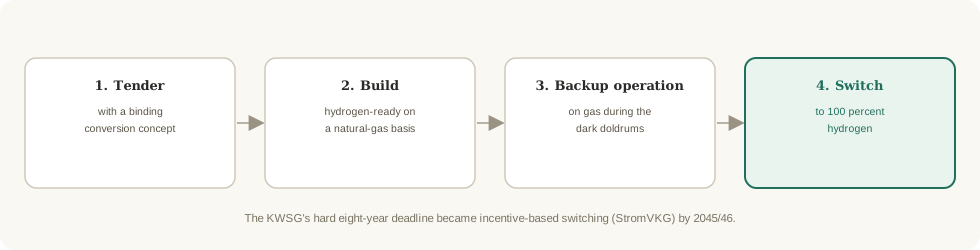
The StromVKG drops that hard eight-year deadline. In its place comes a softer construction: there is no fixed cliff edge for the individual plant, climate-neutral operation is required by 2045/2046, and the active switch is incentivised rather than ordered. The legal obligation now sits at the outer 2045/2046 boundary, while the pull towards hydrogen within that window comes from a financial incentive rather than from a per-plant statutory date.
That incentive runs through differential contracts. They are designed to bring forward the switch for 2 GW by 2040 and a further 2 GW by 2043, so the move to hydrogen is pulled forward by money rather than pushed by a deadline. Instead of every plant facing the same fixed switch date, a defined volume of capacity is incentivised to convert on a staged timeline, which gives the system flexibility about which plants switch when as hydrogen actually becomes available.
The consequence is a shift in where the switchover risk sits. With less legal compulsion comes more dependence on hydrogen availability and price, which makes the location and connection choices taken today more important, not less. An operator can no longer rely on a statutory deadline to force the surrounding supply into place; instead the business case has to stand on a realistic view of when affordable hydrogen will actually reach the plant, which is why the conversion concept and the site's connection to the hydrogen supply carry more weight under the StromVKG than they did under the KWSG.
The economics: an investment grant plus differential costs
An H2-ready plant only adds up if both the more expensive build and the later, more expensive hydrogen operation are covered, and that is exactly what the funding is designed to do by combining capex and opex support. The investment grant addresses the build cost of the hydrogen-capable plant, and the differential-cost subsidy addresses the running cost gap after the switch. Without both halves, the business case breaks: the build premium would deter the investment, and the hydrogen fuel premium would deter the conversion.
The first half is the investment grant (capex) for building the hydrogen-capable plant. The H2-ready premium on the build is real, but according to industry figures it is bounded, in the order of a few percent of the investment, because much of the readiness is about specification and reserved space rather than installing the full hydrogen equipment on day one. The grant covers this incremental build cost so that the choice to build H2-ready instead of plain gas does not penalise the operator at the construction stage.
The second half is the differential-cost subsidy (opex), which covers the difference between the hydrogen and the natural-gas fuel cost for 800 full-load hours per year from the point of the switch. This is the larger and more uncertain cost block, because hydrogen will for some time be more expensive to burn than gas, and the 800 full-load hours are the explicit measure against which that gap is subsidised. The opex subsidy is the de-risking instrument for hydrogen operation: it makes the switch affordable rather than punishing the operator who actually converts.
It is worth contrasting this with how the capacity-market remuneration works, because the two are easy to blur. The funding described here pays for the decarbonisation path, the build and the later hydrogen operation, whereas the capacity-market mechanism remunerates the mere availability of firm capacity. They answer different questions: the H2-ready funding decides whether a plant can be decarbonised, the capacity-market design decides how holding firm capacity ready is paid for. The capacity-market mechanics, the auction design, the central market with a local component and the 2032 launch, are a separate topic and are not pursued further here.
What operators and investors should decide now
Anyone investing in dispatchable generation in 2026 is taking plant and contract decisions today that will determine decarbonisability for decades. The conversion concept is not an appendix to the bid but its core, because the StromVKG checks hydrogen readiness up front and ties the funding to it. The practical message is that the auction participation has to be thought through from the plant concept outwards, not the other way round.

The first job is to design the plant for the switch from the start. The turbine choice, the hydrogen connection and the storage and import links are all part of the conversion concept, not separate procurement decisions to be settled later. Because the StromVKG no longer forces the switch with a hard deadline, the second job is to manage the switchover risk actively: hydrogen availability, price and the incentive-based logic of the differential contracts have to be built into the business case in a way that survives a realistic, not an optimistic, hydrogen ramp.
The points below turn the H2-ready logic into a near-term action list for operators and investors.
- Design the auction bid from the plant concept. Treat the turbine choice, the hydrogen connection and the storage and import links as part of the conversion concept rather than later add-ons, with the connection to the hydrogen core network and to hydrogen storage planned from the outset.
- Manage the switchover risk actively. Build hydrogen availability, price and the incentive-based switching logic of the differential contracts into the business case in a robust way, and assume a realistic rather than an optimistic timeline for affordable hydrogen reaching the plant, whether by import or from storage.
- Integrate capex and opex funding cleanly. Carry the capex investment grant and the opex differential-cost subsidy through the full economic model, and keep the 800 full-load hours per year in view as the explicit basis on which the hydrogen-versus-gas cost gap is covered.
- Keep the KWSG legacy and the capacity market apart. Recognise that the H2-ready design decides decarbonisability while the capacity-market mechanism decides the availability remuneration, and do not conflate the build and conversion funding with the separate auction and capacity-market design that pays for firm capacity.
Further reading
Frequently asked questions
No. The Power Plant Security Act (Kraftwerkssicherheitsgesetz, KWSG) never entered into force as a standalone law. The key points were set out on 5 July 2024 and the draft went into consultation from 11 September 2024, but the project stalled at the collapse of the coalition in November 2024 and was never adopted. The name lives on as the label for the topic, but the instrument that actually governs new dispatchable power plants in 2026 is its re-scoped successor, the StromVKG.
The successor is the Electricity Supply Security and Capacity Act (Strom-Versorgungssicherheits- und Kapazitaetengesetz, StromVKG). The new government re-scoped the project, reached an agreement in principle with the EU Commission on the key points on 15 January 2026 (the state-aid procedure is not yet concluded), presented a draft on 24 April 2026 and adopted the law in cabinet on 13 May 2026. The parliamentary process is open. The successor is not called KWSG.
Under the StromVKG, hydrogen readiness is a concrete build and proof obligation, not a statement of intent. Gas-based plants must be planned and built so that later operation on 100 percent hydrogen is possible through the adaptation of components or operation, and a conversion concept has to be submitted with the bid, so readiness is checked up front rather than only promised. Climate-neutral operation is mandatory by 2045/2046, and the plant must be convertible by then.
The original KWSG had a hard eight-year rule: a switch to 100 percent hydrogen by the first day of the eighth year after commissioning, planned from around 2035. The StromVKG replaces this with a softer solution: there is no hard eight-year deadline, climate-neutral operation is mandatory by 2045/2046, and the active switch is incentivised through differential contracts for 2 GW by 2040 and a further 2 GW by 2043. That shifts the switchover risk from a legal deadline towards hydrogen availability and price.
Funding combines two parts. An investment grant (capex) supports the build of the hydrogen-capable plant, and after the switch to hydrogen a differential-cost subsidy (opex) covers the difference between the hydrogen and the gas fuel cost for 800 full-load hours per year. The capex grant addresses the higher build cost, the opex subsidy de-risks the more expensive hydrogen operation, and together they form the economic bridge that makes an H2-ready plant bankable.