Guarantees of origin for electricity: the HkRNDV amendment and power labelling
A guarantee of origin (GO) is the accounting unit of green power: it separates the green property of a megawatt hour from the kilowatt hour itself, so suppliers can label their power credibly. The electricity register HKNR has issued, traded, imported, exported and cancelled these GOs since 2013, and power labelling under Section 42 EnWG is what brings them to the customer. This article looks at the electricity side and keeps it distinct from the existing article on guarantees of origin for gas and hydrogen, which covers a different register, a different ordinance and different energy carriers. Here the focus is the electricity HKNR, the HkRNDV amendment of 2025, the move to quarterly labelling from 2027, the double-marketing ban that denies a GO to subsidised power, and the greenwashing debate around foreign hydropower.
The electricity guarantee-of-origin register (HKNR) has been run by the Federal Environment Agency (UBA) since 2013. It issues, transfers, imports, exports and cancels guarantees of origin (GO), the accounting units that let suppliers label their power credibly under Section 42 EnWG, where every supplier shows its energy mix, CO2 emissions and radioactive waste per kilowatt hour against the national average. The HkRNDV amendment of 6 August 2025, mostly in force since 1 October 2025, is above all a deregulation: for many PV and wind plants the environmental audit is dropped and the link via the Market Master Data Register is enough, while the audit remains for biomass and co-firing plants. At the same time the amendment tightens the data exchange, because from 2026 suppliers report directly to the UBA under Section 30(5), which lets the register reconcile power labelling against GO cancellation. From delivery year 2027 power labelling becomes quarterly, so suppliers have to hold matching guarantees of origin per generation quarter instead of a single annual balance, which raises the procurement and matching effort and moves the system closer to a time-based green-power logic. One point is often misread: the amendment does not extend guarantees of origin to subsidised EEG power. Under the double-marketing ban (Section 12 HkRNDV, Section 80 EEG) subsidised power gets no GO, its green property is assigned to all consumers in power labelling, and only unsubsidised green power is certifiable and tradable. An extension to subsidised power is a RED III requirement whose German implementation is still open and contested. The credibility gap is the origin of the certificates: a large share of the GOs cancelled in Germany comes from foreign hydropower, around 39 percent from Norway in 2022, which feeds the greenwashing debate. Whoever prepares the Section 30(5) data reporting, shifts procurement to quarterly labelling, uses the simpler GO access since October 2025 and assesses the origin of its GOs is on the front foot.
What the electricity HKNR and power labelling are
The guarantee-of-origin register is the bookkeeping of green power. It separates the green property of the power from the kilowatt hour, so a supplier can label its power credibly even though the electrons themselves cannot be traced.
The electricity guarantee-of-origin register, the HKNR, has been run by the Federal Environment Agency (UBA) since 2013. Its job is to issue guarantees of origin for renewable power, and then to transfer, import, export and cancel them. A guarantee of origin documents that one megawatt hour of green power was generated somewhere, and only the act of cancelling it lets a supplier claim that quantity of green power for a specific customer. Cancellation is the moment the certificate is used up, so it cannot be claimed twice.
Power labelling is the consumer-facing side, and its legal basis is Section 42 EnWG. Every supplier has to show, per kilowatt hour, its energy mix, the CO2 emissions and the radioactive waste, each next to the national average for comparison. The labelling for the previous year is published from 1 July, a fixed cut-off that has applied since 2025. The link between the two is direct: the green-power figures in power labelling are backed by cancelled guarantees of origin, so the register and the label are two ends of the same chain.
What the HkRNDV amendment 2025 changes
The amendment is above all a deregulation. It lowers the bureaucratic hurdle for plant registration and at the same time builds out the data reconciliation, so that the green property of a megawatt hour cannot be marketed twice.

The ordinance dates from 6 August 2025 and is mostly in force since 1 October 2025. Its core move is to drop the environmental audit for many PV and wind plants. Instead of a separate audit to prove the plant exists and what it is, the register now relies on the link via the Market Master Data Register, where the plant is already recorded. For biomass and co-firing plants the audit remains, because the fuel input there has to be verified and a register entry alone does not show it. For operators of solar and wind plants that previously shied away from the bureaucracy, this lowers the barrier to getting guarantees of origin at all.
The second strand is a tighter data exchange. From 2026 suppliers report their data directly to the UBA under Section 30(5) HkRNDV, which lets the register reconcile power labelling against the cancellation of guarantees of origin. In other words, the UBA can now check that the green power a supplier shows in its label is actually covered by cancelled GOs in the register, closing a gap that used to rely on separate reporting paths. Deregulating registration and tightening reconciliation are two sides of the same intent: make access easy, but make double marketing hard.
One clarification is worth making explicitly, because it is easy to misread. The amendment does not extend guarantees of origin to subsidised EEG power. It changes how plants register and how data is reconciled, not who is eligible for a GO. An extension to subsidised power is a separate question that flows from RED III, and its German implementation is still open.
- Ordinance of 6 August 2025, mostly in force since 1 October 2025.
- Environmental audit dropped for many PV and wind plants, linked via the Market Master Data Register.
- The audit remains for biomass and co-firing plants.
- New supplier data reporting to the UBA from 2026 (Section 30(5)), reconciling power labelling against GO cancellation.
Quarterly power labelling from 2027
Power labelling becomes more granular in time. Instead of a single annual balance, suppliers have to hold enough guarantees of origin for each quarter from the delivery year 2027 onwards.
The change starts with the delivery year 2027. Until now a supplier could net its green power over a full year, so a surplus of guarantees of origin in one season could offset a shortfall in another. From 2027 the matching is required per generation quarter, which means a supplier needs guarantees of origin that line up with the quarter in which the power was generated, not just over the year as a whole. The annual balance gives way to four quarterly balances.
The practical effect is a higher procurement and matching effort. A supplier now has to think about when its green power was generated and when its customers consumed, and bring the two closer together in time. Guarantees of origin from a high-generation quarter cannot simply cover a low-generation one. The upside is that the label says something truer: quarterly matching is a step nearer the actual time-based logic of green power, where the value of a green kilowatt hour depends on when it was produced.
- Starts with the delivery year 2027.
- Guarantees of origin per generation quarter instead of an annual balance.
- Higher procurement and matching effort, closer time alignment of generation and consumption.
- Closer to the actual time-based green-power logic.
No guarantee of origin for subsidised power: the double-marketing ban
The German system has a special rule that is often misunderstood. Subsidised power gets no guarantee of origin, because its green property has already been socialised through the subsidy.
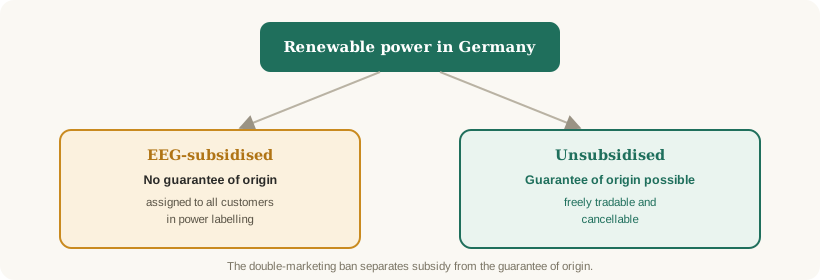
The rule sits in Section 12 HkRNDV and Section 80 EEG: power that draws an EEG subsidy receives no guarantee of origin. The reasoning is that the public already paid for the green property of that power through the subsidy, so it would be double marketing to sell that same green property again as a tradable certificate. To make the logic consistent, the subsidised EEG share is assigned to all consumers in power labelling, as a kind of base layer of green power that everyone receives whether they buy a green tariff or not. Only unsubsidised green power is GO-eligible and freely tradable.
This has a sizeable practical footprint, because the subsidised share is large. Renewables make up around half of the German power mix, and most of that is EEG-subsidised and therefore carries no guarantee of origin. The green power that suppliers can actively certify and sell as a green tariff is the smaller, unsubsidised slice plus imports. That is why so much of the certificate demand is met from abroad, a point the next section returns to.
RED III could change this in future, by allowing guarantees of origin also for subsidised power, which would end the German double-marketing ban as it stands. But the German implementation of that requirement is still outstanding and contested, so for now the ban applies and the distinction between subsidised and unsubsidised green power remains the dividing line of the whole system.
- EEG-subsidised power gets no guarantee of origin (Section 12 HkRNDV, Section 80 EEG).
- The subsidised share is assigned to all consumers in power labelling.
- Only unsubsidised green power is GO-eligible and tradable.
- RED III could change this in future, but the German implementation is outstanding and contested.
Green-power transparency and the greenwashing debate
The biggest credibility problem is the origin of the certificates. A large share of the guarantees of origin cancelled in Germany comes from old foreign hydropower, which calls the build-out effect into question.

The numbers behind the debate are striking. In 2022 around 39 percent of the green-power guarantees of origin used in Germany came from Norway, and historically the share from hydropower has been over 90 percent. Norwegian hydropower is largely decades old, so a German green tariff backed by such a certificate does not finance a single new plant. That is the core of the criticism: the certificate reshuffles the claim to existing green power rather than creating new green capacity.
Two further criticisms follow. The first is double counting in the public mind, where the same megawatt hour can feel green both where it is physically consumed and where the certificate is cancelled. The second is the missing build-out incentive, since buying an old hydropower certificate gives no signal to build new wind or solar. RED III aims to harmonise the system across Europe and to close some of these gaps, but its implementation is delayed, which leaves the current rules in place for longer than intended.
For suppliers, the upshot is that the origin and the new-plant share of their guarantees of origin become a marketing and compliance topic in their own right. A green tariff backed by domestic or new-plant certificates is a stronger and more defensible claim than one backed by foreign legacy hydropower, and customers, journalists and regulators increasingly look at exactly that distinction.
- Around 39 percent of the green-power guarantees of origin used in Germany came from Norway in 2022, historically over 90 percent from hydropower.
- Criticism of double counting and a missing incentive to build new plants.
- RED III aims to harmonise the system across Europe, but the implementation is delayed.
- The origin and the new-plant share of GOs become a marketing and compliance topic.
What companies should do now
Whoever adapts processes and procurement early avoids effort and greenwashing accusations later. The quarterly labelling, the UBA data reporting and the simpler registration access are the next concrete tasks. Direct marketers in particular should line this up with their remote-control duties, which the direct marketing and remote control over the smart meter gateway article sets out, and keep an eye on the wider subsidy reform in the EEG reform and grid package.
- Prepare the Section 30(5) data reporting from 2026. Check the UBA register account and the master data so the direct data reporting to the register works from the start, and so power labelling reconciles cleanly against GO cancellation.
- Shift procurement to quarterly labelling from 2027. Move from an annual balance to four quarterly balances, and procure guarantees of origin that match the generation quarter, so generation and consumption line up in time. The quarter-hour logic of metering is the related shift on the consumption side, set out in ZSG quarter-hour balancing.
- Use the simpler GO access since October 2025. Take advantage of the dropped environmental audit for PV and wind plants and the link via the Market Master Data Register to certify quantities that were previously left uncertified.
- Assess the origin of your guarantees of origin. Weigh domestic and new-plant certificates against foreign legacy hydropower, and steer the mix towards the origin that makes the green-power claim defensible to customers and regulators.
Further reading
Frequently asked questions
The electricity guarantee-of-origin register (HKNR) has been run by the Federal Environment Agency (UBA) since 2013. It issues, transfers, imports, exports and cancels guarantees of origin (GO) for renewable power. A guarantee of origin documents that one megawatt hour of green power was generated, so suppliers can label their power credibly. The cancellation of a GO is what backs the green-power statement in power labelling.
The HkRNDV amendment of 6 August 2025, mostly in force since 1 October 2025, deregulates plant registration. For many PV and wind plants the environmental audit is dropped and the link via the Market Master Data Register is enough, while the audit remains for biomass and co-firing plants. From 2026 suppliers report their data directly to the UBA under Section 30(5), which lets the UBA reconcile power labelling against GO cancellation. The amendment does not extend guarantees of origin to subsidised EEG power.
Under the double-marketing ban, power that draws an EEG subsidy receives no guarantee of origin, because its green property is already socialised through the subsidy. This follows from Section 12 HkRNDV and Section 80 EEG. The subsidised EEG share is assigned to all consumers in power labelling, and only unsubsidised green power is GO-eligible and freely tradable. RED III could change this in future, but the German implementation is still open and contested.
From delivery year 2027 power labelling becomes quarterly. Instead of a single annual balance, suppliers have to hold matching guarantees of origin for each generation quarter. That raises the procurement and matching effort, because generation and consumption have to line up in time more closely. It moves the system closer to the actual time-based logic of green power.
A large share of the guarantees of origin cancelled in Germany comes from foreign hydropower, with around 39 percent from Norway in 2022 and historically over 90 percent from hydropower. Critics argue this allows double counting in the public mind and gives little incentive to build new plants. RED III aims to harmonise the system across Europe, but the German implementation is delayed, which keeps the origin and the new-plant share of GOs a marketing and compliance topic.