Guarantees of Origin for Gas and Hydrogen: The New UBA Register
The Umweltbundesamt is building it as an obligation under EU law, so that the green property of biomethane and hydrogen becomes verifiable and tradable. The launch is expected in 2026, but no binding date is fixed.
The new guarantee-of-origin register for gas and hydrogen makes the renewable or low-carbon property of a quantity of gas verifiable and tradable. The Umweltbundesamt is building it as an obligation under Article 19 of the EU directive RED II, implemented through the Herkunftsnachweisregistergesetz HkNRG in force since 14 January 2023 and the GWKHV ordinance of May 2024. The launch of the gas register is expected in 2026, with no binding date publicly fixed.
The guarantee-of-origin register for gas and hydrogen is the new register, built by the Umweltbundesamt, that proves the renewable or low-carbon property of a quantity of gas towards the final consumer and makes it tradable. So far there is only an electricity register in Germany, in place since 2013, used here only as a comparison, and now registers for gas including hydrogen and for heat and cold are added. The legal driver is Article 19 of the EU directive RED II, which has obliged member states since 30 June 2021 to extend guarantees of origin to renewable gases, heat and cold. Germany missed this deadline by a wide margin. Article 19 is implemented through the Herkunftsnachweisregistergesetz HkNRG, in force since 14 January 2023, made concrete by the GWKHV ordinance of May 2024. The launch of the gas register is expected in 2026, with no binding date publicly fixed, originally 2025 was under discussion. A guarantee of origin runs through three steps, it is issued per energy quantity, can be transferred and traded, and is cancelled when the property is claimed towards the final consumer. The gases covered are renewable gases such as biomethane and green hydrogen as well as low-carbon gases. The guarantee of origin follows the book-and-claim principle and is to be distinguished from the RFNBO world, which works with mass balance and the Union Database and requires its own sustainability certification with at least 70 percent CO2 savings. The central open question is the clean interface to avoid double marketing. The build-up is delayed, the interfaces are complex, EU-wide interoperability is open, and the market ramp-up of green gases runs ahead of the proof structures. Whoever follows the UBA newsletter, keeps existing proofs clean, dovetails guarantee of origin and RFNBO, and clarifies the account structure early is prepared for the start.
What the new GO register for gas and hydrogen is
Germany is getting its first guarantee-of-origin register for gas and hydrogen. The Umweltbundesamt is building it as an obligation under EU law. So far there is only an electricity register, in future the green property of biomethane and hydrogen will also become verifiable and tradable.
Behind the register stands a clear legal trigger. Article 19 of the EU directive RED II has obliged member states since 30 June 2021 to extend guarantees of origin to renewable gases as well as heat and cold. Germany missed this deadline by a wide margin. Article 19 is implemented through the Herkunftsnachweisregistergesetz HkNRG, in force since 14 January 2023, made concrete by the GWKHV ordinance of May 2024. On this basis the Umweltbundesamt is building two new registers, one for gas including hydrogen and one for heat and cold, alongside the register for electricity that has been in place since 2013 and serves here only as a comparison. The launch of the gas register is, according to the Umweltbundesamt, expected in 2026, with no binding date publicly fixed, originally 2025 was under discussion. The market ramp-up of green gases makes the proof urgent: in 2024 around 10 TWh of biomethane from about 230 plants was fed in, and for 2030 a hydrogen demand of 95 to 130 TWh is expected, of which 50 to 70 percent is imported.
Issuance, transfer, cancellation
A guarantee of origin runs through three steps. It is issued per energy quantity, can be traded and transferred, and is cancelled when the green property is claimed towards a customer. In this way the green property is separated in accounting terms from the physical gas.
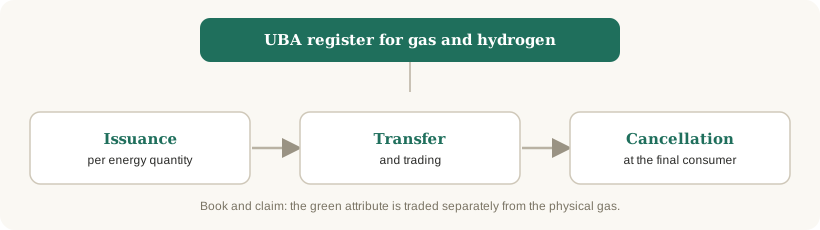
In detail the life cycle follows a fixed sequence. First, the UBA register issues the guarantee of origin per energy quantity, for example for a fed-in quantity of biomethane or hydrogen. Second, the guarantee can be transferred and traded, that is passed on to traders, suppliers and customers, independently of the physical path of the gas. Third, the guarantee is cancelled as soon as the green property is claimed towards the final consumer, at which point it is used up and may not be used again. It is exactly this separation of molecule and property that follows the book-and-claim principle. A special rule applies to heat and cold, where a spatial binding to the respective grid is envisaged, unlike the freely tradable gas guarantee. Conceptually open at the current stage is exactly how the cancellation of hydrogen guarantees on grid withdrawal will be designed.
Which gases are covered
The register covers a broad range. Alongside renewable gases, low-carbon gases are also covered. What matters is the distinction from sustainability certification, because the guarantee of origin proves the marketing, not the sustainability.

In concrete terms the register comprises two groups. The renewable gases include biomethane, landfill gas and sewage gas, green and biogenic hydrogen as well as synthetic methane. The low-carbon gases include low-carbon hydrogen and its derivatives as well as mine gas. What matters is the clean distinction: the guarantee of origin proves the marketing of the green or low-carbon property, it does not prove the sustainability in the sense of the RFNBO rules. RFNBO certification remains a separate proof strand with its own requirements and is not replaced by the guarantee of origin. So whoever wants to market hydrogen or biomethane as RFNBO needs both proofs, the guarantee of origin for the marketing of the property and the RFNBO certification for the sustainability.
GO or RFNBO? Book and claim versus mass balance
Two proof worlds sit side by side and are often confused. The guarantee of origin separates the green property from the molecule, the RFNBO world tracks it along the supply chain. Both have to be dovetailed cleanly to avoid double marketing.
For practice this means: the guarantee of origin follows the book-and-claim principle, the green property is separated from the physical molecule and freely tradable. The RFNBO world, by contrast, works with mass balance, tracks the property along the supply chain and documents it in the Union Database. RFNBO certification requires at least 70 percent CO2 savings as well as its own certification and thus remains a separate proof strand. It is exactly from this coexistence that the central risk of double marketing arises, that is that the same green property is claimed in several registers. A clean interface between the guarantee-of-origin register on the one side and systems such as Biogasregister, Nabisy and the RFNBO register on the other is therefore the precondition for the proof to stay reliable.
Challenges and risks
The build-up is delayed and the interfaces are complex. The market ramp-up of green gases runs ahead of the proof structures. An honest view has to name this, rather than painting the register only as orderly progress.

In detail the risks lie on several levels. First, the build-up is delayed, the launch was pushed from 2025 to an expected 2026, without a binding date being publicly fixed. Second, double counting threatens between the new GO register and existing systems such as Biogasregister, Nabisy and the RFNBO register, as long as the interfaces are not cleanly defined. Third, EU-wide interoperability and the cross-border recognition of guarantees are still open, which carries weight in a strongly import-driven hydrogen market with a 50 to 70 percent import share in 2030. Fourth, it is conceptually open how the cancellation of hydrogen guarantees on grid withdrawal will be designed in detail. A balanced view therefore recognises both the value of a reliable proof of green gases and the real gaps and open points.
Watch the timeline and double marketing: The launch of the gas register is expected in 2026, but not bindingly dated. Whoever bases sales or procurement strategies firmly on a specific start date risks false assumptions. Especially for quantities that are at the same time held in Biogasregister, Nabisy or the Union Database, the interfaces have to be cleanly clarified before the same green property is marketed twice.
The guarantee-of-origin register for gas and hydrogen is real progress and at the same time still a work in progress. The delay of the launch to an expected 2026, the risk of double counting across several registers and the open EU-wide interoperability belong honestly on the table. Whoever sees both, the value of a reliable proof of green gases and the real open points, places the register correctly and can do the groundwork in a targeted way.
What companies should do now
The register is a data and compliance task with lead time. Whoever now keeps existing proofs clean and plans the RFNBO interface is prepared for the start. This turns an announced obligation into a concrete plan.
-
Follow the UBA newsletter and specialist conferences
Follow the UBA newsletter and relevant specialist conferences to keep up with the start and the procedure. As long as the launch is expected in 2026, with no binding date, the official communication of the Umweltbundesamt is the most reliable source for the actual schedule and the registration modalities. Whoever is informed early here avoids time pressure at the start.
-
Keep existing proofs clean
Keep existing proof systems such as Biogasregister, Nabisy and the Union Database clean and consistent. Clean baseline data is the basis for ensuring that no quantities are held twice when connecting to the new register. Whoever tidies up beforehand lowers the risk of double marketing even before the register goes live.
-
Dovetail GO and RFNBO
Plan the guarantee of origin and RFNBO certification as separate but dovetailed strands. Book and claim on the one side and mass balance on the other follow a different logic, but have to fit together without contradiction. Whoever thinks through the interface early avoids the same green property being treated differently in the two worlds.
-
Clarify the account structure
Clarify the account structure and your own roles as producer, trader or supplier early. Which accounts, permissions and processes are needed in the register depends on the respective market role. Whoever sets this structure before the start can issue, transfer and cancel immediately once the register goes into operation.
Further reading
Frequently asked questions
A guarantee of origin for gas is an electronic document that proves the renewable or low-carbon property of a quantity of gas towards the final consumer and makes it tradable. It separates the green property in accounting terms from the physical molecule, so that the biomethane or hydrogen property can be marketed separately. The legal basis is the Herkunftsnachweisregistergesetz HkNRG, which defines the term in Paragraf 2. The guarantee of origin proves the marketing of the property, but does not replace RFNBO sustainability certification.
The new guarantee-of-origin register is operated by the Umweltbundesamt (UBA). It is building two new registers, one for gas including hydrogen and one for heat and cold. So far there is only an electricity register in Germany, which the Umweltbundesamt has run since 2013. The new registers implement Article 19 of the EU directive RED II, which obliges member states to extend guarantees of origin to renewable gases, heat and cold.
The launch of the gas register is, according to the Umweltbundesamt, expected in 2026, with no binding date publicly fixed. Originally 2025 was under discussion. The legal bases are already in place: the Herkunftsnachweisregistergesetz HkNRG has been in force since 14 January 2023, made concrete by the GWKHV ordinance of May 2024. The underlying EU deadline from Article 19 of the RED II directive already expired on 30 June 2021, and Germany missed it by a wide margin.
The guarantee of origin follows the book-and-claim principle: the green property is separated from the physical molecule and is freely tradable. The RFNBO world, by contrast, works with mass balance and tracks the property along the supply chain, documented in the Union Database. RFNBO certification requires at least 70 percent CO2 savings and its own certification. The guarantee of origin proves the marketing, not the sustainability. Both strands stay separate, but have to be dovetailed cleanly to avoid double marketing.
The register is a data and compliance task with lead time. Companies should follow the UBA newsletter and specialist conferences to keep up with the start and the procedure, keep existing proof systems such as Biogasregister, Nabisy and the Union Database clean, plan the guarantee of origin and RFNBO certification as separate but dovetailed strands, and clarify the account structure and the roles as producer, trader or supplier early. Because the launch is expected in 2026 with no binding date, it pays to do the groundwork now.
Let's collaborate
One contact, a team behind it
Thirty minutes on what you're working on, whether grid, metering, market processes, IT architecture or AI. Afterwards you'll know how we'd approach it and who would sit at the table.
Energy and measurement technology since 2010 · innobu GmbH since 2014 · Based in Schleswig-Holstein, Germany
Whoever pitches also delivers: whoever leads the first call stays your contact right through to the steering committee, with established partners in the project. Direct: info@innobu.com