
NIS2 and the KRITIS Umbrella Act: Two Laws, Two Deadlines, One Boardroom Matter
Affected companies must keep them apart.
Cybersecurity in Germany has become a personal duty of the management board in 2026. The NIS2 Implementation Act has applied without a transition period since 6 December 2025 to around 29,500 to over 30,000 companies, with fines up to 10 million euros and personal liability under Section 38 BSIG (Federal Information Security Act). The KRITIS Umbrella Act (Critical Infrastructure Umbrella Act) has added physical resilience since 17 March 2026, with fines up to 1 million euros. Its BBK registration starts only once the KRITIS ordinance says which installations are critical.
Germany put two distinct but interlocking regimes into force in 2026. The NIS2 Implementation Act (NIS2UmsuCG) governs digital cybersecurity and has applied without a transition period since 6 December 2025 to around 29,500 to over 30,000 companies across 18 sectors; the regular registration deadline with the Federal Office for Information Security (BSI) ended on 6 March 2026. The KRITIS Umbrella Act governs the physical and organisational resilience of critical installations, and has been in force since 17 March 2026. Operators of critical installations must register with the Federal Office of Civil Protection and Disaster Assistance (BBK) no later than three months after an installation counts as critical. The KRITIS ordinance that decides this is still missing, and the BBK says there is currently no registration duty. The sharpest break with the old law is personal management liability under Section 38 BSIG: approval, monitoring and training cannot be delegated, and a waiver of liability is excluded. Essential entities face fines up to 10 million euros or 2 percent of worldwide turnover, important entities up to 7 million euros or 1.4 percent, while breaches of the physical resilience duties under the KRITIS Umbrella Act carry separate fines up to 1 million euros. The reporting duty runs in three stages: 24 hours, 72 hours and one month.
Updated October 2026. The first version of 12 June 2026 gave 6 March 2026 as the date the KRITIS Umbrella Act entered into force and 17 July 2026 as the start of BBK registration. Both were wrong. The Act of 11 March 2026 (BGBl. 2026 I No. 66) has applied since 17 March 2026. Operators must register no later than three months after an installation counts as critical (Section 8(1)). The KRITIS ordinance decides that, and it hasn't been issued. The BBK states in its FAQ (retrieved 17 October 2026) that there is currently no registration duty. 17 July 2026 was the deadline in Article 6(1) of the CER Directive (EU) 2022/2557 for member states to identify their critical entities, not a duty for operators. We have corrected the summary, timeline, recommendations and FAQ. What the missing ordinance means for AI in grids and heat is covered in High-risk AI depends on KRITIS status, and the ordinance is still missing.
Two laws, two deadlines: what applies in 2026
Germany has put two separate but interlocking sets of rules into force in 2026. The NIS2 Implementation Act governs digital cybersecurity, the KRITIS Umbrella Act (Critical Infrastructure Umbrella Act) governs the physical and organisational protection of critical installations. Anyone affected must keep the two logics apart, because they have different authorities, duties and deadlines.
The split is clear. NIS2 addresses IT and network security and applies through the BSI, while the KRITIS Umbrella Act addresses access control, perimeter protection and business continuity and applies through the BBK. The NIS2 Implementation Act was promulgated on 6 December 2025 and applies without a transition period; the regular BSI registration deadline ended on 6 March 2026. The KRITIS Umbrella Act of 11 March 2026 has applied since 17 March 2026. Operators of critical installations register with the BBK no later than three months after an installation counts as critical (Section 8(1)), and the ordinance that decides which ones do is still missing. What about 17 July 2026, often quoted as the start of registration? That was the CER Directive deadline for member states to identify their critical entities. It set no date for operators. The two regimes are interlocking, which innobu set out in its guide to BSI-compliant integration.
Who is affected: sectors and thresholds
The question is no longer whether a company is affected but how strongly. The NIS2 Implementation Act covers around 29,500 to over 30,000 companies with at least 50 employees or 10 million euros in annual turnover across 18 sectors, and it splits them into two classes with different levels of duty. The KRITIS Umbrella Act covers a much narrower group of operators of critical installations.

The KRITIS Umbrella Act is framed more narrowly. It affects around 1,300 to 2,000 operators of critical installations, and the decisive criterion is the supply of at least 500,000 people. A single company can therefore fall under both regimes at once: under NIS2 for its digital security and under the KRITIS Umbrella Act for the physical resilience of its critical installations, from perimeter protection to counter-drone defense at energy facilities. The applicability check has to be run separately for each law.
Management liability: cybersecurity becomes a boardroom matter
The biggest break with the old legal position is the personal responsibility of the management. Under Section 38 BSIG (Federal Information Security Act) managing directors must approve the risk management measures, monitor their implementation and attend training in person, and they are liable to their own entity for culpably caused damage. Cybersecurity is no longer an IT task but a duty of the management board.
Approval, monitoring and training are expressly not delegable. A waiver of liability is excluded by law, and blanket clauses in articles of association do not protect managing directors. The management must personally sign off on and document the results of the risk analysis, which turns the formal cybersecurity duty into a matter that reaches the board table.
In practice this changes how decisions are recorded. It is no longer enough for an IT department to implement controls; the management must show that it approved the measures, kept their implementation under review and took part in the required training. The documentation of that chain becomes the evidence that protects the individual managing director when supervision asks questions.
Fines and enforcement: up to 10 million euros
Breaches can become expensive, and the BSI is already conducting active supervision in 2026. Essential entities face fines up to 10 million euros or 2 percent of worldwide annual turnover, important entities up to 7 million euros or 1.4 percent. In each case the higher of the two figures, the euro cap or the turnover share, applies.
Keep the two fine frameworks distinct: The NIS2 fines up to 10 million euros relate to digital cybersecurity duties supervised by the BSI, while the KRITIS Umbrella Act fines up to 1 million euros relate to physical resilience duties supervised by the BBK. A company under both regimes can be exposed to both frameworks at once, so the applicability and the duties have to be mapped separately for each law. Since 29 July 2026 a third authority joins them wherever AI systems are running in the house: the Bundesnetzagentur as AI supervisor.
The obligations catalogue: from registration to audit
NIS2 compliance is not a single step but a recurring cycle of registration, risk management, reporting channels and evidence. Whoever sets the chain up cleanly once meets the ongoing duties far more easily. The path runs from checking applicability through registration to the audits that supervision can call at any time.
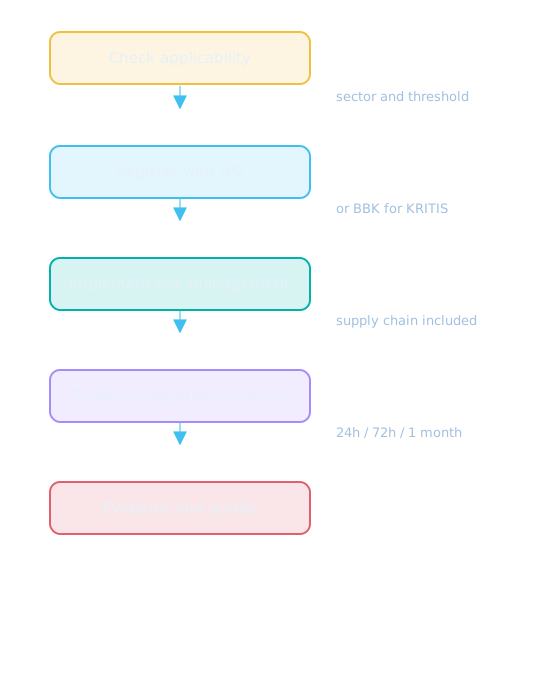
The first step is registration with the BSI for NIS2, and separately with the BBK for the KRITIS Umbrella Act, with operator and installation details. The second is the substantive risk management: security concepts, emergency and backup management, and supply chain security. The third is the three-stage reporting duty, with an early warning within 24 hours, a substantive report within 72 hours, and a final report within one month. The fourth is the standing evidence base that an audit can draw on without a break.
What companies should do now
Utilities, municipal utilities and industrial firms should treat NIS2 and the KRITIS Umbrella Act as a governance and data topic, not a pure IT project, and build the ransomware resilience for municipal utilities that the reporting duty assumes. Whoever structures applicability, supply chains and evidence now avoids liability risks and is ready to deliver at the first inspection.

-
Check applicability per sector and threshold
Test applicability against the 18 NIS2 sectors and the employee and turnover thresholds, then separately against the KRITIS supply threshold, and keep both registrations in view: the BSI one under NIS2 and the BBK one, due three months after the KRITIS ordinance classifies an installation.
-
Build risk management as a provable process
Set up risk management, supply chain security and reporting channels as provable processes, not only as documents, and extend them at the product level with OT security under IEC 62443 and the Cyber Resilience Act.
-
Make the management board sign off
Have the management personally approve and document the risk analysis and attend the required training, because approval, monitoring and training under Section 38 BSIG cannot be delegated or waived.
-
Design data architecture for audit and reporting
Build the data architecture and logging so that audits and incident reports can be evidenced without a break, with the 24-hour, 72-hour and one-month reporting stages supported end to end.
Both laws apply now. The BSI registration deadline has passed, and the BBK registration follows once the KRITIS ordinance is issued. Whoever maps applicability separately for the BSI and the BBK, builds provable processes and lets the management board sign off turns the legal duty into a defensible position. How a wider ethical and legal compliance approach fits alongside cybersecurity shows that governance and data handling under GDPR belong in the same plan.
Deadline, market roles, systems
6 December 2025German NIS2 implementation act in forceLaw · in force
Applicability: Applies to important and essential entities under the BSIG. Sector, headcount, turnover, balance sheet total and critical facility status decide.
If the deadline is missed: Fine possible For energy networks and energy installations, Sections 5c to 5e EnWG replace the BSIG duties. Under Section 95(2) to (4) EnWG, breaches under Section 95(1) nos. 3b to 3e carry fines of up to EUR 10 million for essential and EUR 7 million for important entities, or 2% and 1.4% of worldwide turnover above EUR 500 million. A missed registration under Section 33 BSIG can be fined up to EUR 500,000 (Section 65(2) no. 6 BSIG). Legal basis ↗
- Company-wide, several rolescheck applicabilityChecks whether it is an important or essential entity, registers with the BSI and sets up risk management and incident reporting.Typically affected: ISMS and security operations
A classification for typical market roles, not a review of your individual case and not legal advice. Whether an obligation applies to your company (thresholds, exemptions) is for your legal department or counsel to confirm. The calendar doesn't replace your own deadline review. Information as of: 23 October 2026.
Further reading
Frequently asked questions
The NIS2 Implementation Act governs digital cybersecurity. It applies through the Federal Office for Information Security (BSI), demands risk management and reporting, and carries fines up to 10 million euros. The KRITIS Umbrella Act governs the physical and organisational resilience of critical installations. It applies through the Federal Office of Civil Protection and Disaster Assistance (BBK), demands access control, perimeter protection and business continuity, and carries fines up to 1 million euros. They have different authorities, duties and deadlines, so affected companies must keep the two regimes distinct.
The NIS2 Implementation Act covers around 29,500 to over 30,000 companies in 18 sectors that have at least 50 employees or 10 million euros in annual turnover. It splits them into essential entities, such as energy, transport, banking, health, drinking water, waste water and digital infrastructure, and important entities, such as postal and courier services, waste management, chemicals, food, manufacturing and research. The KRITIS Umbrella Act covers a narrower group of around 1,300 to 2,000 operators of critical installations, defined mainly by the supply of at least 500,000 people.
Under Section 38 BSIG the management must approve the risk management measures, monitor their implementation and attend training in person, and it is liable to its own entity for culpably caused damage. Approval, monitoring and training cannot be delegated, and a waiver of liability is excluded by law. Blanket clauses in articles of association do not protect managing directors. The management must personally sign off on and document the results of the risk analysis.
Essential entities face fines up to 10 million euros or 2 percent of worldwide annual turnover, important entities up to 7 million euros or 1.4 percent, with the higher of the euro cap and the turnover share applying in each case. Breaches of the physical resilience duties under the KRITIS Umbrella Act carry separate fines up to 1 million euros. Missing the BSI registration deadline risks fines and additional regulatory scrutiny, and the BSI is already conducting active supervision in 2026.
The reporting duty has three stages, submitted through the BSI reporting portal: an early warning within 24 hours, a substantive incident report within 72 hours, and a final report within one month. The regular BSI registration deadline under NIS2 ended on 6 March 2026. Under the KRITIS Umbrella Act, operators must register with the BBK no later than three months after an installation counts as critical (Section 8(1)). The KRITIS ordinance decides when that is, and it has not been issued, so according to the BBK there is currently no registration duty.
Let's collaborate
One contact, a team behind it
Thirty minutes on what you're working on, whether grid, metering, market processes, IT architecture or AI. Afterwards you'll know how we'd approach it and who would sit at the table.
Energy and measurement technology since 2010 · innobu GmbH since 2014 · Based in Schleswig-Holstein, Germany
Whoever pitches also delivers: whoever leads the first call stays your contact right through to the steering committee, with established partners in the project. Direct: info@innobu.com