StromVKG and the capacity market: the first auction rounds in 2026
This article sets out what the StromVKG regulates, which bid deadlines and volumes apply in 2026, how the three capacity products are structured, why gas plants dominate the first rounds and how the digital bidding process on the BNetzA platform works.
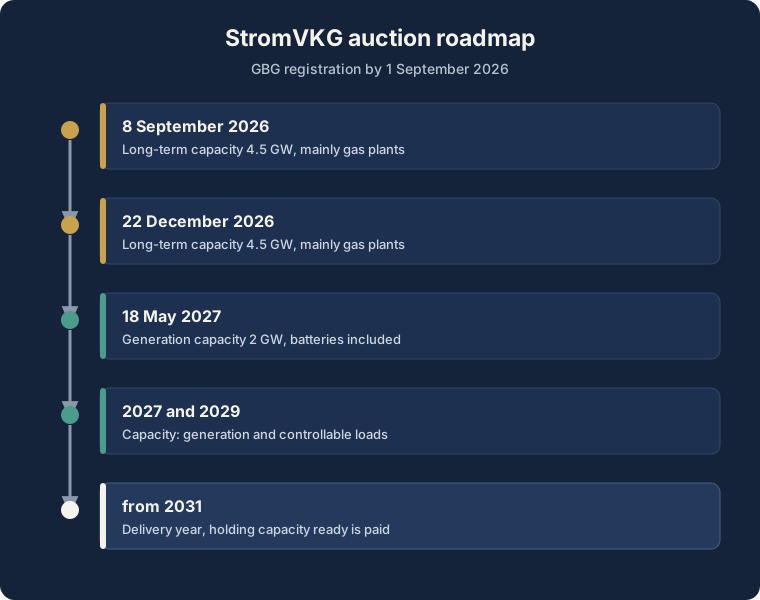
The Electricity Supply Security and Capacity Act (StromVKG) introduces a central capacity market in Germany. It pays for the reliable availability of generation capacity, not only for electricity delivered. The federal cabinet approved the draft on 13 May 2026, with a delivery year from 2031. It starts with two auctions for long-term capacity, bid deadlines 8 September and 22 December 2026, 4.5 gigawatts each, 9 gigawatts in total. Participation is fully digital via the Bundesnetzagentur's Closed User Group platform; registration and authentication must be in place by 1 September 2026. Long-term capacity requires at least ten consecutive hours of full output, which in practice admits only gas plants and excludes battery storage in the first phase. Only from May 2027 can batteries and controllable loads bid. For power plant operators, utilities and flexibility providers, one thing matters most now: set up registration, prequalification and the data household so that a bid can be submitted on time and audit-proof.
What the StromVKG regulates and why now
The StromVKG introduces a central capacity market. In future, it pays not only for the electricity delivered but for the reliable availability of capacity for times when wind and solar are scarce. The federal cabinet approved the draft on 13 May 2026, with a delivery year from 2031.
For you as an operator or utility, this creates a second revenue stream alongside the energy market. Whoever offers guaranteed availability receives an annual capacity payment, but must actually deliver that capacity when it matters. The capacity market is therefore not a subsidy pot but a market model with clear obligations.
- Its predecessor, the Power Plant Security Act (KWSG), never entered into force. How the StromVKG grew out of it is covered in the article on H2-ready power plants and the path from KWSG to StromVKG .
- The goal is a predictable revenue regime that incentivises investment in dispatchable backup capacity as coal and nuclear are phased out.
- The capacity market complements the energy market, it does not replace it. Both revenue streams run in parallel and must be considered together in the portfolio.
The first auction rounds in 2026
The market starts in 2026 with two auctions for long-term capacity. The bid deadlines are 8 September 2026 and 22 December 2026, tendering 4.5 gigawatts of reduced output each, 9 gigawatts in total. If the volume is not fully awarded, a third bid deadline follows on 18 May 2027.
- Awards are made pay-as-bid to the lowest offers, with a minimum bid of 1 megawatt of reduced output.
- A south quota and a south bonus steer awards specifically to sites near grid bottlenecks in the south.
- The term of long-term capacity is 15 years from award, coupled with an obligation to reach climate neutrality by 2045.
Three capacity products, one timeline
The StromVKG defines tiered products with different requirements and terms. The first rounds are tailored to long-term capacity, later rounds open the market to other technologies. Anyone wanting to take part must first know which product fits their plant.

- Long-term capacity: at least ten consecutive hours of full output, 15-year term, starting in 2026. In practice, gas plants dominate here.
- Generation capacity: all generation types, 2 gigawatts at the 18 May 2027 bid deadline, open to battery storage as well.
- Capacity: generation, controllable loads and pools, terms of 1, 7 or 15 years, bid deadlines 1 December 2027 and 1 October 2029.
- All products face an emissions cap of no more than 550 grams of CO2 from fossil fuels per kilowatt-hour.
Why gas plants dominate the first rounds
The ten-hour rule and several additional requirements filter battery storage out of the first phase. Critics see this as a technological pre-decision in favour of gas, even though the capacity market is meant to be technology-neutral.

- Storage must be able to restore the ten-hour output at any time with no more than one hour of lead time, which effectively excludes energy-limited batteries.
- 15-year bids additionally require at least 50 percent of resilience-relevant components to originate from the European Economic Area. For battery cells, most come from China in 2026.
- Hybrid pools of gas plant and battery are prohibited in the long-term and generation auctions. How storage earns money in the market otherwise is covered in the article on grid-scale storage and data centres .
- A study by the think tank Epico concludes that 5 gigawatts of gas capacity would suffice through 2035, while 9 gigawatts are reserved for long-term capacity alone.
The digital bidding process
The entire participation runs digitally. Whoever registers too late or fails to prepare the required evidence cleanly cannot bid. That makes bidders' process maturity as decisive for the award as the bid price.
Bids are submitted only through the Bundesnetzagentur's electronic Closed User Group (GBG) platform. Bidder authentication and registration for the GBG must be completed by 1 September 2026 at the latest. Whoever misses this deadline is out of round one, regardless of how competitive their bid would be.
- Prequalification is handled by the transmission system operators. A grid connection confirmation and the exclusion of double funding under the EEG or CHP Act are prerequisites.
- A bid security of 15 percent of the maximum bid value must be lodged, around 173,000 euros per megawatt in the long-term and generation auctions.
- Longer terms come with investment thresholds: around 201,000 euros per megawatt for seven years and around 431,000 euros per megawatt for fifteen years.
German and EU perspective
Germany is introducing a capacity market later than many of its neighbours. Belgium, the United Kingdom, Poland and Ireland have long run technology-neutral models with battery participation. The German approach is therefore seen as late, but also as unusually narrowly tailored to gas plants.
Financing runs through a levy, not the federal budget. Details on the amount and its distribution are to follow in a separate Capacity Market Act in 2027. The capacity market feeds into the same market processes as the controllable tariffs described in the article on tariff models in 2026 .
- State-aid approval by the European Commission is a critical path for the timeline of the first rounds.
- 15-year contracts require climate neutrality by 2045, including proof that the plant can be converted to hydrogen.
- A separate hydrogen programme targets the conversion of 4 gigawatts of gas capacity, with a first auction by the end of 2027.
Challenges and risks
The capacity market secures supply, but it creates costs and locks in technology paths for a long time. On balance, the gain in predictability is offset by a price risk and a long commitment.
- Higher costs than necessary: reserving 9 rather than the 5 gigawatts estimated by Epico raises backup costs. The levy weighs on electricity prices from 2031.
- Technology lock-in: 15-year commitments cement infrastructure decisions through 2041 and make later corrections harder.
- Market access for storage: domestic battery manufacturers lose market access in the first phase despite investing billions. How storage holds its own in the market is covered in the article on virtual power plants .
- Competition concerns: established utilities benefit from secured investment frameworks, which can reinforce market concentration.
What companies should do now
Power plant operators and utilities should set up process and data household now, not just when the deadline looms. Treating registration as a formality risks being unable to bid at all in the first round. Four steps take priority.
Four priority steps
-
Start GBG registration
Complete authentication and registration for the BNetzA platform by 1 September 2026. This deadline is a hard condition, not an administrative detail.
-
Prepare prequalification
Align documents with the transmission system operator: grid connection, emissions proof and the exclusion of double funding must be robustly documented.
-
Anchor the bidding strategy in the portfolio
Choose sites with an eye on the south quota and weigh the 1, 7 or 15-year term against the investment thresholds. Consider capacity and energy market together.
-
Prepare storage for 2027
Storage and flexibility operators plan for the rounds from May 2027 and factor the EEA component quota into procurement and supply chains early.
The capacity market is one building block of the digital energy transition, not a standalone topic. It feeds into the same digitalisation as congestion management, described in the article on Redispatch 3.0 . Only market design, bidding process and grid control together form a complete picture.
Further reading
Frequently asked questions
The Electricity Supply Security and Capacity Act (StromVKG) introduces a central capacity market in Germany. In short, it pays not only for electricity delivered but for the reliable availability of capacity during hours when wind and solar are scarce. The federal cabinet approved the draft on 13 May 2026, with a delivery year from 2031. The StromVKG is the successor to the Power Plant Security Act, which never entered into force.
In 2026 there are two auctions for long-term capacity, with bid deadlines on 8 September and 22 December 2026. Each tenders 4.5 gigawatts of reduced output, 9 gigawatts in total. To bid, registration and authentication for the BNetzA GBG platform must be completed by 1 September 2026 at the latest.
Long-term capacity requires at least ten consecutive hours of constant full output, which storage must be able to restore at any time with no more than one hour of lead time. That effectively excludes energy-limited batteries. In addition, 15-year bids require at least 50 percent of resilience-relevant components to originate from the European Economic Area. Only from the 18 May 2027 bid deadline can battery storage take part in the generation capacity auction.
Participation is fully digital. Bids are submitted only through the Bundesnetzagentur's electronic Closed User Group (GBG) platform. Prequalification is handled by the transmission system operators; a grid connection confirmation and the exclusion of double funding are prerequisites. A bid security of 15 percent of the maximum bid value, around 173,000 euros per megawatt, must be lodged.
First start GBG registration and authentication, because the 1 September 2026 deadline is a hard condition, not a formality. Then align prequalification documents with the transmission system operator and anchor the bidding strategy in the portfolio, including site selection with an eye on the south quota and the choice of a 1, 7 or 15-year term. Storage and flexibility operators prepare for the rounds from May 2027 and factor the EEA component quota into procurement early.
Let's collaborate
One contact, a team behind it
Thirty minutes on what you're working on, whether grid, metering, market processes, IT architecture or AI. Afterwards you'll know how we'd approach it and who would sit at the table.
Energy and measurement technology since 2010 · innobu GmbH since 2014 · Based in Schleswig-Holstein, Germany
Whoever pitches also delivers: whoever leads the first call stays your contact right through to the steering committee, with established partners in the project. Direct: info@innobu.com