
Electronic price sheet for electricity: price sheet 3, reactive power and automated invoice checking
The electronic price sheet standardises how network operators send their charges to suppliers, so the network usage invoice becomes machine-checkable. There are three price sheets: price sheet 1 for the network usage charges per metering point, price sheet 2 for individual services, and price sheet 3 for the optionally billable other services, above all reactive power. The price sheet is delivered as the EDIFACT message PRICAT, the invoice as INVOIC, which lets suppliers check the invoice automatically against the stored price sheet. This article explains what the electronic price sheet regulates, why price sheet 3 and reactive power are the hardest part, how the automated check works, what changes for network operators and suppliers, the challenges and the transition to API, and what companies should do now. Our MaKo 2026 article sets out the format foundation, the move from EDIFACT to API that the price sheet ultimately rests on.
The electronic price sheet is the standardised, machine-readable format in which a network operator delivers its charges to suppliers. Its legal basis is the Federal Network Agency ruling BK6-20-160, decided on 21 December 2020, which develops the electricity network access conditions and turned freely formatted PDF price sheets into structured data records. There are three standardised price sheets: price sheet 1 for the network usage charges per metering point, price sheet 2 for individual services, and price sheet 3 for the optionally billable other services, above all reactive power. When the topic name speaks of "Teil 3", it means price sheet 3, not a separate official stage. Price sheets 1 and 3 are mandatory in electronic form since 1 January 2023, price sheet 2 since 1 April 2022. The price sheet is delivered as the EDIFACT message PRICAT and the network usage invoice as INVOIC, and each item is referenced through a Federal Network Agency code list of article IDs, with no free items allowed. That standardisation is what makes the invoice machine-checkable: the supplier stores the price sheet received via PRICAT and compares incoming INVOIC invoices automatically against it, checking presence, permitted items and amounts. Deviations become clarification cases, correct invoices are approved, and the whole check moves from manual single-invoice review to mass processing. Price sheet 3 and reactive power are the hardest part: reactive power loads the grid without active energy, the thresholds depend on the network operator, and the ruling BK6-20-120 allows billing only against network users who are also connection users. With the market communication move to API and JSON, the price sheet architecture faces a phased transition that companies should plan for now.
What the electronic price sheet regulates
The electronic price sheet standardises how network operators send their charges to suppliers. With the ruling BK6-20-160, the Federal Network Agency turned freely formatted PDF price sheets into machine-readable data records. The result is a fixed structure of three price sheets that every operator has to follow.

At its core, the legal basis is the Federal Network Agency ruling BK6-20-160, decided by the agency's chamber 6 on 21 December 2020, which develops the electricity network access conditions and introduces the standardised electronic price sheet. The ruling defines three price sheets that every network operator uses: price sheet 1 carries the network usage charges per metering point, price sheet 2 carries the separately billable individual services, and price sheet 3 carries the optionally billable other services, in particular reactive power. The price sheet is delivered as the EDIFACT message PRICAT, and each item is referenced through a Federal Network Agency code list of article numbers and article IDs, so that every position is uniquely identifiable.
The decisive constraint is that network operators may not add their own items. Only the services that the Federal Network Agency has defined are electronically billable, and that is the heart of machine-checkability: a supplier can rely on the fact that any item on the invoice corresponds to a known, permitted article ID. The electronic price sheets 1 and 3 are mandatory since 1 January 2023, at the same time as the network charges for 2023 took effect, while price sheet 2 has applied since 1 April 2022.
Price sheet 3 and reactive power
Price sheet 3 is the collection point for the optionally billable other services, above all reactive power. This is exactly where practice is most varied and the manual check most error-prone, because reactive-power billing is not set nationwide.

Reactive power, also called reactive load, loads the grid without delivering active energy, and it is measured in kvarh. In practice, excess reactive energy is typically billed once the power factor cos phi falls below around 0.9, or once the reactive energy exceeds 50 percent of the active energy. These thresholds are not uniform across Germany: they depend on the price sheet of the respective network operator, and some operators suspend reactive-energy billing entirely. That network-operator dependence is the reason reactive power is the hardest item on the price sheet to handle, because there is no single nationwide value a supplier can assume.
The reactive-energy billing itself is governed by a separate ruling, BK6-20-120 of 21 December 2020, effective 1 April 2022. It allows reactive energy to be billed only against network users who are at the same time connection users. This restriction matters for the automated check, because it means a reactive-power item is only valid for a defined group of network users, and a check has to take that condition into account rather than treating every reactive-power position as billable.
Automated checking of the network usage invoice
The real lever is the automated checking of incoming invoices. Because every item carries a standardised article ID, the supplier can compare the INVOIC invoice automatically against the stored price sheet, instead of checking each invoice by hand.
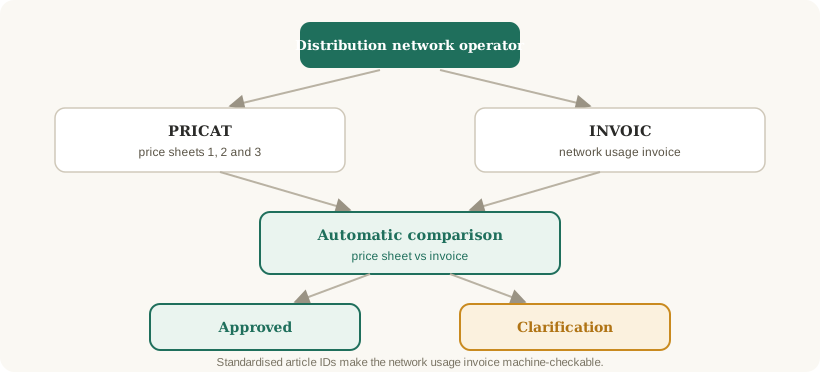
In detail, the network operator sends the price sheet via the EDIFACT message PRICAT and the network usage invoice via INVOIC. The supplier stores the price sheet received through PRICAT and then checks incoming invoices automatically against it: whether a price sheet is present at all, whether the items on the invoice are permitted according to the price sheet, and whether the amounts match. A deviation becomes a clarification case that goes back to the network operator, while a correct invoice is approved for payment. This turns the network usage invoice check into a mass-processing task instead of a manual single-invoice review, which is where the time and the error risk used to sit, especially for the reactive-power special cases on price sheet 3.
Studies and service providers report high error rates in the manual checking of network usage invoices, which is one of the reasons the automated route is attractive. It is worth reading that as an industry statement rather than as a confirmed hard figure, because the rates quoted vary by source and by sample. What is not in dispute is the direction: a standardised price sheet plus a standardised invoice makes a rule-based comparison possible, and a rule-based comparison scales in a way that manual review never can.
What changes for network operators and suppliers
Both sides have to set their IT up for the format. The effort lies above all in the clean mapping of items and in keeping the price sheet current at every network charge round. Our overview of the 24-hour supplier switch (LFW24) shows how tightly these market communication processes now interlock.
For network operators, the change is to map price sheets 1 and 3 onto the article-ID code list and to keep each charge round current. A new network charge does not just change a number, it has to be reflected in the correct article IDs and delivered via PRICAT, so the suppliers can store and validate it. For suppliers, the change is to bring PRICAT receipt, storage and validation into production, so that the automated check runs reliably rather than as a pilot. The hub-based settlement processes that surround this, set out in our MaBiS hub article, depend on the same clean data.
- Network operators map price sheets 1 and 3 via the article-ID code list and keep them current at each charge round.
- Suppliers bring PRICAT receipt, storage and validation logic into production rather than leaving it as a pilot.
- Reactive power is separated cleanly onto price sheet 3 instead of being booked freely.
- Correction invoices are flagged clearly and assigned unambiguously, so the automated check does not treat them as deviations.
Challenges and the transition to API
The price sheet lives in the EDIFACT world today. With the market communication move to API and JSON, a parallel path emerges that changes the architecture over the medium term and brings a real migration risk. The wider network charge reform, set out in our piece on the network tariff reform (AgNeS), is the regulatory backdrop to this.
In detail, the challenges sit on several levels. First, the implementation effort for PRICAT processing and validation is high, because the receipt, storage and rule logic all have to be built and kept reliable. Second, the reactive-power special cases stay complex: the cos phi threshold, the 50-percent reactive-energy boundary and the connection-user condition from BK6-20-120 all have to be modelled correctly, and they vary by network operator. Third, data quality and correction invoices remain a running source of error, because an incorrectly flagged correction or a stale price sheet can produce false clarification cases. Fourth, the parallel operation of EDIFACT and API, phased since 2025, creates a migration risk because both paths have to stay consistent while the move proceeds step by step.
What companies should do now
Whoever maps the price sheet cleanly and automates the check saves effort and avoids wrong payments. An honest stocktake of the reactive-power rules belongs to that. This turns the open transition into a concrete plan.
- Bring the automated INVOIC check into production. Validate incoming network usage invoices automatically against the price sheet stored from PRICAT, checking presence, permitted items and amounts, so the check scales as a mass process rather than a manual review.
- Map the price sheet 3 items via article IDs. Separate reactive power and the other optional services cleanly onto price sheet 3 through the correct article IDs, instead of booking them freely, so each item stays uniquely identifiable.
- Build the reactive-power edge rules into the checks. Model the cos phi threshold, the 50-percent reactive-energy boundary and the connection-user condition from BK6-20-120 as explicit rules, and account for network operators that suspend reactive-energy billing.
- Plan the API and JSON roadmap. Factor the phased move from EDIFACT to API into the price sheet architecture now, so the parallel operation does not turn into an unmanaged migration risk later.
Further reading
Frequently asked questions
The electronic price sheet is the standardised, machine-readable format in which a network operator delivers its charges to suppliers. It was introduced by the Federal Network Agency ruling BK6-20-160 of 21 December 2020, which turned freely formatted PDF price sheets into structured data records. There are three price sheets: price sheet 1 for the network usage charges per metering point, price sheet 2 for individual services, and price sheet 3 for the optionally billable other services. The price sheet is delivered as the EDIFACT message PRICAT, and each item is referenced through a Federal Network Agency code list of article numbers and article IDs, so no free items are allowed.
Price sheet 3 holds the optionally billable other services, above all reactive power. It is the collection point for items that a network operator may bill but does not have to, and it is the most varied part of the price sheet structure. Because reactive power can be billed in different ways depending on the network operator, price sheet 3 is also where the manual checking of the network usage invoice is most error-prone. Price sheets 1 and 3 are mandatory in electronic form since 1 January 2023.
The network operator sends the price sheet as the EDIFACT message PRICAT and the network usage invoice as INVOIC. Because every item carries a standardised article ID, the supplier can compare the incoming INVOIC invoice automatically against the stored price sheet: whether a price sheet is present, whether the items are permitted, and whether the amounts match. A deviation becomes a clarification case, while a correct invoice is approved. This makes the check suitable for mass processing instead of manual single-invoice review.
Reactive power loads the grid without delivering active energy, and it is measured in kvarh. Excess reactive energy is typically billed once the power factor cos phi falls below around 0.9 or the reactive energy exceeds 50 percent of the active energy. These values are not set nationwide: they depend on the price sheet of the respective network operator, and some operators suspend reactive-energy billing entirely. The ruling BK6-20-120 allows billing only against network users who are also connection users.
Today the price sheet lives in the EDIFACT world, delivered as PRICAT with the invoice as INVOIC. With the market communication move to API and JSON a parallel path emerges that will change the architecture over the medium term. Running EDIFACT and API in parallel, phased since 2025, creates a migration risk because both paths have to stay consistent. Companies should plan an API and JSON roadmap into the price sheet architecture rather than treating the current EDIFACT setup as final.