
Kimi K3: China's Open-Weight Model Reaches the Top Tier
Moonshot AI released Kimi K3 on July 16, 2026: a mixture-of-experts model with 2.8 trillion parameters, a 1 million token context window and native vision. In the independent Artificial Analysis evaluation, K3 reaches rank 4 of 189 models, ahead of Claude Opus 4.8 and GPT-5.5. The full weights are scheduled to follow by July 27, 2026 under a Modified MIT license that permits commercial use. Pricing rises over the predecessor K2.6 to 3 US dollars per million input tokens and 15 US dollars per million output tokens, the level of Claude Sonnet. For European companies the Kimi API remains problematic because data processing happens in China. In practice, K3 only becomes GDPR-compliant through self-hosting or EU hosting of the open weights.
What Moonshot AI released
Moonshot AI of Beijing presented its new flagship model Kimi K3 on July 16, 2026, a few days ahead of the World AI Conference in Shanghai. At 2.8 trillion parameters, it is the largest model whose weights are set to become openly available. You can use it today via Kimi.com, Kimi Work, Kimi Code and the Kimi API.
The key facts: a mixture-of-experts design in which only 16 of 896 experts compute per token, a context window of 1 million tokens, native vision, and an always-on reasoning mode. The full weights are scheduled to follow by July 27, 2026 under a Modified MIT license that permits commercial use.
For the first time, a model whose weights are becoming open reaches the level of the closed frontier models in independent testing. The gap between open and closed, which has shaped the AI strategy of many companies, shrinks to months.
Architecture and benchmarks: what sits behind the numbers
K3 combines two architectural changes: Kimi Delta Attention, a hybrid linear attention mechanism, and Attention Residuals. Training was quantization-aware in MXFP4, which makes the weights more compact and later operation cheaper. More important than Moonshot's own figures, though, is what independent testers measure.
| Evaluation | Kimi K3 result | Context |
|---|---|---|
| Intelligence Index (Artificial Analysis) | 57.1 points | Rank 4 of 189, ahead of Opus 4.8 and GPT-5.5 |
| GDPval-AA v2 (knowledge work) | 1687 points | Rank 3, behind Fable 5 Max and GPT-5.6 Sol Max |
| AA-Briefcase (agentic office work) | 1527 points | Rank 2, ahead of GPT-5.6 Sol Max |
| Terminal Bench 2.1 (self-reported) | 88.3 | Coding with terminal tools |
| GPQA-Diamond (self-reported) | 93.5 | PhD-level expert knowledge |
The independent tester Simon Willison credits K3 with good vision capabilities and clean code, but points out one quirk: the reasoning mode only knows the max setting. His single SVG test consumed 16,658 output tokens, 13,241 of them for reasoning, and cost 25 cents. How reliable benchmark claims from Chinese labs are in general is something we examined in our piece on China's AI models under benchmark scrutiny. For K3, the central rankings this time come from independent parties, but the weights themselves cannot be verified before July 27.
The end of cheap AI from China
With K3, Moonshot says goodbye to bargain pricing. The API charges 3 US dollars per million input tokens and 15 US dollars per million output tokens, with cache hits at 0.30 US dollars. That is Claude Sonnet's price level. The predecessor K2.6 cost 0.95 and 4 US dollars, so K3 is roughly three to four times more expensive.
Kimi K3 closes in on Fable 5 and GPT-5.6 Sol, but the era of cheap AI from China is over.
THE DECODER, July 16, 2026Anyone who chose Chinese models mainly for cost reasons needs to recalculate. The always-on reasoning mode sharpens this: even simple requests produce long chains of thought and thus expensive output tokens. A caching strategy and a cost model per use case belong in the design from day one, as described in our piece on token FinOps.
Moonshot can afford the price jump because the company no longer sells as a challenger on price but on its position in the rankings. According to Financial Times reporting, Moonshot is valued at around 31.5 billion US dollars after its latest funding round, up from 20 billion in May 2026.
Open weights and self-hosting
The real lever for companies is the weights release on July 27. A frontier-level model you are allowed to run on your own infrastructure changes the negotiating position toward the US providers, even if you never deploy it. For regulated sectors it is the basis for a sovereign AI coding stack. The Modified MIT license permits commercial use, adaptation and fine-tuning.

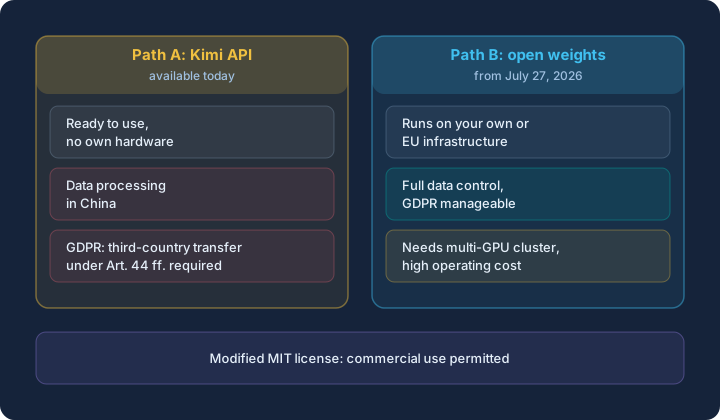
In practice, operating it is anything but trivial. 2.8 trillion parameters mean weights in the terabyte range even at 4-bit quantization. A single server is not enough; a multi-GPU cluster with fast interconnect is realistic. For most teams, the path therefore runs through three stages:
- The Kimi API for first tests with non-critical data, available immediately.
- European GPU cloud providers or managed inference services once the weights are out. For mid-sized companies this is the realistic production route.
- Your own hardware only under permanently high utilization and strict data requirements. What running smaller open models in-house teaches is covered in our piece on local AI models on your own hardware.
European perspective: data protection, AI Act, sovereignty
For European companies, the legal framework decides, not the benchmark. The Kimi API processes data in China, a third country without an adequacy decision. Transfers of personal data then require additional safeguards under Art. 44 ff. GDPR, which is hard to implement cleanly for customer data or confidential documents. The open weights turn the picture around: hosted in-house or in the EU, no data leaves your area of responsibility.
The EU AI Act plays into this as well. K3 is a GPAI model, and the open-source exemption does not apply to models with systemic risk. Whoever runs the weights and substantially modifies them can also take on provider obligations of their own. The deadlines involved are laid out in our overview of the EU AI Act high-risk deadlines.
For Europe's sovereignty debate, the launch stings. Open models at frontier level now come from China, not from Europe. Aleph Alpha and Mistral trail clearly in the rankings, as our piece on Aleph Alpha and Cohere lays out. Anyone who wants to build digital sovereignty on self-hosted models will foreseeably reach for Chinese weights, a dilemma that reshuffles the debate about trustworthy AI.
Challenges and risks
The launch is impressive, but not without open questions. Four points you should know before shortlisting K3.
- Verification is pending. The central rankings are independent, but many detail figures are self-reported. The weights cannot be checked before July 27, and if the release slips, K3 remains an API product for now.
- Only one reasoning setting. The max mode produces long chains of thought even for simple tasks. That drives cost and latency until Moonshot ships graduated modes.
- Governance questions. Training data provenance, built-in content filters, and possible export and sanctions risks of Chinese providers belong in every risk assessment. Our piece on the provenance of AI training data offers a starting point.
- The cost argument no longer carries on its own. At Sonnet-level pricing, K3 competes on capability and control, not on the discount.
What companies should do now
Kimi K3 is a reason to review your model strategy, not a reason for a rushed switch. A staged test under controlled conditions makes sense.

Five priority steps
-
Test with your own benchmarks
Start the evaluation with non-critical data and measure your own tasks, not the leaderboards. A model that shines on GDPval can still fail on your domain documents.
-
Settle the data protection question first
Use the API only for workloads without personal or confidential data. For everything else, wait for the weights release and prepare EU hosting options.
-
Work through the cost model
Reasoning tokens drive the bill. Cache hits cost a tenth of the input price, so a caching strategy belongs in the design, not in the cleanup.
-
Secure your exit capability
Keep prompts, evals and tooling vendor-neutral. The model market turns every few months; a switch should cost weeks, not quarters.
-
Check your AI Act roles
Clarify whether self-hosting with fine-tuning makes you a provider under the EU AI Act, and set up your compliance documentation accordingly.
Further reading
Frequently asked questions
Kimi K3 is the flagship model the Chinese AI company Moonshot AI released on July 16, 2026. It is a mixture-of-experts model with 2.8 trillion parameters, of which only 16 of 896 experts are active per token. It offers a 1 million token context window, native vision and an always-on reasoning mode. The full weights are scheduled for open release by July 27, 2026.
Strictly speaking, Kimi K3 is an open-weight model: Moonshot AI releases the model weights under a Modified MIT license that permits commercial use, adaptation and fine-tuning. Training data and training code remain unpublished. At launch on July 16, 2026, only the API was available; the weights release is announced for July 27, 2026.
The Kimi API charges 3 US dollars per million input tokens, 15 US dollars per million output tokens, and 0.30 US dollars per million tokens on cache hits. That matches Claude Sonnet pricing. The predecessor K2.6 cost 0.95 and 4 US dollars, so K3 is roughly three to four times more expensive. Because the reasoning mode only knows the max setting, even simple tasks produce many reasoning tokens.
Via the Kimi API this is difficult, because data processing takes place in China, a third country without an adequacy decision. Transfers then require additional safeguards under Art. 44 ff. GDPR, which is hard to implement cleanly for personal or confidential data. Deployment becomes practical with the weights release on July 27, 2026: running the model on your own infrastructure or with a European GPU provider keeps full data control.
Artificial Analysis ranks Kimi K3 with 57.1 points on its Intelligence Index at rank 4 of 189 models, behind Claude Fable 5 and two GPT-5.6 Sol settings, but ahead of Claude Opus 4.8, GPT-5.5 and Claude Sonnet 5. On GDPval-AA v2, K3 reaches 1687 points and rank 3; on the agentic office-work benchmark AA-Briefcase it takes rank 2 with 1527 points. It is the first open model at this level.
Kimi K3 has 2.8 trillion parameters. Even with its quantization-aware MXFP4 training, the weights sit in the terabyte range, and a single server is not enough. A multi-GPU cluster with fast interconnect is realistic. For most companies, European GPU cloud providers or managed inference services are the more practical route than owning hardware.
Let's collaborate
One contact, a team behind it
Thirty minutes on what you're working on, whether grid, metering, market processes, IT architecture or AI. Afterwards you'll know how we'd approach it and who would sit at the table.
Energy and measurement technology since 2010 · innobu GmbH since 2014 · Based in Schleswig-Holstein, Germany
Whoever pitches also delivers: whoever leads the first call stays your contact right through to the steering committee, with established partners in the project. Direct: info@innobu.com